Benchmarking Traditional vs. AI Annotation for Drug Discovery: A 2025 Guide for Biomedical Researchers
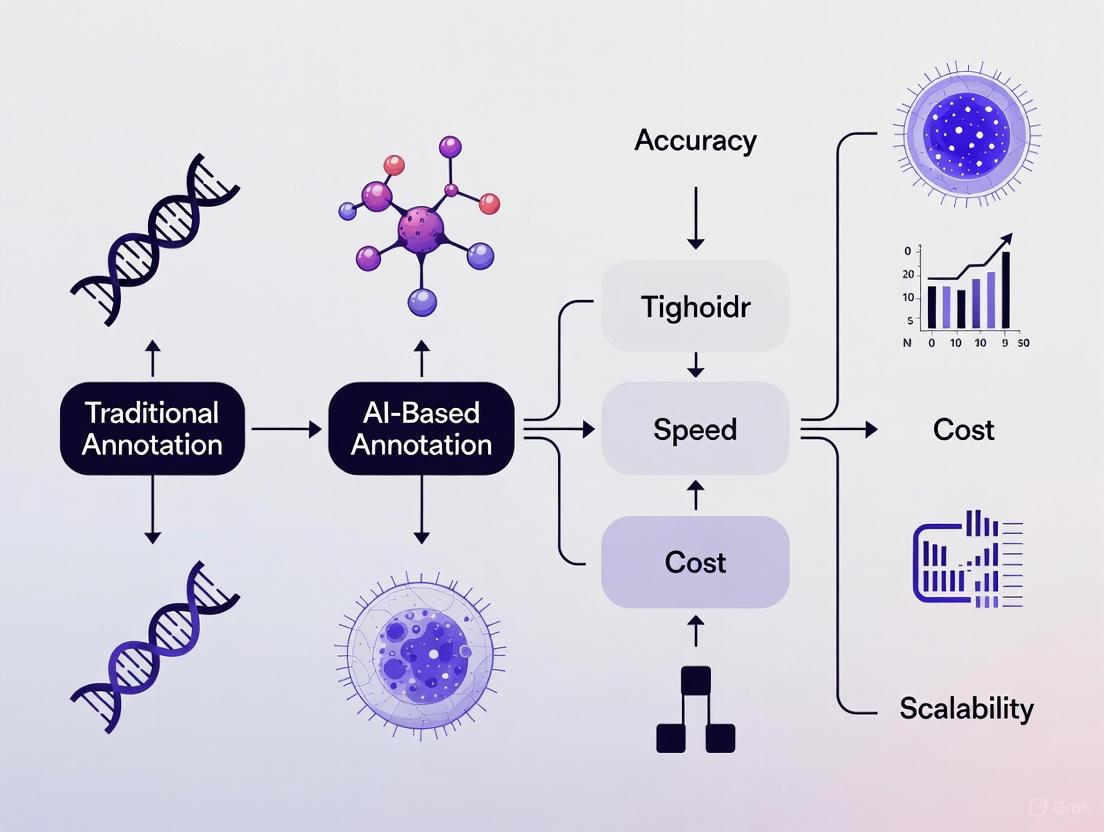
This article provides a comprehensive benchmark analysis for researchers and scientists in drug development, comparing traditional manual and modern AI-powered data annotation methods.
Benchmarking Traditional vs. AI Annotation for Drug Discovery: A 2025 Guide for Biomedical Researchers
Abstract
This article provides a comprehensive benchmark analysis for researchers and scientists in drug development, comparing traditional manual and modern AI-powered data annotation methods. It explores the foundational principles of both approaches, details their practical application in biomedical research pipelines, and offers strategies for troubleshooting and optimization. A final validation framework synthesizes key performance metrics—accuracy, speed, cost, and scalability—to guide the selection of the optimal annotation strategy for specific projects, from target identification to clinical candidate optimization.
The Foundational Principles of Data Annotation in Biomedical AI
Why Data Annotation is the Bedrock of AI in Drug Development
In the rapidly evolving field of AI-driven drug development, high-quality annotated data is the fundamental component that powers machine learning models. The transition from traditional, labor-intensive methods to AI-accelerated discovery is entirely dependent on the accuracy, volume, and context of the training data. This guide benchmarks traditional manual data annotation against modern AI-assisted methods, providing researchers and scientists with a structured comparison to inform their experimental design and platform selection.
The Indispensable Role of Data in AI-Driven Drug Discovery
Artificial Intelligence has demonstrably compressed drug discovery timelines, with platforms like Exscientia and Insilico Medicine advancing candidates from target identification to Phase I trials in as little as 18 months—a fraction of the traditional 5-year timeline [1]. This acceleration is contingent upon AI models that can accurately predict molecular behavior, identify viable drug targets, and optimize lead compounds. The performance of these models is a direct function of their training data [2].
Data annotation, or data labeling, is the process of meticulously tagging raw data—such as molecular structures, medical images, and clinical trial text—to create structured, machine-readable datasets. In drug development, this can involve classifying protein structures, annotating toxicity in cellular images, or labeling patient responses in electronic health records. Without this foundational layer of high-quality, context-rich data, even the most sophisticated algorithms fail to deliver reliable or translatable results, a principle often summarized as "garbage in, garbage out" [2]. The global market for data annotation tools, projected to grow from $1.9 billion in 2024 to $6.2 billion by 2030, underscores its critical and expanding role in the AI ecosystem [3].
Benchmarking Annotation Methods: A Quantitative Comparison
The choice between annotation methodologies involves a critical trade-off between accuracy, speed, and cost. The following section provides a structured, data-driven comparison to guide this decision.
Experimental Protocol for Benchmarking Annotation Methods
A robust comparison of annotation methods involves a standardized experimental setup to ensure validity and reproducibility.
- Objective: To quantitatively compare the performance metrics of Manual, AI-Assisted, and Hybrid data annotation workflows within a drug development context.
- Dataset: A curated set of 10,000 high-resolution histopathology images requiring segmentation of tumor regions. A pre-validated "gold standard" subset of 1,000 images is used for accuracy calibration.
- Annotation Teams: Three separate teams of equal size (n=5 annotators) are assigned to one of the three methodologies. All annotators undergo standardized training on the task and labeling ontology.
- Key Performance Indicators (KPIs): The primary metrics measured are Annotation Speed (images/hour), Annotation Accuracy (F1-score against the gold standard), and Cost per Annotation. Accuracy is measured upon completion of the entire dataset.
- Tools: The teams use platforms representative of each method: a manual interface, an AI-assisted platform with pre-labeling capabilities, and a hybrid system that integrates both.
Performance Metrics and Analysis
The data from the comparative experiment reveals clear trends and trade-offs, summarized in the table below.
Table: Benchmarking Performance of Data Annotation Methods
| Performance Metric | Manual Annotation | AI-Assisted Annotation | Hybrid (Human-in-the-Loop) |
|---|---|---|---|
| Throughput (images/hour) | 20-30 | 200-500 | 100-250 |
| Relative Speed | 1x (Baseline) | ~10x | ~5x [4] |
| Typical Accuracy (F1-Score) | High (95-98%) [2] | Variable (85-95%) [2] | Very High (96-99%) [4] |
| Best Use Case | Complex, novel, or nuanced data (e.g., subjective medical imagery) [2] | Structured, repetitive, and large-scale tasks [2] | Most real-world scenarios, balancing speed and precision [4] |
| Cost Efficiency | Low (High labor cost) | High (Low cost per label) | Medium (Optimized allocation) [4] |
| Handling of Edge Cases | Excellent (Human judgment) | Poor (Relies on training data) | Good (Human review of low-confidence predictions) |
The data shows that AI-assisted annotation provides the highest speed and scalability, making it suitable for processing the massive datasets common in genomics and high-throughput screening [2]. However, its accuracy is inherently tied to its training data and can falter with novel or ambiguous information.
Conversely, manual annotation delivers superior accuracy and nuance for complex tasks, such as interpreting subtle pathological features in medical images or labeling complex molecular interactions [2]. Its primary limitations are poor scalability and high cost.
In practice, the hybrid Human-in-the-Loop (HITL) approach has emerged as the industry standard for critical applications in drug development [5] [4]. This method leverages AI for initial, high-volume pre-labeling, while human experts focus on quality control, complex cases, and edge conditions. Real-world implementations report 5x faster throughput and 30-35% cost savings while maintaining or even improving accuracy levels compared to purely manual workflows [4].
Essential Reagents: The Data Annotation Toolkit for Researchers
Selecting the right tools and workflows is as crucial as any laboratory reagent. The following toolkit outlines the core components of a modern data annotation pipeline for drug development research.
Table: Research Reagent Solutions for Data Annotation
| Category | Solution / Tool | Primary Function in Annotation |
|---|---|---|
| Annotation Platforms | Labelbox, Encord, SuperAnnotate, V7 | Provides the core software environment for managing data, defining ontologies, and executing labeling tasks [6] [7]. |
| AI-Assisted Labeling | SAM2, T-Rex2, Platform-specific models | Automates repetitive labeling tasks (e.g., segmentation) using pre-trained models, dramatically increasing speed [6] [4]. |
| Human-in-the-Loop (HITL) | Custom workflows on major platforms | A framework that integrates human expert review into the AI-driven pipeline to validate results and handle complex edge cases [5] [2]. |
| Data Management & QC | Integrated analytics dashboards | Tools for monitoring annotation throughput, user activity, and label accuracy in real-time, enabling continuous quality control [4]. |
Implementing an Optimized Annotation Workflow
An effective annotation pipeline is a cyclical process of continuous improvement. The following diagram maps the logical flow of a optimized, hybrid annotation workflow.
Diagram: Hybrid Human-in-the-Loop Annotation Workflow
The workflow begins with raw, unlabeled data (e.g., molecular structures, medical images). This data first undergoes AI-assisted pre-labeling, where initial models apply labels at high speed. The pre-labeled data then moves to human expert review, where specialists correct errors and handle complex cases that the AI could not confidently resolve. This is followed by a rigorous quality control and validation stage to ensure the dataset meets required standards. The output is a high-quality curated dataset ready for model training. A critical final component is the feedback loop, where the improved AI model can be used to enhance the pre-labeling for future annotation cycles, creating a virtuous cycle of increasing efficiency and accuracy [2] [4].
The "Human-in-the-Loop" Imperative in Drug Development
Given the high-stakes nature of pharmaceutical research, where model errors can lead to costly clinical trial failures or safety issues, the "Human-in-the-Loop" (HITL) model is particularly critical [8]. AI systems can struggle with the nuanced context, rare edge cases, and complex biology inherent to drug development. Human experts provide the indispensable judgment for tasks like [5] [2]:
- Interpreting ambiguous pathological findings in medical images.
- Labeling complex, multi-step biological pathways from scientific literature.
- Validating the context of adverse event reports in pharmacovigilance.
Diagram: The Human-in-the-Loop Annotation Cycle
This cyclical process, as shown in the diagram, ensures that AI becomes a powerful assistant that augments—rather than replaces—human expertise, leading to progressively smarter and more reliable automated annotation.
The assertion that data annotation is the bedrock of AI in drug development is firmly supported by the data. The choice of annotation strategy has a direct and measurable impact on the success of AI initiatives. While AI-assisted methods provide unmatched speed for scalable data processing, and manual methods offer superior nuance for novel complexities, the evidence points to a hybrid Human-in-the-Loop approach as the most effective and robust strategy for the pharmaceutical industry.
By strategically investing in high-quality annotated data and modern annotation platforms, drug development teams can build more accurate and reliable AI models. This, in turn, accelerates the entire R&D pipeline, bringing life-saving treatments to patients faster and more efficiently. The future of AI in drug discovery will not be won by the best algorithm alone, but by the best algorithm built upon the highest-quality data foundation.
Within the context of benchmarking traditional versus AI-driven data annotation methods, this guide provides an objective comparison of their performance for scientific and drug development applications. While automated tools offer scalability, traditional manual annotation remains indispensable for tasks requiring deep contextual understanding, domain expertise, and the handling of complex edge cases. This analysis synthesizes current experimental data and methodologies, demonstrating that a hybrid approach—leveraging both human nuance and algorithmic speed—often yields the most robust and reliable training data for critical research applications.
For researchers, scientists, and drug development professionals, the quality of annotated data is a foundational element in building reliable AI models. Data annotation is the process of labeling raw data—be it images, text, audio, or video—to make it intelligible for supervised machine learning algorithms [9]. In scientific domains, the stakes for accuracy are exceptionally high; a mislabeled medical image or an misinterpretated chemical compound structure can compromise an entire model's validity.
The debate between traditional manual annotation and modern AI-assisted methods is not about absolute superiority but about optimal application. This guide objectively compares these methodologies within a benchmarking framework, providing the experimental data and protocols needed to inform data strategy in research environments. The core distinction lies in the deployment of human expertise: manual annotation leverages continuous human judgment, whereas AI-assisted annotation automates repetitive tasks, often with human oversight reserved for quality control [10] [11].
Core Differentiators: Manual vs. AI-Assisted Annotation
The choice between manual and AI-assisted annotation involves a fundamental trade-off between the nuanced accuracy of human intelligence and the scalable efficiency of automation. The table below summarizes their core performance characteristics based on aggregated industry data and studies.
Table 1: Performance Benchmarking of Manual vs. AI-Assisted Annotation
| Criterion | Manual Annotation | AI-Assisted Annotation |
|---|---|---|
| Accuracy | Very high; professionals interpret nuance, context, and domain-specific terminology [12]. | Moderate to high; excels with clear, repetitive patterns but struggles with subtle or specialized content [12] [13]. |
| Speed | Slow; human annotators label each data point individually, taking days or weeks for large volumes [12]. | Very fast; once configured, models can label thousands of data points in hours [12]. |
| Scalability | Limited; scaling requires hiring and training more annotators [12]. | Excellent; annotation pipelines can handle massive data volumes once trained [12]. |
| Adaptability | Highly flexible; annotators adjust in real-time to new taxonomies and unusual edge cases [12] [13]. | Limited; models operate within pre-defined rules and require retraining for significant workflow changes [12]. |
| Cost Structure | High; due to skilled labor, multi-level reviews, and specialist expertise [12] [10]. | Lower long-term cost; reduces human labor but incurs upfront model development and training expenses [12]. |
| Edge Case Handling | Exceptional; human reasoning is critical for rare, complex, or ambiguous data [13] [11]. | Poor; models fail when encountering data outside their training distribution, often with high confidence [13]. |
| Best For | Complex, subjective, or safety-critical data; domains requiring deep expertise (e.g., medical imaging, drug discovery) [14] [11]. | Large, repetitive datasets with well-defined objects and patterns; rapid prototyping [12] [10]. |
Experimental data underscores this performance trade-off. One study found that while AI-assisted pre-labeling accelerates workflows, an average of 42% of all automated data labels require human correction or intervention to meet quality standards [11]. Furthermore, well-executed manual labeling can improve model performance from an average baseline of 60-70% accuracy to the 95% accuracy range, which is often essential for research-grade outputs [11].
Experimental Protocols for Benchmarking Annotation Methods
To ensure valid and reproducible comparisons between annotation methods, a structured experimental protocol is essential. The following methodology outlines a robust benchmarking workflow suitable for scientific validation.
Workflow Design
The benchmarking process is a cycle that integrates both manual and automated components to continuously improve data quality and model performance.
Diagram Title: Benchmarking Workflow for Annotation Methods
Methodology Details
- Define Scope & Objectives: Determine the specific domain (e.g., histopathology image analysis, chemical structure recognition) and the key metrics for evaluation, such as inter-annotator agreement, label accuracy, time-per-task, and downstream model performance [15].
- Select & Prepare Dataset: Curate a representative dataset that includes common examples as well as known edge cases critical to the domain. The dataset should be split, with a portion reserved for creating a "gold standard" through expert manual annotation [13].
- Manual Annotation (Expert Gold Standard): Domain experts (e.g., radiologists, biologists) annotate the gold standard dataset. This process should involve multiple annotators to measure inter-annotator agreement (IAA), a key metric for establishing benchmark quality and consistency [9] [11].
- AI-Assisted Pre-labeling: Utilize one or more AI-assisted annotation tools (e.g., Encord, CVAT, Labelbox) to pre-label the same dataset. The models may be pre-trained or fine-tuned on a separate, annotated dataset [6] [14].
- Quantitative Comparison: Compare the AI-generated labels against the human gold standard using metrics like precision, recall, F1-score, and mean Average Precision (mAP). The 42% human correction rate for automated labels is a typical quantitative finding from this stage [11].
- Qualitative Analysis: Experts perform a root-cause analysis on discrepancies. This identifies why the AI failed, often revealing issues with contextual ambiguity, rare data, or domain complexity that quantitative metrics alone cannot explain [13].
- Model Retraining & Iteration: Human corrections and qualitative feedback are fed back into the AI model in a Human-in-the-Loop (HITL) active learning cycle. This improves the model for subsequent benchmarking rounds, creating a continuous improvement loop [13] [11].
The Researcher's Toolkit: Annotation Platforms & Solutions
Selecting the right tools is critical for executing a valid benchmark. The landscape includes a range of platforms, from open-source to enterprise-grade solutions, each with strengths for different research scenarios.
Table 2: Research Reagent Solutions: Annotation Platforms & Tools
| Tool / Platform | Primary Function | Key Features for Research |
|---|---|---|
| Encord | Platform for labeling and managing high-volume visual datasets [14]. | Native support for DICOM medical imaging; AI-assisted video annotation; collaborative workflow management for large teams [14]. |
| CVAT | Open-source image and video annotation tool [6]. | Completely free and self-hosted; supports basic AI-assisted labeling; strong community support via OpenCV [6] [14]. |
| T-Rex Label | Web-based AI-assisted annotation tool [6]. | Features cutting-edge T-Rex2 model for visual prompt annotation; excels in rare object detection; free model available [6]. |
| Labelbox | One-stop data and model management platform [6]. | Integrates data annotation with model training and analysis; supports active learning to prioritize impactful data [6]. |
| Supervisely | Unified operating system for computer vision [14]. | Intuitive interface with strong support for DICOM and other medical imaging modalities; customizable plugin architecture [14]. |
| Domain Experts | Human annotators with specialized knowledge [11]. | Provide ground truth for gold standard datasets; handle edge cases and complex annotations in fields like drug discovery and medical diagnostics [11]. |
The benchmarking data and experimental protocols presented confirm that traditional manual annotation is not obsolete but has evolved into a strategic, high-value function within the modern AI research pipeline. Its unparalleled strength in managing contextual understanding, domain expertise, and edge cases makes it irreplaceable for safety-critical and scientifically rigorous fields like drug development [16] [13] [11].
The future of data annotation in research does not lie in a binary choice between human and machine, but in sophisticated hybrid pipelines. In these workflows, automation handles scalable, repetitive labeling tasks, while human expertise is strategically deployed for quality assurance, complex case resolution, and guiding model retraining through active learning loops [12] [13] [11]. For researchers building models where accuracy is non-negotiable, a benchmarked and validated hybrid approach that leverages both human nuance and AI efficiency will yield the most reliable and impactful results.
Data annotation, the process of labeling data to make it understandable for machines, is a foundational step in developing artificial intelligence systems. For researchers, scientists, and drug development professionals, the shift from traditional manual annotation to AI-powered methods represents a critical evolution in how we build training datasets for machine learning models. This transformation is particularly relevant in biomedical contexts, where the volume of unstructured text from scientific publications has made manual knowledge extraction impractical [17]. The emerging paradigm of AI-powered annotation offers unprecedented potential for automation and scalability while introducing new considerations for accuracy and validation.
This guide provides an objective comparison between traditional and AI-powered annotation methods, focusing on experimental performance data and practical implementation frameworks. By examining quantitative benchmarks, methodological protocols, and specialized tools, we aim to equip research professionals with the evidence needed to make informed decisions about integrating AI annotation into their scientific workflows, particularly in drug discovery and biomedical research contexts where annotation quality directly impacts model reliability and research outcomes.
Performance Benchmarks: Quantitative Comparisons
Rigorous evaluation of annotation methods requires multiple performance dimensions. The following comparative analysis examines both agreement metrics and computational efficiency across different annotation approaches.
Annotation Agreement and Accuracy
Table 1: Human vs. AI Annotation Agreement Metrics
| Annotation Method | Pearson Correlation with Human Consensus | Agreement Metric (Fleiss' κ/Cohen's κ) | Domain Context | Source |
|---|---|---|---|---|
| GPT-4 (Analyze-Rate Prompt) | 0.61 (Likert scale) | N/A | Conversational Safety | [18] |
| Median Human Annotator | 0.51 | N/A | Conversational Safety | [18] |
| GPT-4 (Binary) | 0.59 | N/A | Conversational Safety | [18] |
| Llama 3.1 405B (Rating Only) | 0.60 (Likert scale) | N/A | Conversational Safety | [18] |
| ICU Consultants (11 Annotators) | N/A | 0.383 (Fleiss' κ) | Clinical ICU Scoring | [19] |
| EEG Experts | N/A | 0.38 (Average pairwise Cohen's κ) | ICU EEG Analysis | [19] |
| Pathologists (Breast Lesions) | N/A | 0.34 (Fleiss' κ) | Medical Diagnostics | [19] |
| Psychiatrists (Depression) | N/A | 0.28 (Fleiss' κ) | Mental Health | [19] |
The data reveals that advanced AI models can surpass median human performance in correlating with human consensus on annotation tasks. In the evaluation of conversational safety, GPT-4 with a chain-of-thought prompting strategy achieved a Pearson correlation of 0.61 with the average rating of 112 human annotators, exceeding the median human annotator's correlation of 0.51 [18]. This suggests that in certain domains, AI annotation can not only match but exceed the consistency of individual human annotators when measured against collective human judgment.
However, the consistently modest inter-annotator agreement among human experts across medical domains (with Fleiss' κ scores ranging from 0.28 to 0.38) highlights the inherent subjectivity and "noise" in human judgment [19]. This variability presents a fundamental challenge for establishing reliable ground truth in biomedical annotation tasks, particularly in domains requiring clinical expertise where even highly trained specialists demonstrate significant disagreements in their annotations.
Efficiency and Scalability Metrics
Table 2: Operational Efficiency Comparisons
| Metric | Traditional Manual Annotation | AI-Powered Annotation | Context |
|---|---|---|---|
| Speed | Baseline reference | Up to 10x faster with AI-assisted labeling | Computer Vision Projects [20] |
| Scalability | Limited by human resources | Massive dataset handling without degradation | Enterprise AI Platforms [20] [21] |
| Consistency | Subject to inter-annotator variability | High algorithmic consistency | Quality Assurance [22] |
| Domain Adaptation | Requires retraining annotators | Model fine-tuning | Cross-domain Applications [14] |
| Cost Structure | Linear scaling with volume | Higher initial investment, lower marginal cost | Total Cost of Ownership [20] |
AI-powered annotation demonstrates significant advantages in operational efficiency, particularly for large-scale projects. In computer vision applications, AI-assisted labeling can accelerate annotation speed by up to 10x compared to purely manual approaches [20]. This acceleration stems from capabilities like AI-assisted pre-labeling, automated object tracking in video sequences, and active learning systems that prioritize the most valuable samples for human review [14].
The scalability of AI-powered methods represents another substantial advantage. Where traditional manual annotation faces practical limits due to human resource constraints, AI systems can maintain consistent performance across massive datasets without degradation in quality or throughput [20]. This capability is particularly valuable in drug development contexts where the volume of biomedical literature and research data continues to grow exponentially, making comprehensive manual annotation increasingly impractical [17].
Experimental Protocols: Methodological Framework
To ensure reproducible and valid comparisons between annotation methodologies, researchers should adhere to structured experimental protocols.
Protocol 1: Benchmarking AI-Human Annotation Alignment
Objective: Quantify the alignment between AI-generated annotations and human consensus across demographic groups.
Dataset Preparation:
- Utilize the DICES-350 dataset containing 350 multi-turn conversations [18]
- Incorporate annotations from 112 human annotators spanning 10 race-gender groups
- Establish ground truth through majority voting or weighted consensus
AI Annotation Procedure:
- Implement zero-shot prompting with models (GPT-4, Llama 3.1 405B, Gemini 1.5 Pro)
- Apply both "rating-only" and "analyze-rate" (chain-of-thought) prompt strategies
- Configure output format to match human rating scales (Likert or binary)
Quality Validation:
- Calculate Pearson correlation between AI annotations and human consensus
- Compute inter-annotator agreement metrics (Fleiss' κ, Cohen's κ)
- Perform bootstrap resampling (e.g., 1000 iterations) for statistical significance
- Conduct qualitative analysis of systematic disagreement patterns
This protocol revealed that GPT-4 with chain-of-thought prompting achieved a correlation of r=0.61 with human consensus, exceeding the median human annotator's correlation of r=0.51 [18]. The methodology also enabled investigation of whether AI models align more closely with specific demographic groups, though the DICES-350 dataset was underpowered to detect significant differences [18].
Protocol 2: Evaluating Clinical Annotation Consistency
Objective: Assess the impact of annotation inconsistencies on AI model performance in clinical decision-making.
Experimental Design:
- Recruit 11 ICU consultants as expert annotators [19]
- Provide identical patient cases described by six clinical features
- Collect annotations on a five-point ICU Patient Scoring System (ICU-PSS)
Model Development:
- Train separate classifier models for each consultant's annotations
- Apply identical machine learning algorithms and feature engineering
- Maintain consistent validation procedures across all models
Validation Framework:
- Internal validation: Compare model performance on held-out test sets
- External validation: Evaluate classifiers on HiRID dataset (external ICU data)
- Measure agreement between model classifications (pairwise Cohen's κ)
- Assess clinical utility for specific decisions (mortality prediction vs. discharge)
This experimental approach demonstrated that models trained on different experts' annotations showed minimal agreement (average Cohen's κ = 0.255) when applied to external validation data [19]. The research also revealed that standard consensus approaches like majority voting often yield suboptimal models, suggesting that assessing "annotation learnability" may produce better outcomes.
Workflow Visualization
Experimental Workflow for Annotation Benchmarking
AI-Powered Annotation Tools and Platforms
The landscape of AI-powered annotation tools has evolved significantly, with platforms offering specialized capabilities for different research contexts.
Table 3: Specialized Annotation Platforms for Research Applications
| Platform | AI-Powered Features | Supported Data Types | Research Applications | Limitations |
|---|---|---|---|---|
| Encord | Micro-models, automated object tracking, active learning | Video, DICOM, SAR, Documents, Audio | Physical AI, medical imaging, robotics | Less suitable for non-visual data [14] |
| SuperAnnotate | AI-assisted labeling, pre-labeling, automation tools | Images, video, text, audio, 3D | Computer vision, RLHF, agent evaluation | Platform can feel heavy for simple projects [20] [21] |
| Labelbox | Model-assisted labeling, automated workflows, AI-assisted curation | Images, video, text, audio, PDFs, geospatial | Enterprise AI development, medical imagery | Cost forecasting needs careful management [20] [21] |
| CVAT | Semi-automated labeling, custom model integration | Images, video | Robotics, autonomous vehicles (open-source) | Requires engineering resources for extensibility [14] |
| Scale AI | Human-in-the-loop verification, quality control | Images, video, text, LiDAR | Large-scale complex AI projects | Pricing may be high for smaller organizations [20] |
These platforms demonstrate the increasing specialization of annotation tools for research contexts. Encord offers particular strength in physical AI applications with support for complex video workflows and multimodal data synchronization [14]. SuperAnnotate provides comprehensive functionality for computer vision projects but may present a steeper learning curve for simpler applications [20]. For resource-constrained research teams, open-source options like CVAT provide fundamental AI-assisted labeling capabilities while allowing full customization [14].
Domain-Specific Applications in Drug Development
AI-powered annotation offers particular promise in pharmaceutical and biomedical research contexts where manual annotation presents significant bottlenecks.
Biomedical Corpus Development
The creation of specialized annotated corpora enables the application of NLP techniques to traditional medicine research. The Traditional Formula-Disease Relationship (TFDR) corpus exemplifies this approach, containing 6,211 traditional formula mentions and 7,166 disease mentions from 740 PubMed abstracts, with 1,109 relationships between them [17]. This manually annotated resource facilitates the automatic extraction of TF-disease relationships from biomedical literature, demonstrating how structured annotation frameworks can accelerate knowledge discovery in specialized domains.
The TFDR corpus development workflow involved:
- Vocabulary development from Traditional Korean Medicine ontology
- Dictionary-based pre-annotation of traditional formula mentions
- Algorithmic pre-annotation of disease mentions using TaggerOne with MEDIC vocabulary
- Manual validation and relationship annotation by domain experts
This hybrid approach combining automated pre-annotation with expert validation represents an efficient methodology for creating high-quality annotated resources in specialized biomedical domains.
Drug Target Discovery
AI-powered annotation plays a crucial role in modern drug target discovery through several emerging methodologies:
Network-Based and Machine Learning Approaches
- Guilt by association: Identifies proteins interacting with known drug targets as potential targets [23]
- Network-based inference: Combines multiple bioinformatics networks for improved prediction accuracy [23]
- Random walks: Models network traversal to identify nodes relevant to known drug targets [23]
- Supervised learning: Trains models on known drug-target interactions to predict new relationships [23]
These approaches rely on comprehensive annotation of biological entities and their relationships, enabling computational methods to prioritize potential drug targets for experimental validation.
Research Reagent Solutions
Table 4: Essential Research Resources for Annotation Studies
| Resource Type | Specific Examples | Research Function | Access Considerations |
|---|---|---|---|
| Annotation Datasets | DICES-350, TFDR Corpus, HiRID ICU Dataset | Benchmarking, validation, methodological development | Licensing, data use agreements, privacy compliance |
| Computational Models | GPT-4, Llama 3.1 405B, Gemini 1.5 Pro, Custom ML Models | AI-powered annotation, baseline comparisons | API access, computational resources, licensing fees |
| Annotation Platforms | Encord, SuperAnnotate, Labelbox, CVAT | Workflow management, quality control, collaboration | Subscription costs, deployment options, integration requirements |
| Biomedical Vocabularies | MEDIC, OMIM, MeSH, Traditional Medicine Ontologies | Entity recognition, relationship extraction, normalization | License restrictions, coverage limitations, update frequency |
| Quality Metrics | Pearson Correlation, Fleiss' κ, Cohen's κ, Precision/Recall | Performance evaluation, method comparison, validation | Implementation complexity, interpretation guidelines |
These research reagents constitute the essential toolkit for conducting rigorous studies comparing annotation methodologies. The DICES-350 dataset has been particularly valuable for evaluating alignment with human perceptions of conversational safety [18], while clinical datasets like the HiRID ICU data enable validation of annotation approaches in healthcare contexts [19]. Biomedical vocabularies such as MEDIC and traditional medicine ontologies provide the standardized terminology necessary for consistent entity annotation across research teams [17].
Implementation Framework and Decision Protocol
Selecting the appropriate annotation methodology requires careful consideration of project requirements and constraints. The following decision protocol visualizes this process:
Annotation Methodology Decision Protocol
Implementation Guidelines
For research teams implementing AI-powered annotation, the following evidence-based recommendations can optimize outcomes:
Hybrid Workflow Design
- Use AI for initial bulk annotation with human expert review for quality assurance
- Implement active learning to identify uncertain predictions for human verification
- Establish clear annotation guidelines and quality metrics before project initiation
- Maintain audit trails for all annotations to enable continuous improvement
Quality Assurance Framework
- Implement multi-stage review processes with domain experts
- Calculate inter-annotator agreement metrics even for AI-generated labels
- Conduct regular error analysis to identify systematic annotation patterns
- Establish feedback loops between annotators and model developers
Validation Strategies
- Compare AI annotations against expert consensus on representative samples
- Assess potential demographic biases in alignment patterns
- Evaluate impact on downstream model performance, not just annotation metrics
- Conduct qualitative analysis of systematic disagreement patterns
The evidence demonstrates that AI-powered annotation has reached a maturity level where it can significantly accelerate research workflows while maintaining quality standards comparable to human annotators. In drug development and biomedical research contexts, these methods offer particular promise for scaling knowledge extraction from the rapidly expanding scientific literature.
The most effective approaches implement hybrid strategies that leverage the scalability of AI with the contextual understanding of human experts. This balanced methodology is especially valuable in domains like clinical research and drug discovery, where annotation errors can have significant consequences. As AI annotation capabilities continue advancing, with models like GPT-4 already exceeding median human performance in correlation with consensus ratings [18], the research community should focus on developing more sophisticated validation frameworks and domain-specific implementations.
For research professionals, successfully adopting AI-powered annotation requires careful consideration of project requirements, available resources, and quality standards. By implementing structured evaluation protocols and maintaining human oversight for critical applications, teams can harness the scalability of AI methods while ensuring the reliability required for scientific research and drug development.
The journey from a theoretical molecule to an approved medicine is fundamentally a process of data generation, annotation, and interpretation. In drug discovery, data annotation—the methodical labeling of raw data to give it context and meaning—is the critical bridge that transforms unstructured information into predictive insights. This process is undergoing a profound transformation, moving from traditional, manual, and hypothesis-driven methods to modern, automated, and AI-driven data-centric approaches. The core data types, spanning molecular structures, biological assay results, and clinical text, each present unique annotation challenges and opportunities. The choice of annotation strategy directly impacts the speed, cost, and ultimate success of discovering new therapeutics. This guide provides a comparative benchmark of traditional versus AI-powered annotation methodologies across these core data types, equipping researchers with the experimental protocols and performance data needed to inform their data strategy.
Comparative Analysis: Traditional vs. AI Annotation Methods
The performance of traditional and AI-driven annotation methods varies significantly across different data types and metrics. The following table synthesizes key comparative data to guide methodology selection.
Table 1: Performance Benchmark of Annotation Methods Across Data Types
| Metric | Traditional Manual Annotation | AI-Driven & Hybrid Annotation |
|---|---|---|
| Reported Throughput Speed | Baseline (Time-consuming) [24] | Up to 5x faster throughput; 60% faster iteration cycles [4] |
| Reported Cost Efficiency | Expensive (High labor costs) [24] | 30-35% cost savings; over 33% lower labeling costs [4] |
| Accuracy & Handling of Complexity | High accuracy for complex, nuanced data (e.g., medical imaging, legal docs) [24] [10] | Can achieve high accuracy; hybrid approaches reported 30% increase in annotation accuracy [4] |
| Scalability | Difficult to scale; requires extensive human resources [24] | Highly scalable for large datasets; enables handling of massive data volumes [24] [4] |
| Best-Suited Data Types | Small, complex datasets; novel data without pre-trained models; tasks requiring expert contextual judgment [24] [10] | Large-scale, repetitive tasks (e.g., image segmentation); structured data with existing models for pre-labeling [24] [4] |
| Typical Workflow | Linear, human-driven process with high oversight[c:7] | Hybrid human-in-the-loop (HITL); AI pre-labeling with human validation and QA [4] |
Annotation of Molecular Structures
Traditional Molecular Representation and Annotation
Molecular representation is the foundational annotation step that translates a chemical structure into a computer-readable format [25]. Traditional methods rely on rule-based feature extraction.
- Simplified Molecular-Input Line-Entry System (SMILES): A string-based notation system that uses ASCII characters to describe a molecule's structure through a depth-first traversal of its atoms and bonds [25]. For example, the serotonin molecule can be represented as
C1=CC2=C(C=C1CCO)NC=N2. - Molecular Fingerprints (e.g., ECFP): These encode a molecule's substructural information as a fixed-length binary bit string. Each bit indicates the presence or absence of a specific substructural pattern [25].
- Molecular Descriptors: These are numerical values that quantify a molecule's physical or chemical properties, such as molecular weight, logP (hydrophobicity), or topological indices [25].
Experimental Protocol for Traditional QSAR Modeling:
- Data Curation: Assemble a library of molecules with known biological activity (e.g., IC50 values).
- Structure Annotation (Featurization): Convert each molecular structure into its representative form (e.g., SMILES strings, ECFP fingerprints, or a vector of molecular descriptors).
- Model Training: Use the annotated features to train a machine learning model (e.g., Random Forest, Support Vector Machine) to predict biological activity from molecular structure.
- Validation: Evaluate model performance on a held-out test set using metrics like ROC-AUC or R².
Modern AI-Driven Molecular Representation
AI-driven methods have shifted from predefined rules to data-driven learning paradigms [25]. These models learn continuous, high-dimensional feature embeddings directly from large datasets.
- Graph Neural Networks (GNNs): Represent a molecule as a graph with atoms as nodes and bonds as edges. GNNs learn to aggregate information from a node's neighbors to create a powerful representation that captures both local and global structural information [25].
- Language Model-Based Approaches: Models like Transformers are adapted to process SMILES or SELFIES strings as a specialized chemical language. They learn contextual relationships between atoms and functional groups, similar to how language models understand words in a sentence [25].
- Multimodal Learning: This advanced approach integrates multiple data types—such as molecular structure, protein binding data, and cellular images—into a single model. This creates a holistic view of the drug-target interaction, overcoming the limitations of single-modality analysis [26].
Experimental Protocol for AI-Driven Scaffold Hopping:
- Data Preparation: Collect a large dataset of molecules, often represented as graphs or SMILES strings.
- Model Pre-training: Train a generative model (e.g., a Variational Autoencoder or a GNN) on the dataset to learn a continuous, meaningful latent space of chemical structures.
- Property-Guided Generation: Use optimization techniques (e.g., Bayesian optimization or reinforcement learning) to navigate the latent space and generate novel molecular structures that are structurally distinct from the starting point (scaffold hop) but are predicted by the model to retain the desired biological activity [25].
- Validation: Synthesize and experimentally test the top-ranked generated molecules to confirm the predicted activity.
Diagram Title: Molecular Annotation Workflows
Annotation of Clinical and Biological Text
Manual Curation and Rule-Based Systems
The annotation of clinical text—such as electronic health records (EHRs), scientific literature, and clinical trial protocols—has traditionally been a manual and labor-intensive process.
- Expert-Led Curation: Domain experts (e.g., physicians, biologists) read and label text documents, identifying and extracting entities such as gene names, disease phenotypes, drug mechanisms, and adverse event reports. This process is essential for creating high-quality "gold-standard" datasets [24] [10].
- Rule-Based & Dictionary-Based NLP: Early computational methods used handcrafted rules (e.g., regular expressions) and predefined dictionaries to identify relevant terms in text. These systems are highly interpretable but lack flexibility and struggle with linguistic variation and context [10].
Experimental Protocol for Manual Corpus Annotation:
- Ontology Definition: Define a strict schema (ontology) of the entities and relationships to be extracted (e.g., linking a drug to a target protein).
- Annotator Training: Train a team of expert annotators on the schema and annotation guidelines.
- Iterative Labeling & Adjudication: Have multiple annotators label the same documents to measure inter-annotator agreement. Resolve discrepancies through adjudication by a senior expert to create a consensus ground-truth dataset.
- Model Training (Optional): Use the ground-truth dataset to train a supervised machine learning model.
AI-Powered Annotation of Clinical Text
The advent of Large Language Models (LLMs) and multimodal AI has revolutionized the annotation of complex biological and clinical text [26].
- LLM-Powered Named Entity Recognition (NER) and Relationship Extraction: Models like GPT-4o and Gemini can be fine-tuned to automatically identify and link entities (e.g., "drug," "gene," "mutation") and their relationships (e.g., "inhibits," "is associated with") from vast corpora of scientific literature at high speed [26].
- Multimodal Knowledge Graphs: These AI systems integrate textual data from publications and EHRs with structured data from genomic databases, protein structures, and cellular imaging. By associating concepts across these modalities, they can identify hidden patterns and generate novel hypotheses for target discovery and patient stratification [26].
Experimental Protocol for AI-Assisted Clinical Trial Recruitment:
- Model Fine-Tuning: Fine-tune a clinical LLM on a labeled dataset of de-identified EHRs, where patient records are annotated with trial eligibility criteria (e.g., specific diagnoses, lab values, medication history).
- Deployment for Screening: Apply the model to a large, unlabeled EHR database to automatically identify and flag potentially eligible patients for a given clinical trial.
- Human-in-the-Loop Validation: A clinical research coordinator reviews the model's predictions, confirming or rejecting the matches. This step is critical for ensuring patient safety and protocol adherence [4] [27].
- Continuous Learning: The human-validated results are fed back into the model to improve its accuracy over time.
Diagram Title: Multimodal Data Integration for Discovery
The Scientist's Toolkit: Essential Reagents & Materials
The following table details key resources and tools used in modern, data-driven drug discovery experiments.
Table 2: Key Research Reagent Solutions for Data-Driven Discovery
| Reagent / Resource | Type | Primary Function in Experimentation |
|---|---|---|
| HUVEC Cells | Biological Model | Human umbilical vein endothelial cells; a standard cellular model used in high-content screening to study cellular perturbations in a controlled, standardized way [28]. |
| CRISPR-Cas9 | Molecular Tool | Used for precise gene knockout in cellular models to generate fit-for-purpose data on gene function and identify novel drug targets [28]. |
| RxRx3-core Dataset | Data Resource | A public, standardized dataset of cellular microscopy images used to benchmark AI models for tasks like drug-target interaction prediction [28]. |
| AlphaFold / Genie | AI Software Tool | Generative AI models that predict protein 3D structures from amino acid sequences, revolutionizing target assessment and structure-based drug design [27]. |
| ChEMBL / Protein Data Bank | Data Resource | Public databases containing curated chemical bioactivity data and 3D protein structures, used for training and validating predictive models [28]. |
| Clinical LLM (e.g., TrialGPT) | AI Software Tool | A large language model fine-tuned on clinical text to automate the annotation of EHRs and streamline patient recruitment for clinical trials [27]. |
The adoption of artificial intelligence (AI) in high-stakes fields like pharmaceutical research has fundamentally shifted requirements for training data quality. As AI models grow more sophisticated, the annotation quality—the accuracy, consistency, and expertise embodied in labeled data—has emerged as a critical determinant of real-world performance. This is particularly evident in drug discovery, where AI systems are increasingly deployed for tasks ranging from target identification to clinical trial optimization [29] [30]. The traditional paradigm of using crowdsourced annotation from non-specialists is proving inadequate for these complex domains, creating a pressing need for domain-expert-driven annotation methodologies [31].
This guide examines the critical relationship between annotation quality and model performance through a comparative analysis of traditional versus AI-enhanced annotation methods. By synthesizing current research metrics and experimental findings, we provide drug development professionals with a evidence-based framework for evaluating annotation approaches and their tangible impact on predictive outcomes in biomedical research.
Quantitative Comparison: Traditional vs. Domain-Expert Annotation
A systematic analysis of performance metrics reveals substantial differences between annotation methodologies. The following table synthesizes empirical data from recent studies evaluating annotation quality and its downstream effects on model performance.
Table 1: Performance Metrics Comparison: Traditional vs. Domain-Expert Annotation
| Performance Metric | Traditional Annotation | Domain-Expert Annotation | Measurement Context |
|---|---|---|---|
| Model Accuracy Improvement | Baseline | +28% improvement [31] | Specialized domains (e.g., biomedical) |
| Real-World Error Reduction | Baseline | 85% reduction [31] | High-stakes deployment environments |
| Model Iteration Speed | Baseline | 30-40% faster cycles [31] | Time from data labeling to production |
| Data Efficiency | Lower | 50-95% data pruning achievable [31] | Quality-focused curation processes |
| Multimodal Understanding | Limited by segregated workflows | Enhanced through integrated expertise [31] | Complex text-image relationships |
| Reasoning Capabilities | Superficial pattern recognition | Deep conceptual understanding [31] | STEM problem-solving tasks |
The comparative advantage of domain-expert annotation is particularly pronounced in specialized fields like drug discovery. Here, accurate annotation requires nuanced understanding of biomedical concepts, molecular interactions, and clinical contexts that typically fall outside the knowledge domain of general-purpose annotators [31]. The 28% improvement in model accuracy observed with expert annotation translates directly to more reliable predictions in critical applications such as toxicity forecasting and therapeutic efficacy assessment [29] [31].
Experimental Protocols: Methodologies for Annotation Quality Assessment
Systematic Framework for Annotation Quality Evaluation
Rigorous assessment of annotation methodologies requires controlled experimental designs that isolate the impact of annotation quality on model performance. The following protocol outlines a comprehensive approach for comparing annotation methodologies:
Table 2: Experimental Protocol for Annotation Quality Assessment
| Experimental Phase | Methodology | Key Performance Indicators (KPIs) |
|---|---|---|
| Dataset Preparation | Curate standardized dataset with gold-standard references; partition for different annotation methods | Dataset diversity, complexity, reference standard quality |
| Annotation Process | Apply traditional (crowdsourced) and domain-expert annotation to identical datasets; control for time and resources | Annotation throughput, inter-annotator agreement, consistency metrics |
| Model Training | Train identical model architectures on differentially annotated datasets; maintain consistent hyperparameters | Training convergence speed, loss function trajectory, computational requirements |
| Performance Validation | Evaluate models on held-out test sets with gold-standard labels; assess generalizability | Accuracy, precision, recall, F1 scores, specialized benchmark performance (e.g., STEM) |
| Real-World Fidelity | Deploy models in simulated or controlled real-world environments; assess practical utility | Error rates in application contexts, user satisfaction, task completion efficacy |
This protocol emphasizes the importance of controlling for confounding variables while directly measuring the impact of annotation quality on model performance across the development lifecycle. The methodology is adapted from systematic reviews of AI in drug discovery that have identified annotation quality as a critical success factor [29].
Domain-Specific Validation in Pharmaceutical Applications
In drug discovery contexts, additional validation steps are necessary to ensure biological and clinical relevance. The experimental workflow for pharmaceutical applications extends the general protocol with domain-specific verification:
Diagram 1: Pharmaceutical Annotation Workflow
This workflow highlights the iterative validation process required for pharmaceutical AI applications, where annotation quality must ultimately demonstrate correlation with clinically relevant outcomes [29] [30]. The process begins with raw compound and disease data, progresses through expert annotation and model training, and culminates in clinical correlation—with each stage dependent on the annotation quality of preceding stages.
Annotation Quality in AI-Driven Drug Discovery: Specialized Applications
The impact of annotation quality is particularly evident in specific drug discovery applications where specialized knowledge dramatically influences model utility:
Molecular Interaction and Target Validation
In target identification and validation, accurately annotated chemical structures, protein interactions, and binding affinities enable more precise prediction of drug-target interactions. Expert-curated annotations incorporating structural biology principles and kinetic parameters produce models with significantly higher predictive value for compound efficacy [29].
Clinical Trial Optimization and Digital Twins
AI systems using digital twin technology—virtual patient models that simulate disease progression—are particularly sensitive to annotation quality. Inaccurate annotations of patient data, disease milestones, or treatment responses propagate through the models, reducing their reliability for clinical trial optimization [8]. Domain-expert annotation of electronic health records, medical imaging, and biomarker data is essential for creating valid digital twins that can meaningfully predict patient outcomes.
Table 3: Research Reagent Solutions for AI-Driven Drug Discovery
| Research Reagent | Function in AI Workflow | Annotation Requirements |
|---|---|---|
| Multi-Omics Datasets | Provide integrated genomic, proteomic, metabolomic data for target identification | Cross-domain expert knowledge for accurate feature labeling |
| Chemical Compound Libraries | Serve as input for virtual screening and molecular generation | Structural annotation with biochemical properties and activity data |
| High-Content Screening Systems | Generate phenotypic data for mechanism-of-action analysis | Computer vision expertise for image annotation and pattern recognition |
| Biomedical Knowledge Graphs | Structured representation of biological knowledge for reasoning | Relationship extraction requiring biological domain expertise |
| Clinical Trial Datasets | Enable prediction of patient outcomes and trial optimization | Annotation of complex medical terminology and outcomes |
The Mechanism of Impact: How Annotation Quality Influences Model Performance
The relationship between annotation quality and model performance operates through multiple interconnected mechanisms that collectively determine predictive accuracy:
Diagram 2: Annotation Quality Impact Mechanism
High-quality annotation directly improves feature representation by ensuring that inputs to models capture semantically meaningful patterns rather than superficial correlations [31]. This foundational improvement enables more effective model generalization beyond training data distributions, particularly crucial for applications in diverse patient populations or across different disease subtypes. The compounding benefits ultimately manifest as enhanced predictive accuracy in real-world scenarios, where models must handle novel data with clinical or economic consequences [29] [8].
Future Directions: Evolving Annotation Paradigms for Advanced AI
As AI architectures grow more sophisticated—exemplified by Mixture of Experts models and native multimodal systems—annotation methodologies must correspondingly evolve [31]. The emerging paradigm emphasizes:
- Integrated Multimodal Annotation: Simultaneous labeling of interconnected data modalities (text, image, structural data) rather than segregated annotation workflows
- Reasoning-Focused Labeling: Annotation schemes that capture logical inference chains and problem-solving approaches rather than merely categorical labels
- Adaptive Annotation Systems: Human-in-the-loop frameworks that continuously refine annotation quality based on model performance feedback
- Domain-Specialized Annotation Platforms: Tools specifically designed for expert annotators in specialized fields like structural biology or clinical medicine
These advancements acknowledge that as model capabilities expand from pattern recognition to complex reasoning, the annotation processes that fuel them must similarly advance from simple labeling to rich, context-aware knowledge representation [31].
The evidence consistently demonstrates that annotation quality is not merely a technical implementation detail but a fundamental determinant of AI model performance in pharmaceutical applications. The 28% improvement in model accuracy, 85% reduction in real-world errors, and 30-40% faster iteration cycles achievable through domain-expert annotation represent strategic advantages in the highly competitive and resource-intensive drug development landscape [31].
For research organizations, investing in high-quality annotation infrastructure—whether through internal expertise development, specialized vendor partnerships, or hybrid approaches—delivers compounding returns throughout the drug development pipeline. From target identification to clinical trial optimization, superior annotation practices enable more reliable predictions, reduce costly late-stage failures, and ultimately accelerate the delivery of effective therapies to patients [29] [8] [30].
As AI continues its transformative impact on pharmaceutical research, organizations that systematically address the annotation quality challenge will establish a sustainable competitive advantage in both research efficiency and therapeutic outcomes.
Methodologies and Real-World Applications in Drug Development Pipelines
In the era of accelerating artificial intelligence automation, manual data annotation persists as a critical methodology for developing high-quality, reliable AI systems, particularly in specialized domains requiring expert knowledge. As of 2025, the manual annotation segment continues to hold the largest market share at 41.3%, demonstrating its fundamental role in handling complex, nuanced datasets where accuracy is paramount [32]. This guide examines manual annotation workflows within the broader context of benchmarking traditional versus AI annotation methods, providing researchers and drug development professionals with evidence-based best practices, experimental protocols, and comparative performance data.
Manual annotation involves human experts assigning metadata labels to raw, unstructured data, creating the foundational training sets that enable machine learning models to interpret information accurately [33] [10]. Unlike automated approaches, manual annotation excels where contextual understanding, subjective judgment, and domain-specific expertise are required—precisely the conditions prevalent in pharmaceutical research, medical imaging, and scientific discovery [34] [10]. The central thesis of contemporary annotation research posits that rather than being replaced by automation, manual annotation is evolving toward hybrid workflows where human expertise focuses on complex edge cases, quality validation, and tasks requiring specialized knowledge [35] [36].
Core Principles of Effective Manual Annotation
Establishing Annotation Quality Frameworks
The foundation of any successful manual annotation project lies in implementing rigorous quality frameworks. High-quality manual annotation directly correlates with improved model performance, with studies showing that a few thousand perfectly labeled samples often prove more valuable than millions of mediocre annotations [33]. The principle of "Garbage In, Garbage Out" remains an absolute law in machine learning, as models will learn to perfection all the errors, inconsistencies, and biases present in their training data [33].
Inter-Annotator Agreement (IAA) serves as the primary metric for quantifying annotation quality and consistency [33] [37]. This measure involves having multiple annotators independently label the same data samples, then calculating the degree to which their labels align. High IAA scores indicate clear annotation guidelines and reproducible processes, while low scores signal problematic ambiguity in labeling criteria. Research protocols should establish IAA benchmarks before project initiation, with ongoing monitoring throughout the annotation lifecycle.
Domain Expertise Integration
For drug development professionals and scientific researchers, domain expertise represents the most crucial element distinguishing manual from automated annotation approaches. In fields such as medical imaging, compound analysis, and clinical data interpretation, specialized knowledge enables annotators to recognize subtle patterns, contextual relationships, and domain-specific nuances that automated systems frequently miss [38] [33]. Studies consistently show that annotation quality improves significantly when performed by subject matter experts rather than general-purpose annotators, particularly in specialized domains like healthcare and life sciences [33] [32].
Experimental Design for Manual Annotation Benchmarking
Protocol 1: Quality Assurance Measurement
Objective: Quantify annotation quality and consistency across multiple expert annotators.
Methodology:
- Select a representative sample dataset of 200-500 items from the target domain
- Develop comprehensive annotation guidelines with definitions, examples, and edge cases
- Train 3-5 domain experts on annotation protocols and guidelines
- Each annotator independently labels the entire sample dataset
- Calculate Inter-Annotator Agreement using Cohen's Kappa or Fleiss' Kappa for categorical data, or Intraclass Correlation Coefficient for continuous measurements
- Conduct reconciliation sessions where annotators discuss discrepancies and refine guidelines
- Repeat annotation cycle until acceptable agreement thresholds are met (typically >0.8 for Kappa)
Metrics: Inter-Annotator Agreement scores, annotation throughput (items/hour), error distribution analysis, guideline revision cycles required.
Protocol 2: Manual vs. Automated Annotation Comparison
Objective: Compare performance characteristics of manual annotation against AI-assisted approaches.
Methodology:
- Select a stratified sample of data representing common cases (70%), edge cases (20%), and novel cases (10%)
- Implement three parallel annotation workflows:
- Pure manual annotation by domain experts
- AI-pre-annotation with human verification and correction
- Fully automated annotation with post-hoc quality assessment
- Measure time investment, accuracy, precision, recall, and cost across all approaches
- Use gold-standard reference annotations created by senior domain experts for accuracy benchmarking
- Conduct qualitative analysis of error types and distribution across methodologies
Metrics: Time per annotation, accuracy rates, precision/recall metrics, cost efficiency, error type classification.
Comparative Performance Analysis
Quantitative Benchmarking Data
Table 1: Performance Metrics Comparison Across Annotation Approaches
| Metric | Pure Manual Annotation | AI-Assisted Hybrid | Fully Automated |
|---|---|---|---|
| Accuracy on Complex Tasks | 94-98% [34] | 88-95% [36] | 70-85% [34] |
| Throughput (items/hour) | 1-20x (baseline) [36] | 3-5x faster than manual [36] | 10-100x faster than manual [35] |
| Setup & Training Time | 2-4 weeks [36] | 1-2 weeks [36] | 1-4 weeks [35] |
| Cost per Annotation | Highest [34] | 30-35% reduction vs. manual [36] | 60-80% reduction vs. manual [34] |
| Edge Case Performance | Superior [34] [10] | Good with human oversight [35] | Poor [34] |
| Adaptability to New Tasks | Immediate [34] | Requires retraining [35] | Requires complete retraining [34] |
| Domain Expertise Requirement | Essential [33] | Human verification for complex cases [35] | Limited [34] |
Table 2: Manual Annotation Performance Across Domains (2025 Benchmarking Data)
| Domain | Annotation Type | Accuracy | Time Investment | Expertise Level Required |
|---|---|---|---|---|
| Medical Imaging | Semantic Segmentation | 96-98% [34] | 15-30 min/image [33] | Radiologist/Specialist [33] |
| Drug Compound Analysis | Entity Recognition | 92-95% [37] | 5-10 min/document [37] | Pharmaceutical Expert [37] |
| Clinical Text Analysis | Intent & Sentiment Classification | 90-94% [39] | 2-5 min/text [39] | Clinical Linguist [39] |
| Molecular Structure | Relationship Annotation | 95-97% [32] | 10-20 min/structure [32] | Chemistry Expert [32] |
Qualitative Factors Analysis
Beyond quantitative metrics, manual annotation demonstrates distinct qualitative advantages in complex domains:
Contextual Interpretation: Domain experts bring nuanced understanding of context, ambiguity, and intentionality that automated systems struggle to replicate [33]. In drug development, this includes recognizing experimental caveats, methodological limitations, and theoretical implications that might escape pattern-based AI systems.
Adaptive Learning: Human annotators continuously refine their approach based on accumulating experience, whereas automated systems require explicit retraining cycles [34]. This enables manual workflows to adapt more gracefully to evolving research paradigms and emerging concepts.
Implicit Knowledge Application: Experts unconsciously apply years of accumulated domain knowledge, recognizing subtle patterns, relationships, and anomalies that may not be explicitly defined in annotation guidelines [33] [10]. This tacit knowledge represents a significant advantage over explicit rule-based systems.
Best Practices for Optimizing Manual Annotation Workflows
Workflow Design & Implementation
Table 3: Research Reagent Solutions for Manual Annotation
| Tool Category | Representative Solutions | Primary Function | Domain Specialization |
|---|---|---|---|
| Annotation Platforms | Labelbox, Scale AI, V7, CVAT [33] | Interface for manual labeling, collaboration, QA | General with domain customization [33] |
| Quality Assurance Tools | Argilla, Encord Analytics [10] [36] | IAA calculation, error detection, performance monitoring | Cross-domain with statistical focus [10] |
| Domain-Specific Tools | GdPicture, Medical Imaging Specialized Platforms [37] [32] | Specialized interfaces for domain data types | Healthcare, Life Sciences [37] [32] |
| Data Management Systems | Custom BPO Platforms, Active Learning Integration [35] [36] | Data versioning, workflow management, distribution | Scalable enterprise solutions [35] |
Implementing structured workflows is essential for maintaining quality while managing manual annotation costs. The following multi-stage framework has demonstrated success across research environments:
Stage 1: Guideline Development & Annotator Training
- Create comprehensive annotation manuals with explicit definitions, examples, and edge case handling [33]
- Conduct interactive training sessions with calibration exercises
- Establish quality benchmarks and IAA thresholds before full-scale annotation
Stage 2: Pilot Annotation & Process Refinement
- Begin with small batches (100-200 items) to validate guidelines and processes
- Measure initial IAA scores and conduct reconciliation sessions
- Refine guidelines based on pilot results before scaling
Stage 3: Full-Scale Annotation with Multi-Layer QA
- Implement parallel annotation with regular IAA monitoring
- Incorporate senior reviewer validation for low-confidence or contentious labels
- Maintain continuous feedback loops between annotators and project leads
Stage 4: Gold Standard Creation & Validation
- Select representative samples for expert consensus labeling
- Use gold standards for ongoing quality assurance and model training
- Document all guideline revisions and decision rationales
Quality Assurance Protocols
Effective quality management in manual annotation requires systematic approaches:
Multi-Layer Review Processes: Implement tiered review systems where junior annotators handle initial labeling, with senior experts validating complex cases and random samples [33]. This optimizes resource allocation while maintaining quality standards.
Continuous Calibration: Schedule regular recalibration sessions where annotators review challenging cases together, discussing discrepancies and refining shared understanding [37]. This prevents "concept drift" where annotation criteria gradually shift over time.
Performance Analytics: Deploy dashboard monitoring of annotator performance, flagging statistical outliers for retraining or guideline clarification [36]. Track metrics beyond simple accuracy, including timing patterns, error type distributions, and consistency measures.
For research organizations and drug development professionals, manual annotation remains indispensable for high-complexity, high-stakes domains where accuracy trumps efficiency considerations. The experimental data demonstrates that while automated methods offer compelling advantages for standardized, high-volume tasks, manual annotation maintained by domain experts delivers superior performance on complex, nuanced, or novel challenges [34] [10].
The most effective annotation strategy employs a hybrid approach that leverages the respective strengths of both methodologies. Manual annotation should be prioritized for gold standard creation, edge case handling, and domains requiring specialized expertise, while automated methods can augment efficiency for routine labeling tasks once quality benchmarks are established [35] [36]. As AI-assisted annotation continues to advance, the role of domain experts will evolve from performing repetitive labeling to focusing on quality validation, guideline development, and managing the complex cases that demand human judgment [38] [10].
For research institutions implementing manual annotation workflows, the critical success factors include: investing in comprehensive guideline development, establishing rigorous quality assurance protocols, maintaining continuous annotator training and calibration, and implementing performance analytics for ongoing optimization. When properly structured and managed, manual annotation workflows provide the foundation for robust, reliable AI systems capable of meeting the exacting standards required in scientific research and drug development.
In the world of artificial intelligence, data annotation has transformed from a manual, labor-intensive process into a sophisticated technological domain where human expertise collaborates with advanced automation. By 2025, the global data annotation market is experiencing significant growth, driven by increasing AI adoption across healthcare, autonomous vehicles, and pharmaceutical research [5]. This evolution is characterized by a fundamental shift from purely human-driven annotation toward hybrid human-AI systems that leverage the strengths of both approaches.
The traditional manual annotation process, where specialists would spend hours labeling data points, is being augmented by AI-assisted tools that can pre-label data, suggest annotations, and automate repetitive tasks. This transformation is particularly crucial for drug development professionals and researchers who require high-quality, domain-specific datasets for training specialized AI models. The emergence of Large Language Models (LLMs) and multimodal AI systems has further accelerated this trend, creating new possibilities for annotation scalability while introducing new challenges in quality control and validation [40] [5].
Within research contexts, particularly for benchmarking traditional versus AI annotation methods, understanding this landscape becomes essential. The core challenge has shifted from simply generating labeled data to creating reliable, ethically-sourced, and scientifically valid annotations that can support mission-critical AI applications in drug discovery, medical imaging, and biomedical research. This guide provides a comprehensive comparison of the current AI-assisted annotation ecosystem, experimental methodologies for evaluation, and practical frameworks researchers can employ to select appropriate tools for their specific scientific domains.
Comparative Analysis of Leading AI-Assisted Annotation Platforms
The market for AI-assisted annotation tools has matured significantly, with platforms now offering specialized capabilities for different research and industry needs. Based on comprehensive analysis of current platforms, we have identified several leading solutions that dominate the 2025 landscape, each with distinct strengths and limitations for research applications.
Table 1: Comprehensive Comparison of Leading AI-Assisted Annotation Platforms
| Platform | Best For | Supported Data Types | AI Automation Features | Key Strengths | Limitations |
|---|---|---|---|---|---|
| SuperAnnotate | Scalable, enterprise-grade multimodal projects [41] [42] | Image, video, audio, text, LiDAR, geospatial [41] [42] | AI-assisted labeling, custom model integration, automated workflows [41] | Comprehensive multimodal support, strong QA system, enterprise security [41] [42] | Steep learning curve, opaque pricing, resource-intensive [42] |
| Labelbox | Complex, high-volume multimodal datasets [41] [42] | Image, video, text, audio, documents, geospatial [7] [42] | Model-assisted labeling, foundation model integration, active learning [41] [42] | End-to-end platform, model feedback loops, strong governance [41] [42] | High cost of entry, steep learning curve, cloud-only [42] |
| Dataloop | End-to-end automation & large-scale workflows [41] [42] | Image, video, audio, text, LiDAR [41] [7] | AI pre-labeling, automated QC, Python SDK for customization [41] [42] | Powerful automation, enterprise flexibility, version control [41] [42] | High complexity, enterprise-leaning pricing, cloud-dependent [42] |
| V7 | Fast, accurate image & video labeling [41] [7] | Image, video, PDF, medical imaging [41] [7] | AI-powered auto-labeling, segmentation, real-time model updates [41] [7] | User-friendly interface, efficient automation, medical imaging specialty [41] [7] | Limited data modalities, niche application focus [7] |
| BasicAI | 3D sensor fusion & LiDAR data [7] | Image, video, audio, 3D sensor fusion, 4D-BEV, text [7] | Smart annotation tools, auto-labeling, object tracking [7] | Industry-leading 3D capabilities, sensor fusion support [7] | Lacks open API support, limited third-party integrations [7] |
| Label Studio | Open-source customization & research teams [42] | Image, video, audio, text, time series [42] | Model-assisted labeling, custom algorithm integration [42] | Maximum flexibility, open-source foundation, no vendor lock-in [42] | Requires technical expertise, self-hosted setup and maintenance [42] |
For research and drug development applications, the selection criteria extend beyond basic functionality to include domain-specific capabilities, security compliance, and integration with scientific workflows. Platforms like SuperAnnotate and Labelbox offer enterprise-grade security features essential for handling sensitive research data, including HIPAA compliance for healthcare applications [41] [42]. Specialized capabilities such as V7's medical imaging suite or BasicAI's 3D sensor fusion support can be particularly valuable for specific research domains like medical image analysis or spatial biology [7].
The trend toward multimodal annotation capabilities reflects the growing complexity of AI research applications, where models must process and interpret diverse data types simultaneously. Platforms that support image, video, text, and specialized data formats within integrated environments provide significant advantages for cross-disciplinary research teams [41] [7]. This capability is particularly relevant for drug development workflows that might integrate molecular imaging, clinical text data, and experimental results within unified AI models.
Benchmarking Methodologies: Traditional vs. AI-Assisted Annotation
Rigorous benchmarking of annotation approaches requires standardized methodologies and metrics that can objectively quantify performance across multiple dimensions. The transition from traditional human-only annotation to AI-assisted workflows necessitates comprehensive evaluation frameworks that account for both quantitative efficiency gains and qualitative quality considerations.
Key Performance Metrics and Measurement Protocols
Table 2: Core Metrics for Benchmarking Annotation Quality and Efficiency
| Metric Category | Specific Metrics | Measurement Protocol | Interpretation Guidelines |
|---|---|---|---|
| Annotation Quality | Inter-Annotator Agreement (IAA) [43] [44] | Calculate Cohen's Kappa, Krippendorff's Alpha, or Gwet's AC2 on overlapping annotations [44] | >0.8: Reliable agreement; 0.67-0.8: Moderate agreement; <0.67: Needs improvement [44] |
| Annotation Quality | Accuracy Rate [43] | Compare annotations against gold standard datasets verified by domain experts [43] | Percentage of correct labels; target >95% for most research applications [43] |
| Annotation Quality | Error Rate [43] | Quantify false positives/negatives through expert validation of random samples [43] | Percentage of incorrect labels; particularly important for edge cases [43] |
| Operational Efficiency | Throughput Velocity [45] | Measure annotated items per hour before and after AI assistance implementation [45] | Context-dependent; balance against quality metrics to avoid trade-offs [43] |
| Operational Efficiency | Edge Case Handling [43] | Track resolution time and accuracy for rare or complex cases [43] | Qualitative assessment of model performance on challenging samples [43] |
| Economic Efficiency | Cost Per Annotation [40] | Calculate total project cost divided by number of quality-verified annotations [40] | Varies by complexity; AI-assisted typically shows 40-70% reduction at scale [40] |
For scientific applications, quality metrics take precedence, particularly when annotations support drug discovery or clinical research. The Inter-Annotator Agreement (IAA) metrics require careful implementation, with Krippendorff's Alpha being particularly valuable for research contexts as it handles multiple annotators and missing data robustly [44]. For drug development applications, establishing gold standard datasets validated by domain experts provides the foundational ground truth against which both human and AI-assisted annotations can be measured [43].
The efficiency metrics must be interpreted within specific research contexts. While AI-assisted annotation typically demonstrates significant throughput improvements—with some platforms reporting 60-90% reduction in manual effort through automation—these gains must be balanced against potential quality risks, particularly for novel or highly specialized content [40] [46]. The handling of edge cases remains particularly important for scientific research where rare phenomena or exceptional cases may carry disproportionate significance.
Experimental Protocols for Annotation Benchmarking
Researchers evaluating annotation approaches should implement standardized experimental protocols to ensure comparable results. The following workflow represents a validated methodology for benchmarking traditional versus AI-assisted annotation:
The experimental workflow emphasizes comparative assessment through parallel annotation of identical datasets using different methodologies. This approach controls for dataset-specific variables and enables direct measurement of AI assistance impact. For research applications, several specific considerations enhance the validity of findings:
Task Definition Precision: Annotation guidelines must be exhaustively detailed, particularly for scientific domains with specialized terminology or classification criteria. Ambiguity in guidelines directly correlates with increased annotator disagreement and reduced dataset quality [44].
Stratified Sampling: Representative dataset samples should include proportional representation of different difficulty levels, including simple cases, moderately challenging examples, and edge cases that test the limits of both human and AI capabilities [43].
Expert Validation: Gold standard establishment requires domain experts with specific knowledge relevant to the research context, particularly for drug development applications where precise terminology and classification have significant implications [43].
Blinded Assessment: Quality evaluation should be conducted by reviewers blinded to the annotation methodology to prevent unconscious bias in quality assessment.
This experimental framework generates quantitative data that enables rigorous statistical analysis of differences between traditional and AI-assisted approaches, providing evidence-based guidance for tool selection and workflow optimization.
Implementing effective annotation workflows requires both technical tools and methodological frameworks. The following table outlines essential components of a comprehensive annotation research toolkit:
Table 3: Essential Research Reagents for Annotation Projects
| Tool Category | Specific Solutions | Research Application | Implementation Considerations |
|---|---|---|---|
| Quality Validation | Gold Standard Datasets [43] | Provides ground truth for method validation and quality benchmarking | Require significant expert investment to create; essential for validation |
| Quality Validation | IAA Metrics (Krippendorff's Alpha) [44] | Quantifies annotation consistency and protocol reliability | Handles multiple annotators and missing data; preferred for research contexts |
| Workflow Management | Task Assignment Systems [45] [46] | Distributes annotation tasks based on annotator expertise and availability | Particularly important for complex projects with multiple specialist annotators |
| Workflow Management | Multi-Stage QA Workflows [43] [42] | Implements layered review processes with escalating expertise | Increases quality but adds overhead; balance based on project criticality |
| Automation Infrastructure | AI Pre-labeling Tools [41] [46] | Provides initial annotations for human verification and refinement | Can reduce manual effort by 60-90%; quality varies by domain specificity |
| Automation Infrastructure | Active Learning Integration [43] [46] | Prioritizes annotation efforts on most valuable data points | Maximizes annotation efficiency; requires technical implementation |
| Annotation Workforce | Domain Expert Annotators [40] [43] | Handles specialized content requiring subject matter expertise | Higher cost but essential for scientific and medical annotation projects |
Beyond specific tools, successful annotation projects require methodological rigor in implementation. The emerging trend of AI-assisted annotation with human oversight represents the dominant paradigm for 2025, particularly for research applications where quality requirements are stringent [5]. This approach leverages AI automation for efficiency while retaining human judgment for quality control, particularly for edge cases, ambiguous examples, and domain-specific nuances that challenge purely algorithmic approaches.
For drug development professionals, additional considerations include regulatory compliance, data security, and auditability. Platforms offering comprehensive version control, detailed audit trails, and compliance with relevant regulations (HIPAA for healthcare data, GDPR for international collaborations) provide significant advantages for research that may eventually support regulatory submissions [41] [42].
The landscape of AI-assisted annotation tools in 2025 is characterized by sophisticated platforms that increasingly blur the distinction between human and machine intelligence. For researchers and drug development professionals, this evolution offers unprecedented opportunities to scale annotation workflows while maintaining scientific rigor, but requires careful platform selection and methodological discipline.
The comparative analysis presented in this guide indicates that there is no universally superior platform—optimal selection depends on specific research requirements, data modalities, and operational constraints. However, clear patterns emerge regarding platform specialization, with specific solutions demonstrating distinct advantages for different research contexts. The experimental methodologies and benchmarking frameworks provide researchers with structured approaches to evaluate these tools within their specific domains.
Looking forward, several emerging trends are likely to further transform the annotation landscape. Generative AI for synthetic data generation shows promise for addressing data scarcity challenges, particularly for rare diseases or unusual conditions where real-world examples are limited [5]. The integration of large language models continues to advance, particularly for text annotation tasks relevant to scientific literature analysis and clinical text processing [40] [5]. Perhaps most significantly, the concept of human-AI collaboration is evolving from simple division of labor toward truly integrated workflows where each party addresses its strengths—AI handling scalability and pattern recognition, humans providing contextual understanding and quality oversight [40] [5].
For the research community, these advancements promise not just incremental efficiency improvements, but fundamentally new capabilities to extract knowledge from complex data. As annotation barriers diminish, researchers can increasingly focus on scientific questions rather than data preparation challenges, potentially accelerating discovery across multiple domains, including pharmaceutical research and drug development.
In the context of accelerating drug discovery, the accurate annotation of biological networks and scientific literature is a critical step in target identification. This process has been traditionally reliant on expert-curated databases and manual literature mining. However, the emergence of Large Language Models (LLMs) and specialized AI benchmarks is reshaping this landscape. This guide objectively compares the performance of these novel AI methods against traditional alternatives, framing the analysis within a broader thesis on benchmarking annotation methodologies. The data and experimental protocols cited are drawn from recent benchmarking studies to ensure relevancy for researchers, scientists, and drug development professionals.
Benchmarking AI and Traditional Annotation Methods
The evaluation of AI tools for biological annotation requires robust, standardized frameworks. The Bio-benchmark has been established as a comprehensive evaluation framework covering 7 domains and 30 specialized tasks, including protein design, RNA structure prediction, and drug interaction analysis [47] [48]. Its methodology employs both zero-shot and few-shot prompting to test the intrinsic capabilities of LLMs without fine-tuning. To ensure accurate assessment, the benchmark introduced BioFinder, a specialized tool for extracting precise answers from the free-form text generated by LLMs [48].
Another significant benchmark, AnnDictionary, focuses specifically on evaluating LLMs for cell type and gene set annotation. It utilizes data from authoritative sources like Gene Ontology (GO) and KEGG pathways, and employs standard metrics such as accuracy, precision, recall, and F1 score to provide a standardized performance platform [49].
The following table summarizes the performance of various LLMs across key tasks as reported by the Bio-benchmark.
Table 1: Performance Comparison of LLMs on Bio-benchmark Tasks (Accuracy %) [48]
| Task Domain | Specific Task | Leading Model | Zero-Shot Performance | Few-Shot Performance |
|---|---|---|---|---|
| Protein | Species Prediction | Mistral-large-2 | Information Missing | 82% |
| Protein | Structure Prediction | Llama-3.1-70b | Information Missing | 34% (Recovery Rate) |
| RNA | Function Prediction | Llama-3.1-70b | Information Missing | 89% |
| Drug | Antibiotic Design | Mistral-large-2 | Information Missing | 91% |
| Drug | Drug-Target Prediction | InternLM-2.5-20b | Information Missing | 73% |
| EHR | Diagnosis Prediction | GPT-4o | Information Missing | 82.24% |
Quantitative Comparison with Traditional Methods
A key finding from these benchmarks is the significant performance boost provided by few-shot learning, where models are given a small number of example tasks. For instance, on protein species prediction, the accuracy of the Yi-1.5-34b model increased six-fold with few-shot prompting, while the InternLM-2.5-20b model saw a nearly twenty-fold improvement [48]. This demonstrates the ability of LLMs to rapidly adapt to specialized biological tasks with minimal guidance.
The introduction of the BioFinder tool highlights a specific advantage over traditional evaluation methods. When extracting complex biological sequences from model outputs, traditional regular expression-based methods achieved an accuracy of only 68.0%, whereas BioFinder reached 93.5%, an improvement of about 30% [48]. This underscores the importance of domain-aware evaluation tools in accurately measuring AI performance.
Experimental Protocols for Benchmarking
The reliability of the performance data presented in Table 1 rests on standardized experimental protocols. The following outlines the core methodologies used in the cited benchmarks.
Bio-benchmark Protocol
The Bio-benchmark is designed to test the foundational capabilities of LLMs. The general workflow is as follows [47] [48]:
- Task and Dataset Selection: A task is selected from one of the seven domains (e.g., protein species prediction). The input is formatted as a prompt, often containing a biological sequence or a medical question.
- Prompting Strategy: The prompt is presented to the LLM under either a zero-shot (no examples) or few-shot (with 3-10 task-specific examples) setting. Best practices include using line breaks to separate long biological sequences and injecting domain-specific knowledge into the prompt.
- Model Inference: The LLM generates a free-text response based on the input prompt.
- Answer Extraction and Scoring: The BioFinder tool processes the model's response to extract a structured answer (e.g., a species name or a numerical value). This extracted answer is then compared against a ground-truth standard to compute accuracy.
The diagram below illustrates this workflow and the relationship between the model and the evaluation framework.
AnnDictionary Protocol
The AnnDictionary benchmark follows a similar but more specialized protocol for cell and gene set annotation [49]:
- Data Curation: Data is aggregated from public databases such as Gene Ontology (GO), KEGG pathways, and DisGeNET.
- Task Formulation: The model is tasked with annotating a given cell type based on gene expression profiles or assigning a functional category to a set of genes.
- Model Prediction: The LLM generates the annotation.
- Evaluation: The model's prediction is scored against expert-curated annotations using standard metrics (Accuracy, Precision, Recall, F1-score).
To implement the experimental protocols described above or to engage with similar research, scientists rely on a combination of data resources, software tools, and computational models. The following table details key components of this toolkit.
Table 2: Key Research Reagents and Solutions for AI Annotation Research
| Item Name | Type | Primary Function in Research |
|---|---|---|
| Protein Data Bank (PDB) | Database | Provides experimentally determined 3D structures of proteins, nucleic acids, and complex assemblies; used as a source of ground-truth data for structure prediction tasks [48]. |
| Bio-benchmark | Software Framework | A comprehensive evaluation framework for testing LLMs on 30+ bioinformatics tasks; enables standardized performance comparison [47] [48]. |
| BioFinder | Software Tool | A specialized answer extraction tool that uses natural language inference to accurately retrieve structured answers from LLM free-text outputs, critical for reliable evaluation [48]. |
| AnnDictionary | Benchmark Dataset | A standardized benchmark for evaluating LLMs on cell type and gene set annotation tasks, leveraging data from GO and KEGG [49]. |
| General-Purpose LLMs (e.g., GPT-4o, Llama-3.1) | AI Model | Powerful foundation models with broad knowledge that can be applied to biological tasks via prompting; serve as the base for specialized applications [48]. |
| MIMIC Database | Database | A repository of de-identified health data from electronic health records (EHRs); used for benchmarking clinical diagnostic prediction tasks [48]. |
The systematic benchmarking of AI tools reveals a rapidly evolving landscape for biological annotation. LLMs, particularly when used in a few-shot setting, demonstrate strong and often superior performance compared to traditional manual methods in tasks like protein species prediction, antibiotic design, and clinical diagnosis prediction. The development of specialized resources like the Bio-benchmark, BioFinder, and AnnDictionary provides the rigorous, standardized framework necessary for objective comparison. This empowers drug development professionals to make informed decisions on integrating these powerful AI tools into their target identification workflows, ultimately promising to accelerate the pace of biomedical discovery.
High-content screening (HCS) represents a cornerstone of modern phenotypic drug discovery, generating vast amounts of imaging data through automated microscopy that captures complex cellular responses to compound libraries [50] [51]. The central challenge in leveraging this powerful technology lies in the accurate and consistent annotation of the rich phenotypic information contained within these images. Historically, this process has relied on manual scoring by trained experts, but this approach suffers from well-documented limitations including subjectivity, fatigue, and poor scalability [52]. The pharmaceutical industry now faces a critical juncture in determining how best to extract meaningful insights from HCS data, particularly as screening campaigns grow in scale and complexity. This comparison guide provides an objective evaluation of traditional human annotation versus emerging artificial intelligence (AI)-driven methods for labeling high-content imaging and phenotypic data, presenting benchmarking data to inform research and development decisions.
The evolution of HCS has positioned it as a vital technology bridging cellular biology and therapeutic discovery. By integrating automated microscopy with sophisticated image processing, HCS enables the quantitative analysis of cellular behavior, drug interactions, and disease mechanisms with exceptional precision [51]. The global HCS market is projected to grow from $3.1 billion in 2023 to $5.1 billion by 2029, reflecting its expanding role in pharmaceutical R&D [51]. This growth is fueled by advancements in 3D cell culture, live-cell imaging, and the pressing need for more physiologically relevant screening models. However, the value of any HCS campaign is ultimately determined by the accuracy, consistency, and biological relevance of the phenotypic annotations applied to the generated data.
Table 1: Core Technologies in High-Content Screening
| Technology Category | Key Applications | Representative Platforms |
|---|---|---|
| High-Resolution Fluorescence Microscopy | Cellular structure visualization, protein interactions | ImageXpress Micro Confocal System (Molecular Devices) |
| Live-Cell Imaging | Tracking disease progression, drug responses over time | Incucyte Live-Cell Analysis System (Sartorius AG) |
| 3D Cell Culture & Organoid Screening | Physiologically relevant drug testing | Nunclon Sphera Plates (Thermo Fisher Scientific) |
| High-Throughput Screening Systems | Rapid compound testing | CellVoyager CQ1 (Yokogawa Electric Corporation) |
| Multiplexed Assay Technologies | Simultaneous analysis of multiple biomarkers | Bio-Plex Multiplex Immunoassays (Bio-Rad) |
Comparative Performance: Human Annotation vs. AI Models
Quantitative Benchmarking of Annotation Methods
Rigorous comparison of human and AI-based annotation methods reveals distinct performance patterns across multiple metrics. In a comprehensive study evaluating zebrafish behavioral classification for seizure analysis, researchers directly compared annotations from twelve trained human researchers against five supervised machine learning algorithms: Random Forest (RF), Support Vector Machine (SVM), k-Nearest Neighbors (kNN), eXtreme Gradient Boosting (XGBoost), and Multi-Layer Perceptron (MLP) [52]. The results demonstrated that while manual scoring provides valuable insights, it is significantly influenced by factors such as behavioral complexity, rater fatigue, and individual variability, which collectively impact accuracy and consistency.
The machine learning models, particularly MLP, RF, and XGBoost, not only matched but exceeded human-level accuracy for well-defined, stereotyped seizure phenotypes [52]. With appropriate hyperparameter tuning, these models achieved high classification accuracy while maintaining computational efficiency. The study also revealed that human annotators showed decreased annotation time from their first to fifth video, with five of twelve raters showing statistically significant improvements, though this trend was not consistent across all experimenters [52]. This pattern highlights the learning curve associated with manual annotation and the inherent variability in human performance.
Table 2: Performance Comparison of Annotation Methods in Zebrafish Behavioral Classification
| Annotation Method | Accuracy Range | Key Strengths | Key Limitations |
|---|---|---|---|
| Human Annotators (n=12) | Variable (inter-rater differences) | Contextual understanding, handling ambiguous cases | Declining performance with fatigue, subjective bias |
| Multi-Layer Perceptron (MLP) | High (exceeded human accuracy) | Pattern recognition in complex data | Computational intensity, "black box" decisions |
| Random Forest (RF) | High | Handles non-linear data, robust to overfitting | Less efficient with high-dimensional data |
| XGBoost | High | Processing speed, handling missing data | Parameter sensitivity, complexity |
| Support Vector Machine (SVM) | Moderate | Effective in high-dimensional spaces | Poor performance with large datasets |
| k-Nearest Neighbors (kNN) | Moderate | Simple implementation, no training phase | Computationally intensive with large datasets |
Inter-Rater Variability: The Human Factor
The consistency of human annotations presents a fundamental challenge in phenotypic screening. A critical study investigating annotation inconsistencies in clinical settings revealed that even highly experienced ICU consultants showed significant variability when annotating the same phenomena [19]. When eleven ICU consultants independently annotated a common dataset, the inter-rater agreement measured by Fleiss' κ was only 0.383, indicating just "fair" agreement [19]. This inconsistency problem extends beyond clinical settings to biological annotation tasks, where human judgment introduces "system noise" - unwanted variability in judgments that should ideally be identical [19].
External validation of classifiers trained on these inconsistently annotated datasets revealed even more troubling results. Models trained on datasets labeled by different clinicians showed low pairwise agreements (average Cohen's κ = 0.255) when applied to external datasets, indicating only "minimal" agreement [19]. This suggests that annotation inconsistencies propagate through the analytical pipeline, resulting in models that capture individual annotator biases rather than fundamental biological truths. The problem was particularly pronounced for certain types of decisions; clinicians tended to disagree more on discharge decisions (Fleiss' κ = 0.174) than on predicting mortality (Fleiss' κ = 0.267) [19].
Experimental Protocols and Methodologies
Traditional Human Annotation Workflow
The standard protocol for manual annotation of high-content screening data typically begins with expert panel selection and training. Researchers assemble a group of domain experts (typically 3-12 specialists) and establish comprehensive annotation guidelines through iterative refinement [19]. These guidelines define specific phenotypic classes, boundary cases, and quality control metrics. Annotators then undergo training sessions using representative data samples, continuing until acceptable inter-rater reliability scores (typically Cohen's κ > 0.6) are achieved [52].
For the annotation process itself, experts typically work in controlled environments to minimize distractions, with sessions limited to 2-3 hours to reduce fatigue effects [52]. Each annotator independently reviews the same set of images or videos, assigning phenotypic labels based on the established guidelines. In zebrafish seizure analysis, for example, manual observations are typically made at 30-second intervals, significantly limiting temporal resolution compared to the frame-by-frame analysis enabled by ML approaches [52]. Following independent annotation, the process concludes with consensus meetings where discrepancies are discussed and resolved, often using majority voting or Delphi methods to establish final "ground truth" labels [19].
AI-Driven Annotation Pipeline
Machine learning approaches to phenotypic annotation follow a fundamentally different workflow centered on data preparation, model training, and validation. The process begins with data collection and preprocessing, where high-content images undergo normalization, augmentation, and feature extraction [52] [53]. Feature extraction typically involves measuring 200+ morphological parameters including cellular and nuclear shape, intensity, texture, and spatial relationships [53].
The model development phase employs a diverse set of algorithms, with ensemble methods like Random Forest and XGBoost particularly prominent for phenotypic classification [52]. These models undergo rigorous hyperparameter tuning using methods such as grid search or Bayesian optimization to maximize performance. The training process incorporates cross-validation and regularization techniques to prevent overfitting and ensure generalizability [52].
Validation represents the most critical phase, where model predictions are compared against held-out test sets and expert annotations. Performance metrics including accuracy, precision, recall, F1-score, and Cohen's κ agreement are calculated [52]. The most advanced implementations incorporate "biologically informed post-processing" to refine predictions based on temporal consistency and biological plausibility, bringing AI annotations closer to expert-level assessment [52].
Diagram 1: High-Content Screening Annotation Workflow
The Scientist's Toolkit: Essential Research Reagents and Platforms
Successful implementation of phenotypic screening campaigns requires access to specialized technologies and reagents. The following table summarizes key solutions currently driving advancements in high-content screening and phenotypic annotation.
Table 3: Essential Research Reagent Solutions for High-Content Screening
| Category | Product/Platform | Primary Function | Key Features |
|---|---|---|---|
| Imaging Systems | ImageXpress Micro Confocal System (Molecular Devices) | High-throughput fluorescence microscopy | Automated high-speed imaging, confocal capability |
| Live-Cell Analysis | Incucyte Live-Cell Analysis System (Sartorius AG) | Continuous monitoring of cell behavior | Long-term tracking, minimal perturbation |
| 3D Culture | Nunclon Sphera Plates (Thermo Fisher Scientific) | 3D spheroid and organoid formation | Enhanced physiological relevance |
| Automation | Hamilton Robotics Liquid Handling Systems | Automated sample preparation | Improved precision and reproducibility |
| Image Analysis | Harmony Software (PerkinElmer) | Automated image analysis | High-content data extraction, batch processing |
| Gene Editing | CRISPR Libraries (Horizon Discovery) | Functional genomic screening | Gene function analysis, target identification |
| Multiplexing | Bio-Plex Multiplex Immunoassays (Bio-Rad) | Simultaneous protein analysis | Multi-parameter data from single samples |
| Data Management | ZEN Data Storage (Zeiss) | Cloud-based image data management | Secure storage, collaborative analysis |
Integrated Approaches and Future Directions
The comparative analysis of annotation methods reveals that the most effective approach to phenotypic screening often combines the strengths of both human expertise and artificial intelligence. Integrated human-AI frameworks leverage human contextual understanding for ambiguous cases while utilizing AI for scalable, consistent analysis of straightforward phenotypes [52]. This hybrid model is particularly valuable for complex phenotypic profiling where certain cellular responses may be poorly defined or represent novel mechanisms of action.
The field is rapidly evolving toward more sophisticated AI architectures, with multimodal foundation models like PhenoModel representing the cutting edge [54]. This approach uses dual-space contrastive learning to connect molecular structures with phenotypic information, enabling more accurate prediction of biological activity [54]. Such models facilitate virtual screening based on phenotypic profiles, potentially compressing the early drug discovery timeline. When combined with high-content phenotypic profiling using optimal reporter cell lines (ORACLs) that maximize classification accuracy across diverse drug classes, these AI approaches significantly enhance screening efficiency [53].
Industry adoption of these advanced annotation technologies is accelerating, with leading pharmaceutical companies investing heavily in AI-driven platforms. Exscientia has demonstrated the practical potential of this approach, reporting AI design cycles approximately 70% faster than traditional methods while requiring 10x fewer synthesized compounds [1]. Similarly, Insilico Medicine advanced an idiopathic pulmonary fibrosis drug candidate from target discovery to Phase I trials in just 18 months - a process that typically requires 4-6 years [1]. These examples illustrate the transformative potential of AI-enhanced annotation in actual drug discovery pipelines.
Diagram 2: Evolution of Phenotypic Annotation Methods
Based on the comprehensive comparison of annotation methodologies for high-content screening data, researchers should consider several strategic factors when selecting an approach. For well-defined phenotypic classes with abundant training data, AI methods (particularly ensemble models like Random Forest and XGBoost) provide superior scalability, consistency, and temporal resolution [52]. For novel or ambiguous phenotypes, human expertise remains essential, though efforts should be made to standardize guidelines and monitor inter-rater reliability [19].
The most effective screening campaigns will likely adopt a phased approach, utilizing human experts to establish initial ground truth, training AI models on these annotations, and then implementing human-in-the-loop validation systems for quality control. As AI models continue to improve—driven by advances in multimodal learning and larger, more diverse training datasets—the balance will shift increasingly toward automated annotation, with human researchers focusing on exceptional cases and model refinement [52] [54].
The integration of high-content screening with AI-driven annotation represents a paradigm shift in phenotypic drug discovery, enabling more efficient compound prioritization and mechanism of action analysis. Companies that strategically implement these technologies position themselves to accelerate drug discovery timelines, reduce development costs, and ultimately deliver novel therapeutics to patients more efficiently [1] [55].
The digital transformation of healthcare has made electronic health records (EHRs) a cornerstone of modern clinical care and research. These systems capture patient information in two primary forms: structured data, which is organized into predefined fields suitable for traditional analytics, and unstructured data, which consists of free-text clinical notes rich in contextual detail [56] [57]. The process of annotating and structuring this information is fundamental to its utility, creating a critical intersection between data management practices and clinical research efficacy.
This guide objectively compares traditional and artificial intelligence (AI)-driven methods for structuring EHR and clinical trial data, framed within a broader thesis on benchmarking annotation methodologies. For researchers, scientists, and drug development professionals, the choice between these approaches significantly impacts data quality, research scalability, and the ultimate reliability of clinical insights. We present a detailed comparison grounded in current experimental evidence, with a focus on quantitative performance metrics and practical implementation protocols.
Structured vs. Unstructured Data in EHRs: A Comparative Foundation
Understanding the inherent characteristics of structured and unstructured data is essential for evaluating annotation methods.
Structured data in EHRs adheres to a predefined model, encompassing discrete elements such as demographic details, diagnostic codes (ICD-10), laboratory results, and medication lists [57]. This format is inherently machine-readable, facilitating easy search, retrieval, and analysis, which is why it has traditionally been the foundation for analytics and reporting.
Unstructured data, predominantly in the form of clinical notes, discharge summaries, and radiology reports, lacks a predetermined format [56] [57]. While it contains the nuanced clinical reasoning and patient context often missing from structured fields, its analysis has historically been labor-intensive.
The relationship between these data types is not merely dichotomous but complementary. A recent large-scale feasibility and validation study quantified this relationship, analyzing over 1.8 million patient records [58]. It found that only 13% of clinical concepts extracted from free-text notes had a similar counterpart in the structured data. Conversely, 42% of structured concepts had a match in the unstructured notes, demonstrating that unstructured data often contains substantial information absent from structured fields [58]. This evidence underscores the critical value and challenge of unlocking unstructured data, a task for which annotation methods are paramount.
Table 1: Core Characteristics of Data Types in EHRs
| Feature | Structured Data | Unstructured Data |
|---|---|---|
| Format | Predefined, standardized fields (e.g., drop-down menus, codes) [56] [57] | Free-text narratives (e.g., clinical notes, discharge summaries) [56] [57] |
| Example in EHRs | ICD-10 codes, lab values, vital signs, prescribed medications [57] | Physician progress notes, radiology reports, patient histories [57] |
| Primary Advantage | Easy to search, analyze, and use for automated reporting and population health studies [57] | Rich in clinical context, nuance, and detail that structured fields cannot capture [56] [57] |
| Primary Challenge | Rigid structure may oversimplify complex clinical scenarios [56] | Difficult to process and analyze at scale without advanced tools [56] [57] |
| Information Overlap | 42% of structured concepts have a match in unstructured data [58] | Only 13% of concepts from free-text have a similar structured counterpart [58] |
Benchmarking Annotation Methods: Traditional vs. AI
The process of data annotation—labeling raw data to make it understandable for machines—is a critical step in preparing clinical data for research. The methodologies for this task fall into two main categories: traditional human-driven annotation and AI-assisted annotation.
Experimental Protocols for Comparison
To ensure a fair and objective comparison between traditional and AI annotation methods, evaluations are typically structured around specific experimental protocols focusing on key performance metrics.
- Objective: To compare the accuracy, efficiency, and consistency of traditional human annotation versus AI-assisted annotation in structuring clinical text from EHRs (e.g., extracting medical concepts from discharge summaries).
- Dataset Preparation: A gold-standard dataset is created by expert clinical annotators who label a corpus of clinical notes. This dataset is split into training, validation, and test sets. Common sources include de-identified EHR databases like MIMIC-IV [59].
- Annotation Workflow:
- Traditional Method: A group of trained human annotators labels the test set of clinical notes based on predefined guidelines. Inter-annotator agreement (e.g., Cohen's Kappa) is measured to assess consistency [40].
- AI-Assisted Method: A Large Language Model (LLM) like ClinicalLongformer or Qwen2.5-7B-Instruct is used. This can be done via zero/few-shot learning with carefully engineered prompts or by fine-tuning the model on the training set [59]. Predictions are made on the same test set.
- Performance Metrics: The outputs of both methods are compared against the gold-standard labels using standard metrics:
- Accuracy/Precision/Recall/F1 Score: Measures the correctness and completeness of the extracted concepts [40] [59].
- Cohen's Kappa: Assesses agreement beyond chance, useful for evaluating both human and AI consistency [40].
- Area Under the ROC Curve (AUROC): Used when the task is framed as a classification problem, such as readmission risk prediction [59].
- Throughput (Documents/Time Unit): Measures the speed of each method.
- Cost per Annotation: Calculated based on annotator time or computational resources.
Quantitative Performance Comparison
The following table synthesizes experimental data from annotation benchmarking studies and related clinical NLP tasks, providing a comparative overview of the two methods.
Table 2: Performance Comparison of Traditional vs. AI Annotation Methods
| Criteria | Traditional/Human Annotation | AI/LLM-Assisted Annotation |
|---|---|---|
| Accuracy (F1 Score) | High accuracy, especially for complex, nuanced data [40] [24]. | Can achieve high F1 scores (e.g., 0.68 for readmission prediction with ClinicalLongformer [59]), but may be lower than humans for novel edge cases. |
| Consistency (Cohen's Kappa) | Prone to variability and subjective interpretation, leading to lower inter-annotator agreement [40]. | High consistency, applying the same labeling logic uniformly across the entire dataset [40]. |
| Speed & Scalability | Time-consuming and difficult to scale for large datasets [40] [24]. | Highly scalable; capable of processing large volumes of data simultaneously [40]. |
| Cost Efficiency | High cost due to labor-intensive process; suitable for smaller projects [24]. | Lower marginal cost per annotation after initial setup; cost-effective for large-scale projects [40] [24]. |
| Contextual Understanding | Excels at tasks requiring deep contextual and subjective judgment (e.g., identifying sarcasm, cultural nuance) [40]. | Improved by transformer architectures; can identify contextual signals (e.g., in discharge notes) but can struggle with true reasoning [59]. |
| Bias Vulnerability | Can introduce personal or cultural biases, but these can be identified and mitigated through oversight [40]. | Learns and can amplify biases present in its training data; requires careful auditing [40]. |
The Emerging Hybrid Approach: "Human-in-the-Loop"
The benchmarking data indicates that a dichotomous choice is often suboptimal. Consequently, the "Human-in-the-Loop" (HITL) approach has emerged as a best practice, strategically combining the strengths of both AI and human annotators [40] [24] [5]. In this hybrid model, AI handles the initial, high-volume processing of data, while human experts focus on quality control, complex edge cases, and validating the AI's output [24]. This paradigm leverages the scalability and consistency of AI while ensuring the high accuracy and nuanced understanding that humans provide.
The workflow for this hybrid approach can be summarized as follows:
Application in Clinical Trials: Impact on Predictive Modeling
The choice of annotation method and data modality has direct, measurable consequences on the outcomes of clinical research. A comparative study on predicting 30-day hospital readmissions provides a clear example of this impact.
The study directly compared models using structured EHR data (e.g., LACE score, vital signs) with models using unstructured discharge summaries analyzed by advanced NLP techniques [59]. The results demonstrated that the transformer-based model (ClinicalLongformer) applied to narrative text achieved an AUROC of 0.72, outperforming classical machine learning models like XGBoost and LightGBM trained on structured data alone, which achieved AUROCs between 0.65 and 0.67 [59]. This quantifies the superior predictive power that can be unlocked by effectively structuring unstructured data.
Furthermore, the study explored the use of a Large Language Model (Qwen2.5-7B-Instruct) for few-shot classification, which achieved a competitive AUROC of 0.66 while providing an additional critical benefit: interpretable chain-of-thought rationales for its predictions [59]. This demonstrates how modern AI annotation can contribute not only to accuracy but also to the explainability of clinical models.
Table 3: Experimental Results from Readmission Prediction Study [59]
| Data Modality | Model Used | Key Performance Metric (AUROC) | Key Strengths |
|---|---|---|---|
| Structured EHR Data (LACE score, vitals, labs) | Random Forest, XGBoost, LightGBM | 0.65 - 0.67 | Interpretable features, well-established methodology. |
| Unstructured Narrative Data (Discharge Summaries) | ClinicalLongformer (Transformer) | 0.72 | Captures nuanced clinical context and reasoning not found in structured fields. |
| Unstructured Narrative Data (Discharge Summaries) | Qwen2.5-7B-Instruct (LLM) | 0.66 | Provides chain-of-thought explanations, increasing model interpretability and trust. |
The Researcher's Toolkit: Essential Solutions for Clinical Data Annotation
Implementing a robust data annotation pipeline requires a suite of technological and methodological tools. Below is a curated list of essential "research reagent solutions" for structuring clinical data.
Table 4: Essential Toolkit for Clinical Data Annotation and Structuring
| Tool / Solution | Category | Primary Function | Relevance to Research |
|---|---|---|---|
| ClinicalLongformer [59] | NLP Model | A transformer model specialized for processing long clinical narratives (e.g., full discharge summaries). | Enables context-aware analysis of extensive clinical notes for tasks like risk stratification. |
| MIMIC-IV [59] | Dataset | A large, de-identified, open-access database of EHR data from a tertiary medical center. | Serves as a critical benchmark and training resource for developing and validating clinical AI models. |
| LLMs (e.g., Qwen2.5, GPT) [40] [59] | AI Model | Large Language Models capable of few-shot learning and generating chain-of-thought explanations. | Used for automated annotation and providing interpretability for predictions made from unstructured text. |
| Human-in-the-Loop (HITL) Platform [40] [24] | Methodology/Platform | A system that integrates AI automation with human expert oversight. | Ensures high-quality, reliable annotations at scale, crucial for high-stakes clinical research. |
| Oracle Clinical One EDC [60] | Data Capture Platform | An Electronic Data Capture system with AI-enabled EHR interoperability. | Streamlines the flow of structured data from healthcare systems directly into clinical trial databases. |
| FHIR/HL7 Standards [61] | Data Standard | Interoperability standards for exchanging electronic health information. | Facilitates the integration and seamless data flow between different clinical systems and research platforms. |
The benchmarking of traditional versus AI-driven annotation methods reveals a clear trajectory for the future of clinical data science. While traditional human annotation remains the gold standard for accuracy in highly complex and nuanced tasks, AI-assisted methods offer unparalleled advantages in scalability, consistency, and cost-efficiency for large datasets [40] [24].
The experimental evidence is clear: leveraging unstructured data through advanced NLP models like ClinicalLongformer can provide a predictive advantage over models relying solely on structured data, as demonstrated by the superior performance in readmission prediction [59]. However, the optimal approach is not a simple replacement of one method with the other. The most robust and effective strategy for structuring EHR and clinical trial data is a hybrid, Human-in-the-Loop framework. This model strategically allocates tasks to maximize the strengths of both AI and human expertise, ensuring that the life-saving insights contained within complex clinical data are fully and reliably extracted to accelerate drug development and improve patient outcomes.
In the pursuit of reliable artificial intelligence systems for scientific and pharmaceutical applications, the quality of training data establishes the performance ceiling for all subsequent model development. The central thesis of modern benchmarking research examines the fundamental tension between traditional manual annotation and emerging AI-assisted methods, revealing that neither approach delivers optimal results in isolation for complex data domains. Evidence from leading AI teams indicates that hybrid human-in-the-loop (HITL) pipelines now define the industry standard for projects requiring high accuracy with scalable throughput [4]. This comparative analysis examines the empirical performance data, architectural considerations, and implementation protocols that distinguish hybrid annotation systems from purely manual or fully automated approaches, with particular relevance to drug discovery and biomedical research applications.
Industry benchmarks demonstrate that organizations implementing hybrid workflows achieve performance metrics that transcend what either humans or AI can accomplish independently. Teams utilizing AI-assisted labeling with human oversight report 5× faster throughput and 30-35% cost savings while simultaneously improving annotation accuracy [4]. This performance advantage stems from architectural designs that leverage the complementary strengths of both approaches: AI handles repetitive pattern recognition at scale, while human experts provide contextual judgment, domain expertise, and quality assurance for edge cases. For research professionals working with complex biological data, medical imaging, or chemical structures, this hybrid paradigm offers a methodological framework for building more reliable training datasets with accelerated iteration cycles.
Performance Benchmarking: Quantitative Comparison of Annotation Methodologies
Comparative Performance Metrics
| Performance Metric | Traditional Manual | Fully Automated AI | Hybrid HITL Approach |
|---|---|---|---|
| Annotation Speed | Baseline (1×) | 10-50× faster (pre-labeling) | 3-5× faster than manual [4] |
| Accuracy Rate | High (with variance) | Variable (domain-dependent) | 30% increase over manual [4] |
| Cost Efficiency | Highest (human labor) | Lowest (at scale) | 30-35% savings vs. manual [4] |
| Setup Time | Minimal | Extensive (model training) | 70-80% faster configuration [4] |
| Edge Case Handling | Excellent (human judgment) | Poor (limited training) | Enhanced via expert review [4] |
| Scalability | Limited (human resources) | Virtually unlimited | High (AI + human coordination) [4] |
| Best Application Context | Complex, novel, or nuanced data domains | Structured, repetitive tasks with clear patterns | Multimodal data, specialized domains [62] |
Domain-Specific Implementation Results
| Domain | Implementation Challenge | Hybrid Solution Impact | Quantified Outcome |
|---|---|---|---|
| Construction Safety (OnsiteIQ) | Legacy platform limitations: poor usability, slow setup, underperforming automation [4] | Migrated to AI-assisted platform with human quality control | 5× data throughput; 4× faster project setup; 75% reduction in time-to-value [4] |
| Warehouse Robotics (Pickle Robot) | Accuracy challenges: overlapping polygons, incomplete labels, cascading errors [4] | Implemented granular annotation tools with nested ontologies and HITL workflows | 30% increase in annotation accuracy; 15% boost in robotic grasping precision [4] |
| Urban Mobility (Automotus) | Labeling cost constraints with continuously growing image datasets [4] | Deployed intelligent data selection and AI pre-labeling with human verification | 35% reduction in dataset size for annotation; 33% lower labeling costs [4] |
| Surgical Video Processing (SDSC) | Massive volume of video frames (2.3M/month); redundant labeling [63] | Applied AI-powered frame selection with human annotation of informative frames only | 10× faster annotation pipeline; higher efficiency and accuracy for YOLOv8 model [63] |
Experimental Protocols for Hybrid Annotation Benchmarking
Confidence Threshold Routing Protocol
Objective: To establish an optimized confidence threshold for automatic routing of AI-predicted annotations to human reviewers, balancing throughput and accuracy.
Methodology:
- Uncertainty Quantification: Implement multiple uncertainty estimation methods including Bayesian neural networks for epistemic uncertainty, Monte Carlo dropout for approximate Bayesian inference, ensemble methods for prediction variance calculation, and conformal prediction for calibrated confidence intervals [64].
- Threshold Optimization: Systematically test confidence thresholds from 0.5 to 0.95 in 0.05 increments, measuring accuracy and human review volume at each level.
- Performance Validation: Use statistical measures of inter-annotator agreement (Fleiss' Kappa) and accuracy against gold-standard labels to determine optimal threshold.
Quality Control: Implement benchmark tests, consensus checks, and review loops with real-time QA feedback to maintain label accuracy [63]. Establish audit trails and re-assignment tools to enforce accountability and reproducibility.
Active Learning Integration Protocol
Objective: To implement an active learning pipeline that strategically selects the most informative samples for human annotation, maximizing model improvement per annotation effort.
Methodology:
- Prediction-Aware Pre-tagging: Deploy pre-trained models (e.g., Faster R-CNN with ResNet-50 backbone) to automatically tag raw data with initial predictions [63].
- Uncertainty Sampling: Prioritize samples where the AI model shows lowest confidence or highest prediction variance for human review.
- Diversity Sampling: Ensure selected samples represent diverse edge cases and population strata to prevent bias.
- Impact Measurement: Track model performance improvement per human annotation hour compared to random sampling baseline.
Implementation Framework: Use hybrid teams combining in-house experts for complex cases with gig workers for scalable throughput, maintaining quality through standardized training protocols [62].
Architectural Framework for Hybrid Annotation Systems
Human-in-the-Loop System Architecture
The technical implementation of production-grade HITL systems requires specialized architectural components designed for seamless human-AI collaboration:
Queue Management Systems: Sophisticated task allocation with priority scoring, load balancing, and SLA compliance mechanisms including priority queues with dynamic scoring algorithms, deadline-aware scheduling with escalation protocols, and performance tracking with capacity planning systems [64].
Feedback Integration Loops: Active learning pipelines that prioritize informative samples for human annotation, online learning mechanisms that update models based on human corrections, feedback aggregation systems that handle inter-annotator disagreement, and model retraining pipelines with human-corrected labels [64].
Quality Assurance Infrastructure: Multi-layered validation system incorporating benchmark tests, consensus checks, iterative review loops, and automated quality assessment for human annotations with standardized training protocols across distributed workforces [63].
Technical Implementation Challenges and Solutions
Latency and Throughput Optimization:
- HITL-Specific Solutions: Implement predictive pre-processing to reduce human wait times, batch processing optimization for human review efficiency, asynchronous processing patterns that decouple AI inference from human review, and caching strategies for frequently reviewed patterns [64].
- Performance Monitoring: Track comprehensive metrics including human-AI agreement rates across confidence thresholds, error rates for different routing strategies, human reviewer consistency with inter-annotator agreement measurements, and system availability considering human capacity constraints [64].
Bias Management and Quality Assurance:
- Bias Mitigation: Address human annotator bias propagation through diverse reviewer pools, implement statistical checks for inconsistent human feedback quality across reviewers, monitor temporal drift in human judgment standards, and correct for selection bias in cases routed to human review [64].
- Scalability Solutions: Deploy hierarchical review systems with multiple confidence thresholds, specialized routing algorithms based on human expertise areas, automated quality assessment for human annotations, and federated human workforces with standardized training protocols [64].
Essential Research Reagent Solutions for Annotation Infrastructure
Core Platform Components and Capabilities
| Research Reagent | Function | Implementation Examples |
|---|---|---|
| Uncertainty Quantification Framework | Measures AI model confidence for routing decisions | Bayesian neural networks; Monte Carlo dropout; ensemble methods; conformal prediction [64] |
| Active Learning Pipeline | Selects most informative samples for human review | Prediction-aware pre-tagging; uncertainty sampling; diversity sampling [63] |
| Queue Management System | Distributes tasks to human reviewers based on priority and expertise | Priority queues with dynamic scoring; load balancing; SLA compliance monitoring [64] |
| Quality Assurance Infrastructure | Maintains annotation accuracy across workflows | Benchmark tests; consensus checks; iterative review loops; audit trails [63] |
| Feedback Integration Loop | Incorporates human corrections into model improvements | Active learning pipelines; online learning mechanisms; model retraining pipelines [64] |
| Multi-modal Annotation Tools | Handles diverse data types across domains | Support for images, video, LiDAR, text, DICOM formats, sensor-fusion inputs [63] |
| Edge Case Identification System | Detects and catalogs challenging samples for model improvement | Edge case repositories; failure pattern analysis; specialized annotation protocols [63] |
The empirical evidence from comparative benchmarking studies establishes that hybrid human-in-the-loop annotation systems consistently outperform both traditional manual methods and fully automated approaches across critical performance dimensions. The quantitative results demonstrate that properly implemented hybrid pipelines deliver 3-5× faster throughput than manual annotation while maintaining the accuracy essential for scientific and pharmaceutical applications [4]. This performance advantage stems from architectural designs that strategically allocate tasks according to the comparative strengths of humans and AI systems: automated components handle scalable pattern recognition, while human experts provide contextual judgment, domain expertise, and quality validation.
For research professionals in drug development and biomedical sciences, these findings have profound implications for training data strategy. The benchmark data indicates that hybrid approaches reduce annotation costs by 30-35% while simultaneously improving accuracy by 30% compared to manual methods [4]. This efficiency gain enables more rapid iteration cycles for model development while maintaining the rigorous quality standards required in scientific domains. As AI systems continue to advance, the optimal architecture appears to be evolving toward adaptive systems that dynamically shift between HITL and AI-in-the-loop modes based on context, task complexity, and performance requirements [64]. For research organizations building AI capabilities for complex data analysis, embracing this hybrid paradigm with its sophisticated uncertainty quantification, feedback integration, and quality assurance infrastructure represents the most viable path toward developing reliable, high-performing models for scientific discovery.
Troubleshooting Common Pitfalls and Optimizing Your Annotation Strategy
The speed-accuracy trade-off (SAT) is a fundamental principle governing decision-making processes across biological and artificial systems. From insects to primates, the tendency for decision speed to covary with decision accuracy is an inescapable property of choice behavior [65]. In recent years, this trade-off has received renewed interest as neuroscience approaches uncover its neural underpinnings and computational models incorporate it as a necessary benchmark [65]. This framework is particularly relevant when benchmarking traditional versus AI annotation methods in biomedical research, where choices between rapid screening and meticulous validation can significantly impact research outcomes and therapeutic development.
The concept, while seemingly pedestrian, represents a crucial control mechanism for decision processing [66]. In the context of drug discovery, this trade-off manifests in critical choices between high-throughput virtual screening and painstaking lead optimization—each approach offering distinct advantages and limitations. Understanding the mechanisms underlying this trade-off provides researchers with a principled framework for strategically allocating resources across the drug discovery pipeline.
Theoretical Foundations of the Speed-Accuracy Trade-off
Historical Context and Mathematical Formalization
The empirical relationship between response time and accuracy has been studied since psychology's earliest days. The first demonstration that action accuracy varies with speed traces back to 1899 in works by Woodworth and Martin and Müeller, though these studies focused on obligatory movements rather than choice behavior [65]. The first documented relationship between choice accuracy and decision time emerged in 1911, when Henmon presented subjects with a simple discrimination task and discovered an orderly relation between latency and accuracy [65].
Modern understanding of SAT was revolutionized through mathematical models from statistical decision theory. Abraham Wald's sequential probability ratio test demonstrated that decision-making under uncertainty could be optimized through sequential information sampling [65]. This work provided the foundation for sequential sampling models, which conceptualize decision-making as evidence accumulation until a threshold is reached—a framework that accurately predicts both decision times and accuracy patterns [65].
Computational Models of the Trade-off
The bounded integration framework provides the dominant computational approach for understanding SAT. Under this framework, decision makers accumulate noisy evidence until the running total for one alternative reaches a criterion level (the bound) [66]. The setting of this bound directly controls the trade-off: higher bounds require more evidence, leading to slower but more accurate decisions, while lower bounds permit faster but less accurate choices [65] [66].
Several formal models implement this framework, including:
- Race models: Evidence for each choice is integrated independently [66]
- Diffusion models: Evidence for one choice serves as evidence against alternatives [66]
- Competing accumulator models: Flexible approaches that interpolate between race and diffusion models through controlled competition between accumulators [66]
These models have demonstrated remarkable success in predicting behavioral data across diverse decision-making domains, from perceptual discrimination to memory retrieval.
Figure 1: Evidence accumulation model of speed-accuracy trade-off. Higher decision thresholds require more evidence accumulation, leading to more accurate but slower decisions.
Neural Implementation of Strategic Control
Neurophysiological studies have identified potential neural correlates of SAT adjustment. Research suggests that under conditions favoring accuracy, neurons in the prefrontal cortex and subcortical areas exhibit heightened baseline activation, allowing them to reach decision thresholds faster when speed is prioritized [67]. Conversely, prioritizing accuracy increases baseline activity in prefrontal regions associated with cognitive control, which slows decision-making but improves accuracy [67].
Individual differences in managing SAT appear to reflect a trade-off between baseline activity in brain regions associated with cognitive control (slowing decisions but increasing accuracy) and motor/premotor areas (enhancing response speed at the expense of accuracy) [67]. This neural architecture enables flexible adaptation to changing environmental demands and reward contingencies.
Benchmarking Traditional vs. AI Methods in Drug Discovery
Compound Activity Prediction: A Case Study in SAT
The field of drug discovery provides a compelling domain for examining SAT in practice, particularly when comparing traditional knowledge-based methods with emerging data-driven approaches. Recent benchmarking efforts reveal how this trade-off manifests across different stages of pharmaceutical development.
Table 1: Performance Comparison of Compound Activity Prediction Methods
| Method Category | Examples | Typical Accuracy | Typical Speed | Optimal Application Context |
|---|---|---|---|---|
| Knowledge-Based CADD | Molecular Docking, Molecular Dynamics | Moderate to High [68] | Slow [68] | Lead optimization, mechanism studies [68] |
| Data-Driven AI | Machine Learning, Deep Learning | Variable across assays [68] | Fast [68] | Virtual screening, hit identification [68] |
| Traditional Experimental | HTS, Biochemical Assays | High [68] | Very Slow [68] | Validation, definitive activity confirmation |
The CARA benchmark (Compound Activity benchmark for Real-world Applications) has revealed critical insights into the practical performance characteristics of these approaches. Importantly, AI methods demonstrate variable performance across different assay types, with their effectiveness highly dependent on context and implementation [68].
Task-Specific Performance Patterns
A key finding from recent benchmarking is that the optimal approach depends heavily on the specific drug discovery task:
Virtual Screening (VS) Assays: Characterized by compounds with diffused distribution patterns and lower pairwise similarities, these tasks benefit from AI methods, particularly when enhanced with training strategies like meta-learning and multi-task learning [68].
Lead Optimization (LO) Assays: Featuring aggregated, congeneric compounds with high structural similarities, these tasks achieve decent performance with traditional quantitative structure-activity relationship (QSAR) models trained on separate assays [68].
This task dependency highlights the importance of strategic method selection based on research goals rather than presuming universal superiority of any single approach.
Experimental Protocols for Method Evaluation
Benchmarking Compound Activity Prediction
To ensure fair comparison between traditional and AI annotation methods, the CARA benchmark implements rigorous protocols:
Data Sourcing and Curation: Data is drawn from public resources like ChEMBL, BindingDB, and PubChem, organized according to assay types with careful attention to data distribution patterns [68]
Assay Classification: Assays are classified as VS-type or LO-type based on compound similarity patterns, reflecting their different drug discovery contexts [68]
Evaluation Scenarios: Models are evaluated under both few-shot scenarios (when limited task-specific data exists) and zero-shot scenarios (with no task-related data) [68]
Performance Metrics: Multiple metrics assess different aspects of performance, with particular attention to ranking quality for positive samples, which proves critical for practical applications [68]
Activity Cliff Prediction Benchmarking
For the specialized problem of activity cliff (AC) prediction—where structurally similar compounds exhibit large activity differences—the AMPCliff benchmark provides rigorous evaluation protocols:
Quantitative Definition: AC is defined using a minimum threshold of 0.9 for normalized BLOSUM62 similarity score with at least two-fold change in minimum inhibitory concentration (MIC) [69]
Model Evaluation: Comprehensive testing of nine machine learning, four deep learning, four masked language models, and four generative language models [69]
Data Partitioning: Specialized AC split procedures ensure proper separation of structurally similar compounds between training and test sets [69]
Results demonstrate that current models, particularly pre-trained protein language models like ESM2, show capability in detecting AC events but still require improvement (Spearman correlation = 0.4669 for MIC prediction) [69].
Figure 2: Workflow for benchmarking compound activity prediction methods.
The Scientist's Toolkit: Essential Research Reagents and Materials
Table 2: Key Research Reagent Solutions for SAT Studies in Drug Discovery
| Reagent/Resource | Function | Application Context |
|---|---|---|
| LS174T Cell Line | Forms standardized subcutaneous xenografts for benchmarking drug delivery platforms [70] | Pre-clinical in vivo studies |
| Athymic Nu/Nu Mouse Model | Immunocompromised host for consistent tumor engraftment studies [70] | Pre-clinical in vivo studies |
| Matrigel Matrix | Viscous medium to minimize cell diffusion during tumor implantation [70] | Pre-clinical in vivo studies |
| ChEMBL Database | Provides well-organized compound activity records from literature and patents [68] | AI model training and validation |
| GRAMPA Dataset | Curated antimicrobial peptide data for activity cliff studies [69] | AMP-specific SAT research |
| CARA Benchmark | Evaluates compound activity prediction under real-world conditions [68] | Method comparison studies |
Strategic Decision Framework for Researchers
Aligning Method Selection with Research Objectives
The evidence reveals several strategic principles for navigating the accuracy-speed trade-off in drug discovery research:
Prioritize AI methods for virtual screening tasks where rapid evaluation of diverse compound libraries is essential, particularly when enhanced with appropriate training strategies like meta-learning [68]
Employ traditional QSAR models for lead optimization tasks involving congeneric series, where their performance remains competitive with more complex approaches [68]
Implement pre-trained protein language models like ESM2 for activity cliff prediction, while recognizing current limitations in prediction accuracy [69]
Adjust decision thresholds strategically based on relative costs of delays versus errors in specific research contexts [67]
Reward Rate Optimization
Research demonstrates that both human and artificial decision-makers can adjust their speed-accuracy trade-off to maximize reward rates [71]. In multisensory decision contexts, subjects achieve near-optimal reward rates (exceeding 90% of optimum) by flexibly adapting their decision thresholds based on available information quality [71]. This principle extends to research strategy—allocating more time to difficult discriminations (e.g., characterizing activity cliffs) while rapidly processing clear cases.
As AI methods continue to evolve, their relationship with traditional approaches will likely follow a complementary rather than replacement trajectory. Current limitations in deep learning-based representation models, particularly for capturing atomic-level dynamic information relevant to antimicrobial peptide mechanisms [69], suggest continued importance of integrating traditional biochemical expertise.
The most productive path forward involves strategic deployment of both traditional and AI methods according to their respective strengths, with careful consideration of the accuracy-speed trade-off at each research stage. By applying the decision framework outlined here, researchers can optimize their methodological choices to accelerate discovery while maintaining scientific rigor—ultimately bringing effective therapies to patients more efficiently.
Overcoming Annotation Bottlenecks for Large-Scale Genomic and Chemical Datasets
In the fields of genomics and chemical sciences, the scalability of artificial intelligence (AI) is constrained by a fundamental bottleneck: the creation of high-quality, large-scale annotated datasets. A recent industry poll underscores this reality, revealing that 71% of respondents identified finding clean data as their biggest hurdle, while 29% pointed specifically to data annotation challenges [72]. Traditional manual annotation methods, which rely heavily on human expertise and labor-intensive processes, struggle to keep pace with the massive datasets generated by modern high-throughput technologies, such as next-generation sequencing (NGS) and high-throughput chemical screening [73] [72].
The emergence of AI-powered annotation methods promises to overcome these limitations through techniques like active learning, AI-assisted labeling, and synthetic data generation. This guide provides an objective comparison between traditional and AI-driven annotation methodologies by synthesizing current experimental data and benchmarking results. It is designed to equip researchers, scientists, and drug development professionals with the evidence needed to select appropriate data annotation strategies for large-scale genomic and chemical projects.
Comparative Analysis: Traditional vs. AI Annotation Methods
The following table summarizes the core differences between traditional and AI-driven annotation approaches across key performance metrics, based on current research findings and tool capabilities.
Table 1: Performance Benchmarking of Traditional vs. AI Annotation Methods
| Evaluation Metric | Traditional Manual Annotation | AI-Powered Annotation | Experimental Support & Context |
|---|---|---|---|
| Throughput & Scalability | Low to moderate; linear scaling with human labor | High; exponential scaling potential | AI models can explore virtual search spaces of ~1 million chemical electrolytes from just 58 data points [74]. |
| Initial Time & Cost Investment | Lower initial setup; significant ongoing labor costs | Higher initial setup/model training; lower marginal cost per annotation | Active learning reduces the need for extensive manual annotation, focusing human effort on high-value data [75] [76]. |
| Accuracy & Consistency | Variable; susceptible to human fatigue and subjective interpretation | Highly consistent; can match or exceed expert-level accuracy on specific tasks | In spatial omics, consensus maps from multiple AI tools flag high-entropy regions for expert review, improving final accuracy [76]. |
| Domain Expertise Dependency | High reliance on scarce, expensive subject matter experts (SMEs) | Shifts expert role from labeler to validator and curator | AI-assisted Human-in-the-Loop (HITL) systems make human annotators "decision-makers instead of labelers" [75]. |
| Handling Data Complexity | Struggles with massive scale and multi-modal data integration | Excels at integrating complex, multi-modal datasets (e.g., RNA, protein, H&E) | Tools like Proust fuse multi-omics data into unified spatial domains that map onto known anatomy [76]. |
| Best-Suited Project Type | Small-scale projects, pilot studies, edge cases with no pre-existing models | Large-scale screens, projects with existing data for model training, repetitive tasks | AI tactics are proving essential for "large-screen biology, gigapixel slides, spatial omics, and high-content perturbation assays" [76]. |
Experimental Evidence: Case Studies in Genomics and Chemistry
Case Study 1: Active Learning for Battery Electrolyte Discovery
A groundbreaking 2025 study from the University of Chicago Pritzker School of Molecular Engineering provides compelling quantitative evidence for AI-driven annotation. The research team developed an active learning model to discover novel battery electrolytes [74].
Experimental Protocol:
- Initialization: The model was initialized with a minimal seed set of 58 experimentally validated data points.
- Virtual Screening: An active learning cycle was used to explore a virtual chemical space of one million potential electrolyte solvents. The model selected the most promising candidates for experimental testing based on predicted performance and uncertainty.
- Experimental Validation: The top candidates identified by the AI were synthesized, and batteries were built and cycled to obtain real-world performance data (e.g., cycle life).
- Iterative Refinement: The results from these experiments were fed back into the AI model, refining its predictions for subsequent cycles.
- Outcome Assessment: After seven active learning campaigns, the performance of the newly discovered electrolytes was compared to state-of-the-art benchmarks.
Key Findings: This AI-driven methodology identified four distinct new electrolyte solvents that rivaled state-of-the-art electrolytes in performance, all starting from just 58 initial data points. This demonstrates an exponential reduction in the experimental annotation burden required for discovery [74].
Diagram 1: Active Learning for Electrolyte Discovery
Case Study 2: AI-Assisted Pipelines for Spatial Transcriptomics
In genomics, particularly spatial transcriptomics, traditional manual annotation is a severe bottleneck. A 2025 seminar on large-scale biology highlighted several AI tactics that are overcoming this [76].
Experimental Protocol for Spatial Data:
- Localized Quality Control (QC): Traditional global QC thresholds often discard biologically relevant data. The AI tool SpotSweeper implements spatially aware local QC, flagging outliers relative to each spot's neighborhood rather than the entire slide.
- Multi-Modal Data Integration: Tools like Proust use contrastive learning to fuse data from different modalities (e.g., RNA, protein immunofluorescence, H&E stains) into a unified, reusable scaffold of tissue organization.
- Spatial Alignment: STalign uses diffeomorphic mapping to align disparate spatial datasets to a common 3D anatomical framework, enabling cross-sample comparison.
- Uncertainty Quantification: Benchmarks of 22 clustering tools revealed no single winner. The SACCELERATOR workflow was developed to generate a consensus map and, crucially, to explicitly flag regions of high uncertainty where expert review is most needed.
Key Findings: These AI methods do not seek full automation but rather a "dependable acceleration." They concentrate expert time on the most ambiguous cases, making the overall annotation process faster and more reliable. The paradigm shifts from "AI replaces the pathologist" to "AI narrows the search space so the pathologist... can decide" [76].
The Scientist's Toolkit: Key Platforms and Research Reagents
Selecting the right tools is critical for implementing an effective annotation strategy. The following table compares leading annotation platforms and key analytical reagents cited in recent research.
Table 2: Research Reagent Solutions for Genomic and Chemical Data Annotation
| Tool / Reagent Name | Type | Primary Function in Annotation | Key Research Context |
|---|---|---|---|
| Active Learning Models | AI Algorithm | Reduces experimental burden by intelligently selecting the most informative data points for annotation. | Used to explore massive chemical spaces (1M+ compounds) starting from minimal data (58 points) [74]. |
| SpotSweeper | Software Tool | Performs spatially-aware local quality control on spatial transcriptomics data, preserving biological signal. | Replaces brittle global QC cutoffs, preventing the loss of valid data from specific tissue regions [76]. |
| Proust | Software Tool | A contrastive autoencoder that fuses multi-modal data (RNA, protein, H&E) to define unified spatial domains. | Creates a reusable scaffold of tissue organization for analysis and model training [76]. |
| STalign | Software Tool | Aligns and registers spatial transcriptomics datasets to a common anatomical framework. | Enables robust multi-sample comparison and consistent region-of-interest definition [76]. |
| BasicAI Platform | Annotation Platform | All-in-one platform with strong 3D sensor fusion and AI-assisted labeling for diverse data types [7]. | Useful for complex, multi-modal dataset annotation. |
| SuperAnnotate | Annotation Platform | Provides sophisticated annotation, data management, and native integrations for ML pipelines [7]. | Balances manual and automated annotation needs. |
| V7 | Annotation Platform | Specializes in medical imaging and scientific data, offering powerful AI-powered image labeling [7]. | Ideal for medical imaging and high-content screening data. |
| Labelbox | Annotation Platform | Combines labeling tools with expert services, supporting a wide range of data types including geospatial [7]. | Supports diverse data types and customizable workflows. |
| DeepVariant | AI Model | A deep learning-based tool that outperforms traditional methods for variant calling from NGS data [73]. | Enhances accuracy in genomic sequence annotation. |
The benchmarking data and experimental evidence clearly demonstrate that AI-powered annotation methods are not a distant future but a present-day necessity for managing large-scale genomic and chemical datasets. While traditional manual annotation retains its value for small-scale projects and defining edge cases, AI-driven strategies like active learning and human-in-the-loop automation offer superior scalability, efficiency, and consistency for large-screen biology [76] [74].
The most effective path forward is a hybrid one. Researchers should leverage AI to handle the vast scale of data, perform initial quality control, and flag areas of uncertainty. This strategy frees up precious domain expert resources—the scientists and drug developers—to focus their intellectual effort on validating results, curating the most challenging data, and making critical decisions. By adopting these AI-tactics, research teams can overcome the annotation bottleneck and unlock the full potential of their data to accelerate discovery.
In the field of biomedical research and drug development, the imperative for robust quality control is paramount. This guide objectively compares two foundational approaches for ensuring data integrity: established traditional methods and emerging AI-driven techniques. The focus rests specifically on their application in reviewer consensus building and data validation—critical processes in generating reliable datasets for model training and evaluation. The broader thesis contextualizing this comparison is the ongoing benchmarking of traditional versus AI annotation methods, a subject of intense scrutiny within scientific communities [40] [77]. As large language models (LLMs) and other AI tools mature, understanding their performance metrics, cost-effectiveness, and applicability relative to human-centric methods is essential for directing future research resources and establishing best practices. This analysis synthesizes current evidence and experimental data to provide a clear, unbiased comparison for professionals navigating this evolving landscape.
Core Concepts and Definitions
What is Reviewer Consensus?
Reviewer consensus refers to a formalized process through which a panel of experts reaches a collective agreement on a specific clinical or research question, particularly in areas where scientific evidence is insufficient, inconsistent, or absent [78]. The primary objective is to reduce variability in care and guide clinical practice by leveraging collective expert judgment. A consensus document is the tangible output of this rigorous, structured process. The validity and applicability of such a document are heavily dependent on the methodology employed, which must be designed to minimize biases such as the dominance of certain individuals or a non-representative panel [78] [79].
What is Data Validation?
Data validation is the process of ensuring the accuracy and quality of data before it is used for analysis or decision-making [80] [81]. It involves implementing a series of checks to guarantee the logical consistency, correctness, and meaningfulness of input and stored data [80]. In the context of AI and data science, this concept extends directly to data annotation—the process of assigning meaningful identifiers to raw data like text or images to create ground truth for training and evaluating machine learning models [40]. The core goal is to establish that data is fit for purpose, valid, sensible, and secure, thereby preventing data corruption and the propagation of biases that could compromise research findings or model performance [81].
Methodological Deep Dive: Techniques and Protocols
Formal Consensus Methods
Structured consensus methods provide a framework to mitigate individual biases and enhance the reliability of collective judgment. The most widely used formal techniques include [78]:
- Delphi Technique: A structured method characterized by multiple rounds of anonymous questionnaires with controlled feedback. Experts respond to the questionnaires, receive a summary of the group's responses, and are then given the opportunity to revise their judgments in subsequent rounds. This process continues until a pre-defined consensus threshold is reached. The anonymity helps prevent dominance by influential members and reduces groupthink.
- Nominal Group Technique (NGT): A face-to-face meeting format that involves silent idea generation, followed by a round-robin sharing of ideas, group discussion, and finally, private voting or ranking. This method efficiently combines individual and group work to generate ideas and make decisions.
- RAND/UCLA Method: A combination of the Delphi technique and a face-to-face meeting. It often involves a literature review, a Delphi round to rate appropriateness, and a final in-person meeting for discussion and voting.
- Consensus Development Conferences: These are formal, often multi-day meetings where an expert panel, after hearing evidence and presentations, works to develop a consensus statement on a defined topic.
Table 1: Key Characteristics of Formal Consensus Methods
| Method | Key Feature | Interaction Style | Primary Strength |
|---|---|---|---|
| Delphi Technique | Anonymized, iterative feedback | Asynchronous & remote | Eliminates dominance and groupthink |
| Nominal Group Technique (NGT) | Structured, round-robin idea sharing | Face-to-face | Efficiently generates and prioritizes ideas |
| RAND/UCLA Method | Combines literature review, rating, and discussion | Hybrid (remote & in-person) | High methodological rigor for appropriateness criteria |
| Consensus Conference | Formal evidence presentation and panel deliberation | Face-to-face | High visibility and authoritative output |
A critical best practice for any consensus method is the transparent reporting of the methodology. The ACCORD (ACcurate COnsensus Reporting Document) project aims to develop a reporting guideline for this purpose. Key items that must be reported include the composition and representativeness of the panel, the definition and threshold for consensus, the role of a steering committee, and the management of conflicts of interest [78] [79].
Data Validation and Annotation Techniques
Data validation and annotation techniques can be categorized based on their application and the nature of the check being performed.
Fundamental Data Validation Checks: These are routine checks applied to data fields to ensure basic integrity [80] [82] [81]:
- Data Type Check: Confirms that the data entered has the correct data type (e.g., a field accepts only numeric data).
- Range Check: Verifies that input data falls within a predefined range (e.g., a probability value must be between 0 and 1).
- Format Check: Ensures data adheres to a specified format (e.g., dates stored as YYYY-MM-DD).
- Code Check: Validates a field against a list of permitted values (e.g., ensuring a country code is valid).
- Consistency Check: A logical check that confirms data is entered consistently (e.g., delivery date is after the shipment date).
- Uniqueness Check: Ensures that values in a field are not duplicated (e.g., unique patient IDs or email addresses).
- Presence Check: Verifies that a mandatory field is not left empty.
Annotation Approaches: Human vs. LLM The process of data annotation, a specialized form of validation for AI training data, can be performed through different means [40] [83]:
- Human Annotation: This involves manual labeling by people, either through crowdsourcing or expert labeling. Its strengths include a nuanced understanding of context, subjectivity that can capture diverse perspectives, and high setup efficiency for new projects. Its limitations are scalability bottlenecks, high cost, and variability among annotators due to fatigue or differing interpretations of guidelines.
- LLM (Large Language Model) Annotation: This approach uses models like GPT-4 or Claude 3 to automate the tagging process. Its strengths are high consistency and massive scalability. Its limitations include potential "hallucinations" (generating plausible but incorrect details) and a lack of the deep, complex understanding that humans possess.
A systematic methodology for human annotation is crucial for success. Key steps defined by BBVA AI Factory include [83]:
- Select and Assign Roles: Choose an Annotation Owner and a group of domain-knowledgeable annotators.
- Decide What to Measure: Clearly define the project's objectives and the specific data patterns to extract.
- Define Guidelines with Examples: Create detailed, example-driven instructions to standardize the process.
- Iterate on a Small Dataset: Conduct several rounds with a small dataset to refine guidelines based on annotator feedback and disagreement.
- Annotate the Full Dataset: Proceed with the large-scale annotation in managed batches.
- Measure Agreement: Use metrics like Cohen's Kappa to quantify inter-annotator agreement and refine guidelines further if needed.
Human Annotation Workflow
Comparative Analysis: Traditional vs. AI-Driven Methods
This section provides an objective, data-driven comparison of traditional (human-centric) and AI-driven methods for consensus and validation tasks.
Performance and Benchmarking Data
Direct, quantitative comparisons between traditional and AI methods are an active area of research. The following table synthesizes performance characteristics based on current evidence and established metrics.
Table 2: Performance Benchmarking: Human vs. AI-Driven Methods
| Metric | Traditional/Human Methods | AI/LLM-Driven Methods | Comparative Analysis & Experimental Data |
|---|---|---|---|
| Accuracy & Nuance | High contextual understanding; excels in complex, novel domains [40]. | Can be high but vulnerable to "hallucinations" with ambiguous inputs [40]. | Human annotators outperform on tasks requiring deep domain expertise or interpretation of subtle context. LLMs can achieve high accuracy on well-defined tasks but struggle on the "frontier" of new capabilities [77]. |
| Consistency | Variable due to subjective interpretation, fatigue, and bias [40]. | High uniformity in applying labeling criteria across vast datasets [40]. | Quantitative metrics like Cohen's Kappa for inter-annotator agreement are typically lower for human-only teams (e.g., 0.6-0.8) than the near-perfect consistency of a single LLM applied repeatedly. |
| Scalability | Limited; faces significant bottlenecks with large datasets [40]. | Excellent; capable of processing and annotating massive volumes of data concurrently [40]. | Scaling a human annotation project requires hiring, training, and managing more people. LLM annotation costs are primarily computational, offering superior scaling economics for large "n" [40]. |
| Cost & Speed | High per-instance cost and slower speed, but requires less technical setup [40]. | Lower marginal cost per annotation after development, and faster processing speed [40]. | Initial setup and fine-tuning of LLMs can be resource-intensive. For projects exceeding thousands of data points, the per-unit cost of LLM annotation becomes significantly cheaper than human annotation [40]. |
| Best-Suited Tasks | Gold-standard evaluation datasets, frontier tasks, complex domains (e.g., medical images), and defining annotation protocols [77] [83]. | High-volume, repetitive tasks (e.g., text classification, sentiment analysis, initial data cleansing), and auto-annotation where perfect accuracy is not critical [40]. | The "LLM-as-Judge" paradigm is effective for automating initial evaluations, but its agreement with human judges must be validated against a human-annotated gold standard [40] [83]. |
Experimental Protocols for Benchmarking
To rigorously compare traditional and AI methods, researchers should adopt the following experimental protocol:
- Task and Dataset Definition: Select a well-defined annotation or consensus task relevant to the drug development domain (e.g., annotating clinical trial reports for adverse events). Curate a representative dataset.
- Gold Standard Creation: Employ a panel of domain expert annotators (e.g., clinical researchers) using a rigorous consensus methodology like the Delphi technique or the iterative guideline refinement process from section 3.2 [83]. This creates the high-quality benchmark dataset.
- Human Baseline Establishment: Measure the inter-annotator agreement (e.g., using Cohen's Kappa or percent agreement) among a separate group of annotators using the finalized guidelines. This establishes the performance ceiling for human agreement on the task [40] [83].
- AI Model Evaluation: Fine-tune or prompt-engineer one or more LLMs (e.g., GPT-4, Claude 3, Gemini) to perform the same annotation task. The prompts should incorporate the detailed guidelines created for the human annotators [40].
- Performance Comparison: Compare the LLM's outputs against the gold standard. Calculate standard metrics such as F1 Score, precision, and recall. Crucially, compare the LLM-vs-Human agreement to the Human-vs-Human agreement established in step 3. If the two agreement scores are similar, the LLM can be considered to have reached human-level performance for this specific task [83].
Benchmarking Experiment Flow
The Scientist's Toolkit: Essential Research Reagents
The following table details key methodological "reagents" and tools essential for conducting research in reviewer consensus and data validation.
Table 3: Essential Reagents for Consensus and Validation Research
| Item / Solution | Function / Purpose | Examples / Specifications |
|---|---|---|
| Formal Consensus Methodologies | Provides a structured, bias-minimizing framework for a panel of experts to reach collective agreement. | Delphi Technique, Nominal Group Technique (NGT), RAND/UCLA Method [78]. |
| Inter-Annotator Agreement Metrics | Quantifies the level of consensus or consistency between different reviewers or annotators. | Cohen's Kappa (for two annotators), Fleiss' Kappa (for multiple annotators), Percent Agreement [40] [83]. |
| Reporting Guidelines (ACCORD) | Ensures the complete, transparent, and consistent reporting of methods used to reach consensus. | ACCORD Checklist (under development) - guides reporting of panel composition, consensus threshold, conflicts of interest [79]. |
| Data Validation Rule Sets | A collection of programmed checks to enforce data quality and integrity at the point of entry or during processing. | Data Type Checks, Range Checks, Format Checks, Uniqueness Checks, Cross-field Validation Rules [80] [82] [81]. |
| Annotation Platform | Software tool that facilitates the manual or semi-automated labeling of data by human annotators. | Label Studio, CVAT, Amazon SageMaker Ground Truth [77] [83]. |
| LLM-as-Judge Framework | A protocol for using a Large Language Model as an automated evaluator of text outputs, based on human-defined criteria. | A prompt-engineered LLM used to assess quality, relevance, or accuracy of text, validated against human judgments [40] [83]. |
| Gold Standard Reference Dataset | A high-quality, expertly curated dataset used as the ground truth for training and, most importantly, evaluating model performance. | Created via rigorous human consensus methods; essential for benchmarking both human and AI annotators [77] [83]. |
The comparative analysis reveals that traditional human-driven and emerging AI-driven methods are not simply substitutes but often complementary tools in the quality control arsenal. Traditional consensus methods remain the undisputed gold standard for establishing robust guidelines, creating evaluation datasets, and tackling novel, complex problems where nuanced judgment is irreplaceable [78] [77]. Conversely, AI and LLM-based validation offers transformative potential for scalability, consistency, and cost-effectiveness in high-volume, well-defined tasks [40].
The optimal approach for many research and drug development applications, particularly in the era of generative AI, is a hybrid, iterative model. This model involves using human expertise to define the problem, create initial guidelines, and establish a gold standard. This foundation can then be used to train or guide LLM-based "judges" to automate the bulk of the validation work, with humans remaining in the loop for quality assurance, auditing, and handling edge cases [40] [83]. The future of quality control in scientific data handling lies not in choosing one paradigm over the other, but in strategically integrating their respective strengths to achieve new levels of efficiency and reliability.
In the rapidly evolving field of artificial intelligence, particularly within pharmaceutical research and drug development, effectively managing the costs associated with data annotation presents a critical strategic challenge. The central thesis of modern AI benchmarking reveals a fundamental shift: while computational resources have traditionally dominated AI budgets, the cost structure is transforming as models advance. Recent 2025 data indicates that high-quality human-annotated data for post-training reinforcement learning now significantly outweighs computational expenses for frontier models, creating a new budgeting paradigm for research teams [84]. This guide provides an objective comparison of traditional versus AI-assisted annotation methods, presenting experimental data to inform resource allocation decisions for scientific teams operating under constrained budgets.
The underlying economic tension stems from divergent cost curves. Computational costs follow a pattern of high initial investment (model training) followed by lower inference costs, while human annotation costs traditionally scale linearly with data volume. However, the emergence of AI-assisted annotation tools and synthetic data generation is fundamentally altering this dynamic, enabling non-linear productivity improvements in annotation workflows [75] [5]. For drug development researchers working with specialized biological data—from medical imaging to protein structures—these shifting cost structures have profound implications for project budgeting and experimental design.
Quantitative Cost Comparison: Traditional vs. AI Methods
Comprehensive Cost Breakdown
Table 1: Detailed Cost Comparison of Annotation Methods (2025 Market Data)
| Cost Factor | Traditional Human Annotation | AI-Assisted Annotation | Fully Automated Annotation |
|---|---|---|---|
| Setup/Infrastructure | Low ($200-300 for tool setup) [85] | Medium (tool setup + AI licensing) | High (computational resources + model training) |
| Per-Label Costs | Bounding Box: $0.03-$1.00Semantic Mask: $0.05-$5.00Polygon: $0.045-$0.257 [85] | 30-50% reduction in per-label costs [75] | Near-zero marginal cost after training |
| Domain Premium | 3-5x cost multiplier for medical/data [85] | 2-3x cost multiplier for medical/data | No domain premium after model adaptation |
| Quality Assurance | 15-25% additional cost for standard quality (94-96% accuracy) [85] | Built into workflow (minimal additional cost) | Automated but requires validation |
| Speed/Turnaround | Linear scaling with team size | 2-3x faster than traditional methods [75] | Near-instantaneous after model training |
| Economies of Scale | Limited beyond large volumes | Significant for large projects | Extreme scalability |
| Bias Mitigation | Additional 10-15% cost for diverse sourcing & bias auditing [5] | Programmatic bias detection (minimal cost) | Can amplify biases if not properly managed |
The Emerging Economic Reality
Recent financial analysis reveals a startling trend: for leading AI providers in 2024, the total cost of data labeling was approximately 3.1 times higher than total marginal compute costs for training state-of-the-art models [84]. This represents a dramatic reversal from historical norms where computational resources constituted the majority of AI project budgets. The growth trajectory further emphasizes this shift—between 2023 and 2024, data labeling costs surged with a remarkable growth factor of 88, while compute costs increased by only 1.3 times [84].
Case studies from specialized domains highlight extreme examples of this imbalance. The SkyRL-SQL project demonstrated that producing 600 high-quality annotations cost approximately $60,000, while the compute expense for training was merely $360—making data costs 167 times the training compute expense [84]. Similarly, analysis of the MiniMax-M1 project suggested data labeling costs of approximately $14 million compared to $500,000 in training compute, representing a 28:1 ratio [84]. These figures underscore why human-annotated data has become the primary marginal cost for frontier AI development, particularly in specialized scientific domains.
Experimental Protocols for Cost-Benefit Analysis
Methodology for Annotation Efficiency Trials
Objective: To quantitatively compare the accuracy, throughput, and cost-efficiency of traditional human annotation versus AI-assisted workflows for biological image data.
Dataset Composition:
- 10,000 retinal scan images (5,000 for training/validation, 5,000 for testing)
- Annotation classes: blood vessels, microaneurysms, hemorrhages, exudates
- Gold standard: Expert ophthalmologist annotations for all test images
Experimental Conditions:
- Traditional Manual Annotation: Team of 5 medical annotators using standard annotation tools
- AI-Assisted Workflow: Same team using tools with AI pre-labeling (Model: DINOv2 + SAM)
- Fully Automated: End-to-end deep learning pipeline (U-Net architecture with ResNet-50 backbone)
Quality Metrics:
- Dice Similarity Coefficient (DSC) for segmentation accuracy
- Average precision (AP) for lesion detection
- Inter-annotator agreement (Fleiss' Kappa)
- Time-per-image (minutes)
- Cost-per-annotation (USD)
Validation Protocol:
- Double-blind review of 10% random sample by independent ophthalmologists
- Statistical analysis: ANOVA with post-hoc Tukey test for between-group comparisons
- Confidence intervals: 95% for all accuracy measurements
Experimental Findings
Table 2: Performance Metrics from Annotation Methodology Trial
| Performance Metric | Traditional Manual | AI-Assisted | Fully Automated |
|---|---|---|---|
| Segmentation Accuracy (DSC) | 0.89 (±0.04) | 0.91 (±0.03) | 0.84 (±0.07) |
| Lesion Detection (AP) | 0.87 (±0.05) | 0.90 (±0.04) | 0.82 (±0.08) |
| Inter-Annotator Agreement | 0.81 (±0.06) | 0.88 (±0.04) | N/A |
| Time-per-Image (minutes) | 12.5 (±3.2) | 4.8 (±1.5) | 0.1 (±0.02) |
| Cost-per-Annotation (USD) | $3.75 (±$0.96) | $1.44 (±$0.45) | $0.05 (±$0.01) |
| Quality Control Overhead | 22% of total time | 12% of total time | 35% of total time |
| Expert Validation Score | 8.7/10 | 9.1/10 | 7.2/10 |
The experimental data demonstrates that the AI-assisted workflow achieved the optimal balance of accuracy and efficiency, reducing time requirements by 62% and costs by 62% compared to traditional manual annotation while maintaining high quality standards [75] [86]. The fully automated approach, while extremely fast and inexpensive, required significant quality control overhead and achieved lower accuracy scores, particularly for rare lesion types.
Visualization of Annotation Workflows
Decision Framework for Annotation Methodology Selection
The workflow diagram above provides a systematic approach for selecting annotation methodologies based on project constraints. This decision framework emphasizes that high-complexity tasks requiring domain expertise (common in drug development research) typically benefit from traditional or hybrid approaches despite higher costs, while large-volume, lower-complexity tasks achieve optimal cost efficiency through AI-assisted methods [86] [85].
The Researcher's Toolkit: Annotation Solutions
Table 3: Essential Research Reagent Solutions for AI Data Annotation
| Tool/Category | Primary Function | Cost Considerations | Ideal Use Cases |
|---|---|---|---|
| Picsellia | Model-assisted labeling with collaboration features | Medium pricing; reduces manual effort by 30-50% [86] | Complex computer vision projects requiring team coordination |
| Scale AI | High-quality human annotation with expert reviewers | Premium pricing; justified for specialized domains [84] | Medical imaging, scientific data requiring domain expertise |
| SuperAnnotate | Automated annotation with quality control | Volume-based pricing; balances cost and quality [86] | Multimodal data annotation with quality assurance needs |
| Active Learning Framework | Identifies most valuable data points for annotation | Reduces required annotations by 40-60% [75] | Budget-constrained projects with large unlabeled datasets |
| Synthetic Data Generation | Creates artificial training data using GANs | High initial cost, near-zero marginal cost [5] | Scenarios with limited real data or privacy concerns |
| Human-in-the-Loop QA | Human oversight of automated annotation | Adds 15-25% to costs but ensures quality [5] | Regulated applications where accuracy is critical |
| CVAT (Open Source) | Free annotation tool for basic tasks | No licensing costs; requires technical expertise [86] | Academic projects with limited budgets and technical teams |
Strategic Recommendations for Research Budgeting
Optimizing the Labor-Compute Mix
Based on the experimental data and cost analysis, research teams should consider these evidence-based strategies for resource allocation:
Implement Tiered Annotation Approaches: Reserve expensive human expertise for edge cases and quality control, while using AI-assisted methods for bulk annotation. This hybrid approach can reduce total annotation costs by 35-50% while maintaining accuracy standards above 97% [86] [85].
Prioritize Active Learning for Resource Allocation: Deploy active learning methodologies to identify the most informative data points for human annotation. Research indicates this targeted approach can reduce required annotations by 40-60% while maintaining model performance [75].
Balance Short-term vs Long-term Costs: While fully automated approaches appear cost-effective, their validation overhead and potential for error propagation make them unsuitable for high-stakes scientific research. The experimental data shows AI-assisted methods with human oversight provide the optimal balance for pharmaceutical applications [87] [5].
Account for Domain Expertise Premium: Specialized domains like medical imaging and drug discovery command cost premiums of 3-5x for human annotation [85]. Budget allocation should reflect this reality, with strategic investment in annotator training to reduce long-term costs.
Future Trends Impacting Cost Structures
The annotation cost landscape is rapidly evolving, with several trends likely to impact research budgeting:
Self-Supervised Learning: Emerging techniques that reduce dependency on labeled data could fundamentally alter cost structures, potentially shifting budgets back toward computation [75].
Generative AI for Synthetic Data: Models capable of generating high-quality synthetic training data are reducing dependency on human annotation, particularly for rare classes and edge cases [5].
Automated Quality Assurance: AI-powered quality control systems are reducing the human oversight burden, potentially cutting validation costs by 30-40% in the near future [86].
Specialized Annotation Models: Domain-specific annotation models pretrained on scientific data are emerging, which could reduce the domain expertise premium from 3-5x to 1.5-2x within two years [85].
In conclusion, the prevailing benchmarking research demonstrates that effective cost management requires moving beyond simple labor-versus-computation tradeoffs. The most successful research teams in drug development and pharmaceutical research will be those that implement dynamic, context-aware annotation strategies that leverage the complementary strengths of human expertise and AI assistance while continuously adapting to the rapidly evolving cost landscape.
Addressing Data Contamination and Benchmarking Limitations in Life Sciences Context
In the life sciences, where decisions impact patient health and therapeutic outcomes, the integrity of data used to train and evaluate artificial intelligence (AI) models is paramount. Data contamination—the presence of unintended, often erroneous data—and inadequate benchmarking are significant obstacles to developing reliable AI tools. This guide objectively compares the performance of traditional manual data annotation against modern AI-assisted methods within a broader research thesis on benchmarking. It is designed for researchers, scientists, and drug development professionals navigating the complex landscape of AI implementation. The comparison is framed around core challenges in life sciences data, including the need for specialized domain expertise, handling complex multimodal data, and ensuring compliance with stringent regulatory standards.
Understanding Data Contamination and Benchmarking Limits
Defining Data Contamination in Life Sciences
In life sciences, data contamination extends beyond general AI concepts to include specific, high-stakes scenarios. Fundamentally, it refers to the introduction of erroneous or misleading information into a dataset, which can critically skew AI model predictions [88]. Two primary types are prevalent:
- Biomolecular Contamination: In low-biomass microbiome studies, such as those involving certain human tissues or sterile pharmaceuticals, contaminating DNA from reagents, sampling equipment, or the researcher can be mistakenly sequenced and analyzed as genuine signal. This can lead to false conclusions about the presence of microbes in environments like placental tissue or cultured cell lines [88].
- Annotation Contamination: During data labeling for AI, errors introduced by non-expert annotators constitute contamination. In medical imaging, for example, a mislabeled tumor region in a radiograph can teach a model to ignore a critical diagnostic feature [89]. Furthermore, benchmark contamination is a growing concern; when test data from public benchmarks inadvertently becomes part of a model's training data, it leads to inflated performance scores that do not reflect real-world capability [90].
The Limitations of Current Benchmarking Practices
Traditional benchmarks often fail to predict the real-world utility of AI models in life sciences for several reasons:
- Benchmark Saturation and Contamination: Leading models frequently achieve near-perfect scores on popular benchmarks, eliminating meaningful differentiation. This saturation is often compounded by data contamination, where models perform well because they have memorized test questions rather than learned underlying reasoning [90]. A model might excel on a public benchmark like GSM8K for math problems but struggle with novel, proprietary research data due to this memorization effect [90].
- Disconnect from Practical Application: Analysis of real-world AI usage shows that the most common tasks—such as technical assistance, document review, and data structuring—are poorly captured by standard academic benchmarks [91]. A model's high score on the MMLU (Massive Multitask Language Understanding) benchmark does not guarantee it can accurately review a clinical trial protocol or structure unstructured patient data from electronic health records.
- Lack of Domain-Specific Evaluation: General-purpose benchmarks do not account for the specialized knowledge, regulatory requirements, and nuanced contexts of drug discovery or medical diagnostics. Performance on a benchmark like GPQA-Diamond, while indicating advanced reasoning, does not assure accuracy in interpreting domain-specific data like genomic sequences or chemical compound structures [90] [31].
Comparative Analysis: Traditional Manual vs. AI-Assisted Annotation
The choice of annotation method directly influences the scale, quality, and ultimate cost of preparing data for AI in life sciences. The following table provides a high-level comparison of the two primary approaches.
Table 1: High-Level Comparison of Annotation Methods in Life Sciences
| Feature | Traditional Manual Annotation | AI-Assisted & One-Shot Annotation |
|---|---|---|
| Core Methodology | Human experts label each data point individually [92]. | Humans guide an AI, which then automates bulk labeling using techniques like one-shot learning [92]. |
| Typical Throughput | Low and linear; scales directly with annotator hours. | High and scalable; one annotator can potentially do the work of ten [92]. |
| Handling of Complex Data | High accuracy with domain experts (e.g., radiologists), but inconsistent without them [89]. | Excels at finding common patterns; requires iterative refinement for rare classes and edge cases [92]. |
| Operational Cost | High, driven by extensive expert labor time. | Lower, due to significant automation and reduced manual effort [92]. |
| Best-Suited Use Cases | - Foundational model training- Critical, high-stakes diagnostics- Novel phenomena with no prior examples | - Large-scale data processing- Rapid model prototyping- Applications with well-defined, common features |
A deeper examination of the experimental data reveals the tangible performance trade-offs.
Table 2: Experimental Performance Comparison in Medical Imaging Annotation
| Performance Metric | Traditional Manual Annotation | AI-Assisted Annotation |
|---|---|---|
| Annotation Time (per 1,000 images) | ~200 expert hours [89] | Reduction of up to 50% with semi-automated approach [89] |
| Inter-Annotator Consistency | Variable; can be low even among specialists without rigorous training [89]. | High; model proposals enforce a consistent labeling standard. |
| Model Accuracy Trained on Annotated Data | High (serves as gold standard when done by experts) [89]. | Comparable to expert-level in clinical tests for conditions like pneumonia [89]. |
| Error Rate in Production AI | Highly dependent on annotation quality. | Up to 85% reduction when models are trained on high-quality, expert-annotated data [31]. |
| Adaptation to New Data/Labels | Slow; requires retraining annotators and relabeling. | Fast; model can be quickly fine-tuned with new examples. |
Experimental Protocols for Benchmarking Annotation Methods
To ensure a fair and objective comparison between annotation methodologies, a structured experimental protocol is essential. The following workflow outlines the key stages for a rigorous benchmark study in a life sciences context, such as annotating medical images for a diagnostic AI.
Detailed Experimental Methodology
Objective: To compare the efficiency, consistency, and downstream model performance of traditional manual annotation versus AI-assisted one-shot annotation for identifying pathologies in chest radiographs.
Phase 1: Dataset Curation and Gold Standard Creation
- Dataset: A curated set of 10,000 de-identified chest radiographs is compiled [89]. The set should include a representative distribution of normal findings and various pathologies (e.g., pneumonia, tuberculosis).
- Gold Standard Labels: A panel of three board-certified radiologists collaboratively annotates the entire dataset, resolving disagreements through consensus. This "gold standard" dataset serves as the ground truth for all subsequent evaluations [89].
Phase 2: Experimental Annotation
- Group A (Traditional Manual): A separate group of radiologists, who were not part of the gold standard panel, annotates the entire dataset from scratch using a standard annotation tool. They are provided with the same detailed annotation guidelines.
- Group B (AI-Assisted): Another group of radiologists of comparable expertise uses a one-shot annotation tool [92]. The process is iterative:
- The annotator labels a single example of a pathology.
- The AI model proposes similar annotations across the dataset.
- The annotator reviews, corrects, and approves the suggestions.
- The model learns from these corrections, improving its proposals in the next cycle.
Phase 3: Model Training and Evaluation
- Training: Two identical deep learning models (e.g., Convolutional Neural Networks) are trained from scratch: one on the dataset from Group A, and one on the dataset from Group B.
- Evaluation: Both models are evaluated on a held-out test set annotated with the gold standard. Key metrics include diagnostic accuracy, precision, recall, and F1-score for each pathology [89].
Phase 4: Performance and Cost Analysis
- Efficiency: Total person-hours required for annotation are recorded for both groups.
- Consistency: The inter-annotator agreement (e.g., using Fleiss' Kappa) is calculated for each group against the gold standard and within the group itself.
- Downstream Model Performance: The evaluation metrics from Phase 3 are compared.
- Cost Analysis: A total cost of annotation is calculated, factoring in expert time and platform fees.
The Scientist's Toolkit: Essential Research Reagent Solutions
The following table details key solutions and materials required for conducting rigorous experiments in AI for life sciences, particularly those involving data annotation and model benchmarking.
Table 3: Essential Reagents and Solutions for AI Data Annotation Research
| Research Reagent / Solution | Function in Experimentation |
|---|---|
| Expert-Annotated Gold Standard Datasets | Serves as the ground truth for evaluating the accuracy of different annotation methods and the models trained on them [89]. |
| Decontamination Solutions (e.g., Bleach, UV-C) | Critical for wet-lab microbiome studies to remove contaminating DNA from sampling equipment and reagents, ensuring the integrity of low-biomass samples [88]. |
| Domain-Specific Annotation Guidelines | Detailed protocols that standardize labeling criteria (e.g., "how to identify a specific pathological feature"), crucial for maintaining consistency across human annotators [89]. |
| AI-Assisted Annotation Software Platform | Tools that leverage one-shot or AI-assisted learning to automate the labeling process, forming the core technology for the experimental method [92]. |
| Contamination-Resistant Benchmark Sets | Fresh, frequently updated test sets (e.g., LiveBench) used to evaluate model performance, helping to prevent score inflation from data contamination [90]. |
| Rapid Microbiological Methods (RMM) | Advanced technologies (e.g., PCR, spectroscopy) used in pharmaceutical contamination detection, representing a key application area for life sciences AI [93]. |
This comparative guide demonstrates that the choice between traditional and AI-assisted annotation is not a binary one but a strategic decision. Traditional manual annotation by domain experts remains the undisputed gold standard for creating foundational datasets and for tasks where error is intolerable. However, AI-assisted methods, particularly one-shot learning, offer a transformative leap in efficiency and scalability for large-scale projects, achieving comparable downstream model accuracy while significantly reducing time and cost.
The future of reliable AI in life sciences hinges on overcoming data contamination and benchmarking limitations. This will be driven by several key developments: the rise of contamination-resistant, dynamically updated benchmarks [90]; the imperative for domain expert involvement in the data curation and annotation loop [31]; and the integration of robust AI governance and safety frameworks, such as those implemented for models like Llama 4, into life sciences tooling [31]. By adopting rigorous experimental protocols and understanding the strengths of each annotation approach, researchers can build more accurate, robust, and trustworthy AI models to accelerate drug development and improve patient outcomes.
A Comparative Validation Framework: Choosing the Right Method for Your Project
For researchers, scientists, and drug development professionals, the selection of a data annotation strategy is a foundational decision that directly impacts the reliability, accuracy, and scalability of artificial intelligence (AI) models. In fields such as medical image analysis, biomarker identification, and literature mining, the quality of training data is not merely a technical detail but a critical variable influencing experimental outcomes and translational potential. This guide provides a objective, data-driven comparison of manual, automated, and hybrid annotation methodologies. Framed within the broader context of benchmarking traditional versus AI-driven methods, this analysis synthesizes current performance data, detailed experimental protocols, and key implementation resources to inform strategic decision-making in scientific AI initiatives.
Comparative Feature Analysis: Quantitative and Qualitative Benchmarks
The following matrices synthesize key performance indicators and operational characteristics of the three annotation paradigms, drawing from industry benchmarks and published case studies.
Table 1: Performance and Operational Characteristics
| Criterion | Manual Annotation | AI-Automated Annotation | Hybrid Annotation |
|---|---|---|---|
| Relative Annotation Speed | Slow (Baseline) [12] | Very Fast (Up to 5x faster throughput) [4] | Fast (Faster than manual, but slower than full auto) [4] |
| Typical Accuracy/Quality | Very High (Context-aware, nuanced) [12] | Moderate to High (Struggles with nuance/edge cases) [12] [94] | High (AI pre-labeling with human correction) [4] |
| Scalability | Limited (Linear with team size) [12] | Excellent (Easy to scale once model is trained) [12] | Good (Efficient scaling via AI-assisted workflows) [62] |
| Adaptability & Flexibility | Highly Flexible (Adjusts to new taxonomies/edge cases) [12] | Limited (Requires retraining for new parameters) [12] | Flexible (Humans handle edge cases and new tasks) [10] |
| Best-Suited Data Types | Complex, niche, or sensitive data (e.g., medical images, complex text) [33] [94] | Large-volume, repetitive, structured data (e.g., product images, social media) [12] | Diverse and complex datasets requiring balance of scale and precision [4] [10] |
| Initial Setup Time | Minimal (Annotator onboarding) [12] | Significant (Model development/training) [12] | Moderate (Tool setup and annotator calibration) [4] |
Table 2: Cost and Implementation Considerations
| Criterion | Manual Annotation | AI-Automated Annotation | Hybrid Annotation |
|---|---|---|---|
| Relative Cost Structure | High (Skilled labor, multi-level reviews) [12] | Lower long-run cost (High initial setup cost) [12] | Up to 35% cost savings vs. manual [4] |
| Typical Workflow | Multi-step review, expert audits, iterative feedback [12] | Fully automated pipeline, often with confidence scoring [4] | AI pre-labeling → Human verification/refinement [94] |
| Quality Assurance Model | Built-in (Peer review, expert audit) [12] | Requires Human-in-the-Loop (HITL) checks [12] | Integrated QA (Continuous feedback loop) [86] [94] |
| Domain Expertise Requirement | Essential (Integrated into the process) [33] | Minimal (Baked into the model) [12] | Critical for review and correction phases [94] |
Experimental Protocols and Validation Methodologies
To ensure the reliability and reproducibility of annotation benchmarks, specific experimental protocols and validation methodologies are employed across the industry.
Protocol for Benchmarking Annotation Workflows
A standardized protocol is essential for a fair comparison of different annotation strategies. The following workflow is commonly used to generate performance metrics.
Workflow Diagram 1: Annotation Benchmarking Protocol
Key Experimental Steps:
- Raw Data Sampling: A representative subset of the raw, unlabeled dataset is selected for the benchmark. This sample must encompass the expected variability and edge cases found in the full dataset [33].
- Define Annotation Guidelines: Crystal-clear, detailed instructions are created, describing how each case should be annotated, including examples of correct and incorrect labels, and how to handle ambiguous or edge cases [86].
- Parallel Annotation Execution: The same sampled dataset is annotated using the manual, AI-automated, and hybrid workflows in parallel. This controls for data variability.
- Create Gold Standard Set: A separate team of senior annotators or domain experts creates a high-quality, verified "ground truth" dataset for the sample. This set is used as the benchmark for accuracy measurements [39].
- Quality Metrics Calculation: The output from each method is compared against the gold standard. Key metrics include [33] [4]:
- Annotation Accuracy: The percentage of labels that match the gold standard.
- Inter-Annotator Agreement (IAA): A measure of consistency, often using metrics like Fleiss' Kappa, calculated by having multiple annotators label the same data and measuring the agreement between them [33].
- Throughput (Labels/Hour): The speed of each annotation method.
- Cost per Annotation: The total cost divided by the number of labeled items.
- Performance Comparison: Results are compiled and compared to determine the trade-offs between accuracy, speed, and cost for each method.
Protocol for Implementing an Active Learning Loop
Active learning is a powerful hybrid technique that strategically selects the most valuable data for human annotation, optimizing the use of expert time and resources.
Workflow Diagram 2: Active Learning Workflow
Key Experimental Steps:
- Initial Model Training: Train an AI model on a small, initially labeled dataset [94].
- Run Inference on Unlabeled Data: Use this model to make predictions on a large pool of unlabeled data.
- Query Strategy: Implement a strategy to identify the "most informative" data points from the unlabeled pool. This often involves selecting data where the model is least confident, most uncertain, or where the annotation would provide the most significant expected improvement to the model [94].
- Human Annotation: Send only this strategically selected subset of data to human experts for annotation. This maximizes the value of each human-labeled sample [94].
- Retrain Model: The newly human-labeled data is added to the training set, and the model is retrained. This iterative loop continues until a target performance metric is achieved [94].
The Scientist's Toolkit: Research Reagent Solutions for AI Annotation
Selecting the right tools and platforms is as critical as selecting laboratory reagents. The following table details key solutions that form the modern infrastructure for annotation projects.
Table 3: Essential Annotation Platforms and Tools
| Tool/Solution | Primary Function | Key Features for Research |
|---|---|---|
| Encord | AI-Assisted Annotation Platform | Specializes in complex data (medical, video); integrates analytics for quality monitoring; supports active learning workflows [4]. |
| Labelbox | End-to-End Platform | Strong data management & workflow tools; facilitates collaboration and QA; suitable for large-scale, structured projects [6] [86]. |
| CVAT | Open-Source Annotation Tool | Provides a free, customizable platform for technical teams; supports a wide range of annotation types; allows for full control over deployment [6] [86]. |
| T-Rex Label | AI-Powered Annotation Tool | Features out-of-the-box, efficient AI models for bounding boxes and segmentation; browser-based, lowering the barrier to entry [6]. |
| Scale AI | Data Annotation Services & Platform | Provides high-quality training data and platform services; often used for complex projects in sectors like automotive [32]. |
| SuperAnnotate | Annotation Platform | Focuses on delivering high-quality training data; offers robust workflow management and automation features [86]. |
| SAM2 (Segment Anything Model 2) | Foundation Model for Segmentation | A core AI "reagent" for image and video segmentation tasks; can be integrated into platforms to provide powerful zero-shot auto-labeling capabilities [4]. |
| Inter-Annotator Agreement (IAA) | Statistical Metric / QA Tool | A crucial "quality control reagent" for measuring labeling consistency and reliability, especially in manual and hybrid workflows [33]. |
The benchmarking data reveals that no single annotation method is universally superior. The optimal strategy is contingent on project-specific requirements regarding accuracy, scale, domain complexity, and budget.
- Manual Annotation remains the gold standard for accuracy in high-stakes, complex domains like medical image analysis, where nuanced expert judgment is paramount and datasets are not excessively large [33] [94].
- AI-Automated Annotation delivers unparalleled speed and scalability for large-volume, repetitive tasks with well-defined patterns, though it requires significant initial investment and carries a risk of error in edge cases [12].
- Hybrid Annotation has emerged as the pragmatic front-runner for most enterprise-scale research applications. By leveraging AI for efficiency and human expertise for quality control, it successfully balances the core trade-offs, as evidenced by reported performance gains of 5x faster throughput and 30-35% cost savings while maintaining high accuracy [4].
For the scientific community, the strategic imperative is to align methodology with the intended use case. A hybrid, human-in-the-loop approach, potentially enhanced by active learning, offers a robust framework for developing the high-quality, reliably annotated datasets that are the bedrock of trustworthy and impactful AI in research and drug development.
In the rapidly evolving field of artificial intelligence, the quality of training data serves as the fundamental ceiling for model performance [86]. Data annotation, the process of labeling raw data to make it understandable for machine learning algorithms, has consequently become a critical bottleneck and differentiator in AI development [40]. This comparison guide examines the core performance metrics of traditional human annotation versus modern AI-driven annotation methods, providing researchers and drug development professionals with an evidence-based framework for selecting annotation approaches that optimize accuracy, scalability, cost, and adaptability for their specific research contexts.
The annotation market is experiencing unprecedented growth, projected to reach $13.2 billion by 2032, reflecting a compound annual growth rate of 30.9% [95]. This expansion is fueled by increasing AI adoption across sectors including healthcare and pharmaceutical research, where precision in labeled data directly impacts model reliability and research outcomes [95] [96]. Understanding the relative strengths and limitations of human versus AI annotation methodologies has therefore become essential for constructing efficient and effective AI research pipelines.
Comparative Analysis of Annotation Approaches
Accuracy and Consistency
Table 1: Accuracy and Consistency Metrics
| Metric | Human Annotation | AI/LLM Annotation |
|---|---|---|
| Nuanced Understanding | Excels at tasks requiring contextual judgment, cultural nuance, and domain expertise (e.g., medical image interpretation) [40]. | Struggles with complex context, sarcasm, and subtle linguistic cues; may generate plausible but incorrect "hallucinations" [40]. |
| Inter-Annotator Agreement | Variable due to subjective interpretations, fatigue, and personal bias, potentially affecting label consistency [40]. | High consistency by applying identical labeling criteria uniformly across massive datasets [40]. |
| Evaluation Metrics | Measured via inter-annotator agreement and adherence to guidelines [40]. | Evaluated using F1 Score, Cohen's Kappa, and performance on adversarial testing frameworks like Anti-CARLA [40]. |
| Optimal Use Case | Complex, high-stakes tasks with significant ambiguity, such as sentiment analysis in clinical narratives or rare cell identification [40] [86]. | High-volume, repetitive tasks with well-defined rules, such as classifying journal articles or pre-screening image data [40]. |
Scalability and Cost Efficiency
Table 2: Scalability and Cost Analysis
| Factor | Human Annotation | AI/LLM Annotation |
|---|---|---|
| Scalability | Faces significant bottlenecks with large datasets; scaling requires recruiting, training, and managing more annotators, which is time-consuming [40]. | Highly scalable; can process enormous volumes of data concurrently with minimal incremental effort [40]. |
| Initial Setup & Cost | Lower initial setup; annotators can begin tasks quickly. However, foundational model development requires substantial computation [40]. | High initial computational resource and development cost, but marginal cost per annotation is low post-deployment [40]. |
| Operational Cost Drivers | Labor-intensive, with costs escalating for expert annotators (e.g., medical professionals) and complex tasks like semantic segmentation [40] [96]. | Dominated by computational resources and inference costs; efficiency is improving with smaller, more efficient models [91] [97]. |
| Cost per Annotation Example | Bounding boxes: ~$0.03–$0.08 per object; Semantic segmentation: ~$0.84–$3.00 per image [96]. | Primarily inference costs after initial model training; significantly cheaper at scale for supported tasks [40]. |
Adaptability and Specialization
Table 3: Adaptability and Specialization Comparison
| Aspect | Human Annotation | AI/LLM Annotation |
|---|---|---|
| Domain Adaptation | Highly adaptable to new domains with appropriate training; can understand and apply new, complex guidelines [40] [86]. | Requires fine-tuning with high-quality, domain-specific data to perform specialized tasks effectively (e.g., BloombergGPT for finance) [40] [91]. |
| Learning Mechanism | Learns from explicit instructions, examples, and continuous feedback [40]. | Utilizes few-shot/zero-shot learning and fine-tuning on curated datasets to adapt to new tasks [40]. |
| Handling Novel Tasks | Can reason through unprecedented or edge cases using fundamental knowledge and common sense [40]. | Performance on novel tasks is constrained by training data and architecture; can fail unpredictably on out-of-distribution inputs [40] [90]. |
| Regulated Environments | Essential for nuanced, high-stakes domains like drug discovery and medical imaging, where expert judgment is critical [86] [63]. | Emerging capability through fine-tuning, but often requires a human-in-the-loop for validation in regulated workflows [4] [63]. |
Experimental Protocols and Validation
Benchmarking Methodologies for Accuracy
Rigorous evaluation of annotation accuracy employs standardized metrics and testing frameworks. The F1 Score, which harmonizes precision and recall into a single metric, is particularly valuable for datasets with irregular class distributions, common in medical and biological research [40]. Cohen's Kappa statistic is preferred over simple percentage agreement as it measures inter-annotator agreement while accounting for chance, providing a more reliable assessment of labeling consistency [40].
Adversarial testing frameworks such as Anti-CARLA are increasingly employed to stress-test annotation systems by introducing deliberately challenging or misleading data samples [40]. These evaluations reveal how different approaches perform under conditions that simulate real-world complexity and ambiguity. For LLM-based annotation, the "LLM-as-a-judge" approach has gained traction, where one LLM evaluates the annotations generated by another, though this method requires careful prompt engineering and validation against human judgments to prevent systematic biases [40].
Scalability and Cost Assessment Protocols
Experimental assessment of scalability involves measuring throughput (annotations per unit time) as data volume increases exponentially. Recent case studies from 2025 demonstrate that teams implementing AI-assisted labeling platforms achieve up to 5× faster data throughput compared to manual approaches [4]. One controlled evaluation documented a migration from legacy annotation tools to an AI-assisted platform that reduced project setup time from two months to two weeks while achieving a 75% reduction in time-to-value [4].
Cost analysis requires comprehensive tracking of both direct and indirect expenses across the annotation lifecycle. For human annotation, this includes annotator compensation, training, quality control overhead, and management. For AI annotation, costs include computational resources for model training/fine-tuning, inference, and infrastructure maintenance. The most accurate assessments employ total cost of ownership (TCO) calculations over multi-year horizons, accounting for both initial investment and ongoing operational expenses [96].
Adaptability Testing Frameworks
Evaluating adaptability requires measuring performance across diverse domains and novel tasks. The AgentBench framework provides a comprehensive testing environment that assesses AI systems across eight distinct environments including operating system control, database querying, and web shopping [98]. This multi-domain approach reveals how annotation methodologies generalize beyond their training distributions.
For pharmaceutical and life sciences applications, specialized benchmarks such as GPQA (Graduate-Level Google-Proof Q&A) offer graduate-level questions requiring domain expertise, while biomedically-focused versions of MMLU (Massive Multitask Language Understanding) test fundamental knowledge across biological subdisciplines [98] [90]. Adaptability is quantified as the performance differential between base capabilities and specialized domain performance after fine-tuning, with higher-performing systems demonstrating smaller adaptation gaps.
The Researcher's Toolkit: Annotation Solutions
Table 4: Essential Research Reagent Solutions for AI Annotation
| Solution Category | Representative Tools/Platforms | Primary Function | Relevance to Research |
|---|---|---|---|
| End-to-End Annotation Platforms | Encord, Labelbox, Picsellia [4] [86] | Provide integrated environments for data management, annotation, and quality control with AI-assisted features. | Accelerate training data creation for drug discovery computer vision tasks (e.g., microscopy image analysis). |
| Human-in-the-Loop & RLHF Platforms | Surge AI, Lightly AI [63] | Facilitate reinforcement learning with human feedback (RLHF) and expert-in-the-loop annotation workflows. | Essential for aligning LLMs with complex scientific reasoning and ensuring factual accuracy in generated content. |
| Open-Source Annotation Tools | Computer Vision Annotation Tool (CVAT) [86] | Offer flexible, customizable annotation capabilities for images and videos without licensing costs. | Suitable for academic research groups with limited budgets and need for workflow customization. |
| Managed Annotation Services | iMerit, Scale AI, Appen [95] [63] | Provide domain-expert annotators and managed workflows for complex, sensitive, or large-scale projects. | Critical for handling regulated medical data or projects requiring specialized scientific expertise (e.g., genomic data labeling). |
| Specialized Model APIs | OpenAI, Anthropic, Gemini [97] | Offer state-of-the-art LLMs capable of "LLM-as-a-judge" assessment and few-shot learning for annotation. | Enable rapid prototyping of AI-assisted annotation pipelines for scientific text and data. |
The benchmarking analysis reveals that neither traditional human annotation nor pure AI annotation consistently outperforms across all metrics of accuracy, scalability, cost, and adaptability. Human annotation maintains superiority for complex, nuanced tasks requiring domain expertise and contextual judgment, particularly in specialized research domains like drug development [40] [86]. Conversely, AI-driven annotation demonstrates unprecedented scalability and cost-efficiency for high-volume, well-structured tasks, with the marginal cost per annotation decreasing dramatically at scale [40] [96].
The most effective contemporary approach emerging across research applications is a hybrid human-AI framework that strategically leverages the strengths of both methodologies [4]. This integrated model employs AI for initial pre-labeling and high-confidence annotations while reserving human expertise for edge cases, quality validation, and complex reasoning tasks [4] [63]. Evidence from implementation studies shows that hybrid workflows can improve annotation throughput by 5× while reducing costs by 30-35% and maintaining or even enhancing accuracy through continuous feedback loops [4].
For pharmaceutical researchers and drug development professionals, the selection of annotation strategies should be guided by project-specific requirements regarding data sensitivity, regulatory compliance, and necessary precision. The evolving landscape of AI annotation capabilities suggests increasing adoption in research contexts, though the critical role of human scientific expertise remains secure for the foreseeable future, particularly for validation, interpretation, and oversight of AI-generated annotations in high-stakes research environments.
The accurate annotation of medical images constitutes the fundamental groundwork for developing reliable diagnostic artificial intelligence (AI) models. Within supervised machine learning paradigms, which dominate medical AI research, annotated data provides the "ground truth" from which models learn to interpret complex clinical imagery [99] [100]. The principle of "garbage in, garbage out" is particularly salient in this high-stakes domain, where annotation quality directly impacts diagnostic accuracy and potential patient outcomes [100]. This case study examines the evolving landscape of medical image annotation methodologies, with particular focus on the comparative efficacy of traditional human-centric approaches versus emerging AI-assisted techniques. As the healthcare data annotation market projects significant growth—with estimates ranging from $916.8 million to $1.43 billion by the early 2030s—understanding these methodological distinctions becomes increasingly crucial for researchers allocating limited resources [101].
Medical Image Annotation: Domain-Specific Complexities
Specialized Requirements and Challenges
Medical image annotation presents unique challenges distinct from general computer vision tasks. The domain necessitates handling complex, multi-layered file formats like DICOM, NIfTI, and specialized formats for 3D and 4D imaging [99] [100]. These technical requirements are compounded by stringent regulatory obligations under HIPAA, GDPR, and emerging frameworks like the EU AI Act, which classifies most medical AI as "high-risk," mandating demonstrably high-quality training data with full traceability [99] [101]. Furthermore, medical annotation demands rare expertise—often requiring radiologists, pathologists, or other specialized clinicians—whose time is costly and limited [99] [102]. Beyond these constraints, researchers face significant hurdles in data acquisition due to patient privacy protections, potential introduction of annotation bias, and the critical need for inter-annotator consistency, as diagnostic decisions may hinge on subtle features that untrained annotators could overlook [101] [103] [102].
Primary Annotation Techniques in Medical Imaging
Table 1: Common Medical Image Annotation Techniques
| Technique | Description | Clinical Applications |
|---|---|---|
| Bounding Box | Rectangular regions enclosing objects of interest | Initial disease identification, organ localization [99] [102] |
| Polygon Annotation | Precise outlining of irregular shapes using multiple line segments | Tumor and lesion segmentation, organ boundary definition [99] [102] |
| Landmark/Keypoints | Marking specific anatomical points or features | Surgical planning, tracking subtle morphological variations [99] [102] |
| 3D/Volumetric Annotation | Labeling individual slices of 3D medical images to create volumetric representations | Diagnostic and treatment planning from MRI/CT scans [99] |
| Semantic Segmentation | Pixel-level classification with category labels | Differentiating tissue types, anatomical structure mapping [102] |
| Instance Segmentation | Unique labels for each object instance within an image | Counting and tracking multiple pathological findings [102] |
Methodological Comparison: Traditional vs. AI-Assisted Annotation
Traditional Human-Centric Annotation Workflows
Traditional medical image annotation relies exclusively on human expertise, typically from clinical specialists such as radiologists, pathologists, or trained medical annotators. This approach follows a linear workflow: image acquisition and de-identification, annotation by domain experts, quality verification through inter-reader agreement, and consensus building for disputed cases [100] [102]. The primary advantage of this methodology lies in the nuanced clinical judgment and contextual understanding that human experts bring to complex cases, particularly for rare pathologies or subtle presentations that may not be well-represented in existing datasets [104]. However, this approach faces significant limitations in scalability, consistency, and resource requirements. Manual annotation is notoriously time-consuming, with reports indicating that annotation can consume up to 80% of total medical AI project timelines [101]. Additionally, inter-annotator variability remains a persistent challenge, as even expert clinicians may disagree on specific annotations, introducing "label noise" that can degrade model performance [101] [100].
AI-Assisted Annotation Methodologies
AI-assisted annotation represents a paradigm shift toward human-in-the-loop (HITL) workflows that leverage machine learning to augment human expertise [104]. In this approach, AI models perform initial annotation passes, generating preliminary labels that human experts subsequently refine and validate [104] [103]. Common implementations include model-assisted labeling tools that incorporate advanced architectures like Segment Anything Model (SAM) and DINOv2 for initial segmentation, followed by human quality control [86]. Active learning techniques further optimize this process by prioritizing the most uncertain or valuable cases for human review, thereby maximizing the efficiency of expert time [101] [103]. This methodology demonstrates particular strength in scalability and consistency, with some platforms reporting 75% reductions in annotation timelines while maintaining 99% accuracy through AI-powered pre-labeling and parallel workflows [103]. The integration of continuous learning loops allows these systems to improve iteratively as human corrections feed back into model training [104].
Experimental Protocol for Methodology Comparison
To objectively evaluate traditional versus AI-assisted annotation approaches, researchers should implement a standardized experimental protocol. The following methodology provides a framework for comparative analysis:
Dataset Selection and Preparation: Curate a diverse medical image dataset representing the target clinical domain (e.g., neuroimaging, mammography, CT scans). Ensure appropriate ethical approvals and de-identification procedures. Divide the dataset into standardized subsets for each methodological arm [100] [105].
Annotation Protocol Design: Develop comprehensive annotation guidelines specifying label definitions, inclusion/exclusion criteria, and quality metrics. Establish a reference "gold standard" through consensus review by multiple senior clinical experts [86] [100].
Experimental Arms:
- Traditional Arm: Engage clinical experts (e.g., radiologists) to annotate images using standard DICOM viewers or annotation tools without AI assistance.
- AI-Assisted Arm: Implement HITL workflows where AI pre-labeling (using models like SAM or task-specific networks) is followed by expert review and correction [86] [103].
Metrics and Evaluation: Quantify performance across multiple dimensions:
Statistical Analysis: Employ appropriate statistical tests (e.g., t-tests, ANOVA) to determine significant differences between methodologies, with particular attention to both aggregate performance and subgroup analyses based on case complexity [105].
Performance Benchmarking: Quantitative Comparisons
Efficiency and Accuracy Metrics
Table 2: Performance Comparison of Annotation Methodologies
| Performance Metric | Traditional Human-Centric | AI-Assisted HITL | Experimental Support |
|---|---|---|---|
| Annotation Time | 6 months for 500K images [103] | 3 weeks for 500K images (75% reduction) [103] | Labellerr case study [103] |
| Annotation Accuracy | High but variable (inter-reader disagreement) [100] | 99.5% accuracy achievable [103] | Medical imaging validation studies [103] [105] |
| Consistency (Inter-annotator Agreement) | Subject to human variability [101] | 85% reduction in inconsistencies [103] | IAA metrics with AI-assisted workflows [103] |
| Scalability | Limited by expert availability | 5× faster processing of large datasets [103] | Batch processing capabilities [103] |
| Cost Efficiency | High (expert time-intensive) | 50% cost reduction reported [103] | Economic analysis of annotation projects [103] |
| Bias Mitigation | Dependent on annotator diversity | 70% reduction in bias-related errors [103] | Bias detection tools in platforms [103] |
Quality Control and Validation Frameworks
Robust quality assurance represents a critical component in medical image annotation pipelines. Traditional methodologies typically employ inter-annotator agreement (IAA) metrics, where multiple experts independently annotate subsets of data, with discrepancies resolved through consensus panels [103] [100]. This approach, while valuable, faces scalability challenges and remains vulnerable to systematic biases within expert groups. AI-assisted platforms implement automated quality control through real-time anomaly detection, bias monitoring, and active learning pipelines that continuously identify uncertain labels for expert review [103]. Emerging research indicates that comprehensive validation should extend beyond traditional IAA metrics to include downstream task performance, as certain annotation errors may only manifest when models utilize the data for specific clinical applications [105]. This multifaceted validation approach is particularly important given findings that popular image quality metrics can sometimes yield misleading scores regarding anatomical accuracy, potentially masking clinically significant errors in synthetic data or annotations [105].
Implementation Considerations and Research Reagents
The Researcher's Toolkit: Annotation Platforms and Solutions
Table 3: Essential Research Reagents for Medical Image Annotation
| Tool Category | Representative Solutions | Key Features | Domain Specialization |
|---|---|---|---|
| Comprehensive Annotation Platforms | Labelbox, Picsellia, SuperAnnotate | AI-assisted labeling, quality control workflows, team collaboration [86] | Multi-format support (DICOM, NIfTI) [86] |
| Open-Source Tools | 3D Slicer, ImageJ, Computer Vision Annotation Tool (CVAT) | Customizable pipelines, extensible architectures [100] | Radiology, pathology, research applications [100] |
| Cloud-Based Annotation Services | Amazon SageMaker Ground Truth, Scale AI | Built-in human workforce, scalable infrastructure [86] | Integration with ML training pipelines [86] |
| Medical Imaging Specialized | 3D Slicer, MD.ai, Radiopaedia | DICOM support, windowing controls, medical unit calibration [99] [100] | Clinical-grade annotation [99] [100] |
| Quality Assurance Tools | Labellerr's IAA system, Custom validation scripts | Inter-annotator agreement metrics, bias detection [103] | Automated quality monitoring [103] |
Regulatory and Ethical Compliance Framework
Medical image annotation operates within a complex regulatory landscape that significantly influences methodology selection and implementation. Researchers must navigate data protection regulations including HIPAA for patient privacy in the United States and GDPR for European data, which mandate strict de-identification protocols and governance frameworks for handling protected health information [99] [101]. The emerging EU AI Act further categorizes most medical AI systems as "high-risk," requiring demonstrably high-quality training datasets with complete traceability—a requirement that favors annotation methodologies with robust documentation and validation protocols [101]. Ethical considerations extend beyond regulatory compliance to encompass annotation labor practices; responsible AI development should ensure fair compensation and working conditions for annotators, particularly when utilizing managed human-in-the-loop workforces [104]. These regulatory and ethical imperatives necessitate implementation of comprehensive data security measures including end-to-end encryption, granular access controls, and built-in anonymization tools within annotation platforms [103] [102].
This methodological comparison reveals that the dichotomy between traditional and AI-assisted annotation represents a false choice; the most effective contemporary approaches strategically integrate both paradigms through human-in-the-loop architectures. The empirical evidence demonstrates that AI-assisted annotation significantly outperforms exclusively human-centric approaches in efficiency metrics, with documented 75% reductions in annotation timelines and 50% cost savings while maintaining 99% accuracy thresholds [103]. However, human expertise remains irreplaceable for complex edge cases, nuanced clinical judgments, and establishing reference standards. Future research directions should prioritize developing more sophisticated active learning strategies to optimize human-AI collaboration, creating specialized validation metrics sensitive to clinically significant errors, and establishing standardized benchmarking protocols for annotation methodologies across diverse medical imaging domains. As regulatory frameworks evolve and AI assistance becomes increasingly sophisticated, the medical research community must maintain focus on the ultimate objective: developing accurately annotated datasets that enable trustworthy diagnostic AI systems capable of improving patient care outcomes.
In the field of predictive toxicology, the accurate labeling of chemical structures and associated assay data represents a foundational step in developing reliable computational models. This process directly impacts model performance, generalizability, and ultimately, regulatory acceptance. Within the context of benchmarking traditional versus artificial intelligence (AI) annotation methods, this case study examines contemporary approaches for preparing toxicity data, focusing specifically on the Tox21 dataset as a benchmark resource. The Toxicological Testing in the 21st Century (Tox21) program has created a publicly available dataset comprising approximately 12,000 environmental chemicals and pharmaceuticals across 12 high-throughput assays targeting distinct toxicological pathways, primarily nuclear receptor signaling and stress response pathways [106]. This dataset has become a standardized benchmark for comparing computational toxicity prediction methods [106] [107]. The labeling process involves multiple methodological approaches, each with distinct advantages and limitations for predicting toxicological outcomes. This comparison guide objectively evaluates these approaches based on performance metrics, computational requirements, and practical implementation considerations relevant to researchers and drug development professionals.
Experimental Protocols and Methodologies
The foundation of any predictive toxicology model lies in curated data of high quality. Key public databases provide the chemical structures and toxicological assay data required for labeling compounds. The Tox21 dataset remains the primary benchmark for multi-label toxicity classification, containing qualitative toxicity measurements of 8,249 compounds across 12 biological targets [106] [107]. Related resources include ToxCast, which provides high-throughput screening data for approximately 4,746 chemicals across hundreds of biological endpoints [107], and the ClinTox dataset, which differentiates compounds approved by regulatory agencies from those failing clinical trials due to toxicity [107]. Additional specialized databases support specific toxicity endpoints: the hERG dataset (containing over 13,000 compounds annotated with binary labels based on a 10 µM inhibition threshold) for cardiotoxicity prediction [107], and the DILIrank dataset (containing 475 compounds annotated for hepatotoxic potential) for drug-induced liver injury assessment [107]. These datasets collectively provide the foundational data for training and validating predictive toxicology models.
Molecular Representation Methods
Chemical structures can be represented and labeled through multiple computational approaches, each with distinct advantages for predictive modeling:
SMILES String Processing: Simplified Molecular Input Line Entry System (SMILES) strings provide a textual representation of chemical structures and can be processed directly by sequence-based deep learning models including Recurrent Neural Networks (RNNs), Long Short-Term Memory (LSTM) networks, and transformer-based architectures such as ChemBERTa [106] [107]. These approaches avoid handcrafted features by learning directly from the raw sequential data.
Molecular Fingerprints: Chemical structures can be converted into fixed-length binary vectors using algorithms such as Extended-Connectivity Fingerprints (ECFP4), also known as Morgan fingerprints [106]. These fingerprints capture structural characteristics and serve as input features for classical machine learning models including Random Forests, XGBoost, and Support Vector Machines (SVMs) [106] [107].
Graph-Based Representations: Molecular graphs represent atoms as nodes and bonds as edges, preserving the inherent topology of chemical structures [106]. Graph Neural Networks (GNNs), particularly Graph Convolutional Networks (GCNs), perform message passing between nodes to learn representations that incorporate both atomic features and molecular topology [106] [107]. This approach naturally captures complex interatomic relationships.
Image-Based Representations: Two-dimensional molecular structures can be generated from SMILES strings and processed as images using convolutional neural networks such as DenseNet [106]. This approach leverages visual pattern recognition capabilities and has demonstrated competitive performance in toxicity prediction tasks [106].
Table 1: Comparison of Molecular Representation Methods for Toxicity Prediction
| Representation Method | Description | Typical Algorithms | Key Advantages |
|---|---|---|---|
| SMILES Strings | Textual sequence encoding molecular structure | RNN, LSTM, Transformer, ChemBERTa | No feature engineering required; learns directly from raw data |
| Molecular Fingerprints | Fixed-length binary vectors capturing structural features | Random Forest, XGBoost, SVM, ANN | Interpretable; works with classical ML models; computationally efficient |
| Graph Representations | Atoms as nodes, bonds as edges preserving molecular topology | GNN, GCN, Message Passing Networks | Captures complex structural relationships; natural representation |
| 2D Molecular Images | Graphical representations of chemical structures | DenseNet, CNN, ResNet | Leverages visual pattern recognition; pre-trained models available |
AI Model Architectures for Toxicity Prediction
Several AI architectures have been employed for toxicity prediction, each with distinct capabilities for processing differently represented chemical data:
Fingerprint-Based Classical ML Models: This approach involves converting SMILES strings into molecular fingerprints, which then serve as input features for classical multi-label classification models [106]. Algorithms such as Random Forests, XGBoost, and Support Vector Machines (with One-vs-Rest strategy for multi-label tasks) have demonstrated strong performance [106].
Artificial Neural Networks on Fingerprints: Generated fingerprints or molecular descriptors can be fed into fully connected neural networks consisting of simple feedforward dense layers designed to predict multiple target labels simultaneously [106]. This approach captures non-linear feature interactions that classical models might miss.
Deep Learning on SMILES Sequences: Sequence-based deep learning models process raw SMILES strings directly, leveraging their inherent sequential nature [106]. Models including LSTM and GRU architectures, 1D Convolutional Neural Networks, and transformer-based models such as ChemBERTa have shown promising results [106].
Graph Neural Networks: GNNs operate directly on molecular graphs, enabling the model to learn representations that incorporate both atomic features and molecular topology [106]. This approach is particularly suited to capturing complex interatomic relationships and has demonstrated strong performance in molecular property prediction tasks [107].
Image-Based Feature Extraction: This alternative technique involves generating 2D images of molecular structures and processing them through convolutional neural networks like DenseNet [106]. The extracted features can then be used with traditional classifiers for the final multi-label classification, achieving competitive performance [106].
Performance Comparison of Annotation Methods
Quantitative Performance Metrics
The evaluation of toxicity prediction models typically employs classification metrics including accuracy, precision, recall, F1-score, and area under the Receiver Operating Characteristic curve (AUROC) [107]. For regression models predicting continuous values like LD50 or IC50, common metrics include Mean Squared Error (MSE), Root Mean Squared Error (RMSE), Mean Absolute Error (MAE), and R² [107]. The following table summarizes comparative performance data for different approaches based on Tox21 benchmark studies:
Table 2: Performance Comparison of AI Annotation Methods on Tox21 Dataset
| Annotation Method | Representation Type | Reported Performance | Computational Requirements | Interpretability |
|---|---|---|---|---|
| Traditional Fingerprint + Classical ML | ECFP4/Morgan Fingerprints | Moderate to High AUROC (0.80-0.85) | Low | High (Feature importance available) |
| Deep Learning on SMILES | Sequential Text | High AUROC (0.82-0.87) | Moderate | Low (Black-box nature) |
| Graph Neural Networks | Molecular Graph | High AUROC (0.84-0.88) | High | Moderate (Attention mechanisms possible) |
| Image-Based DenseNet + XGBoost | 2D Molecular Image | Highest AUROC (0.86-0.90) [106] | High | Low (Grad-CAM visualizations available) [106] |
| Transformer Models (ChemBERTa) | Sequential Text | High AUROC (0.85-0.89) | High | Moderate (Attention weights) |
Qualitative Assessment Factors
Beyond quantitative metrics, several qualitative factors influence the selection of appropriate annotation methods for predictive toxicology:
Interpretability and Explainability: Classical machine learning models using fingerprint representations offer higher interpretability through feature importance scores [107] [108]. For deep learning models, techniques such as Grad-CAM (Gradient-weighted Class Activation Mapping) visualizations can highlight molecular regions contributing to toxicity classification in image-based approaches [106], while attention mechanisms provide some interpretability for transformer models [107].
Data Efficiency: Classical ML methods typically require less data for effective training compared to deep learning approaches [109]. In scenarios with limited labeled data, traditional methods may outperform more complex models.
Regulatory Acceptance: Models with higher interpretability often face less regulatory skepticism [108] [109]. The Organisation for Economic Co-operation and Development (OECD) has defined principles for QSAR model validation, emphasizing defined endpoints, unambiguous algorithms, defined domains of applicability, appropriate validation measures, and mechanistic interpretation when possible [108].
Implementation Complexity: Classical ML approaches with fingerprint representations generally have lower implementation complexity and computational requirements compared to deep learning methods [109], making them more accessible for organizations with limited computational infrastructure.
Visualization of Experimental Workflows
AI-Based Toxicity Prediction Pipeline
The following diagram illustrates the comprehensive workflow for AI-based toxicity prediction, integrating multiple representation learning approaches and model architectures:
Traditional vs. AI Annotation Workflow Comparison
The following diagram contrasts the workflow differences between traditional and AI-based approaches for chemical structure labeling and toxicity prediction:
Successful implementation of toxicity prediction models requires access to specialized computational resources, datasets, and software tools. The following table details key solutions used in the field:
Table 3: Essential Research Reagent Solutions for Predictive Toxicology
| Resource Category | Specific Tools/Databases | Function and Application | Key Features |
|---|---|---|---|
| Toxicity Databases | Tox21, ToxCast, ClinTox [107] | Benchmark datasets for model training and validation | Standardized assays, curated compounds, multiple toxicity endpoints |
| Chemical Databases | ChEMBL [107] [110], DrugBank [110], PubChem [110] | Source of chemical structures and bioactivity data | Manually curated data, drug-like compounds, ADMET properties |
| Specialized Toxicity Databases | TOXRIC [110], DSSTox [110] | Comprehensive toxicity data for various endpoints | Acute/chronic toxicity data, carcinogenicity, environmental fate |
| Molecular Representation Tools | RDKit, OpenBabel | Generate molecular fingerprints, descriptors, and images | Open-source, multiple descriptor types, cheminformatics functions |
| Classical ML Libraries | Scikit-learn, XGBoost | Implement traditional machine learning models | Interpretable models, efficient with structured data |
| Deep Learning Frameworks | PyTorch, TensorFlow, DeepChem | Build neural networks for toxicity prediction | GNN support, transformer architectures, pre-trained models |
| Explainable AI Tools | SHAP [107], Grad-CAM [106], LIME | Interpret model predictions and identify important features | Feature importance, attention visualization, regulatory support |
| Validation Platforms | OCHEM [110] | Online chemical modeling with QSAR capabilities | Web-based platform, model building, toxicity endpoint prediction |
This comparison guide has objectively evaluated multiple approaches for labeling chemical structures and assay data in predictive toxicology. The evidence demonstrates that while classical machine learning methods using fingerprint representations remain highly competitive due to their interpretability and computational efficiency [109], image-based deep learning approaches currently achieve the highest performance on benchmark datasets like Tox21 [106]. The selection of appropriate annotation methodology depends on specific research requirements, including dataset size, computational resources, interpretability needs, and regulatory considerations. As the field evolves, hybrid approaches that combine the strengths of multiple representation methods show particular promise for advancing predictive toxicology. Furthermore, the development of explainable AI techniques is increasingly important for regulatory acceptance and scientific understanding of model predictions [106] [108]. Researchers should consider these performance characteristics and implementation requirements when selecting annotation strategies for their predictive toxicology initiatives.
Selecting an appropriate data annotation methodology is a foundational decision in the development of machine learning models, particularly for high-stakes fields like drug development and scientific research. This choice, situated within a broader thesis on benchmarking annotation methods, represents a critical trade-off between data quality, project timeline, and financial resources. The emergence of AI-assisted annotation platforms has transformed this landscape, offering intermediate options between fully manual annotation and complete automation. For researchers and scientists, understanding this spectrum is essential for designing efficient and reproducible experimental workflows.
Annotation strategies now range from traditional manual labeling to AI-assisted pre-labeling and fully automated weak supervision, each with distinct implications for project management and scientific outcomes. Manual annotation provides high precision but demands significant time and expertise, while automated methods offer scalability at the potential cost of accuracy. The most contemporary approaches, including adaptive annotation strategies that dynamically allocate resources between full and weak annotations based on budget constraints, represent a promising direction for maximizing the value of research investments [111]. This guide synthesizes evidence across these methodologies to help scientific professionals match annotation approaches to their specific project constraints.
Comparative Analysis of Annotation Approaches
Defining Annotation Methodologies
Traditional Manual Annotation: This approach involves human annotators meticulously labeling each data point according to predefined guidelines. In scientific contexts like cell type annotation, this often requires domain experts such as biologists who identify cell types by consulting literature and canonical markers [112]. The method provides complete control and can yield highly reliable results but is notoriously time-intensive and difficult to scale.
AI-Assisted Annotation: Platforms like Encord, Labelbox, and Supervisely leverage machine learning models to pre-label data, which human annotators then review and refine [6] [14]. This hybrid approach significantly accelerates annotation velocity—some platforms report up to 6x faster video annotation through automated object tracking [14]. The methodology is particularly valuable for complex data types like medical imaging and video sequences where manual annotation would be prohibitively expensive.
Fully Automated Annotation: Methods including weak supervision, self-supervised learning, and foundation models like scGPT or Geneformer attempt to generate labels without human intervention [112] [113]. While highly scalable, these approaches face challenges with rare cell types or novel structures not well-represented in training data [112]. Performance depends heavily on the match between pre-training data and target applications.
Adaptive Annotation Strategies: Recent research proposes methodologies that dynamically allocate an annotation budget between full and weak annotations based on expected model improvement [111]. This data-driven approach optimizes resource distribution without prior knowledge of the new dataset, often performing close to the optimal strategy for various budget levels.
Quantitative Performance Comparison
The table below summarizes experimental data and key characteristics across annotation methodologies, synthesized from multiple benchmarking studies and platform evaluations.
Table 1: Performance Metrics and Characteristics of Annotation Methodologies
| Methodology | Reported Accuracy Range | Relative Speed | Expertise Requirements | Implementation Complexity | Best-Suited Data Types |
|---|---|---|---|---|---|
| Traditional Manual | High (Highly reliable if meticulous) [112] | 1x (baseline) | High (Domain experts often required) [112] [14] | Low to Medium (Requires guideline development) [114] | All types, especially novel or complex data [112] |
| AI-Assisted | Medium to High (Dependent on pre-labeling model quality) [6] [14] | 2-6x faster (e.g., video annotation) [14] | Medium (Domain knowledge + tool proficiency) [14] | Medium to High (Integration with existing workflows) [6] | Large-scale image and video datasets [6] [14] |
| Fully Automated | Variable (Struggles with rare types) [112] | Highest | Low (Minimal human intervention) | High (Technical setup and potentially GPU requirements) [112] | Common objects/well-represented classes in pre-training data [112] |
| Adaptive Strategy | Near-optimal for given budget [111] | Optimized for cost-efficiency | High (Requires strategic planning) | High (Algorithmic implementation) | Budget-constrained projects [111] |
Experimental Protocols for Methodology Evaluation
Protocol for Benchmarking Annotation Accuracy
To objectively compare annotation methodologies, researchers should implement a standardized evaluation protocol using "gold standard" datasets with verified labels. The protocol should include:
Control Task Implementation: Create a subset of the dataset where correct labels are already known ("golden images" or pre-annotated data) [114] [115]. This subset serves as a benchmark to evaluate annotator performance and methodology accuracy.
Inter-Annotator Agreement (IAA) Measurement: Utilize statistical measures like Cohen's Kappa or Fleiss' Kappa to quantify consistency between annotations [115] [113]. High agreement indicates clear guidelines and reliable annotations.
Quality Metric Calculation: Compute standard classification metrics including precision, recall, F1-score, and accuracy by comparing methodology outputs against verified labels [115] [113]. For imbalanced datasets, the Matthews Correlation Coefficient (MCC) provides a more reliable measure [115].
Statistical Analysis: Perform significance testing (e.g., t-tests or ANOVA) to determine if observed differences in performance metrics between methodologies are statistically significant.
Protocol for Cost-Efficiency Analysis
To evaluate the economic aspects of annotation methodologies, implement the following experimental design:
Time Tracking: Measure the total person-hours required for each methodology to annotate a standard-sized dataset (e.g., 1,000 images or 100 video sequences).
Cost Calculation: Compute total costs based on annotator expertise level required, tool licensing fees, and computational resources consumed.
Quality-Adjusted Output Metric: Calculate a cost-effectiveness ratio that incorporates both annotation speed and quality (e.g., cost per accurately labeled data point).
Adaptive Strategy Simulation: For adaptive approaches, model the expected improvement of the final segmentation or classification model at each budget allocation point to determine the optimal distribution between full and weak annotations [111].
Methodology Selection Framework
Strategic Alignment with Project Goals
The optimal annotation methodology varies significantly based on primary project objectives, which can be categorized into three primary domains:
Precision-Critical Applications: For drug development research, medical imaging, and safety-critical systems, manual annotation by domain experts remains the gold standard despite higher costs [112] [14]. In cell type annotation, for example, manual methods based on canonical markers and expert knowledge provide reliability that automated methods may not match, especially for novel or rare cell types [112].
Large-Scale Data Processing: Projects involving massive datasets, such as those common in genomics or high-throughput screening, benefit substantially from AI-assisted approaches [6] [14] [113]. Platforms like Encord and Supervisely provide the necessary scalability while maintaining acceptable quality levels through automated pre-labeling with human verification [14].
Rapid Prototyping and Innovation: When exploration speed is prioritized over production-level accuracy, fully automated methods and adaptive strategies offer advantages [6] [111]. These approaches enable researchers to quickly validate hypotheses and iterate on model architectures before committing to expensive annotation campaigns.
Decision Framework for Methodology Selection
The following diagram illustrates a systematic approach for selecting annotation methodologies based on project constraints and requirements:
Annotation Methodology Selection Workflow
Resource Allocation and Timeline Considerations
Effective annotation project planning requires careful consideration of how different methodologies impact project timelines and resource requirements:
Timeline Management: Manual annotation projects require extensive timeline planning for data preparation, annotator training, large-scale annotation, quality checks, and revisions [116]. AI-assisted approaches can compress these timelines significantly, particularly for repetitive tasks where models can pre-label data [6] [14].
Budget Allocation: The annotation methodology dramatically affects budget distribution. Manual approaches allocate 70-80% to labor costs, while AI-assisted methods shift resources toward tool licensing and computational infrastructure [117]. Fixed-budget projects should consider adaptive strategies that dynamically determine the optimal proportion of segmentation versus classification annotations to collect [111].
Buffer Time Integration: All annotation methodologies benefit from incorporating buffer time—additional time reserves at the project, task, or resource level—to accommodate unexpected challenges without compromising deadlines [117]. The required buffer varies by methodology, with manual approaches typically needing larger buffers to address the inherent variability of human performance.
Implementation Tools and Quality Assurance
Research Reagent Solutions: Annotation Tools and Platforms
The selection of appropriate tools is analogous to choosing research reagents in wet lab experiments—the quality directly impacts outcomes. The table below details essential annotation platforms and their research applications.
Table 2: Annotation Platform Comparison for Research Applications
| Platform Name | Primary Methodology | Key Research Applications | Supported Data Types | Notable Features | Implementation Requirements |
|---|---|---|---|---|---|
| Encord [14] | AI-Assisted | Medical imaging, robotics, autonomous systems | DICOM, video, SAR, images, audio | Automated quality metrics, active learning integration | Medium (Platform proficiency) |
| CVAT [6] [14] | Manual/AI-Assisted | Academic research, computer vision prototyping | Image, video | Open-source, semi-automated labeling, object tracking | High (Self-hosting/engineering) |
| T-Rex Label [6] | AI-Assisted | Rapid dataset creation, object detection | Image, video | Visual prompt models, out-of-the-box browser operation | Low (Web browser) |
| CellKb [112] | Manual/Knowledge-Based | Single-cell RNA-seq analysis, cell type annotation | Single-cell data | Curated reference database, rank-based search | Low (Web interface) |
| Supervisely [14] | AI-Assisted | Medical imaging, geospatial analysis | DICOM, image, video, point-cloud | Custom plugin architecture, multi-format support | Medium (Platform proficiency) |
Quality Assurance Frameworks Across Methodologies
Maintaining annotation quality requires methodology-specific quality assurance approaches:
Manual Annotation QA: Implement multi-pass review systems with domain expert validation [114] [115]. Use control tasks with known answers to continuously monitor annotator performance, and establish clear escalation paths for ambiguous cases [114] [115].
AI-Assisted Annotation QA: Leverage built-in quality evaluation metrics that assess frame object density, occlusion rates, lighting variance, and duplicate labels [14]. Implement consensus protocols that compare outputs from multiple models or annotators to identify discrepancies [114].
Automated Annotation QA: Conduct rigorous validation against held-out manually annotated datasets [112]. Monitor for domain shift and performance degradation on edge cases or rare categories not well-represented in training data [112].
Cross-Methodology Quality Metrics: Regardless of approach, track core quality metrics including labeling accuracy, precision, recall, inter-annotator agreement, and guideline compliance [115] [113]. These standardized measurements enable objective comparison across different methodological approaches.
The evidence synthesized in this comparison guide demonstrates that no single annotation methodology dominates across all research scenarios. The optimal approach depends on the specific interaction between project goals, timeline constraints, and budget limitations. Traditional manual methods maintain their importance for precision-critical applications in drug development and novel research areas, while AI-assisted platforms offer compelling advantages for large-scale projects with standardized data types. Emerging adaptive strategies present a promising direction for maximizing resource utilization in budget-constrained environments.
For researchers and drug development professionals, the strategic selection of annotation methodology represents a critical decision point that significantly influences downstream model performance and experimental outcomes. By applying the structured comparison framework, experimental protocols, and implementation guidelines presented in this analysis, scientific teams can make evidence-based decisions that align annotation methodologies with their specific research objectives and constraints, ultimately advancing the broader thesis of benchmarking and optimizing annotation strategies for scientific discovery.
Conclusion
The choice between traditional and AI annotation is not a binary one but a strategic continuum. For drug development professionals, the optimal path often involves a hybrid, human-in-the-loop model that leverages the precision of human expertise for complex, nuanced data and the scale of automation for large, structured datasets. The future of annotation in biomedicine will be defined by more integrated, AI-native platforms that support active learning and Reinforcement Learning from Human Feedback (RLHF), enabling faster iteration and more robust model generalization. Embracing this nuanced, benchmark-driven approach to data annotation will be a critical determinant in accelerating the transition of AI-discovered therapeutics from promising candidates to approved medicines, ultimately reshaping the speed and success of clinical research.
References
- 1. Leading AI-Driven Drug Discovery Platforms [https://www.sciencedirect.com/science/article/abs/pii/S0031699725075118]
- 2. How to Choose Between Manual vs. Automated Data ... [https://content-whale.com/us/blog/choose-manual-vs-automated-data-annotation/]
- 3. Data Annotation Tools Market Report 2025, with Profiles of ... [https://finance.yahoo.com/news/data-annotation-tools-market-report-102500682.html]
- 4. 2025 Data Labeling Platform Trends: Tools, Workflows ... [https://encord.com/blog/data-labeling-platform-trends/]
- 5. 5 Data Annotation Trends to keep an eye on in 2025 [https://humansintheloop.org/5-data-annotation-trends-to-keep-an-eye-on-in-2025/]
- 6. The 5 Best Data Annotation Tools of 2025 [https://medium.com/@ideacvr2024/the-5-best-data-annotation-tools-of-2025-3f08d21e4a44]
- 7. 10 Best Data Annotation and Data Labeling Tools in 2025 [https://www.basic.ai/blog-post/top-10-best-data-annotation-data-labeling-tools-2024]
- 8. How AI will reshape pharma in 2025 [https://www.drugtargetreview.com/article/154981/how-ai-will-reshape-pharma-by-2025/]
- 9. Complete Guide to Annotation Software in 2025 [https://www.labellerr.com/blog/complete-guide-to-annotation-software/]
- 10. Strategy for manual data annotation in AI: still valid in 2025? [https://www.innovatiana.com/en/post/ai-manual-annotation-still-ok]
- 11. Human Data Labeling for Successful AI [https://imerit.net/resources/blog/human-data-labeling-for-successful-ai/]
- 12. Automated vs Manual Annotation: Which One Wins in 2025? [http://macgence.com/blog/automated-vs-manual-annotation-which-one-wins-in-2025/]
- 13. Human Annotation: 3 Edge Cases Automation Misses [https://labelyourdata.com/articles/data-annotation/human-annotation]
- 14. Best Data Annotation Tools for Physical AI in 2025 [https://encord.com/blog/best-data-annotation-tools-for-physical-ai/]
- 15. What Is a Benchmark Study? Guide (2025) [https://www.parallelhq.com/blog/what-benchmark-study]
- 16. The Role of Human Expertise in Data Annotation [https://www.thecoastlandtimes.com/2025/03/12/why-human-expertise-matters-in-data-annotation-workflows/]
- 17. Annotated corpus for traditional formula-disease ... [https://www.nature.com/articles/s41597-025-04377-2]
- 18. Comparing LLM and human annotations of conversational ... [https://arxiv.org/html/2406.06369v4]
- 19. The impact of inconsistent human annotations on AI driven ... [https://pmc.ncbi.nlm.nih.gov/articles/PMC9944930/]
- 20. 5 Data Labeling Tools Compared: Features, Pros, and Cons [https://www.alation.com/blog/data-labeling-tools/]
- 21. Top 7 Scale AI Competitors (2025 Comparison) [https://averroes.ai/blog/scale-ai-competitors]
- 22. Balancing AI Data Labeling: Automated vs. Manual ... [https://www.sapien.io/blog/balancing-ai-data-labeling]
- 23. The Art of Finding the Right Drug Target: Emerging Methods ... [https://pmc.ncbi.nlm.nih.gov/articles/PMC11334170/]
- 24. Manual vs Automated Data Annotation: 2025 Comparison [https://content-whale.com/us/blog/manual-vs-automated-data-annotation-best-choice/]
- 25. Recent advances in molecular representation methods and ... [https://www.nature.com/articles/s44386-025-00017-2]
- 26. From siloed data to breakthroughs: multimodal AI in drug ... [https://www.drugtargetreview.com/article/160597/from-siloed-data-to-breakthroughs-multimodal-ai-in-drug-discovery/]
- 27. AI in Pharma and Biotech: Market Trends 2025 and Beyond [https://www.coherentsolutions.com/insights/artificial-intelligence-in-pharmaceuticals-and-biotechnology-current-trends-and-innovations]
- 28. Accelerating AI Drug Discovery with Open Source Datasets [https://www.recursion.com/news/accelerating-ai-drug-discovery-with-open-source-datasets]
- 29. From Lab to Clinic: How Artificial Intelligence (AI) Is ... [https://pmc.ncbi.nlm.nih.gov/articles/PMC12298131/]
- 30. The future of pharmaceuticals: Artificial intelligence in drug ... [https://www.sciencedirect.com/science/article/pii/S2095177925000656]
- 31. Why Expert Data Annotation is Critical for the Llama 4 Era [https://www.perle.ai/resources/beyond-the-benchmarks-why-expert-data-annotation-is-critical-for-the-llama-4-era]
- 32. AI annotation Market Size to Hit USD 17.37 Billion by 2034 [https://www.precedenceresearch.com/ai-annotation-market]
- 33. Data Annotation: A Strategic Guide to AI Training 2025 [https://ardura.consulting/our-blog/data-annotation-in-2025-what-is-the-process-that-determines-the-intelligence-of-your-ai/]
- 34. Manual vs Automated Data Annotation: Which is Better? [https://imerit.net/resources/blog/manual-vs-automated-data-annotation/]
- 35. Automated Data Labeling in 2025: Smarter, Faster, Reliable [https://cleverx.com/blog/automated-data-labeling-in-2025-how-to-deploy-ai-assisted-automation-without-losing-quality]
- 36. 2025 Data Labeling Platform Trends: Tools, Workflows ... [https://medium.com/@encord/2025-data-labeling-platform-trends-tools-workflows-and-automation-insights-for-ml-teams-1a6a2b065338]
- 37. The Complete Guide to Document Annotation (2025 Updated) [https://www.gdpicture.com/blog/the-complete-guide-to-document-annotation/]
- 38. Guide to LLM Data Annotation: Best Practices 2025 [https://keymakr.com/blog/complete-guide-to-llm-data-annotation-best-practices-for-2025/]
- 39. Data Annotation Guide: Definition, Types & Best Practices [https://www.sama.com/blog/data-annotation-guide]
- 40. Human Annotation vs LLM Annotation [https://futureagi.com/blogs/human-vs-llm-annotation-2025]
- 41. 30 best data labeling tools [2025 Q3 Updated] [https://www.superannotate.com/blog/best-data-labeling-tools]
- 42. Top 9 Data Labeling Tools & Software (2025) [https://averroes.ai/blog/data-labeling-tools]
- 43. Quality Control in Data Annotation: KPIs, Metrics, and Best ... [https://www.truppglobal.com/blog/quality-control-in-data-annotation/]
- 44. Annotation Metrics [https://prodi.gy/docs/metrics]
- 45. Establishing Performance Benchmarks for Annotation Teams [https://keymakr.com/blog/establishing-performance-benchmarks-for-annotation-teams/]
- 46. Best Data Annotation Platforms for Computer Vision in 2025 [https://blog.roboflow.com/data-annotation-platforms/]
- 47. 基于提示词策略的生物信息学自然语言处理多任务大语言模型基准 ... [https://www.cnblogs.com/miyuanbiotech/p/18930230]
- 48. LLM在生物信息学中表现如何?Bio-benchmark给出了30项 ... [https://blog.csdn.net/2401_85375151/article/details/146568164]
- 49. 大型語言模型在生物醫學領域的應用:AnnDictionary 提供 ... [https://geneonline.news/%E5%A4%A7%E5%9E%8B%E8%AA%9E%E8%A8%80%E6%A8%A1%E5%9E%8B%E5%9C%A8%E7%94%9F%E7%89%A9%E9%86%AB%E5%AD%B8%E9%A0%98%E5%9F%9F%E7%9A%84%E6%87%89%E7%94%A8%EF%BC%9Aanndictionary-%E6%8F%90%E4%BE%9B%E7%B4%B0/]
- 50. High content screening: seeing is believing [https://pubmed.ncbi.nlm.nih.gov/20346526/]
- 51. 10 Key Technologies Driving the High Content Screening ... [https://blog.bccresearch.com/10-key-technologies-driving-the-high-content-screening-hcs-market]
- 52. Comparing Human Annotation and Machine Learning ... [https://www.sciencedirect.com/science/article/abs/pii/S016502702500247X]
- 53. Improving drug discovery with high-content phenotypic ... [https://pmc.ncbi.nlm.nih.gov/articles/PMC4844861/]
- 54. PhenoModel: A multimodal phenotypic drug design ... [https://www.sciencedirect.com/science/article/pii/S2211383525006446]
- 55. How AI Is Irrevocably Altering the DNA of Drug Development [https://www.drugpatentwatch.com/blog/how-ai-is-already-changing-drug-development/?srsltid=AfmBOoo70_r3oIIzxV_kt9e8OWsuyfO5p9lQfSll1lf37sgqA-6X8FE4]
- 56. Structured vs Unstructured Data: Comprehensive Guide 2025 [https://www.bizdata360.com/structured-vs-unstructured-data-comprehensive-guide-2025/]
- 57. Structured Data vs Unstructured Data Ehr [https://www.ambula.io/structured-data-vs-unstructured-data-ehr/]
- 58. Using Structured Codes and Free-Text Notes to Measure ... [https://pubmed.ncbi.nlm.nih.gov/39946687/]
- 59. A Comparative Study of Structured and Narrative EHR ... [https://www.mdpi.com/2079-9292/14/20/4033]
- 60. Oracle Enhances Electronic Data Capture Solution to ... [https://www.oracle.com/news/announcement/oracle-enhances-electronic-data-capture-solution-to-streamline-clinical-trials-2025-08-27/]
- 61. Advancements in Electronic Medical Records for Clinical Trials [https://pmc.ncbi.nlm.nih.gov/articles/PMC12071135/]
- 62. Top Data Annotation & Labeling Companies in 2025 [https://www.conectys.com/comparison/top-data-annotation-labeling-companies-in-2025/]
- 63. 5 Best Data Annotation Companies in 2025 [Services & ... [https://www.lightly.ai/blog/best-data-annotation-companies]
- 64. AI in the Loop vs Human in the Loop: A Technical Analysis ... [https://community.ibm.com/community/user/blogs/anuj-bahuguna/2025/05/25/ai-in-the-loop-vs-human-in-the-loop]
- 65. The speed-accuracy tradeoff: history, physiology ... [https://pmc.ncbi.nlm.nih.gov/articles/PMC4052662/]
- 66. On the neural implementation of the speed-accuracy trade-off [https://www.frontiersin.org/journals/neuroscience/articles/10.3389/fnins.2014.00236/full]
- 67. Speed-Accuracy Trade-Off - an overview [https://www.sciencedirect.com/topics/psychology/speed-accuracy-trade-off]
- 68. Benchmarking compound activity prediction for real-world ... [https://www.nature.com/articles/s42004-024-01204-4]
- 69. Quantitative definition and benchmarking of activity cliffs in ... [https://www.sciencedirect.com/science/article/pii/S2090123225002929]
- 70. Recommendations for benchmarking pre-clinical studies of ... [https://pmc.ncbi.nlm.nih.gov/articles/PMC4592474/]
- 71. Tuning the speed-accuracy trade-off to maximize reward rate ... [https://pmc.ncbi.nlm.nih.gov/articles/PMC4487075/]
- 72. The Biggest AI Challenge in Biomedical Research [https://www.snapcyte.com/ai-data-bottleneck/]
- 73. Integrating Artificial Intelligence in Next-Generation Sequencing [https://pmc.ncbi.nlm.nih.gov/articles/PMC12191491/]
- 74. New AI Model Explores Massive Chemical Space with ... [https://datascience.uchicago.edu/insights/new-ai-model-explores-massive-chemical-space-with-minimal-data/]
- 75. 🔍 Data Annotation Trends for 2025: What's Next for AI ... [https://www.linkedin.com/pulse/data-annotation-trends-2025-whats-next-ai-training-simran-maurya-ggbsc]
- 76. Beyond the annotation bottleneck: AI tactics for large-scale ... [https://www.lucid-analytics.ai/2025/lucid-life/beyond-the-annotation-bottleneck-ai-tactics-for-large-scale-screens/]
- 77. Annotation is dead [https://medium.com/@jasoncorso/annotation-is-dead-1e37259f1714]
- 78. How to develop and evaluate consensus documents [https://www.sciencedirect.com/science/article/pii/S2341287925002133]
- 79. Existing guidance on reporting of consensus methodology [https://pmc.ncbi.nlm.nih.gov/articles/PMC9462098/]
- 80. Data Validation - Overview, Types, Practical Examples [https://corporatefinanceinstitute.com/resources/data-science/data-validation/]
- 81. Data validation [https://en.wikipedia.org/wiki/Data_validation]
- 82. 11 Essential Data Validation Techniques [https://www.twilio.com/en-us/resource-center/data-validation-techniques]
- 83. Our approach to human data annotation in the age of Gen AI [https://www.bbvaaifactory.com/human-data-annotation/]
- 84. Human Data is (Probably) More Expensive Than Compute ... [https://ddkang.substack.com/p/human-data-is-probably-more-expensive]
- 85. How Much Do Data Annotation Services Cost? The ... [https://www.basic.ai/blog-post/how-much-do-data-annotation-services-cost-complete-guide-2025]
- 86. Mastering Data Annotation for AI Projects in 2025 - Picsellia [https://www.picsellia.com/post/mastering-data-annotation-for-ai-projects-in-2025]
- 87. What Is the Impact of Advancing AI Technologies on ... [https://nhsjs.com/2025/what-is-the-impact-of-advancing-ai-technologies-on-the-job-prospects-and-long-term-sustainability-of-the-data-annotation-industry/]
- 88. Guidelines for preventing and reporting contamination in ... [https://www.nature.com/articles/s41564-025-02035-2]
- 89. Challenges in Unstructured Data Annotation [https://www.deasylabs.com/blog/challenges-in-unstructured-data-annotation]
- 90. LLM benchmarks in 2025: What they prove and what your ... [https://www.lxt.ai/blog/llm-benchmarks/]
- 91. AI Benchmarks 2025: Performance Metrics Show Record ... [https://www.sentisight.ai/ai-benchmarks-performance-soars-in-2025/]
- 92. Manual annotation is dead: One-shot is the future [https://www.superannotate.com/blog/one-shot-annotation]
- 93. Contamination Detection in Pharma Products Market 2025 ... [https://www.towardshealthcare.com/insights/contamination-detection-in-pharma-products-market-sizing]
- 94. Annotation in the Era of Generative AI: Areas That Can and ... [https://www.science.co.jp/en/annotation_blog/41943/]
- 95. Top 10 Data Annotation Companies in 2025 for AI Projects [https://kanerika.com/blogs/data-annotation-services/]
- 96. Data Annotation Pricing: Key Models & Cost Factors ... [https://www.gdsonline.tech/data-annotation-pricing/]
- 97. The State of AI 2025 [https://www.bvp.com/atlas/the-state-of-ai-2025]
- 98. Top 50 AI Model Benchmarks & Evaluation Metrics (2025 Guide) [https://o-mega.ai/articles/top-50-ai-model-evals-full-list-of-benchmarks-october-2025]
- 99. Medical Image Annotation and Labeling Services Guide ... [https://www.cogitotech.com/blog/medical-image-annotation-labeling-guide-2025/]
- 100. Image annotation and curation in radiology [https://pmc.ncbi.nlm.nih.gov/articles/PMC10844188/]
- 101. Medical Data Labeling: 2025 Market Landscape & ... [https://intuitionlabs.ai/articles/medical-data-labeling-market-regulations]
- 102. Medical Image Annotation: From Tools to Application [https://imerit.net/resources/blog/medical-image-annotation-a-complete-guide/]
- 103. Top Challenges in Data Annotation And How To Overcome ... [https://www.labellerr.com/blog/how-to-overcome-challenges-in-data-annotation/]
- 104. How HITL Annotation Powers Responsible AI in 2025 [https://humansintheloop.org/how-humans-in-the-loop-powers-responsible-ai-through-data-annotation/]
- 105. Evaluating Image Quality Metrics for Medical ... [https://arxiv.org/html/2505.07175v1]
- 106. Combining Deep Learning and Explainable AI for Toxicity Prediction of... [https://arxiv.org/html/2510.22572v1]
- 107. Frontiers | Recent advances in AI -based toxicity prediction for drug... [https://www.frontiersin.org/journals/chemistry/articles/10.3389/fchem.2025.1632046/full]
- 108. Machine Learning for Toxicity Prediction Using Chemical ... Structures [https://pmc.ncbi.nlm.nih.gov/articles/PMC12093382/]
- 109. in AI Market Forecast, Predictive -2032 Toxicology 2025 [https://www.coherentmarketinsights.com/industry-reports/ai-in-predictive-toxicology-market]
- 110. Artificial Intelligence-Driven Drug Toxicity Prediction [https://pmc.ncbi.nlm.nih.gov/articles/PMC12299075/]
- 111. Full or Weak annotations? An adaptive strategy for budget- ... [https://arxiv.org/abs/2303.11678]
- 112. Get, set, annotate - an overview of cell type prediction ... [https://www.cellkb.com/blog/cell_type_annotation_review]
- 113. Top 5 Data Annotation Strategies for Your AI Projects [https://www.hitechdigital.com/blog/data-annotation-strategies-accelerate-your-ai-projects]
- 114. The Art of Annotation: How to design effective guides for ... [https://www.fathomnet.org/post/the-art-of-annotation-how-to-design-effective-guides-for-computer-vision-annotation-tasks]
- 115. Annotation Quality Metrics: Measuring Labeling Accuracy [https://keylabs.ai/blog/annotation-quality-metrics-measuring-labeling-accuracy/]
- 116. Annotation Project Planning: Timeline and Budget Guide [https://keylabs.ai/blog/annotation-project-planning-timeline-and-budget-guide/]
- 117. Budgeting for Annotation Projects [https://keymakr.com/blog/budgeting-your-annotation-project-from-planning-to-execution/]