DMSO vs Glycerol: A Comprehensive Analysis of Cryoprotection Efficiency for Research and Clinical Applications
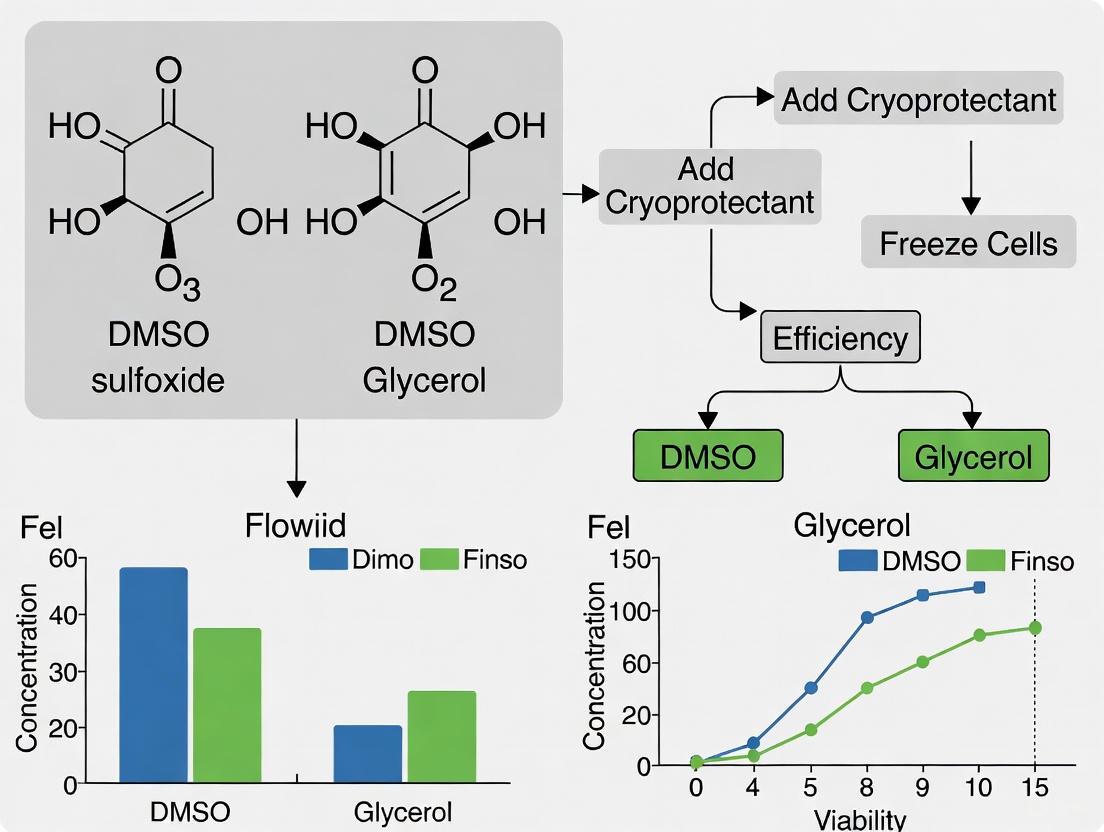
This article provides a critical comparison of dimethyl sulfoxide (DMSO) and glycerol as cryoprotective agents (CPAs), addressing the needs of researchers and drug development professionals.
DMSO vs Glycerol: A Comprehensive Analysis of Cryoprotection Efficiency for Research and Clinical Applications
Abstract
This article provides a critical comparison of dimethyl sulfoxide (DMSO) and glycerol as cryoprotective agents (CPAs), addressing the needs of researchers and drug development professionals. It explores the fundamental mechanisms of both permeating agents, detailing their application-specific efficacy across diverse cell types including regulatory T cells, adipose tissue, bacteria, and keratinocytes. The content presents optimized protocols, addresses common challenges like toxicity and ice formation, and validates findings through comparative data on post-thaw viability, functionality, and cellular integrity. By synthesizing current evidence, this review serves as a strategic guide for selecting and optimizing cryopreservation protocols to maximize cell recovery and functionality in biomedical research and clinical applications.
Cryoprotectant Fundamentals: Unraveling the Mechanisms of DMSO and Glycerol
Core Principles of Low-Temperature Cell Preservation
The long-term preservation of cells, tissues, and biological constructs at low temperatures is a cornerstone of modern biotechnology, pharmaceutical development, and regenerative medicine. The core principle underlying successful cryopreservation is the use of cryoprotective agents (CPAs) to mitigate the lethal damage caused by ice crystal formation, osmotic stress, and membrane disruption during freezing and thawing cycles. Among the numerous chemicals investigated for their cryoprotective properties, dimethyl sulfoxide (DMSO) and glycerol have emerged as two of the most widely utilized and studied permeating CPAs. These agents function by penetrating cell membranes and reducing intracellular ice formation, a primary cause of cryoinjury. The choice between DMSO and glycerol, or their combination with other agents, significantly impacts post-thaw viability, functionality, and biochemical integrity across diverse biological systems. This guide provides a systematic, evidence-based comparison of DMSO and glycerol cryoprotection efficiency, drawing upon recent experimental data to inform researchers and drug development professionals in their protocol optimization efforts.
Fundamental Mechanisms of Action
Molecular and Biophysical Interactions
The cryoprotective efficacy of DMSO and glycerol stems from their distinct molecular interactions with cellular components, particularly lipid membranes and water molecules.
DMSO-Membrane Interactions: Recent molecular dynamics simulations using updated AMBER force fields reveal that DMSO at low concentrations (1.5–10 vol%) partitions at the hydrophobic-hydrophilic interface of lipid membranes. Contrary to some earlier studies, these improved models show that DMSO induces little to no statistically significant membrane thinning or acyl chain disordering in dimyristoyl phosphatidylcholine (DMPC) membranes. Its primary mechanism may involve solvent effects rather than direct bilayer alteration, potentially stabilizing membranes against ice-induced mechanical stress during cryopreservation [1].
Glycerol-Membrane Interactions: Glycerol, a triol sugar alcohol, functions as a membrane stabilizer by forming hydrogen bonds with phospholipid head groups and water molecules. This interaction reduces the freezing point of aqueous solutions and increases solution viscosity, thereby slowing ice crystal growth and mitigating mechanical damage to cellular structures. Studies on adipose tissue preservation suggest glycerol's structural similarity to biological lipid components may confer a specific advantage for preserving complex tissues [2].
Table 1: Core Biophysical Properties of DMSO and Glycerol
| Property | DMSO | Glycerol |
|---|---|---|
| Chemical Classification | Sulfoxide | Triol Sugar Alcohol |
| Molecular Weight | 78.13 g/mol | 92.09 g/mol |
| Primary Mechanism | Modifies water H-bonding network; partitions into membrane interfaces [1] | Forms extensive H-bonds; increases solution viscosity; stabilizes membranes [2] |
| Membrane Permeability | High | Moderate (slower cellular uptake) |
| Reported Cytotoxicity | Higher at elevated concentrations and temperatures [3] | Generally lower and better tolerated [2] |
Visualizing Cryoprotectant Mechanisms
The following diagram illustrates the proposed molecular-level interactions of DMSO and glycerol with a cell membrane during cryopreservation.
Diagram Title: Molecular Interactions of DMSO and Glycerol with Cell Membranes
Comparative Efficacy Across Biological Systems
Bacterial and Microorganism Preservation
Studies on Enterobacterales strains reveal significant differences in viability after 12 months of storage at -20°C depending on cryoprotectant composition. A formulation containing 70% glycerol with nutrient supplements (peptone and yeast extract) demonstrated the highest survival rate at 88.87%, outperforming a combination of 10% DMSO with 70% glycerol (84.85%) and 10% DMSO alone (83.50%). Notably, glycerol alone without nutrients yielded a significantly lower survival rate of 44.81%, highlighting the importance of supplemental components for long-term bacterial viability [4].
For probiotic bacteria like Bacillus coagulans and Streptococcus thermophilus, sucrose demonstrated superior cryoprotection during lyophilization, attributed to its low Gibbs free energy of solvation which facilitates the formation of stable protective hydrate shells around bacterial cells [5].
Table 2: Cryoprotectant Efficacy in Microorganism Preservation
| Organism / System | Optimal CPA | Concentration | Reported Efficacy | Key Findings |
|---|---|---|---|---|
| Enterobacterales [4] | Glycerol + Nutrients | 70% Glycerol | 88.87% survival after 12 months at -20°C | Superior to DMSO-containing formulations for long-term storage. |
| Bacillus coagulans & Streptococcus thermophilus [5] | Sucrose | 12% | Improved survival after lyophilization | Low Gibbs free energy of solvation enables effective hydrate shell formation. |
Mammalian Cell and Tissue Preservation
Adipose Tissue: A direct comparison showed that 70% glycerol effectively preserved human adipose tissue structure and function during cryopreservation. Treated tissues maintained high G3PDH activity (24.41 ± 0.70, comparable to 24.76 ± 0.48 in fresh tissue), high viability of adipose-derived stem cells (ASCs), and superior in-vivo retention rates (52.37 ± 7.53%) after transplantation in nude mice, significantly outperforming DMSO-based formulations and showing lower tissue inflammation [2].
Platelets: Research into platelet cryopreservation highlights a movement toward DMSO-free protocols. Controlled-rate freezing (CRF) with isotonic saline alone achieved post-thaw recovery rates of approximately 87%, with the addition of novel agents like choline chloride-glycerol deep eutectic solvent (DES) not providing significant further improvement. This indicates that optimized physical parameters (like CRF) can reduce reliance on potentially toxic chemical CPAs like DMSO in some applications [6].
Bioinks for Tissue Engineering: The choice of CPA significantly influences the properties of bioinks. In pre-crosslinked alginate bioinks, 10% glycerol improved viscosity and yield stress, enhancing printability and significantly boosting post-thaw cell viability compared to CPA-free controls. In contrast, DMSO incorporation reduced these key rheological properties, detrimentally affecting the bioink's structural integrity during the cryobioprinting process [7].
Table 3: Cryoprotectant Efficacy in Complex Biological Systems
| Biological System | Optimal CPA | Key Performance Metrics | Comparative Notes |
|---|---|---|---|
| Adipose Tissue [2] | 70% Glycerol | G3PDH activity: ~24.4; In-vivo retention: ~52%; Low inflammation. | Outperformed DMSO+FBS in structure, stem cell viability, and transplant success. |
| Platelets [6] | DMSO-free (CRF + NaCl) | Post-thaw recovery: ~87%; Functional markers preserved. | Effective protocol reduces DMSO-related toxicity concerns. |
| Cell-Laden Bioinks [7] | 10% Glycerol | Improved viscosity, yield stress, and post-thaw cell viability. | DMSO reduced viscoelastic properties critical for printability. |
Spermatozoa and Reproductive Cells
A comprehensive study on alpaca epididymal spermatozoa revealed that cryoprotectant concentration was a more critical factor than the specific type of CPA. While DMSO at 7% and glycerol at 3.5% provided the highest post-thaw motility, these results were not significantly different from those achieved with other CPAs like ethylene glycol (EG) or dimethylformamide (DMF) at their optimal concentrations. Overall, lower concentrations (1% and 3.5%) consistently yielded better post-thaw motility, viability, and mitochondrial membrane potential than a 7% concentration across most CPA types [8].
Experimental Protocols and Methodologies
This protocol is designed for preserving Enterobacterales strains at -20°C for up to 12 months.
- 1. Inoculum Preparation: Prepare bacterial suspensions in phosphate-buffered saline (PBS) at pH 7.2, adjusted to a density of 0.5 McFarland units. Concentrate the bacterial biomass via centrifugation at 10,000 × g at 20°C for 10 minutes.
- 2. Cryoprotectant Resuspension: Resuscent the cell pellet in 5 mL of the selected cryoprotectant. The tested formulations include:
- Cryoprotectant 1: 70% Glycerin, 8% glucose, nutrient supplements (peptone, yeast extract) in PBS.
- Cryoprotectant 2: 10% DMSO, 70% Glycerin, 8% glucose, nutrient supplements in PBS.
- Cryoprotectant 3: 10% DMSO, 8% glucose in PBS.
- Cryoprotectant 4: 70% Glycerin, 8% glucose in PBS.
- 3. Aliquot and Equilibrate: Dispense 500 µL of the cryoprotectant-bacteria suspension into 1.5 mL cryotubes. Allow equilibration at 4–6°C for 30 minutes.
- 4. Freezing: Transfer the equilibrated cryotubes to a -20°C storage freezer.
- 5. Thawing and Assessment: For viability assessment, rapidly thaw cryotubes at 37°C for 3–5 minutes with mild shaking. Determine the number of viable bacterial cells using the standard plate counting (SPC) method by streaking serial dilutions onto Nutrient Agar plates and incubating at 37°C for 18–22 hours.
This protocol evaluates the efficacy of glycerol for preserving composite tissues.
- 1. Tissue Preparation: Wash freshly harvested human adipose tissue to remove free oil and blood. Divide the pure adipose tissue into 1 mL samples.
- 2. CPA Mixing: Combine each 1 mL adipose tissue sample with 1 mL of CPA solution at room temperature. Key comparison groups include:
- 60%, 70%, 80%, 90% glycerol-PBS solutions.
- 0.25 mol/L trehalose-PBS solution.
- 10% DMSO + 90% Fetal Bovine Serum (FBS) (positive control).
- No CPA (blank control).
- 3. Controlled-Rate Freezing: Use a controlled-rate freezing container with a cooling rate of -1°C/min. Hold samples at -80°C for at least 12 hours before transferring to long-term storage in liquid nitrogen (-196°C).
- 4. Thawing and Washing: After storage, thaw samples in a 37°C water bath. Wash the thawed tissues twice with PBS to remove residual CPAs.
- 5. Viability Assessment: Assess tissue viability through G3PDH activity assays, stromal vascular fraction (SVF) cell viability counts (using trypan blue exclusion and flow cytometry with Calcein-AM/PI), and histological examination (H&E staining). For in-vivo assessment, transplant tissue into nude mouse models and evaluate retention rates and histology after one month.
The following workflow diagram summarizes the key steps common to cryopreservation protocols.
Diagram Title: General Workflow for Cryopreservation Protocols
The Scientist's Toolkit: Essential Research Reagents
A well-equipped laboratory requires specific reagents and materials to conduct rigorous cryopreservation studies. The following table details key solutions and their functions as derived from the cited experimental protocols.
Table 4: Essential Reagents for Cryopreservation Research
| Reagent / Solution | Composition / Preparation Notes | Primary Function in Cryopreservation |
|---|---|---|
| DMSO Solution [4] [2] | Often used at 10% (v/v) in culture medium or PBS. Must be sterilized by filtration. | Penetrating CPA; reduces intracellular ice formation. |
| Glycerol Solution [4] [2] | Concentrations vary (e.g., 70% for bacteria, 60-70% for tissues). Can be autoclaved. | Penetrating CPA; stabilizes membranes; reduces osmotic stress. |
| Nutrient-Supplemented CPA [4] | 70% Glycerin, 8% glucose, peptone, yeast extract in PBS. | Provides cryoprotection and nutritional support for long-term microbial viability. |
| Trehalose Solution [2] | 0.25 mol/L in PBS. | Non-penetrating CPA; protects cells from osmotic shock. |
| Phosphate-Buffered Saline (PBS) [4] | Standard pH 7.2. Used for washing and as a base for CPA solutions. | Maintains osmotic balance and pH stability. |
| Fetal Bovine Serum (FBS) with DMSO [2] | 90% FBS + 10% DMSO (v/v). | Provides CPA and complex nutrients/matrix for sensitive mammalian cells. |
The comparative analysis of DMSO and glycerol reveals a nuanced landscape in cryoprotectant selection. Glycerol demonstrates superior performance in specific contexts, including long-term bacterial preservation (particularly when supplemented with nutrients) and the cryopreservation of complex tissues like human adipose, where it maintains high cellular activity and promotes better in-vivo outcomes with reduced inflammation. Its favorable effects on the rheological properties of bioinks further underscore its utility in advanced tissue engineering applications. DMSO remains a highly effective and rapidly penetrating CPA, though concerns regarding its cytotoxicity and potential effects on membrane properties persist. The trend in research is moving toward several key areas: First, the optimization of CPA-free protocols using advanced physical freezing methods like controlled-rate freezing. Second, the development of novel cryoprotectant formulations, including deep eutectic solvents (DES) and sugar-based solutions, which aim to combine high efficacy with low toxicity. Finally, the recognition that concentration and combination strategies are often as critical as the choice of CPA itself. The optimal cryoprotective strategy is therefore highly dependent on the specific biological system, desired post-thaw functionality, and storage constraints, necessitating empirical validation for each new application.
Cryopreservation is a cornerstone technology in biomedical research and clinical applications, enabling the long-term storage of biological materials—from single cells to complex tissues—by cooling them to extremely low temperatures, effectively halting all biochemical and metabolic processes [9]. The fundamental challenge of cryopreservation lies in mitigating the damaging effects of ice crystal formation, which can cause irreversible mechanical damage to cell membranes and cellular structures [10] [9]. Cryoprotective Agents (CPAs) are chemical compounds specifically designed to protect biological materials from this freezing-induced damage. Since the initial discovery of glycerol's protective effects in the 1940s, followed by dimethyl sulfoxide (DMSO) in the 1950s, these two agents have emerged as the most widely used and studied CPAs in cryobiology [9] [11]. They function by fundamentally altering the physical behavior of water during the freezing process, stabilizing cellular membranes, and maintaining cell viability during both freezing and thawing phases. While both are permeating CPAs capable of crossing cell membranes, DMSO and glycerol exhibit distinct chemical properties, mechanisms of action, and biological effects that determine their suitability for different applications in research and clinical settings. Understanding these differences is crucial for researchers and drug development professionals seeking to optimize cryopreservation protocols for specific cell types, tissues, or organisms.
Fundamental Chemical Properties and Mechanisms
Chemical Structures and Basic Properties
Dimethyl sulfoxide (DMSO) is a highly polar organosulfur compound with the chemical formula (CH₃)₂SO. It features a sulfinyl group (S=O) bonded to two methyl groups, creating a molecular structure with a significant dipole moment. This polar nature allows DMSO to readily dissolve both polar and non-polar compounds, making it an exceptionally effective solvent. DMSO has a relatively low molecular weight (78.13 g/mol) and rapidly penetrates biological membranes, a property that underpins its effectiveness as a cryoprotectant but also contributes to its cellular toxicity at higher concentrations [11]. The rapid membrane permeation of DMSO can cause significant osmotic stress and can disrupt membrane-bound proteins during the addition and removal phases [10].
Glycerol (C₃H₈O₃), also known as glycerin, is a simple polyol compound consisting of a three-carbon chain with three hydroxyl groups (-OH) attached. This structure makes it highly hygroscopic and capable of forming extensive hydrogen-bonding networks with water molecules. With a higher molecular weight (92.09 g/mol) than DMSO, glycerol penetrates cells more slowly, generally resulting in less acute osmotic stress [2] [10]. Its natural presence in biological systems as the backbone of triglycerides contributes to its generally superior biocompatibility and lower toxicity profile compared to DMSO [2]. The hydroxyl groups allow glycerol to interact strongly with water molecules and biological macromolecules, stabilizing proteins and membrane structures during freezing.
Table 1: Fundamental Chemical Properties of DMSO and Glycerol
| Property | DMSO | Glycerol |
|---|---|---|
| Chemical Formula | (CH₃)₂SO | C₃H₈O₃ |
| Molecular Weight (g/mol) | 78.13 | 92.09 |
| Primary Functional Groups | Sulfinyl group (S=O) | Three hydroxyl groups (-OH) |
| Membrane Permeability | High | Moderate |
| Rate of Cellular Uptake | Rapid | Slow |
| Hydrogen-Bonding Capacity | Moderate | High |
| General Biocompatibility | Moderate to Low | High |
Molecular Mechanisms of Cryoprotection
The cryoprotective mechanisms of both DMSO and glycerol operate through multiple complementary pathways that address the primary causes of freezing damage. Both agents function primarily by suppressing ice formation through colligative action—the dissolution of solute molecules in water reduces the freezing point and decreases the amount of water available to form ice crystals at any given temperature. This effect is concentration-dependent and applies to both intracellular and extracellular environments [9].
DMSO's protective mechanism involves particularly strong interactions with water molecules through its highly polar sulfinyl group, which disrupts the hydrogen-bonding network of water and prevents the organization of water molecules into ice crystal lattices [1]. Molecular dynamics simulations have revealed that DMSO preferentially partitions at the hydrophobic-hydrophilic interface of lipid membranes while being partially excluded from the polar headgroup region relative to water [1]. This interfacial positioning allows DMSO to modulate membrane fluidity and permeability, which can both protect against ice crystal penetration and increase susceptibility to osmotic stress. DMSO is known to enhance plasma membrane permeability and alter membrane structure by increasing its fluidity in a concentration-dependent manner [1].
Glycerol's cryoprotective action stems from its ability to form extensive hydrogen bonds with water molecules and biological structures. The three hydroxyl groups create a protective hydration shell around proteins and lipid membranes, maintaining their native conformation even when water molecules are scarce during freezing-induced dehydration [2] [10]. This "water replacement" hypothesis suggests that glycerol molecules can substitute for water molecules at critical sites on biological structures, preventing protein denaturation and membrane fusion. Glycerol also increases the viscosity of both intracellular and extracellular solutions, slowing down diffusion-limited processes and inhibiting ice crystal growth and recrystallization during warming [7].
Diagram 1: Molecular mechanisms of DMSO and glycerol cryoprotection. While both agents share common protective pathways (green), they also exhibit distinct mechanism profiles (red for DMSO, blue for glycerol).
Comparative Experimental Performance Data
Efficacy Across Biological Systems
Experimental data from diverse biological systems reveals significant differences in the cryoprotective efficacy of DMSO and glycerol, heavily dependent on the specific biological material being preserved, concentration used, and freezing protocol employed.
In bacterial cryopreservation, glycerol generally demonstrates superior performance. A comprehensive study on Enterobacterales strains found that cryoprotectant solutions containing 70% glycerol with nutrient supplements achieved the highest survival rate (88.87%) after 12 months of storage at -20°C, significantly outperforming solutions containing 10% DMSO alone (83.50%) or DMSO-glycerol combinations (84.85%) [4]. Similarly, in the colonial choanoflagellate Salpingoeca rosetta, a model organism for studying multicellularity, glycerol at 15% concentration proved significantly more effective than comparable DMSO concentrations, with 5% solutions of either CPA showing the poorest recovery rates [12].
In complex tissue preservation, glycerol's advantages become even more pronounced. Research on human adipose tissue cryopreservation demonstrated that 70% glycerol effectively maintained tissue integrity, cellular activity, and adipose-derived stem cell (ASC) viability and differentiation capability [2]. Tissue preserved with 70% glycerol exhibited G3PDH activity of 24.41 ± 0.70, comparable to fresh tissue (24.76 ± 0.48), and achieved a transplantation retention rate of 52.37 ± 7.53%, significantly higher than other CPA formulations [2]. Notably, glycerol-based preservation resulted in lower tissue inflammation compared to DMSO-based protocols, highlighting its superior biocompatibility for clinical applications.
However, DMSO remains valuable in specific cell therapy applications, particularly for mesenchymal stromal cells (MSCs), where it is the preferred cryoprotectant despite toxicity concerns [11]. DMSO's rapid membrane penetration provides effective protection during the rapid cooling phases often used in cell therapy product preservation. The trade-off between efficacy and toxicity is particularly evident in these applications, where DMSO concentrations around 10% are standard despite known side effects.
Table 2: Comparative Performance of DMSO and Glycerol Across Biological Systems
| Biological System | Optimal DMSO Concentration | Optimal Glycerol Concentration | Key Performance Findings | Primary Reference |
|---|---|---|---|---|
| Enterobacterales Bacteria | 10% (83.50% survival) | 70% (88.87% survival) | Glycerol with nutrients superior to DMSO alone or combinations | [4] |
| Adipose Tissue | 10% + FBS (positive control) | 70% (52.37% graft retention) | Glycerol preserved structure, function, with lower inflammation | [2] |
| Alpaca Spermatozoa | 3.5-7% (motility varies) | 3.5% (best overall profile) | Concentration critical; glycerol less toxic at effective concentrations | [8] |
| Saccharomyces cerevisiae | 5% (in combinations) | >5% (in combinations) | Combinations with trehalose or PVP often superior to single CPAs | [10] |
| Choanoflagellates | 5-15% (poor recovery) | 15% (optimal recovery) | Glycerol significantly outperformed DMSO at all concentrations | [12] |
| Mesenchymal Stromal Cells | 10% (standard clinical) | Not established | DMSO remains standard despite toxicity concerns | [11] |
Concentration-Dependent Effects and Toxicity
The efficacy and toxicity of both CPAs exhibit strong concentration dependence, with optimal concentrations varying significantly across biological systems.
DMSO toxicity manifests at multiple levels. At the cellular level, DMSO can disrupt membrane integrity, alter membrane fluidity properties, and affect cellular function even at low concentrations [1] [11]. Molecular dynamics studies indicate that DMSO-induced membrane thinning, expansion of membrane surface area, and increased acyl chain disordering occur in a concentration-dependent manner [1]. In clinical applications, DMSO administration has been associated with various adverse effects, including transient mild headache, chills, gastrointestinal symptoms, and in higher concentrations or doses, hematological disturbances such as hemolysis and hemoglobinuria [11]. The characteristic "garlic-like" odor caused by dimethyl sulfide excretion through breath is a common patient complaint [11].
Glycerol toxicity is generally less pronounced than DMSO, though still concentration-dependent. In alpaca epididymal sperm cryopreservation, glycerol at 3.5% concentration provided the best overall post-thaw quality, while higher concentrations (7%) proved detrimental to motility, viability, and mitochondrial membrane potential [8]. Similar patterns were observed in adipose tissue preservation, where glycerol concentrations above 70% showed diminished efficacy [2]. The slower membrane penetration rate of glycerol reduces osmotic stress during addition and removal, contributing to its improved safety profile, though this requires longer equilibration times in protocol optimization.
Diagram 2: Concentration-dependent efficacy-toxicity relationship for DMSO and glycerol. Note the broader optimal concentration range for glycerol compared to DMSO.
Experimental Protocols and Methodologies
Standard Cryopreservation Workflow
The following generalized protocol for comparative evaluation of DMSO and glycerol efficacy incorporates best practices from multiple experimental approaches documented in the literature:
Sample Preparation Phase:
- Cell/Tissue Harvesting: Obtain biological material under standardized conditions. For cells, achieve target confluence (e.g., 90% for ASCs [2]); for tissues, process to remove unnecessary components (e.g., wash adipose tissue to remove free oil and liquid [2]).
- CPA Solution Preparation: Prepare stock solutions of DMSO and glycerol in appropriate carrier medium (e.g., PBS, culture medium, or specialized extender). Include nutrient supplements (peptone, yeast extract) when appropriate for bacterial systems [4].
- Equilibration: Mix biological material with CPA solutions gradually to minimize osmotic shock. Standard DMSO equilibration occurs at 4°C for 10-30 minutes [10]; glycerol may require longer equilibration (30-60 minutes) due to slower membrane penetration [2] [8].
Freezing Phase:
- Cooling Rate Optimization: Use controlled-rate freezing when possible. A common protocol cools at -1°C/min to -40°C, then rapid cooling to -90°C at 10°C/min before transfer to long-term storage [10]. For tissues, a simple -1°C/min protocol in a freezing container at -80°C suffices for many applications [2].
- Long-term Storage: Maintain samples at ultralow temperatures (-80°C to -196°C) for predetermined periods. Studies indicate ultra-low temperature freezers may suffice for short-term storage, while liquid nitrogen vapor phase is preferred for long-term preservation [12].
Thawing and Assessment Phase:
- Rapid Thawing: Thaw samples rapidly in a 37°C water bath with gentle agitation [4] [10] until ice crystals completely disappear.
- CPA Removal: For glycerol, often requires stepwise dilution to prevent osmotic shock [2]. For DMSO, removal depends on application—often retained in cell therapy products to minimize processing damage [11].
- Viability Assessment: Employ multiple assessment methods: standard plate counting for microorganisms [4], trypan blue exclusion for cell viability [2], flow cytometry for membrane integrity and mitochondrial function [8], and functional assays specific to the biological system (e.g., G3PDH activity for adipose tissue [2], motility analysis for sperm [8]).
Diagram 3: Standard cryopreservation workflow for comparative evaluation of DMSO and glycerol efficacy.
The Scientist's Toolkit: Essential Research Reagents
Table 3: Essential Reagents and Equipment for Comparative CPA Studies
| Category | Specific Items | Function in CPA Research | Application Examples |
|---|---|---|---|
| Cryoprotective Agents | DMSO (cell culture grade), Glycerol (USP grade) | Primary cryoprotectants for comparison | DMSO: 5-15% in medium; Glycerol: 10-70% in PBS or medium [4] [2] |
| Cell Culture Materials | Cell culture media, Fetal Bovine Serum, PBS, Trypsin/EDTA | Maintain cell viability during processing | DMEM with 10% FBS for MSC culture [11]; Trypticase Soy Broth for bacterial culture [4] |
| Cryopreservation Equipment | Controlled-rate freezer, Cryogenic vials, Liquid nitrogen tank | Standardize freezing and storage conditions | CryoMed Controlled Rate Freezer for yeast [10]; Liquid nitrogen for long-term adipose storage [2] |
| Viability Assessment Tools | Hemocytometer, Flow cytometer, Microplate reader | Quantify post-thaw recovery and function | Trypan blue exclusion for SVF cells [2]; JC-1 for mitochondrial membrane potential [8] |
| Specialized Assay Kits | G3PDH activity assay, LDH release assay, CCK-8 proliferation kit | Evaluate specific biochemical functions | G3PDH assay for adipose tissue viability [2]; LDH for platelet integrity [6] |
| Molecular Biology Reagents | Collagenase, RNA extraction kits, PCR reagents | Analyze cellular responses to cryopreservation | Collagenase digestion for SVF isolation [2]; Proteomic analysis for yeast [10] |
Research Applications and Safety Considerations
Application-Specific Recommendations
The choice between DMSO and glycerol depends heavily on the specific research application and biological system:
For microbial cryopreservation, glycerol generally demonstrates superior performance for most bacterial strains and eukaryotic microorganisms. The Enterobacterales study clearly showed 70% glycerol with nutrient supplements achieved the highest survival rates after long-term storage [4]. Similarly, for protists like choanoflagellates, 15% glycerol significantly outperformed DMSO at comparable concentrations [12].
In tissue engineering and regenerative medicine, the choice is more complex. For adipose tissue preservation, 70% glycerol demonstrated excellent structural maintenance, high graft retention rates, and lower inflammation compared to DMSO-based formulations [2]. However, for mesenchymal stromal cell products destined for clinical applications, DMSO remains the standard cryoprotectant at approximately 10% concentration, despite known toxicity concerns, due to its established efficacy and regulatory precedent [11].
For reproductive cell cryopreservation, optimal CPA selection shows species-specific variations. In alpaca epididymal sperm, both DMSO and glycerol at 3.5% concentration provided acceptable protection, though glycerol showed better overall preservation of membrane integrity and mitochondrial function [8]. The critical importance of concentration optimization is particularly evident in these sensitive systems, where both over- and under-concentration can severely impact post-thaw functionality.
In novel biopreservation applications, combination approaches often show promise. Studies with Saccharomyces cerevisiae demonstrate that CPA combinations (e.g., DMSO with trehalose or PVP) can provide superior protection compared to single-agent formulations [10]. Similarly, emerging research on deep eutectic solvents (DES) combining choline chloride with glycerol suggests potential for next-generation cryoprotectants with reduced toxicity [6].
Safety and Regulatory Considerations
Safety profiles differ significantly between DMSO and glycerol, with important implications for research and clinical applications:
DMSO safety concerns include both cellular toxicity and patient side effects. At the cellular level, DMSO can induce differentiation in certain cell types, alter membrane properties, and affect cellular function [1] [11]. In clinical administration, DMSO has been associated with various adverse effects including nausea, vomiting, cardiovascular effects, and neurological symptoms [11]. The characteristic garlic-like odor caused by dimethyl sulfide excretion is a common patient complaint. For hematopoietic stem cell transplantation, a maximum dose of 1 g DMSO per kg body weight per infusion is generally considered acceptable [11], though many MSC therapy products deliver significantly lower doses (2.5-30 times lower than this threshold) [11].
Glycerol safety advantages include its natural presence in biological systems and generally lower toxicity profile. As the backbone of triglycerides, glycerol has inherent biocompatibility that makes it particularly attractive for clinical applications [2]. In adipose tissue transplantation, glycerol-preserved tissue showed significantly lower inflammation compared to DMSO-preserved controls [2]. The slower membrane penetration reduces osmotic stress during addition and removal, though this requires appropriate protocol adjustments.
Regulatory considerations favor DMSO for certain clinical applications based on historical precedent and established protocols. For cell therapy products like MSCs, DMSO remains the cryoprotectant of choice despite its known toxicity, primarily due to extensive historical data and regulatory familiarity [11]. However, for tissue preservation and newer applications, glycerol's superior safety profile makes it an increasingly attractive option, particularly as protocols become standardized and validated.
DMSO and glycerol, while both effective permeating cryoprotectants, exhibit distinct chemical properties, mechanisms of action, and biological effects that determine their appropriateness for specific research and clinical applications. DMSO's rapid membrane penetration and strong ice crystal suppression make it valuable for sensitive cell systems like MSCs, though its toxicity profile requires careful management. Glycerol's superior biocompatibility, hydrogen-bonding capability, and lower toxicity make it particularly suitable for bacterial cultures, complex tissues, and applications where minimized inflammatory response is critical. The experimental evidence clearly demonstrates that optimal CPA selection is system-dependent, with glycerol generally outperforming DMSO in microbial and tissue preservation, while DMSO maintains its role in specific cell therapy applications. Concentration optimization emerges as a critical factor for both agents, often more important than the choice between them. Future research directions include developing improved combination formulations, exploring novel cryoprotectants like deep eutectic solvents, and establishing standardized, application-specific protocols that maximize post-preservation viability while minimizing toxicological concerns.
The field of cryobiology, the "cold life science," was fundamentally shaped by the quest to protect biological materials from the devastating effects of ice crystal formation during freezing [9]. The discovery and evolution of Cryoprotective Agents (CPAs) mark a transformative journey in biology and medicine, enabling the long-term storage of cells, tissues, and organs. Central to this history are two pivotal compounds: glycerol and dimethyl sulfoxide (DMSO). For decades, these have served as the cornerstone conventional cryoprotectants, allowing for the preservation of everything from sperm and embryos to complex stem cell therapies [13]. This guide objectively compares the cryoprotection efficiency of DMSO and glycerol by examining contemporary research, presenting quantitative data, and detailing the experimental protocols that define their use in modern laboratories. Framed within a broader thesis on comparative cryoprotection research, this analysis provides researchers, scientists, and drug development professionals with a clear, data-driven understanding of these critical reagents.
Key Discoveries and Historical Timeline
The foundational breakthroughs in cryopreservation were driven by the systematic investigation of compounds that could penetrate cells and prevent intracellular ice formation. The initial breakthrough came with the discovery of glycerol's protective effects. This was followed years later by the introduction of DMSO, which offered high efficacy and ease of use, leading to its widespread adoption, particularly in clinical cell therapy preservation protocols.
Table 1: Historical Milestones in CPA Development
| Year | Discovery / Event | Significance |
|---|---|---|
| 1776 | Spallanzani observes sperm mobility in cold [9] | Early recognition of biological tolerance to low temperatures. |
| 1949 | Polge et al. discover glycerol's cryoprotective ability for fowl sperm [9] | Marked the birth of modern cryopreservation; first use of a penetrating CPA. |
| 1953 | Successful human pregnancy using cryopreserved glycerol-treated sperm [9] | Proved the clinical viability of cryopreservation. |
| 1960s | Introduction of DMSO as a cryoprotectant [13] | Provided an alternative, highly effective penetrating CPA. |
| 1963 | Mazur characterizes the kinetics of ice formation and cell water transport [9] | Established a theoretical framework for optimizing cooling rates. |
| 1980s-Present | DMSO becomes the standard for freezing hematopoietic stem cells and MSCs [11] | Solidified DMSO's role in clinical cell therapy. |
| 2000s-Present | Intensive research into DMSO-free solutions (e.g., Sucrose-Glycerol-Isoleucine) [14] [15] | Driven by concerns over DMSO toxicity, aiming to develop safer clinical alternatives. |
Comparative Performance Analysis: DMSO vs. Glycerol
Modern research directly compares the performance of DMSO and glycerol across various cell types. The following data, synthesized from recent multicenter studies and experimental reports, provides a quantitative basis for evaluating their cryoprotection efficiency. Key metrics include post-thaw viability, cell recovery, and functional integrity.
Table 2: Performance Comparison of DMSO vs. Glycerol in Recent Studies
| Cell Type / Application | CPA Formulation | Post-Thaw Viability | Post-Thaw Recovery | Key Findings | Source |
|---|---|---|---|---|---|
| Mesenchymal Stromal Cells (MSCs) - Int. Multicenter Study | 5-10% DMSO (in-house) | Avg. decrease of 4.5% from pre-freeze baseline | Lower by 5.6% vs. SGI solution | Preserved immunophenotype (CD73, CD90, CD105) and global gene expression. | [14] |
| DMSO-free (Sucrose, Glycerol, Isoleucine) | Avg. decrease of 11.4% from pre-freeze baseline | 92.9% (better than in-house DMSO) | Viability >80% deemed clinically acceptable. Slightly lower viability but better recovery. | [14] | |
| Sperm (Fertile Donors) | Egg-yolk + Glycerol | Not Specified | Not Specified | Established standard for sperm cryopreservation. | [16] |
| Sucrose + Glycerol | Not Specified | Not Specified | An effective DMSO-free alternative cryoprotectant combination. | [16] | |
| C2C12 Myoblasts | 5-10% DMSO at 1°C/min cooling | 65% viability | Not Specified | Slow cooling (1°C/min) promoted better cell accommodation in FCS channels and higher viability. | [17] |
| 3D Bioprinting (Alginate Bioink) | 10% DMSO | Not Specified (Reduced viscosity) | Not Specified | Reduced bioink viscosity and yield stress. | [7] |
| 10% Glycerol | Not Specified (Improved viability) | Not Specified | Improved bioink properties and significantly enhanced post-thaw cell viability vs. no CPA. | [7] | |
| Platelets | DMSO (Traditional) | Functional markers preserved post-thaw | >85% | Established method, but requires washing and has cytotoxicity concerns. | [18] |
| NaCl-only (DMSO-free) | Functional markers preserved post-thaw | >85% | Simplified, less toxic protocol; recovery and function comparable to DMSO when using CRF. | [18] |
Detailed Experimental Protocols
To ensure reproducibility and provide a clear basis for comparison, this section outlines the standard methodologies employed in the key studies cited.
Protocol: International Multicenter Study on MSCs
This protocol evaluates a novel DMSO-free solution against traditional DMSO-containing cryoprotectants for mesenchymal stromal cells (MSCs) [14].
- Cell Preparation: MSCs were isolated from human bone marrow or adipose tissue and cultured ex vivo according to local protocols at each of the seven participating international centers.
- CPA Preparation:
- Test Solution: A DMSO-free solution containing Sucrose, Glycerol, and Isoleucine (SGI) in Plasmalyte A was prepared at a central facility (University of Minnesota).
- Control Solutions: Cryoprotectant solutions containing 5-10% DMSO were prepared locally at each participating center as their "in-house" standard.
- Freezing Process: Cell suspensions were aliquoted into vials or bags. For six out of seven centers, the containers were placed in a controlled-rate freezer. One center used a -80°C freezer overnight. All samples were subsequently transferred to liquid nitrogen for storage.
- Thawing and Analysis: Cells were kept frozen for at least one week before thawing. Post-thaw assessment included:
- Viability and Recovery: Measured using standard assays (e.g., trypan blue exclusion).
- Immunophenotype: Analysis by flow cytometry for standard MSC markers (CD45, CD73, CD90, CD105).
- Transcriptional Profile: Global gene expression analysis was performed.
Protocol: Sperm Cryopreservation with Different Media
This protocol assesses the impact of different glycerol-based cryoprotectants on sperm DNA integrity in fertile and infertile males [16].
- Sample Collection and Grouping: Thirty human semen samples were collected and categorized into two groups: fifteen from fertile donors and fifteen from infertile, smoking donors.
- CPA Application: Each sample was divided into three portions and cryopreserved using different media:
- Medium 1: Egg-yolk + Glycerol
- Medium 2: Sucrose + Glycerol
- Medium 3: Glycerol alone
- Freezing Process: Cryoprotective media were added dropwise to 1 mL semen samples in cryovials. The vials were equilibrated, then placed in a -20°C freezer for 30 minutes, followed by a vapor phase of liquid nitrogen (-80°C) for 10-15 minutes, before final storage in liquid nitrogen (-196°C).
- Thawing and Analysis: After one month of storage, samples were thawed and analyzed for:
- Sperm Motility and Morphology: Using Computer-Assisted Sperm Analysis (CASA).
- DNA Fragmentation Index (DFI): Assessed using the Sperm Chromatin Structure Assay (SCSA).
- Apoptotic Markers: Levels of Caspase-3 were measured.
Protocol: Analyzing Freeze-Concentrated Solution (FCS) Morphology
This study investigates the physical mechanisms of cryoprotection, specifically how cooling rates and CPAs affect the microscopic environment where cells reside during freezing [17].
- Sample Preparation: A 10 μL aliquot of a sodium fluorescein solution in DMSO (at concentrations of 5, 10, or 20 wt%) is sandwiched between two glass slides. For cell accommodation studies, rabbit red blood cells are dispersed in the DMSO solution.
- Cooling and Observation: The sample is placed on a temperature-controlled cooling stage mounted on an upright fluorescent microscope. The solution is cooled at controlled rates (e.g., 1°C/min, 10°C/min, 30°C/min) while being continuously monitored.
- Image Acquisition and Analysis: Fluorescence and transmission images are captured to visualize the morphology of the FCS channels and the location of cells.
- The width of the FCS channels and the size of ice particles are statistically analyzed using image analysis software (e.g., ImageJ).
- Cell Viability Correlation: In parallel experiments, C2C12 myoblast cells are subjected to the same freezing profiles in DMSO. Post-thaw viability is determined using a trypan blue staining assay. The relationship between FCS morphology (channel size) and cell recovery rate is then established.
Mechanisms of Action and Functional Insights
The efficacy of DMSO and glycerol stems from their distinct yet complementary interactions with cellular structures and the extracellular environment during freezing.
Molecular Interactions with Lipid Membranes
DMSO's interaction with cell membranes has been a key area of research. Advanced molecular dynamics simulations using updated AMBER force fields show that DMSO and water penetrate lipid membranes to a similar depth. Contrary to some earlier studies, these improved models indicate that DMSO, particularly at low concentrations (1.5-10 vol%), causes little to no statistically significant membrane thinning or expansion in fluid-phase membranes. Its primary effect may be more related to solvent interactions and preventing ice formation rather than drastically altering membrane structure [1]. Both DMSO and glycerol function as penetrating CPAs, meaning they cross the cell membrane. They increase the intracellular solute concentration, thereby depressing the freezing point and reducing the amount of intracellular ice formation, which is a primary cause of cell death [13] [17].
Impact on Biophysical Properties in Tissue Engineering
In advanced applications like 3D bioprinting, the choice of CPA significantly influences the physical properties of bioinks. Studies on alginate-based bioinks reveal a clear divergence between DMSO and glycerol:
- DMSO: Acts as a plasticizer, reducing the viscosity and yield stress of pre-crosslinked alginate bioinks. This can be detrimental to the printability and shape fidelity of complex 3D structures [7].
- Glycerol: Interacts with crosslinking agents (e.g., calcium chloride) to improve viscosity and yield stress. This enhancement of rheological properties, coupled with its effectiveness as a CPA, makes glycerol a superior choice for cryobioprinting applications, leading to higher post-thaw cell viability in fabricated constructs [7].
The Critical Role of Cooling Rates
The efficiency of any CPA is inextricably linked to the cooling rate. Research on freeze-concentrated solution (FCS) morphology demonstrates that slow cooling rates (e.g., 1°C/min) promote the formation of larger FCS channels. These larger channels more effectively accommodate cells, allowing them to be shielded in a protective, concentrated solute environment. In contrast, rapid cooling creates fine ice crystals and narrow FCS channels, increasing the probability of mechanical damage to cells and leading to significantly lower post-thaw viability [17]. This underscores that protocol optimization is as critical as the choice of CPA itself.
The Scientist's Toolkit: Essential Reagents and Materials
Table 3: Key Reagents and Materials for Cryopreservation Research
| Reagent / Material | Function in Cryopreservation | Example Application / Note |
|---|---|---|
| Dimethyl Sulfoxide (DMSO) | Penetrating CPA; inhibits intracellular ice nucleation. | Standard for hematopoietic stem cells and MSCs; use at 5-10% concentration. |
| Glycerol | Penetrating CPA; protects from osmotic damage. | Historically first CPA; used for sperm, oocytes, and in novel DMSO-free mixtures. |
| Sucrose | Non-penetrating CPA; helps control osmotic stress. | Common component of DMSO-free media (e.g., with glycerol and isoleucine). |
| Trehalose | Non-penetrating sugar; stabilizes membranes and proteins. | Used in DMSO-free protocols; often requires electroporation for intracellular delivery. |
| Isoleucine | Amino acid; postulated to enhance cryoprotection. | Component of novel SGI DMSO-free cryoprotectant for MSCs [14]. |
| Poloxamer 188 | Non-ionic surfactant; reduces membrane damage. | Added to cryomedia to improve post-thaw cell recovery and viability. |
| Controlled-Rate Freezer | Equipment that provides a precise, programmable cooling rate. | Critical for optimizing FCS formation and achieving high, reproducible viability [17]. |
| Ice Nucleation Seeder | Device to induce consistent, controlled ice formation. | Improves protocol reproducibility by standardizing the initial freezing point. |
The historical reliance on DMSO is being rigorously re-evaluated. While it remains a highly effective and widely used CPA, concerns over its toxicity and negative impact on certain material properties are driving innovation [11] [15]. Contemporary research, as detailed in this guide, demonstrates that glycerol-based and other DMSO-free formulations can achieve comparable, and in some cases superior, post-thaw recovery and function for specific cell types and applications [14] [7] [18]. The future of cryopreservation lies not in a single "perfect" CPA, but in the rational design of application-specific solutions. This involves combining penetrating agents like glycerol with non-penetrating components like sucrose, and optimizing supporting parameters such as cooling rates. As the field advances, this nuanced, evidence-based approach to selecting and developing cryoprotectants will be crucial for enabling the next generation of biotherapeutics and regenerative medicine applications.
Cryopreservation is a cornerstone technology for the long-term storage of biologics, enabling advancements in cell and gene therapy, assisted reproduction, and biobanking [19] [20]. The process involves cooling cells to very low temperatures (typically -80°C to -196°C) to halt all biochemical activity. However, the journey to and from these temperatures exposes biological materials to two primary, interconnected challenges: the mechanical damage from ice crystal formation and the deleterious effects of osmotic stress [19] [21]. These phenomena are the principal drivers of cryoinjury, leading to cell death, compromised functionality, and reduced efficacy of therapeutic products.
During freezing, the phase change of water is the primary cause of damage. As extracellular water freezes, solutes are excluded from the growing ice lattice, leading to a dramatic increase in the solute concentration of the unfrozen extracellular solution. This creates a hypertonic environment, causing water to osmotically exit the cell. This process results in cellular dehydration and excessive cell shrinkage, which can cause irreversible damage to membranes and cellular structures [19]. Conversely, if the cooling rate is too rapid, water does not have sufficient time to leave the cell, leading to the formation of lethal intracellular ice crystals that puncture and disrupt organelles and membranes [19] [21]. The thawing process presents its own dangers, particularly ice recrystallization, where smaller ice crystals melt and refreeze into larger, more damaging structures [19]. To mitigate these challenges, cryoprotective agents (CPAs) are employed. However, the use of CPAs introduces a critical trade-off, as their necessary presence to prevent ice damage can simultaneously exacerbate osmotic stress and introduce chemical toxicity [19] [20].
Comparative Analysis of DMSO and Glycerol
To protect cells from ice formation, permeating CPAs like Dimethyl Sulfoxide (DMSO) and glycerol are essential. They function by forming hydrogen bonds with water, depressing the freezing point, and facilitating vitrification—a process where water transitions into a glassy, non-crystalline solid [19] [21]. The following table provides a structured comparison of these two widely used agents.
Table 1: Comparative Profile of DMSO and Glycerol as Cryoprotective Agents
| Feature | DMSO (Dimethyl Sulfoxide) | Glycerol (GLY) |
|---|---|---|
| Chemical Class | Permeating cryoprotectant | Permeating cryoprotectant |
| Primary Mechanism | Penetrates cells, depresses ice formation, induces water pores in membranes at ~10% concentration [21] | Penetrates cells, reduces intracellular ice crystal formation and osmotic pressure differences [22] |
| Common Usage Concentrations | 5-10% (v/v) for slow freezing; higher for vitrification [20] [21] | 6-70%, varying significantly by cell and tissue type [23] [22] [24] |
| Key Advantages | Rapid membrane permeability, broad applicability, clinically validated, considered the "gold standard" [20] [21] | Generally lower cytotoxicity for some cell types; effective for composite tissues like adipose and testicular tissue [23] [22] |
| Documented Risks & Limitations | - Induces oxidative stress and disrupts cellular metabolism [20]- Alters epigenetic landscape and gene expression [20] [15]- Causes patient side effects (nausea, cardiovascular events) [20]- Synergistic toxicity with other compounds [19] | - Can act as a contraceptive in avian models by impairing sperm-oviduct interaction [24]- Temperature-dependent toxicity, particularly at physiological temperatures [24]- Can cause hemolysis or alter red blood cell shape [19] |
The efficacy of DMSO and glycerol is highly dependent on the biological system and cryopreservation protocol. The table below summarizes experimental data from various studies, highlighting this context-dependent performance.
Table 2: Experimental Performance Data of DMSO and Glycerol Across Biological Systems
| Biological System | Cryopreservation Method | CPA and Concentration | Key Outcome Metric | Reported Result | Citation |
|---|---|---|---|---|---|
| Fowl Spermatozoa | Pellets (fast freezing) | DMA (Dimethylacetamide) | Fertility Rate | 92.7% | [23] |
| Fowl Spermatozoa | Pellets (fast freezing) | Glycerol | Fertility Rate | Lower than DMA | [23] |
| Fowl Spermatozoa | Straws (slow freezing) | Glycerol | Fertility Rate | 63.9% | [23] |
| Fowl Spermatozoa | Straws (slow freezing) | DMA | Fertility Rate | 26.7% | [23] |
| Human Adipose Tissue | Slow freezing (-1°C/min) | 70% Glycerol | G3PDH Activity (vs. fresh tissue) | 24.41 ± 0.70 (Fresh: 24.76 ± 0.48) | [22] |
| Human Adipose Tissue | Slow freezing (-1°C/min) | DMSO + FBS | G3PDH Activity | Lower than 70% Glycerol | [22] |
| Chicken Sperm | Insemination of fresh semen | 2% Glycerol | Fertility Rate | ~50% reduction | [24] |
| Chicken Sperm | Insemination of fresh semen | 6% Glycerol | Fertility Rate | Complete infertility | [24] |
Detailed Experimental Protocols and Methodologies
Protocol: Cryopreservation of Fowl Spermatozoa for Fertility Assessment
This protocol is adapted from a comparative study that directly evaluated DMSO, glycerol, and dimethylacetamide (DMA) [23].
- Objective: To compare the efficacy of different cryoprotectants and freezing methods on the post-thaw fertility of fowl spermatozoa.
- Materials:
- Semen Samples: Collected from fowl.
- Cryoprotectants: Glycerol, DMSO, DMA.
- Freezing Containers: Straws and pellets.
- Cooling Apparatus: Controlled-rate freezer or method for direct plunging into liquid nitrogen (LN₂).
- Assessment Tool: Artificial insemination and fertility tracking.
- Method Steps:
- Semen Collection and Preparation: Collect semen and divide it into aliquots for each CPA treatment group.
- CPA Addition: Add cryoprotectants to semen. The study noted that for pellet freezing, DMA was added at temperatures of -6°C or 5°C.
- Equilibration: Allow time for CPA penetration (e.g., 1 or 30 minutes for glycerol in straws).
- Freezing:
- Straw Method: Use a slow, controlled freezing rate.
- Pellet Method: Directly plunge small drops of the semen-CPA mixture into LN₂ for very high cooling rates.
- Storage: Store frozen samples in LN₂.
- Thawing: Thaw samples using an appropriate method (e.g., in a water bath at 37°C).
- Assessment: Perform artificial insemination and track the percentage of fertilized eggs to determine fertility rates.
- Key Findings: The highest fertility rates were achieved with DMA in pellets, directly plunged into LN₂. When using straws and a slow freezing rate, glycerol provided better fertility than DMA, though the results were lower than the best pellet method. This underscores the profound interaction between the choice of CPA and the physical freezing method [23].
Protocol: Evaluating Glycerol for Adipose Tissue Cryopreservation
This protocol assesses the use of high-concentration glycerol for a complex composite tissue [22].
- Objective: To evaluate the efficacy and biosafety of glycerol as a CPA for human adipose tissue cryopreservation.
- Materials:
- Tissue: Human adipose tissue from liposuction procedures.
- Cryoprotectants: Glycerol solutions (60%, 70%, 80%, 90%, 100%), Trehalose (0.25 mol/L), DMSO + FBS.
- Freezing Container: Controlled-rate freezing container.
- Animal Model: Nude mice for in vivo transplantation studies.
- Method Steps:
- Tissue Preparation: Wash and divide adipose tissue into 1 mL samples.
- CPA Mixing: Mix each tissue sample with 1 mL of the respective CPA solution.
- Cryopreservation: Use a controlled-rate freezer at a cooling rate of -1°C/min. Hold at -80°C before transfer to -196°C LN₂ for long-term storage.
- Thawing and Washing: Thaw samples in a 37°C water bath and wash with PBS to remove CPAs.
- In Vitro Analysis:
- Structural Integrity: Histological examination.
- Metabolic Activity: Glyceraldehyde-3-phosphate dehydrogenase (G3PDH) activity assay.
- Cell Viability: Stromal vascular fraction (SVF) isolation and viability count via flow cytometry.
- In Vivo Analysis: Transplant thawed tissue into nude mice and assess graft retention and health after one month.
- Key Findings: Tissues cryopreserved with 70% glycerol showed the highest G3PDH activity, which was comparable to fresh tissue. The 70% glycerol group also resulted in a significantly higher graft retention rate (52.37 ± 7.53%) in vivo and better preservation of adipose-derived stem cell (ASC) function compared to other groups, including DMSO+FBS [22].
Mechanisms of Action and Pathways
The balance between cryoprotection and toxicity is governed by the physical and biochemical interactions of CPAs with cells. The following diagram synthesizes the primary mechanisms of cryodamage and the protective actions of CPAs, leading to the critical outcomes of cell survival or death.
Diagram 1: Pathways of Cryodamage and Cryoprotection. This flowchart illustrates how the physical stresses of cryopreservation lead to cell damage and how CPAs like DMSO and glycerol act to mitigate this damage, while simultaneously introducing the risk of chemical toxicity.
A nuanced understanding of glycerol's action, particularly its toxicity, is revealed in recent research. In avian models, glycerol's contraceptive effect is not merely due to general sperm toxicity. Studies show that at physiological temperatures (41°C), glycerol significantly impairs sperm motility, mitochondrial activity, and ATP concentration. Crucially, it disrupts the sperm's ability to migrate to and be stored in the sperm storage tubules (SSTs) of the female oviduct and hinders its capacity to penetrate the inner perivitelline membrane. These functional deficits occur even when sperm appear morphologically intact, explaining the dramatic drop in fertility despite successful cryopreservation [24].
Essential Research Reagents and Solutions
The following table catalogues key reagents and materials essential for conducting cryopreservation research, as featured in the cited studies.
Table 3: Essential Research Reagent Solutions for Cryopreservation Studies
| Reagent / Material | Primary Function | Example Application Context |
|---|---|---|
| Dimethyl Sulfoxide (DMSO) | Penetrating CPA; depresses freezing point, increases membrane permeability, promotes vitrification. | Slow freezing of hematopoietic stem cells, lymphocytes, and other primary cell lines [20] [21]. |
| Glycerol | Penetrating CPA; reduces intracellular ice formation and osmotic pressure differences. | Cryopreservation of spermatozoa, adipose tissue, ovarian tissue, and other composite tissues [23] [22] [24]. |
| Dimethylacetamide (DMA) | Penetrating CPA; alternative to DMSO and glycerol. | High-fertility outcome cryopreservation of fowl spermatozoa using pellet freezing methods [23]. |
| Trehalose | Non-penetrating CPA and osmotic buffer; provides extracellular cryoprotection and stabilizes membranes. | Component of DMSO-free or glycerol-free freezing media for stem cells and other sensitive cell types [15] [21]. |
| Fetal Bovine Serum (FBS) | Source of proteins; provides membrane stabilization, ice recrystallization inhibition, and growth factors. | Common additive (e.g., 10-90%) in traditional cryopreservation media to support post-thaw recovery [20] [22]. |
| Ethylene Glycol (EG) | Penetrating CPA; rapidly permeates cells, commonly used in vitrification solutions. | Vitrification of oocytes and embryos, often in combination with other CPAs [25] [15]. |
| Deep Eutectic Solvents (DES) | Novel CPA class; designed for low toxicity and high biocompatibility, e.g., Choline Chloride-Glycerol. | Investigational agent for DMSO-free cryopreservation of platelets and other cell types [6]. |
| Controlled-Rate Freezer | Equipment that provides a precise, user-defined cooling rate (e.g., -1°C/min). | Essential for standardized slow-freezing protocols to minimize intracellular ice formation [22] [21]. |
The comparative analysis of DMSO and glycerol reveals that there is no universal "best" cryoprotectant. The optimal choice is a complex function of the biological material, the freezing method, and the desired functional outcome post-thaw. DMSO remains the gold standard for many applications due to its rapid penetration and broad effectiveness, but its profile of cytotoxicity and clinical side effects drives the search for alternatives [20] [15]. Glycerol presents a less toxic option for some systems, such as composite tissues, but can be entirely unsuitable for others, as dramatically evidenced by its contraceptive effects in avian species [23] [24].
Future research is increasingly focused on innovative strategies to overcome the dual challenges of ice and osmosis. These include developing DMSO-free formulations using combinations of sugars, polymers, and novel synthetic molecules [15] [6]. Advanced physical methods, such as nanowarming using magnetic nanoparticles to achieve ultra-rapid and uniform warming, show promise in preventing the ice recrystallization that occurs during thawing [19] [15]. Furthermore, a deeper understanding of ice dynamics, such as the critical finding that ice formation in oocytes primarily occurs during warming rather than cooling, is redirecting protocol optimization efforts [25]. As the field progresses, the integration of multidisciplinary approaches—combining novel materials science, advanced engineering, and cell biology—will be key to developing next-generation cryopreservation protocols that minimize both physical and chemical cryodamage.
Cryopreservation is a foundational technology enabling the long-term storage of biological materials—from single cells to complex tissues—by cooling them to extremely low temperatures where metabolic and biochemical processes effectively stop [9]. The success of this process hinges critically on cryoprotective agents (CPAs), chemical compounds that protect biological structures from the lethal damage caused by ice crystal formation during freezing and thawing cycles [9]. Without these agents, intracellular and extracellular ice formation would mechanically disrupt cellular membranes and organelles, rendering preserved materials non-viable upon thawing.
CPAs are broadly categorized into two distinct classes based on their ability to cross biological membranes. Penetrating cryoprotectants (also known as intracellular CPAs) are low molecular weight compounds capable of entering cells, where they directly protect intracellular structures. In contrast, non-penetrating cryoprotectants (extracellular CPAs) remain outside cells, where they exert protective effects through osmotic regulation and membrane stabilization [7] [26]. The strategic selection and combination of these agents form the cornerstone of effective cryopreservation protocols across diverse biological applications.
This guide provides a comprehensive comparative analysis of these two CPA classes, focusing on their distinct mechanisms of action, experimental performance data, and optimal application scenarios. Special emphasis is placed on dimethyl sulfoxide (DMSO) and glycerol as benchmark penetrating agents, examining their relative efficacy and safety profiles through recent experimental findings. The objective data and methodologies presented herein will empower researchers to make evidence-based decisions in developing and optimizing cryopreservation protocols for specific research and clinical applications.
Fundamental Mechanisms: How Different Cryoprotectants Work
Penetrating Cryoprotectants: Intracellular Protection
Penetrating cryoprotectants function primarily by crossing cell membranes and directly interacting with intracellular components. Their protective mechanism is multifaceted, involving colligative action that reduces the freezing point of intracellular solutions and minimizes the amount of water available for ice crystal formation [27]. By replacing intracellular water, these agents effectively decrease the volume of ice that forms during cooling, thereby reducing mechanical damage to cellular structures [26].
Common penetrating agents include dimethyl sulfoxide (DMSO), glycerol, ethylene glycol (EG), propylene glycol (PG), and methanol (MET) [27]. These compounds typically feature low molecular weights and high membrane permeability, allowing them to rapidly equilibrate across cellular membranes. The cryoprotective effect generally increases with concentration; however, this benefit is counterbalanced by potential cytotoxicity at elevated levels, necessitating careful optimization for each cell type and application [27]. DMSO and glycerol remain the most extensively utilized penetrating CPAs due to their well-characterized protective properties and widespread historical use.
Non-Penetrating Cryoprotectants: Extracellular Stabilization
Non-penetrating cryoprotectants provide protection through external mechanisms without entering cells. These compounds stabilize the extracellular environment and cell membranes through osmotic effects that promote gentle cellular dehydration before freezing, thereby reducing the likelihood of intracellular ice formation [7]. Additionally, many non-penetrating agents interact directly with membrane phospholipids, helping to maintain structural integrity during freezing-induced stress [26].
This category includes sugars (such as sucrose, trehalose, glucose, and fructose), polymers (including hydroxyethyl starch, polyethylene glycol, and polyvinyl pyrrolidone), and proteins (such as fetal bovine serum and skim milk) [7] [27]. These agents function by increasing the viscosity of the extracellular solution, which physically restricts ice crystal growth and stabilizes protein structures [28]. When used in combination with penetrating CPAs, non-penetrating agents can synergistically enhance overall cryoprotection while allowing reduction of penetrating CPA concentrations to less toxic levels [29] [7].
Table 1: Characteristics of Common Cryoprotectants
| Cryoprotectant | Type | Molecular Weight (g/mol) | Key Mechanism | Common Applications |
|---|---|---|---|---|
| DMSO | Penetrating | 78.1 | Lowers intracellular freezing point, reduces ice crystal formation | Mammalian cells, stem cells, tissue engineering |
| Glycerol | Penetrating | 92.1 | Replaces intracellular water, inhibits ice nucleation | Microorganisms, sperm cryopreservation, red blood cells |
| Ethylene Glycol | Penetrating | 62.1 | Rapid membrane penetration, colligative action | Oocyte and embryo vitrification |
| Sucrose | Non-penetrating | 342.3 | Osmotic dehydration, membrane stabilization | Combination cocktails, lyophilization |
| Trehalose | Non-penetrating | 342.3 | Water replacement, vitrification enhancement | Bacteria preservation, pharmaceutical formulations |
| Fetal Bovine Serum | Non-penetrating | N/A (mixture) | Membrane stabilization, nutrient supply | Cell culture cryopreservation |
Molecular Interactions: Insights from Computational Modeling
Advanced computational methods like density functional theory (DFT) provide molecular-level insights into cryoprotectant mechanisms. DFT calculations reveal how cryoprotectants form hydrogen bonds with water molecules, creating stable hydration shells that interfere with ice crystal formation [26]. For example, sucrose demonstrates exceptional cryoprotective efficiency due to its multiple hydroxyl groups that form extensive hydrogen-bonding networks with water molecules, effectively preventing water molecules from organizing into ice crystal structures [26].
These computational approaches enable researchers to predict the cryoprotective potential of compounds by analyzing electron density distribution and interaction energies, potentially accelerating the discovery of new cryoprotectants with optimized properties [26]. The integration of theoretical modeling with experimental validation represents a powerful approach for advancing cryopreservation science.
Comparative Performance: Experimental Data and Applications
Efficiency in Cell and Tissue Cryopreservation
Recent studies directly comparing penetrating and non-penetrating cryoprotectants reveal context-dependent performance advantages. In stem cell cryopreservation, hydrogel microencapsulation technology combined with just 2.5% DMSO sustained cell viability above the 70% clinical threshold while preserving cell phenotype and differentiation potential [29]. This represents a significant reduction from the conventional 10% DMSO concentration, mitigating toxicity concerns while maintaining efficacy.
Research on bacterial preservation demonstrates that combination approaches often yield optimal results. For Enterobacterales strains, cryoprotectants containing 70% glycerin with nutrient supplements achieved 88.87% survival rates after 12 months at -20°C, outperforming formulations with DMSO alone (83.50%) or glycerin without supplements (44.81%) [4]. Similarly, lyophilization of probiotic strains with cryoprotectant mixtures containing 5% glucose, 5% sucrose, 7% skim milk powder, and 2% glycine provided optimal protection during storage, particularly at ultra-low temperatures (-80°C) [28].
In sperm cryopreservation studies, penetrating agents generally outperform non-penetrating alternatives. For noble scallop sperm, 10% DMSO provided the best protection, significantly preserving sperm motility, velocity, and morphology compared to other permeable agents or non-permeable options [27]. Similarly, research on alpaca epididymal sperm revealed that DMSO and glycerol at optimal concentrations yielded the highest post-thaw motility values [8].
Table 2: Comparative Performance of Cryoprotectants Across Biological Systems
| Biological System | Most Effective Penetrating CPA | Performance | Most Effective Non-Penetrating CPA | Performance | Key Findings |
|---|---|---|---|---|---|
| Mesenchymal Stem Cells [29] | 2.5% DMSO | >70% viability, retained phenotype & differentiation | Hydrogel microencapsulation | Enabled low-CPA cryopreservation | Microencapsulation reduced DMSO requirement by 75% |
| Enterobacterales Bacteria [4] | 10% DMSO + 70% glycerin | 84.85% survival after 12 months | 70% glycerin + nutrients | 88.87% survival after 12 months | Nutrient supplements critical for non-penetrating CPA efficacy |
| Probiotic Bacteria [28] | 15% glycerol (reference) | Baseline comparison | 5% glucose + 5% sucrose + 7% skim milk + 2% glycine | Optimal protection | Combination non-penetrating superior to single penetrating agents |
| Noble Scallop Sperm [27] | 10% DMSO | Best motility, velocity, morphology | Fetal Bovine Serum | Concentration-dependent protection | Penetrating CPAs generally superior for sperm preservation |
| Alpaca Sperm [8] | 3.5% Glycerol or 7% DMSO | Highest post-thaw motility | Not applicable | Not applicable | Concentration more critical than CPA type |
Toxicity Profiles and Safety Considerations
A critical factor in cryoprotectant selection is toxicity, which varies significantly between agents and is concentration-dependent. DMSO, while highly effective, has demonstrated concentration-dependent cytotoxicity and has been associated with adverse reactions in clinical applications, including nausea, vomiting, arrhythmias, neurotoxicity, and respiratory depression [29] [11]. However, a comprehensive review of DMSO in cryopreserved mesenchymal stromal cell products concluded that with appropriate dosing and administration protocols, DMSO concentrations in these products do not pose significant safety concerns for patients [11].
Notably, glycerol exhibits different toxicity profiles across biological systems. In stallion sperm, glycerol demonstrated toxicity effects on membrane integrity, cytoskeleton, and mitochondrial membrane potential [8]. For bovine pulmonary artery endothelial cells, high-throughput screening identified several cryoprotectants with favorable toxicity and permeability profiles, suggesting alternatives to conventional CPAs [3].
Non-penetrating cryoprotectants generally demonstrate lower toxicity compared to penetrating agents, as they do not enter cells and interact with intracellular components [26]. This advantage makes them particularly valuable in combination approaches, where they can partially replace penetrating agents to reduce overall toxicity while maintaining cryoprotective efficacy [29] [7].
Methodological Approaches: Experimental Protocols and Assessment
High-Throughput Screening for Cryoprotectant Discovery
Traditional cryoprotectant screening has been limited by low-throughput methods. Recently, researchers developed an automated plate reader-based approach that enables rapid assessment of cell membrane permeability and toxicity for candidate CPAs [3]. This method measures approximately 100 times faster than previous techniques and allows simultaneous toxicity assessment using the same 96-well plate.
The protocol involves loading cells with calcein fluorescence marker and monitoring fluorescence changes during exposure to hypertonic CPA solutions. Cell shrinkage causes decreased fluorescence, while subsequent permeation of CPA and water returns fluorescence toward baseline. The rate of this recovery enables calculation of membrane permeability parameters [3]. Following permeability measurements, the same wells are assessed for toxicity by measuring calcein retention after CPA removal—dead cells with compromised membranes release calcein, reducing fluorescence [3].
This methodology identified 23 candidate chemicals with favorable toxicity and permeability properties from 27 tested, demonstrating its utility for initial screening in cryoprotectant discovery [3].
Hydrogel Microencapsulation Protocol for Low-CPA Cryopreservation
A promising approach for reducing penetrating CPA concentration involves hydrogel microencapsulation before cryopreservation. The following protocol adapted from recent stem cell research enables effective cryopreservation with only 2.5% DMSO [29]:
Cell Preparation: Culture human umbilical cord mesenchymal stem cells (hUC-MSCs) to 80% confluence, trypsinize, and collect cell pellet via centrifugation.
Microsphere Core Solution Preparation: On ice, prepare core solution containing 0.68g mannitol and 0.15g hydroxypropyl methylcellulose in 15ml sterile water. Add 0.1mol/L NaOH, 5mg/mL Type I collagen, and resuspend cell pellet in core solution.
Electrostatic Spraying Encapsulation: Draw core solution into syringe connected to coaxial needle assembly. Fill second syringe with sodium alginate shell solution (0.46g mannitol + 0.2g sodium alginate). Use high-voltage electrostatic spraying device (6kV) with flow rates of 25μL/min (core) and 75μL/min (shell). Collect resulting microdroplets in calcium chloride solution for instant gelling.
Low-CPA Cryopreservation: Transfer microcapsules to cryopreservation medium containing 2.5% DMSO. Implement controlled-rate freezing followed by storage in liquid nitrogen.
Thawing and Recovery: Rapidly thaw microcapsules at 37°C, wash to remove cryoprotectant, and culture in standard conditions for functional assessment.
This methodology demonstrates that biomaterial-assisted cryopreservation enables significant reduction of DMSO concentration while maintaining cell viability and functionality [29].
Research Reagent Solutions: Essential Materials for Cryoprotectant Studies
Table 3: Essential Research Reagents for Cryoprotectant Investigation
| Reagent/Category | Specific Examples | Research Function | Application Notes |
|---|---|---|---|
| Penetrating CPAs | DMSO, Glycerol, Ethylene Glycol, Propylene Glycol, Methanol | Intracellular cryoprotection | Concentration optimization critical; balance efficacy with toxicity |
| Non-Penetrating CPAs | Sucrose, Trehalose, Fructose, Glucose, Fetal Bovine Serum, Skim Milk | Extracellular stabilization, osmotic control | Often used in combinations; enhance penetrating CPA efficacy |
| Hydrogel Materials | Sodium Alginate, Collagen Type I, Calcium Chloride, Mannitol | 3D microenvironment creation, reduced CPA requirement | Enable microencapsulation approaches for low-CPA cryopreservation |
| Viability Assays | Calcein AM, Standard Plate Counting, Membrane Integrity Stains | Post-thaw viability assessment | Multiple assessment methods recommended for comprehensive evaluation |
| Nutrient Supplements | Peptone, Yeast Extract, Amino Acids, Vitamins | Enhanced survival during cryopreservation | Particularly important for bacterial and microorganism preservation |
| Analytical Tools | Automated Plate Readers, Fluorescence Microscopy, DFT Software | High-throughput screening, mechanism investigation | Computational methods accelerate candidate screening |
The comparative analysis of penetrating and non-penetrating cryoprotectants reveals distinct advantages and limitations for each category, emphasizing the importance of context-specific selection for optimal cryopreservation outcomes. Penetrating agents like DMSO and glycerol offer superior protection for many cell types, particularly when intracellular ice formation represents the primary preservation challenge. However, their inherent toxicity at standard concentrations has driven development of strategies to reduce their concentration, such as hydrogel microencapsulation [29] and combination with non-penetrating agents [7].
Non-penetrating cryoprotectants provide valuable alternatives, either as primary protectants for less sensitive systems or as complementary agents in combination cocktails. Their generally lower toxicity profiles make them particularly attractive for clinical applications where safety concerns limit penetrating CPA concentrations [11]. Furthermore, computational approaches like DFT modeling are increasingly enabling rational design of cryoprotectant cocktails with optimized interactions and reduced toxicity [26].
The evolving landscape of cryoprotectant research points toward combination strategies that leverage the strengths of both penetrating and non-penetrating agents while minimizing their individual limitations. As high-throughput screening methods [3] and computational modeling [26] accelerate cryoprotectant discovery, researchers can expect more tailored solutions for specific biological systems, advancing the preservation of increasingly complex biological constructs from single cells to tissues and organs.
Protocol Development: Application-Specific Strategies for DMSO and Glycerol
The cryopreservation of cells, tissues, and reproductive materials is a cornerstone of modern biotechnology, regenerative medicine, and assisted reproduction. The success of these preservation efforts hinges critically on the use of cryoprotective agents (CPAs) that prevent ice crystal formation and mitigate cellular damage during freezing and thawing processes. Among the numerous available CPAs, dimethyl sulfoxide (DMSO) and glycerol have emerged as two of the most widely employed permeating cryoprotectants across diverse biological applications [30].
The fundamental challenge in cryopreservation protocol development lies in balancing CPA efficacy with toxicity. While higher concentrations provide superior protection against ice formation, they simultaneously increase the risk of cellular damage through various mechanisms, including osmotic shock, membrane disruption, and metabolic interference. This comparative guide examines the optimal concentration ranges for DMSO and glycerol across various biological systems, providing researchers with evidence-based data to inform protocol development for specific applications.
Comparative Mechanisms of Action
Cellular Protection and Toxicity Pathways
DMSO and glycerol, while both permeating cryoprotectants, operate through distinct yet overlapping molecular pathways to protect cells during cryopreservation and exert their toxic effects. Understanding these mechanisms is essential for optimizing their application.
The diagram below illustrates the key mechanisms of cryoprotection and toxicity for DMSO and glycerol:
Table 1: Fundamental Properties of DMSO and Glycerol
| Property | DMSO | Glycerol |
|---|---|---|
| Chemical Formula | C₂H₆OS | C₃H₈O₃ |
| Molecular Weight (g/mol) | 78.13 | 92.09 |
| Mechanism of Cryoprotection | Rapid membrane penetration, intracellular ice suppression, protein stabilization at subzero temperatures [30] | Gradual membrane penetration, osmotic balance modulation, intracellular ice suppression [30] |
| Primary Toxicity Mechanisms | Histamine release, membrane integrity disruption, ROS generation, mitochondrial function interference [30] [11] | Osmotic stress at high concentrations, membrane phospholipid disruption, cytoplasmic viscosity alteration [30] [31] |
| Metabolism | Oxidized to dimethyl sulfone, reduced to dimethyl sulfide (garlic-like odor) [11] | Incorporated into glycolytic and gluconeogenic pathways |
DMSO's smaller molecular size enables rapid cellular penetration, which is advantageous for fast equilibration but can precipitate acute osmotic shock if not properly controlled. Its capacity for protein stabilization manifests primarily at subzero temperatures, while at higher temperatures, it can actually destabilize protein structures [30]. Conversely, glycerol's more gradual permeability reduces osmotic stress risks but may necessitate longer equilibration periods. Glycerol demonstrates more predictable osmotic effects compared to DMSO, making it preferable for particularly sensitive cell types [30].
Concentration Optimization Across Biological Systems
Sperm Cryopreservation
Sperm cryopreservation represents one of the most established applications of cryoprotectants, with significant species-specific variations in optimal CPA concentrations.
Table 2: Optimal Concentrations for Sperm Cryopreservation
| Species | CPA | Optimal Concentration | Post-Thaw Motility/ Viability | Key Findings | Source |
|---|---|---|---|---|---|
| Alpaca | DMSO | 7% | 41.3% motility | Higher concentrations (7%) provided best protection despite increased toxicity | [8] |
| Glycerol | 3.5% | 41.5% motility | Intermediate concentration (3.5%) optimal; higher concentrations detrimental | [8] | |
| Canine | Glycerol | 3% | Highest motility index & mitochondrial activity | Rapid freezing (-31°C/min) with 3% glycerol yielded optimal results | [31] |
| Glycerol | 6% | Viability maintained at 24h | Effective for longer-term post-thaw survival | [31] |
A comprehensive factorial study on alpaca epididymal spermatozoa demonstrated that CPA concentration played a more decisive role than CPA type in determining post-thaw quality. While 7% DMSO and 3.5% glycerol yielded comparable motility results immediately post-thaw (approximately 41%), the toxicity profile differed significantly, with glycerol generally exhibiting lower cellular damage at equivalent concentrations [8]. For canine sperm, research revealed that 3% glycerol combined with rapid freezing rates (-31°C/min) provided optimal mitochondrial preservation, which is critical for sperm motility and energy production [31].
Cell Therapy and Regenerative Medicine
Cell-based therapies present unique challenges for cryopreservation, as both post-thaw viability and therapeutic functionality must be preserved.
Table 3: Cell Therapy Applications - Concentration and Outcomes
| Cell Type | CPA | Typical Concentration | Key Findings | Clinical Considerations | Source |
|---|---|---|---|---|---|
| Mesenchymal Stromal Cells (MSCs) | DMSO | 10% (v/v) | Standard for clinical cryopreservation; acceptable viability with proper protocols | Doses of 1 g DMSO/kg body weight considered acceptable; MSC products typically contain 2.5-30x lower concentrations [11] | [11] |
| General Mammalian Cells | DMSO | 5-10% (v/v) | Reliable protection for most cell lines; concentration-dependent toxicity | Rapid cooling after addition and quick removal after thawing critical to minimize damage | [30] |
| Sensitive Primary Cells | Glycerol | 1-2 M (≈7-14% v/v) | Lower toxicity alternative for DMSO-sensitive cells; may require combination with penetrating CPAs | Stepwise addition and removal methods help prevent osmotic shock | [30] |
The administration of DMSO-cryopreserved cellular therapeutics to patients necessitates careful consideration of both cellular toxicity and patient safety. A 2025 review concluded that DMSO concentrations in mesenchymal stromal cell (MSC) therapy products typically deliver doses 2.5-30 times lower than the 1 g DMSO/kg body weight generally accepted for hematopoietic stem cell transplantation [11]. With appropriate premedication and infusion protocols, only isolated infusion-related reactions were reported, supporting the continued use of DMSO in clinical cell therapy applications [11].
Microorganism and Specialized Applications
The principles of CPA optimization extend beyond mammalian cells to microorganisms and specialized biomedical applications.
Table 4: Specialized Applications and Microbial Cryopreservation
| Application | CPA | Optimal Concentration | Survival Rate/ Efficacy | Key Findings | Source |
|---|---|---|---|---|---|
| Enterobacterales Strains | Glycerol | 70% with nutrient supplements | 88.87% after 12 months at -20°C | Superior to DMSO-containing formulations; nutrient supplements enhanced viability | [4] |
| Platelet Cryopreservation | DMSO-free | Controlled-rate freezing with NaCl | >85% recovery | DMSO-free approach maintained functional integrity; deep eutectic solvents showed potential | [32] |
| Red Blood Cells | Glycerol | State-of-the-art | Comparable viability | Traditional standard; extensive washing requires >1 hour processing | [33] |
| RBC Alternative | Polyampholytes + DMSO + trehalose | Combined formulation | Comparable viability to glycerol | Rapid washout (<30 minutes); promising for emergency applications | [33] |
For microorganism preservation, a systematic evaluation of Enterobacterales strains revealed that 70% glycerol with nutrient supplements (peptone and yeast extract) achieved the highest survival rate (88.87%) after 12 months of storage at -20°C, significantly outperforming DMSO-containing formulations [4]. This highlights the importance of species-specific optimization and the potential benefits of nutrient supplementation in cryoprotectant formulations.
High-Throughput Screening and Mixture Strategies
Advanced Screening Technologies
Recent technological advances have enabled more systematic approaches to CPA optimization. High-throughput screening methods now allow simultaneous assessment of membrane permeability and toxicity for dozens of candidate chemicals. One innovative approach uses volume-dependent changes in calcein fluorescence measured via automated plate reader to evaluate CPA properties [3].
This methodology enables approximately 100 times faster permeability measurement than previous techniques while simultaneously assessing CPA toxicity in the same 96-well plate. Using this system, researchers screened 27 chemicals at both 4°C and room temperature, identifying 23 with favorable toxicity and permeability properties for further investigation [3]. Such approaches facilitate data-driven selection of CPA candidates rather than reliance on traditional, potentially suboptimal choices.
CPA Mixture Strategies
A promising strategy to mitigate CPA toxicity while maintaining efficacy involves using multi-CPA formulations. Research demonstrates that mixtures can reduce overall toxicity through two primary mechanisms: mutual dilution and toxicity neutralization [34].
The experimental workflow below illustrates how high-throughput screening identifies optimal CPA mixtures:
Mutual dilution occurs when each CPA in a mixture lowers the concentration of others, exploiting the concentration-dependent nature of CPA toxicity. Toxicity neutralization refers to the phenomenon where the addition of a second CPA reduces or eliminates the specific toxicity of a primary CPA [34]. Automated screening has confirmed known cases of toxicity neutralization (e.g., formamide toxicity reduction by DMSO) and revealed new promising combinations (e.g., formamide and glycerol) [34].
The Scientist's Toolkit: Essential Research Reagents
Table 5: Key Reagents for Cryoprotectant Research
| Reagent/Chemical | Function in Cryoprotectant Research | Application Notes |
|---|---|---|
| Dimethyl Sulfoxide (DMSO) | Penetrating cryoprotectant | Use high-purity, compendial grade for reproducible results; concentration typically 5-10% (v/v) for mammalian cells [30] |
| Glycerol | Penetrating cryoprotectant | Lower toxicity alternative; typical concentrations 5-15% (v/v) depending on cell type [30] |
| Trehalose | Non-penetrating cryoprotectant | Extracellular protection; typically 0.1-0.5 M; often combined with penetrating CPAs [30] |
| Sucrose | Non-penetrating cryoprotectant | Osmotic buffer and membrane stabilizer; commonly 0.1-0.5 M in cryoprotectant solutions [30] |
| Calcein-AM | Fluorescent cell viability indicator | Used in high-throughput screening for simultaneous permeability and toxicity assessment [3] |
| HEPES-buffered saline | pH stabilization | Maintains physiological pH during CPA exchange steps [34] |
| Nutrient supplements (peptone, yeast extract) | Enhanced viability | Particularly beneficial for microbial cryopreservation [4] |
The optimization of cryoprotectant concentrations represents a critical balance between cellular protection and toxicity mitigation. DMSO consistently demonstrates superior efficacy at preventing ice formation across multiple biological systems, but its toxicity profile necessitates careful concentration control, typically between 5-10% (v/v) for most mammalian cell applications. Glycerol offers a favorable toxicity profile, with optimal concentrations ranging from 3-6% for sperm preservation and up to 15% for robust cell lines, though its slower permeability may require protocol adjustments.
Emerging strategies, including high-throughput screening and CPA mixture formulations, present promising avenues for advancing cryopreservation protocols. The identification of toxicity neutralization between specific CPA combinations enables the development of more effective, less toxic vitrification solutions. Furthermore, the recognition that optimal concentrations are highly specific to cell type, species, and application underscores the necessity for systematic, evidence-based protocol optimization rather than one-size-fits-all approaches.
As cryopreservation continues to enable advancements in regenerative medicine, biobanking, and assisted reproduction, the precise balancing of CPA efficacy and toxicity will remain fundamental to achieving high post-preservation viability and functionality.
Cryopreservation is a vital process in biomedical research and therapy, enabling long-term storage of living cells and tissues by halting biological activity at ultra-low temperatures. The success of this process critically depends on cryoprotectant agents (CPAs), which protect cells from the lethal damage caused by ice crystal formation and osmotic stress during freezing and thawing. Among the various CPAs available, dimethyl sulfoxide (DMSO) and glycerol have emerged as the most widely utilized permeable cryoprotectants, yet their efficacy varies significantly across different cell types.
This comparison guide provides an objective analysis of DMSO versus glycerol cryoprotection efficiency across T cells, stem cells, and primary tissues, drawing upon current experimental data and optimized protocols. The evaluation encompasses post-thaw viability, functional recovery, and cell-type-specific considerations to inform researchers and therapy developers in selecting appropriate cryopreservation strategies.
Comparative Performance Data: DMSO vs. Glycerol
Table 1: Cryoprotectant Performance Across Cell Types
| Cell Type | Optimal Cryoprotectant | Concentration | Post-Thaw Viability/Recovery | Key Findings | Citation |
|---|---|---|---|---|---|
| Enterobacterales Strains | Glycerol + Nutrients | 70% Glycerol | 88.87% survival after 12 months at -20°C | Superior to DMSO-based formulas; nutrient supplementation crucial. | [4] |
| Enterobacterales Strains | DMSO Only | 10% DMSO | 83.50% survival after 12 months at -20°C | Lower survival vs. nutrient-supplemented glycerol. | [4] |
| T Cells | DMSO + rHSA | 5-10% DMSO | ~2-fold expansion in 72 hrs; maintained CD4/CD8 balance. | Enables DMSO reduction; enhances post-thaw proliferation. | [35] |
| Human ES/iPS Cells | DMSO (Commercial Media) | Proprietary | High thawing efficiencies | Serum-free, defined media like mFreSR are recommended. | [36] |
| Mammalian Oocytes | EG + DMSO | Varying combinations | Higher survival & maturation rates | Combination outperforms single agents. | [37] |
| Drone Sperm | DMSO + PVP | DMSO + 6% PVP | Optimal motility & membrane integrity | Superior to glycerol, DMA, or EG alone. | [38] |
Table 2: Impact of Cryopreservation on T Cell Phenotype and Function
| Parameter | Pre-Cryo Baseline | Post-Thaw Observation | Significance | Citation |
|---|---|---|---|---|
| Metabolic Response | Normal activation | Delayed & diminished activation in first 4.5 hours | Indicates metabolic stress from cryopreservation. | [39] |
| Memory Phenotypes (Tscm/Tcm) | Baseline proportion | Increased at 24 hours post-thaw | Differentiated phenotypes more susceptible to cryo-damage. | [35] |
| CD8+ Cytotoxic T Cells | ~25% (CD4/CD8 ~3:1) | Reduced to nearly half of original proportion | Albumin inclusion mitigates loss, preserving CD4/CD8 ratio. | [35] |
Detailed Experimental Protocols
Cryopreservation of Bacterial Strains (Enterobacterales)
A 2024 study systematically evaluated four cryoprotectant formulations for preserving 15 Enterobacterales strains at -20°C, providing a direct comparison of glycerol and DMSO efficacy [4].
- Inoculum Preparation: Overnight plate cultures were suspended in phosphate-buffered saline (PBS) at a density of 0.5 McFarland units. Bacterial cells were concentrated via centrifugation at 10,000 × g for 10 minutes.
- Cryoprotectant Formulations: The pellet was resuspended in one of four cryoprotectants:
- Cryoprotectant 1: 70% glycerin, 8% glucose, peptone, yeast extract, PBS.
- Cryoprotectant 2: 10% DMSO, 70% glycerin, 8% glucose, peptone, yeast extract, PBS.
- Cryoprotectant 3: 10% DMSO, 8% glucose.
- Cryoprotectant 4: 70% glycerin, 8% glucose.
- Freezing and Storage: Suspensions were aliquoted into cryotubes, equilibrated at 4–6°C for 30 minutes, and stored at -20°C for 12 months.
- Assessment: Post-thaw viability was determined by rapid thawing at 37°C for 3–5 minutes followed by standard plate counting. Survival rates were calculated as Cryoprotectant 1: 88.87%, Cryoprotectant 2: 84.85%, Cryoprotectant 3: 83.50%, Cryoprotectant 4: 44.81% [4].
Cryopreservation of Human T Cells for Therapy
Advanced protocols for T cell cryopreservation focus on preserving function and phenotype for therapeutic applications like CAR-T therapy.
- Cell Preparation: T cells are activated and expanded in vitro. Pre-freeze characterization is essential, ensuring cells are in log phase and free of contamination [40] [35].
- Freezing Medium Formulation: Cells are resuspended in a cryoprotectant solution. A common base is commercial, defined media like CryoStor CS10 (10% DMSO). To enhance performance and reduce DMSO toxicity, recombinant Human Serum Albumin (rHSA) like Optibumin can be added.
- Adding 10% of a 25% rHSA solution to CryoStor CS10 reduces final DMSO to 6% [35].
- Freezing Protocol: Cells are aliquoted into cryogenic vials. A controlled freezing rate of approximately -1°C/minute is critical. This is achieved using an isopropanol freezing container (e.g., "Mr. Frosty") or a controlled-rate freezer placed at -80°C overnight [36] [40].
- Storage: Vials are transferred to long-term storage in the vapor phase of liquid nitrogen (< -135°C) [36] [40].
- Post-Thaw Assessment: Cells are rapidly thawed in a 37°C water bath. Viability is assessed not just immediately post-thaw, but also over 72 hours to monitor recovery and proliferation. Flow cytometry is used to monitor critical phenotypes (Tscm, Tcm, CD4/CD8 ratio) [35]. Recent research emphasizes monitoring metabolic recovery within the first 4.5 hours post-thaw using techniques like optical metabolic imaging [39].
Vitrification of Mammalian Oocytes
A 2025 systematic review analyzed effective cryoprotectant combinations for mammalian oocyte vitrification, an ice-free preservation method [37].
- CPA Cocktails: Vitrification typically uses combinations of permeable and non-permeable CPAs. Common permeable agents include ethylene glycol (EG), DMSO, and glycerol. Non-permeable agents include sugars like sucrose.
- Protocol Workflow: Oocytes are exposed to equilibration and vitrification solutions in a step-wise manner to minimize osmotic shock. The cell-loaded device is then plunged directly into liquid nitrogen.
- Key Finding: The review concluded that ethylene glycol (EG) combined with DMSO or glycerol yielded higher oocyte survival and maturation rates compared to other cryoprotectant combinations [37].
The Scientist's Toolkit: Essential Research Reagents
Table 3: Key Reagents for Cell Cryopreservation
| Reagent / Material | Function / Purpose | Example Products / Formulations |
|---|---|---|
| Permeable CPAs | Penetrate cell, prevent intracellular ice crystal formation. | DMSO, Glycerol, Ethylene Glycol (EG) |
| Non-Permeable CPAs | Increase extracellular viscosity, control osmotic pressure. | Sucrose, Glucose, Trehalose, PVP |
| Serum-Free Freezing Media | Defined, animal-origin-free media for clinical applications. | CryoStor CS10, mFreSR (for hES/iPS) |
| Recombinant Albumin | Improves post-thaw viability & allows DMSO reduction; animal-free. | Optibumin |
| Controlled-Rate Freezers | Programmable devices ensuring optimal -1°C/min cooling rate. | Various commercial systems |
| Passive Freezing Containers | Insulated containers for approximate -1°C/min cooling in -80°C freezer. | Nalgene "Mr. Frosty", Corning CoolCell |
| Cryogenic Vials | Sterile vials for safe storage in liquid nitrogen. | Corning Cryogenic Vials |
Discussion and Mechanistic Insights
The experimental data reveals that the superiority of DMSO or glycerol is not absolute but is profoundly influenced by biological context. Glycerol's dramatic success in Enterobacterales cryopreservation, especially when supplemented with nutrients, highlights the importance of post-thaw metabolic recovery [4]. The nutrients likely provide immediate energy and building blocks for repair, facilitating higher survival rates during long-term storage at a relatively warm -20°C.
In contrast, DMSO is the cornerstone for cryopreserving sensitive mammalian cells like T cells and stem cells, which are stored at much lower temperatures. Its smaller molecular size may facilitate faster penetration, a critical factor for larger, more complex cells. However, its concentration-dependent toxicity is a major limitation [35] [41]. The strategy of supplementing DMSO-based media with recombinant albumin (rHSA) to physically displace and lower final DMSO concentration represents a significant advancement. This approach mitigates DMSO's toxic effects while enhancing cell recovery, as demonstrated by improved T cell proliferation and maintained CD4/CD8 ratios [35].
Furthermore, cryopreservation inflicts broad cellular damage beyond immediate cell death. Studies on T cells show a delayed and diminished activation response post-thaw, linked to a significant metabolic shift detectable via autofluorescence imaging [39]. This "metabolic lag" underscores that viability assays immediately post-thaw are insufficient for predicting long-term functionality, especially for therapies where rapid in vivo engagement is critical.
The choice between DMSO and glycerol is cell-type-dependent. Glycerol, particularly when combined with nutrient supplements, demonstrates high efficacy for prokaryotic cells like Enterobacterales. For mammalian cells, including T cells and stem cells, DMSO remains the dominant CPA, though best practices involve using defined, serum-free commercial media and strategies like rHSA supplementation to mitigate its toxicity. The most advanced protocols often employ combinations of cryoprotectants (e.g., DMSO with EG for oocytes, DMSO with PVP for drone sperm) to leverage synergistic protective effects [37] [38]. A successful cryopreservation strategy must therefore be optimized for the specific cell type and must consider not only immediate viability but also long-term functional and metabolic recovery.
Cryopreservation serves as a cornerstone technology in biomedical research and clinical applications, enabling the long-term storage of cells, tissues, and reproductive materials for scientific study and medical treatment. The fundamental principle behind cryopreservation is to halt all biochemical and metabolic processes through extreme低温, placing biological specimens in a state of suspended animation that preserves their viability and functionality for future use [9]. Two primary technical approaches have emerged as the dominant methodologies in this field: controlled-rate freezing (slow freezing) and vitrification. While both techniques share the common goal of preserving biological integrity at low temperatures, they employ fundamentally different physical mechanisms and operational procedures to achieve this outcome.
Controlled-rate freezing involves a gradual, programmed reduction of temperature at precisely defined cooling rates, typically around -1°C/minute, which allows for controlled dehydration of cells before extracellular ice formation [21]. This method relies on cryoprotective agents (CPAs) such as dimethyl sulfoxide (DMSO) and glycerol at relatively low concentrations to protect cells from freezing injury. In contrast, vitrification employs ultra-rapid cooling rates and higher CPA concentrations to achieve a glass-like solidification without ice crystal formation [42]. The selection between these methodologies represents a critical decision point for researchers and clinicians, with implications for post-thaw viability, functional preservation, and applicability across different biological systems. This review systematically compares these techniques with particular emphasis on their interactions with the cryoprotectants DMSO and glycerol, providing evidence-based guidance for protocol selection across diverse applications.
Fundamental Principles and Mechanisms
Physical and Chemical Basis
The successful preservation of biological materials at ultralow temperatures requires overcoming the inherently damaging effects of ice formation, both intracellularly and extracellularly. When cells are cooled below 0°C without adequate protection, ice crystals mechanically disrupt cellular membranes through physical penetration, while simultaneously causing lethal increases in solute concentration in the remaining liquid phase as water freezes out of solution [21]. These two mechanisms—mechanical disruption and solute toxicity—represent the primary challenges in cryopreservation and form the theoretical basis for both major techniques.
Controlled-rate freezing operates on the principle of controlled dehydration through slow cooling, typically at approximately 1°C/minute [21]. This gradual temperature reduction allows water to migrate out of cells before freezing, minimizing deadly intracellular ice formation. The cryoprotectants used in this approach, such as DMSO and glycerol, function by depressing the freezing point of water and increasing intracellular solute concentration, thereby promoting vitrification of water at low temperatures [21]. These permeating agents (PAs) must be highly water soluble at low temperatures, able to cross biological membranes easily, and ideally minimally toxic to cells [21]. DMSO exhibits particularly favorable properties in this context, as it increases membrane porosity in a concentration-dependent manner, allowing more efficient water transport during the freezing process [21].
Vitrification represents a fundamentally different approach by eliminating ice formation entirely through ultra-rapid cooling and higher CPA concentrations. This technique transforms biological solutions into a glass-like amorphous solid without crystalline structure, avoiding the mechanical damage associated with ice crystals [42]. Achieving this state requires a delicate balance between cooling rate and CPA concentration—higher cooling rates enable vitrification with lower CPA concentrations, reducing potential chemical toxicity [42]. The cryoprotectants used in vitrification protocols often include combinations of permeating agents like DMSO, ethylene glycol (EG), and propanediol, along with non-permeating agents (NPAs) such as sucrose, trehalose, and polyethylene glycol (PEG) [21]. These NPAs exert their protective effects extracellularly by inducing vitrification to a lesser extent than PAs and moderating osmotic stress during freezing and thawing processes [21].
Cryoprotectant Mechanisms: DMSO versus Glycerol
The efficacy of both cryopreservation techniques depends heavily on the cryoprotectants employed, with DMSO and glycerol representing the most widely used options. While both function as permeating cryoprotectants, they exhibit distinct mechanisms of action and performance characteristics across different biological systems.
DMSO (dimethyl sulfoxide) operates through multiple protective mechanisms. At low concentrations (around 5%), it decreases membrane thickness and increases membrane permeability, while at standard cryopreservation concentrations (10%), it induces water pore formation in biological membranes [21]. This pore formation facilitates replacement of intracellular water with cryoprotectants that promote vitrification. Additionally, DMSO interacts strongly with water molecules through hydrogen bonding, depressing the freezing point and reducing the availability of water molecules for crystal formation [21]. Recent molecular dynamics simulations using updated AMBER force fields have provided new insights into DMSO-membrane interactions, showing that DMSO penetrates to similar depths as water within lipid membranes and maintains its cryoprotective efficacy at low concentrations (1.5-10%) without statistically significant membrane disordering effects [1].
Glycerol, the first discovered cryoprotectant, functions through similar physicochemical principles but with different biological interactions. Like DMSO, glycerol depresses the freezing point of water and increases intracellular solute concentration, but it does not induce membrane pore formation to the same extent as DMSO [21]. This fundamental difference in membrane interaction may contribute to the varying efficacy observed between these cryoprotectants across different cell types. Experimental evidence from human primary conjunctival cells demonstrates significantly higher post-thaw viability with DMSO (79.9%) compared to glycerol (60.6%) [43]. Importantly, this viability advantage did not compromise proliferative capacity, clonogenic potential, or differentiation capacity, suggesting superior cryoprotection without functional impairment [43].
Table 1: Comparison of Key Cryoprotectant Properties
| Property | DMSO | Glycerol |
|---|---|---|
| Molecular Weight | 78.13 g/mol | 92.09 g/mol |
| Membrane Permeability | High, induces pore formation at 10% concentration | High, without significant pore induction |
| Standard Concentration | 10% in cell media (approx. 2M) | 10-15% |
| Primary Mechanism | Hydrogen bonding with water, membrane fluidity modification | Hydrogen bonding with water, intracellular solute increase |
| Toxicity Profile | Moderate, concentration-dependent | Generally lower |
| Optimal Cooling Rate | Varies by cell type | Varies by cell type |
Quantitative Comparison of Technique Efficacy
Survival Metrics Across Biological Systems
The relative performance of controlled-rate freezing versus vitrification varies significantly across different cell types and tissues, reflecting their unique structural and physiological characteristics. Comparative studies provide quantitative evidence for technique selection based on specific biological applications.
In ovarian tissue cryopreservation, a domain where both techniques are extensively applied, vitrification demonstrates particular advantages for stromal preservation. A systematic comparison of human ovarian tissue cryopreservation revealed that while both methods preserved follicular morphology similarly, the ovarian stroma showed significantly better morphological integrity after vitrification compared to controlled-rate freezing (P < 0.001) [44]. This stromal superiority translated to functional advantages in transplantation models, where vitrified ovarian tissue exhibited restored endocrine function with increasingly superior hormone production compared to slow-frozen tissue over a 6-week post-transplantation period [45]. Additionally, stromal cell apoptosis was significantly lower in vitrification groups at 4 weeks post-transplantation (P < 0.05), though this difference normalized by 6 weeks [45].
For specific cell types, controlled-rate freezing maintains important applications. In hepatocyte and hematopoietic stem cell preservation, slow cooling rates approximately 1°C/minute consistently yield superior results [21]. Conversely, rapid cooling demonstrates better outcomes for oocytes, pancreatic islets, and embryonic stem cells [21]. This divergence highlights the critical importance of cell-specific optimization rather than universal technique application.
Table 2: Performance Comparison by Cell/Tissue Type
| Cell/Tissue Type | Optimal Technique | Reported Survival/Outcome | Key Findings |
|---|---|---|---|
| Ovarian Tissue (Stroma) | Vitrification | Significantly better morphological integrity (P < 0.001) [44] | Superior stromal preservation, reduced apoptosis post-transplantation |
| Ovarian Follicles | Both | Similarly preserved with both methods [44] | No significant difference in follicular morphology |
| Human Conjunctival Cells | Controlled-rate (DMSO) | 79.9% viability with DMSO vs. 60.6% with glycerol [43] | DMSO superior regardless of freezing technique |
| Enterobacterales Strains | Controlled-rate (Glycerol) | 88.87% survival with nutrient-supplemented glycerol [4] | Nutrient supplements critical for bacterial cryopreservation |
| Cryobioprinted Constructs | Vitrification (Glycerol) | Significant improvement with 10% glycerol [7] | Glycerol improved viscosity and yield stress in bioinks |
Cryoprotectant Performance Across Techniques
The interaction between cryopreservation technique and cryoprotectant selection significantly influences post-preservation outcomes. Direct comparative studies provide insights into optimal CPA selection for different methodological approaches.
Experimental evidence from human primary conjunctival cells demonstrates a clear advantage for DMSO over glycerol in controlled-rate freezing protocols, with viability rates of 79.9% ± 7.0% versus 60.6% ± 7.9% respectively (P = 0.001) [43]. This viability advantage emerged without compromising proliferative capacity, clonogenic potential, or differentiation capacity, as measured by p63α and keratin 19 expression [43]. This suggests that DMSO provides superior membrane protection during the freezing process without inducing long-term functional impairment.
In bacterial cryopreservation, glycerol-based cryoprotectants demonstrated superior performance for Enterobacterales strains maintained at -20°C for 12 months [4]. The optimal formulation containing 70% glycerol with nutrient supplements achieved 88.87% survival, significantly outperforming DMSO-only formulations (83.50%) and glycerol without nutrients (44.81%) [4]. This highlights the importance of nutrient supplementation in bacterial preservation and suggests fundamental differences in cryoprotectant requirements between mammalian cells and microorganisms.
Emerging applications in tissue engineering further illustrate the complex interplay between technique and cryoprotectant. In cryobioprinting—a novel approach that integrates cryoprotectants directly into bioinks for fabricating preservable tissue constructs—glycerol demonstrated superior performance over DMSO in alginate-based bioinks [7]. Glycerol incorporation improved viscosity and yield stress due to interactions with calcium chloride used for pre-crosslinking, while DMSO-incorporated bioinks showed reduction in these critical rheological properties [7]. This application-specific performance reversal highlights the context-dependent nature of cryoprotectant efficacy.
Experimental Protocols and Methodologies
Standardized Protocols for Technique Comparison
To ensure reproducible results in cryopreservation research, standardized protocols are essential for meaningful comparison between techniques. The following methodologies represent well-established approaches for evaluating controlled-rate freezing versus vitrification.
Ovarian Tissue Vitrification Protocol (VF2) [45]:
- Equilibration: 10% ethylene glycol (EG) + 10% DMSO + 20% Serum Substitute Supplement (SSS) in M199 medium for 25 minutes at room temperature.
- Vitrification Solution: 20% EG + 20% DMSO + 0.5M sucrose + 20% SSS in M199 for 15 minutes at room temperature.
- Cooling: Direct plunging into liquid nitrogen.
- Warming: Rapid immersion in 1M sucrose + 20% SSS + M199 at 37°C for 1 minute.
- Stepwise Dilution: Sequential transfer through 0.5M, 0M, and 0M sucrose solutions with 20% SSS in M199 for 5 minutes each at room temperature.
Ovarian Tissue Controlled-Rate Freezing Protocol [45]:
- Cryoprotectant Solution: L-15 medium + 10% SSS + 10% DMSO + 0.1M sucrose.
- Equilibration: 30 minutes at 4°C with cryoprotectant solution.
- Cooling Program:
- From 2°C to -6°C at 2°C/minute
- Manual seeding at -6°C
- From -6°C to -40°C at 0.3°C/minute
- From -40°C to -140°C at 10°C/minute
- Storage in liquid nitrogen vapor phase
- Thawing: Rapid warming in 37°C water bath for 2 minutes, followed by stepwise dilution in decreasing sucrose concentrations.
Microbial Cryopreservation Protocol [4]:
- Cryoprotectant Formulation: 70% glycerol + 1% peptone + 1% yeast extract + 8% glucose in phosphate-buffered saline.
- Cell Preparation: Suspension at 0.5 McFarland standard in cryoprotectant.
- Equilibration: 30 minutes at 4-6°C.
- Freezing: Direct transfer to -20°C storage.
- Thawing: Rapid warming at 37°C for 3-5 minutes with mild shaking.
Assessment Methodologies for Post-Thaw Viability
Accurate evaluation of cryopreservation outcomes requires multiple complementary assessment methods to capture both structural and functional recovery.
Structural Integrity Assessment:
- Histological Evaluation: Light and electron microscopic analysis of cellular ultrastructure and organizational integrity [44].
- TUNEL Assay: Quantification of apoptosis in stromal and parenchymal cells post-thawing [45].
- Immunohistochemistry: Detection of cell-specific markers (e.g., p63α, keratin 19) to verify phenotypic maintenance [43].
Functional Capacity Assessment:
- Hormonal Recovery: Measurement of estradiol production after transplantation in nude mice models for ovarian tissue [45].
- Clonogenic Assay: Colony forming efficiency (CFE) testing to assess proliferative potential of stem cell populations [43].
- Metabolic Function: Proteomic analysis via LC-MS/MS to evaluate global protein expression and functional pathway preservation [46].
- Angiogenic Capacity: CD31 immunohistochemistry to assess vascular regeneration potential in transplanted tissues [45].
Technical Workflow and Decision Pathways
The selection between controlled-rate freezing and vitrification requires careful consideration of multiple biological and technical factors. The following decision pathway provides a systematic approach to technique selection based on experimental objectives and sample characteristics:
Diagram 1: Decision Pathway for Cryopreservation Technique Selection
Essential Research Reagents and Materials
Successful implementation of cryopreservation protocols requires specific reagents and equipment tailored to each technique. The following table summarizes essential research solutions for controlled-rate freezing and vitrification studies:
Table 3: Essential Research Reagents for Cryopreservation Studies
| Reagent/Category | Specific Examples | Function/Application | Technique |
|---|---|---|---|
| Permeating Cryoprotectants | DMSO, Glycerol, Ethylene Glycol, 1,2-Propanediol | Penetrate cell membranes, depress freezing point, inhibit intracellular ice formation | Both |
| Non-Permeating Cryoprotectants | Sucrose, Trehalose, Raffinose, Polyethylene glycol | Extracellular vitrification, osmotic balance, ice recrystallization inhibition | Both (especially vitrification) |
| Base Media | MEM, L-15, M199, HEPES-buffered solutions | Maintain physiological pH and osmolarity during processing | Both |
| Protein Supplements | Fetal Bovine Serum, Serum Substitute Supplement | Membrane stabilization, nutrient support | Both |
| Vitrification Carriers | Cryoloop, Metal grid, Cryotop | Enable ultra-rapid cooling through minimal volume | Vitrification |
| Programmable Freezers | Planar freezer, CryoMed | Precise control of cooling rates | Controlled-rate |
| Viability Assays | Trypan blue exclusion, TUNEL assay, CFE | Quantify post-thaw survival and function | Both |
| Functional Assays | ELISA, Immunohistochemistry, Proteomics | Assess specialized tissue functions post-preservation | Both |
The comparative analysis of controlled-rate freezing and vitrification techniques reveals a complex landscape where optimal methodology is highly dependent on specific biological applications and experimental constraints. Vitrification demonstrates superior performance for ovarian stromal preservation, oocytes, pancreatic islets, and embryonic stem cells, while controlled-rate freezing remains the gold standard for hepatocytes, hematopoietic stem cells, and mesenchymal stem cells [21]. The emerging technique of cryobioprinting represents a promising convergence of these approaches, integrating cryoprotectants directly into bioinks for fabricatable and preservable tissue constructs [7].
The comparison between DMSO and glycerol cryoprotection efficiency reveals similarly context-dependent outcomes. DMSO consistently outperforms glycerol in mammalian cell systems such as human conjunctival cells [43], while glycerol-based formulations show advantages in microbial preservation and tissue engineering applications [7] [4]. This divergence highlights the critical importance of matching cryoprotectant properties to specific biological systems and preservation objectives.
Future research directions should focus on developing reduced-toxicity vitrification solutions through optimized CPA combinations [42], improving controlled-rate freezing protocols through enhanced understanding of cell-specific cooling requirements [21], and exploring novel cryoprotectant formulations that minimize toxicity while maintaining efficacy [46]. The integration of proteomic and molecular approaches to cryopreservation assessment will further elucidate the fundamental mechanisms of cryoprotection [46], enabling more rational design of preservation protocols across the expanding range of biological applications.
Cryoprotective agents (CPAs) are essential components in the preservation of biological materials, enabling long-term storage by mitigating damage caused during the freezing and thawing processes. For over six decades, dimethyl sulfoxide (DMSO) and glycerol have served as the cornerstone cryoprotectants for preserving cells, tissues, and increasingly complex biological systems [47]. However, growing concerns regarding DMSO's toxicity, epigenetic effects, and clinical side effects have accelerated research into DMSO-free preservation strategies, particularly those utilizing glycerol and combination approaches [48] [47].
This guide provides an objective comparison of cryoprotection efficiency between DMSO and glycerol, with a specific focus on glycerol-based and combination formulations. It synthesizes current experimental data to help researchers and drug development professionals navigate the evolving landscape of DMSO-free cryopreservation protocols, balancing the need for high post-thaw recovery with functional integrity for therapeutic and research applications.
Performance Comparison: DMSO vs. Glycerol and Combination Formulations
Extensive research has evaluated the performance of DMSO and glycerol across diverse biological systems. The following tables summarize key quantitative findings from recent studies, providing a comparative overview of their efficacy.
Table 1: Post-Thaw Viability and Recovery Across Cell Types
| Cell / Sample Type | CPA Formulation | Post-Thaw Viability/Recovery | Key Findings | Source |
|---|---|---|---|---|
| Human Primary Conjunctival Cells | 10% DMSO | 79.9% ± 7.0% | Significantly higher cell survival compared to glycerol | [43] |
| 10% Glycerol | 60.6% ± 7.9% | [43] | ||
| hiPSC-Derived Cardiomyocytes | 10% DMSO | 69.4% ± 6.4% | Lower recovery compared to optimized DMSO-free cocktails | [48] |
| Optimized DMSO-free (Trehalose, Glycerol, Isoleucine) | > 90% | Superior recovery, preserved morphology and function | [48] | |
| Water Buffalo Spermatozoa | 7% Glycerol (Control) | 59.81% In Vivo Fertility | Baseline for comparison | [49] |
| 1.75% Glycerol + 1.75% DMSO (Synergism) | 69.45% In Vivo Fertility | Enhanced progressive motility, DNA integrity, and fertility | [49] | |
| Enterobacterales Strains (12 Months @ -20°C) | 70% Glycerin + Nutrients | 88.87% Survival Rate | Highest survival among tested formulations | [4] |
| 10% DMSO + 70% Glycerin + Nutrients | 84.85% Survival Rate | Good performance, slightly lower than glycerin-only with nutrients | [4] | |
| 10% DMSO | 83.50% Survival Rate | Moderate performance | [4] | |
| 70% Glycerin only | 44.81% Survival Rate | Poor performance without nutritional supplements | [4] |
Table 2: Assessment of Cryoprotectant Toxicity and Functional Preservation
| Assessment Aspect | DMSO (Dimethyl Sulfoxide) | Glycerol | Combination/Novel Formulations |
|---|---|---|---|
| Reported Toxicity & Side Effects | Cytotoxicity, epigenetic changes, patient allergic/neurological reactions, contaminant leaching from plastics [48] [47] | Lower acute toxicity; can cause osmotic shock if not removed properly ("contraceptive effect" in some species) [49] [47] | Toxicity reduction via mutual dilution and neutralization; novel agents like Deep Eutectic Solvents (DES) show low toxicity [34] [6] |
| Post-Thaw Functionality | Can reduce contractility in cardiomyocytes; increased arrhythmic events [48] | Maintains clonogenic and proliferative capacity in conjunctival cells [43] | Preserved function: Buffalo sperm fertility and hiPSC-CM contractility maintained [49] [48] |
| Key Mechanisms | Rapid penetration, reduces ice crystal formation [47] | Penetrates cell, increases internal viscosity, replaces intracellular water [49] | Synergistic action: Combines benefits of permeating and non-permeating CPAs [34] [49] |
Experimental Protocols for Key Studies
To facilitate the replication and critical evaluation of these findings, this section outlines the detailed methodologies from several pivotal studies cited in the comparison tables.
Protocol: High-Throughput Toxicity Screening of CPA Mixtures
This protocol, designed to identify promising low-toxicity CPA combinations, utilizes automated liquid handling for enhanced accuracy and throughput [34].
- Cell Model: Bovine Pulmonary Artery Endothelial Cells (BPAECs) are cultured in well plates. This cell type is critically vulnerable during cryopreservation, and its survival is essential for post-transplant organ function.
- CPA Exposure: Cells are exposed to five common CPAs (formamide, 1,2-propanediol, ethylene glycol, dimethyl sulfoxide, and glycerol) and their binary and ternary combinations. Exposures are performed at room temperature, varying both concentration and duration.
- Automated Handling: A Hamilton Microlab STARlet system automates all liquid handling steps, including multi-step CPA addition and removal. This system randomizes CPA treatments within 96-well plates to minimize well-position bias.
- Viability Assessment: Post-exposure cell viability is quantified using a metabolic assay, such as PrestoBlue, which measures cellular reducing capacity as a proxy for live cells.
- Data Analysis: Toxicity data is analyzed to identify mixtures where the observed toxicity is lower than predicted from individual CPA toxicities, indicating synergistic toxicity neutralization.
Protocol: Evaluating Cryoprotectant Synergism in Buffalo Spermatozoa
This experiment demonstrates a specific protocol for testing synergism between glycerol and DMSO in a complex cellular system [49].
- Sample Preparation: Ejaculates from water buffalo bulls are collected and initially evaluated for motility and concentration. Qualified samples are divided into five aliquots.
- Experimental Groups:
- Control: Diluted with extender containing 7% glycerol.
- Group 1: Diluted at 37°C and 4°C with extender containing 3.5% DMSO.
- Group 2: Diluted at 37°C with 3.5% glycerol, then at 4°C with 3.5% DMSO.
- Group 3: Diluted at 37°C with 3.5% DMSO, then at 4°C with 3.5% glycerol.
- Group 4 (Synergism): Diluted at both 37°C and 4°C with an extender containing a combination of 1.75% glycerol and 1.75% DMSO.
- Freezing Protocol: Samples are cooled from 37°C to 4°C over 2 hours, equilibrated for 4 hours, loaded into straws, and frozen in a programmable freezer using an ultra-fast freezing rate before being plunged into liquid nitrogen.
- Post-Thaw Analysis: After 24 hours, straws are thawed in a 37°C water bath for 30 seconds. Sperm quality is assessed via Computer-Assisted Sperm Analysis (CASA) for motility and velocity, alongside tests for membrane integrity, mitochondrial function, DNA integrity, and in vivo fertility rates.
Protocol: Efficacy Assessment for Bacterial Strain Preservation
This method evaluates long-term cryopreservation of bacterial strains using different cryoprotectant compositions at -20°C [4].
- Bacterial Strains and Inoculum: Fifteen strains of the order Enterobacterales are used. Inocula are prepared in phosphate-buffered saline (PBS) to a density of 0.5 McFarland units. The biomass is concentrated via centrifugation and the pellet is resuspended in the cryoprotectant solution.
- Cryoprotectant Compositions: Four different cryoprotectants are tested:
- Cryoprotectant 1: 70% glycerin, peptone, yeast extract, glucose, and PBS.
- Cryoprotectant 2: 10% DMSO, 70% glycerin, peptone, yeast extract, glucose, and PBS.
- Cryoprotectant 3: 10% DMSO and 8% glucose in PBS.
- Cryoprotectant 4: 70% glycerin and 8% glucose in PBS.
- Freezing and Thawing: Cryotubes containing the cryoprotectant-bacteria suspensions are equilibrated at 4–6°C for 30 minutes and then frozen at -20°C. For testing, samples are rapidly thawed in a 37°C water bath with mild shaking for 3–5 minutes.
- Viability Assessment: The survival rate is determined after 12 months of storage using the Standard Plate Counting (SPC) method. Serial dilutions are plated on Nutrient Agar, incubated, and colonies are counted to determine the number of viable bacteria.
The Scientist's Toolkit: Key Research Reagent Solutions
Successful cryopreservation relies on a core set of reagents and instruments. The following table details essential materials and their functions in cryopreservation research.
Table 3: Essential Reagents and Equipment for Cryopreservation Studies
| Reagent / Equipment | Function / Application in Research |
|---|---|
| Permeating CPAs (DMSO, Glycerol, Ethylene Glycol) | Penetrate the cell membrane to protect against intracellular ice formation and mitigate osmotic shock. Used individually or in combination to reduce toxicity [34] [47]. |
| Non-Permeating CPAs (Trehalose, Sucrose, Glucose) | Remain outside the cell, elevating extracellular osmotic pressure to promote protective dehydration and inhibit ice recrystallization [46] [4] [48]. |
| Deep Eutectic Solvents (DES) | Novel class of tunable, often less toxic cryoprotectants. Example: Choline Chloride-Glycerol mixtures show potential for membrane stabilization [6]. |
| Nutrient Supplements (Peptone, Yeast Extract) | Added to cryoprotectant solutions to improve bacterial viability during long-term storage by providing essential nutrients [4]. |
| Controlled-Rate Freezer | Equipment that precisely controls cooling rates during freezing, which is critical for optimizing post-thaw recovery and enabling certain DMSO-free protocols [46] [6] [48]. |
| Automated Liquid Handling System | Platforms like the Hamilton Microlab STARlet automate CPA addition/removal, enabling high-throughput, accurate, and randomized screening of CPA toxicity [34]. |
| Viability Assays (PrestoBlue, Trypan Blue, Plate Counting) | Metabolic dyes (PrestoBlue) and exclusion dyes (Trypan Blue) for assessing cell viability; standard plate counting for determining bacterial survival rates [34] [4] [43]. |
Visualizing Experimental Workflows
The following diagram illustrates the logical workflow and decision points in a high-throughput screening approach for evaluating cryoprotectant formulations, as described in the experimental protocols.
High-Throughput CPA Screening Workflow
The move toward DMSO-free cryopreservation is driven by demonstrable concerns regarding DMSO's toxicity and clinical side effects. As the data and protocols in this guide illustrate, glycerol-based and combination formulations present a viable and often superior alternative for many applications. The key advantages of these approaches include proven synergistic effects that lower overall toxicity and the potential for enhanced post-thaw recovery and function in sensitive cell types like hiPSC-CMs.
Future progress will likely be fueled by high-throughput screening methods and the rational design of novel CPA cocktails that include sugars, sugar alcohols, and other osmolytes. While DMSO remains a standard in many labs, the growing body of evidence supports the strategic adoption of DMSO-free, glycerol-inclusive formulations to improve the safety and efficacy of cryopreserved products for both research and clinical use.
The successful cryopreservation of biological materials represents a critical capability across biomedical research, pharmaceutical development, and clinical applications. Central to this process are cryoprotective agents (CPAs) such as dimethyl sulfoxide (DMSO) and glycerol, which protect cells from freezing-induced damage. However, these protective compounds introduce their own challenges—particularly the risk of osmotic shock during their addition and removal. When cells are exposed to hypertonic CPA solutions, water rapidly exits the cell membrane, causing potentially damaging cell shrinkage. Conversely, when CPAs are removed, water influx can cause cells to swell beyond their volumetric tolerance limits [50] [51].
The stepwise addition and removal of CPAs has emerged as a fundamental strategy to minimize these osmotic injuries. By gradually changing CPA concentrations rather than employing single-step transitions, this approach controls the rate of water movement across cell membranes, maintaining cellular volume within tolerable limits. This methodology represents a critical balance between providing sufficient cryoprotection while minimizing procedure-induced damage [52] [51]. Within the broader context of comparing DMSO versus glycerol cryoprotection efficiency, understanding and optimizing these osmotic management strategies becomes paramount for researchers seeking to maximize post-thaw cell viability and functionality.
Theoretical Foundation: Osmotic Principles and Cell Volume Response
The biological response to CPA exposure follows well-established osmotic principles. When cells are placed in hypertonic CPA solutions, water exits rapidly across the semi-permeable cell membrane, causing cell shrinkage. Subsequently, permeating CPAs like DMSO and glycerol enter the cells, accompanied by water return, resulting in volume restoration [52]. The two-parameter model describing this mass transfer is governed by the equation:
dVc/dt = Lp * A * R * T * (ΔC)
Where Vc represents cell volume, Lp is membrane hydraulic conductivity, A is membrane surface area, R is the universal gas constant, T is temperature, and ΔC is the osmotic gradient [50].
During CPA removal, the process reverses: cells first swell as water enters rapidly down the osmotic gradient, then return toward their original volume as CPAs exit. When volume changes exceed the upper volume tolerance limit, typically 150-200% of normal cell volume for RBCs, membrane integrity is compromised, leading to cell lysis [50]. For adherent human mesenchymal stem cells (hMSCs), studies have demonstrated that while osmotic shock during CPA addition and removal led to intracellular alkalization, proper protocol implementation preserved cell viability and attachment capacity [51].
Table 1: Key Osmotic Parameters for Common Cell Types
| Cell Type | Hydraulic Conductivity (Lp) | Upper Volume Limit | Critical Cooling Rate | Primary Osmotic Vulnerability |
|---|---|---|---|---|
| Red Blood Cells | 1.74 × 10⁻¹² m/(Pa·s) [50] | ~150% isotonic volume [50] | Not applicable | Hemolysis during rapid glycerol removal |
| Human Mesenchymal Stem Cells | Not specified in sources | Not specified in sources | 1°C/min optimal [51] | Actin cytoskeleton disruption, altered mitochondrial localization |
| Oocytes | Not specified in sources | Not specified in sources | 2000°C/min (vitrification) [51] | Zona pellucida damage, spindle apparatus disruption |
| Platelets | Not specified in sources | Not specified in sources | Controlled rate freezing [6] | Spontaneous activation, membrane receptor degradation |
Comparative Methodology: Stepwise Protocols for DMSO vs. Glycerol
Traditional Multi-Step Centrifugation Methods
The historical development of CPA introduction methods has evolved from Fixed Volume Steps (FVS) to more sophisticated Fixed level of Shrinkage/Swelling steps (FSS) [50]. These approaches recognize that DMSO and glycerol exhibit different membrane permeability characteristics, necessitating tailored protocols for each CPA.
For DMSO, which has relatively high membrane permeability, a typical stepwise addition protocol might involve:
- Initial equilibration in 0.5 M DMSO for 5-10 minutes
- Centrifugation and resuspension in 1.0 M DMSO for 5-10 minutes
- Final suspension in the target concentration (1.5-2.0 M) before cooling [52]
For glycerol, with its lower membrane permeability, the process requires more gradual steps:
- Initial exposure to 0.3 M glycerol for 10 minutes
- Sequential increases to 0.6 M, 0.9 M, with 10-minute equilibration periods
- Final transfer to the target concentration (typically 1.0 M for optimal cryopreservation) [53]
The removal process typically reverses these steps, with careful attention to the final transition to CPA-free media. Research has demonstrated that minimizing glycerol exposure time to 1-5 minutes and using stepwise addition/removal significantly improves sperm survival rates even at high glycerol concentrations (0.8 M) [53].
Microfluidic-Controlled Continuous Concentration Gradients
Recent technological advances have introduced microfluidic approaches that create continuous, linear concentration gradients rather than discrete steps. These systems leverage laminar flow diffusion in serpentine microchannels to gradually alter extracellular CPA concentrations [52]. One study demonstrated that a microchannel length of 250 mm achieved nearly 100% mixing efficiency for CPA exchange [52].
The microfluidic approach offers distinct advantages for both DMSO and glycerol handling:
- For DMSO: Enables rapid but controlled removal, minimizing toxic exposure time while preventing excessive swelling
- For Glycerol: Allows slower, more extended removal profiles compatible with its lower membrane permeability
- Universal benefits: Eliminates centrifugation damage, reduces mechanical stress, and improves post-cryopreservation viability across multiple cell types [52]
Experimental data with Human Umbilical Vein Endothelial Cells (HUVECs) demonstrated that the microfluidic approach achieved significantly higher post-cryopreservation viability compared to traditional multi-step methods at all tested CPA concentrations [52].
Diagram 1: CPA addition workflow comparison. The microfluidic method creates continuous gradients without centrifugation steps.
Comparative Experimental Data: DMSO vs. Glycerol Performance
Osmotic Stress Profiles and Cell Recovery Metrics
Direct comparison of DMSO and glycerol reveals significant differences in their osmotic effects and recovery profiles. Experimental studies measuring post-thaw viability across cell types provide critical insights for protocol selection.
Table 2: Osmotic Recovery and Toxicity Comparison Between DMSO and Glycerol
| Parameter | DMSO | Glycerol | Experimental Context |
|---|---|---|---|
| Membrane Permeability | Higher permeability (shorter equilibration) [52] | Lower permeability (longer equilibration required) [24] | Molecular dynamics simulations & permeability assays |
| Optimal Removal Method | 3-step dilution or microfluidic [52] | 5+ step dilution or extended microfluidic [24] | HUVEC & sperm cryopreservation studies |
| Toxicity Kinetics | Concentration & time-dependent [1] [52] | Concentration & temperature-dependent [24] | Exposure time minimization critical for both |
| Post-Thaw Viability with Stepwise Removal | 75-85% [52] | 70-80% [4] | Cell type-dependent variability |
| Upper Volume Limit During Removal | ~160% isotonic volume [50] | ~150% isotonic volume [50] | Red blood cell studies |
| Molecular Interaction with Membranes | Partitions at hydrophobic-hydrophilic interface [1] | Forms hydrogen-bonding networks [7] | Molecular dynamics simulations |
Species and Cell Type-Specific Responses
The optimal stepwise protocol varies significantly across cell types and species. For instance, avian spermatozoa demonstrate exceptional sensitivity to glycerol, with fertility rates dropping by approximately 50% at just 2% glycerol concentration and complete infertility at 6% concentration [24]. This contrasts with many mammalian cells, which tolerate significantly higher glycerol concentrations.
For human mesenchymal stem cells (hMSCs), research has demonstrated that a cooling rate of 1°C/min with controlled CPA addition and removal best maintains cell viability, intracellular properties, and post-thaw recovery capacity [51]. Interestingly, studies on adherent hMSCs found that while osmotic shock during CPA procedures altered intracellular pH, it did not significantly impact cell viability or F-actin distribution when properly managed [51].
Implementation Strategies: Optimizing Stepwise Protocols
Practical Considerations for Protocol Selection
When implementing stepwise CPA addition and removal protocols, researchers must consider several practical aspects:
- Exposure Time Management: For DMSO, toxicity is strongly time-dependent, necessitating minimized exposure [52]. For glycerol, effects are more concentration and temperature-dependent, with significant impacts at physiological temperatures [24].
- Temperature Optimization: Performing CPA addition at reduced temperatures (4°C) can mitigate toxic effects for some cell types, while removal at physiological temperatures may improve glycerol efflux [24].
- Cell-Specific Tolerance: Adherent cells may respond differently to osmotic stress compared to suspension cells, with alterations in cytoskeletal organization and attachment capacity [51].
Emerging Alternatives and Advanced Approaches
Recent research has explored innovative alternatives to traditional CPAs, including deep eutectic solvents (DES). Studies investigating choline chloride-glycerol DES for platelet cryopreservation found post-thaw recovery rates comparable to conventional methods (88.2% with DES vs. 86.9% with control) while potentially reducing toxicity concerns [6].
Additionally, CPA-free cryopreservation approaches using controlled-rate freezing with only NaCl have shown promise for platelets, achieving recovery rates >85% while completely eliminating CPA-related osmotic stress [6]. However, this approach currently remains limited to specific cell types.
Diagram 2: Osmotic dynamics during CPA addition and removal. Stepwise protocols control volume changes to stay within tolerable limits.
The Researcher's Toolkit: Essential Materials and Reagents
Table 3: Essential Reagents and Equipment for Stepwise CPA Protocols
| Item | Function/Application | Specific Examples |
|---|---|---|
| Permeating CPAs | Intracellular cryoprotection | DMSO (for most mammalian cells), Glycerol (spermatozoa, some specialized applications) [4] [24] |
| Non-Permeating CPAs | Extracellular protection, osmotic buffering | Sucrose, trehalose, hydroxyethyl starch [5] [7] |
| Basal Media | Carrier solution for CPAs | DMEM, PBS, specific cell culture media [51] [7] |
| Centrifugation Equipment | Traditional multi-step protocols | Clinical centrifuges with temperature control [4] |
| Microfluidic Devices | Continuous gradient protocols | Serpentine channel chips (250mm length for complete mixing) [52] |
| Analytical Tools | Viability and function assessment | Flow cytometry, membrane integrity stains, mitochondrial potential assays [6] [24] |
The stepwise addition and removal of cryoprotective agents represents a critical methodology for balancing the protective benefits of CPAs against their potential osmotic damage. The comparative analysis between DMSO and glycerol reveals distinct handling requirements for each CPA, necessitating customized protocols based on cell type, CPA permeability characteristics, and specific application requirements.
While traditional multi-step centrifugation methods remain widely used, emerging microfluidic technologies offer promising alternatives with enhanced precision and reduced mechanical stress. The selection between DMSO and glycerol, as well as the specific stepwise protocol employed, should be guided by empirical optimization for each biological system, with careful attention to osmotic limits, toxicity kinetics, and post-preservation functionality requirements. As cryopreservation methodologies continue to advance, the principles of controlled osmotic management remain fundamental to successful biological preservation across research and clinical applications.
Overcoming Limitations: Addressing Toxicity, Storage, and Regulatory Challenges
Cryoprotectant agents (CPAs) are indispensable tools in modern biotechnology, enabling the long-term preservation of cells, tissues, and increasingly complex biological constructs for research and therapeutic applications. The fundamental challenge in cryopreservation science lies in balancing the protective efficacy of CPAs against their inherent cellular toxicity. Among the most widely used penetrating cryoprotectants, dimethyl sulfoxide (DMSO) and glycerol represent two pillars of cryopreservation protocols, each with distinct toxicological profiles and protective mechanisms. Understanding the concentration-dependent effects and exposure time limitations of these compounds is critical for optimizing cryopreservation outcomes across different biological systems.
Recent advances in cryobiology have revealed that CPA toxicity is not merely a function of concentration alone, but rather a complex interplay of multiple factors including exposure duration, temperature, cell type sensitivity, and the specific molecular interactions between the CPA and cellular components. This comprehensive analysis synthesizes current research evidence to provide a structured comparison of DMSO and glycerol toxicity profiles, offering researchers evidence-based guidance for protocol optimization in various experimental and therapeutic contexts.
Comparative Toxicity Mechanisms: DMSO vs. Glycerol
Fundamental Differences in Molecular Interactions
The toxicity profiles of DMSO and glycerol stem from their fundamentally different interactions with biological membranes and cellular components. Research employing Overhauser dynamic nuclear polarization (ODNP) to measure water diffusivity at gel-phase dipalmitoylphosphatidylcholine (DPPC) bilayer surfaces has revealed striking differences in their mechanisms of action. DMSO substantially increases the diffusivity of surface water relative to bulk water, effectively decoupling the solvent from the lipid surface and disrupting hydration dynamics. In contrast, glycerol affects surface water diffusivity similarly to its effects on bulk water, primarily altering global solvent properties through increased viscosity without specifically targeting membrane interfaces [54].
These differential effects on membrane hydration translate to distinct impacts on interbilayer forces. DMSO significantly decreases both the range and magnitude of repulsive forces between bilayers, indicating substantial membrane dehydration. Glycerol, however, either increases interbilayer repulsion or has minimal effect on the lipid-water interface [54]. The proposed mechanism for this divergence lies in the hydrogen-bonding capabilities of the two solutes: DMSO actively dehydrates lipid head groups through competitive hydrogen bonding, while glycerol integrates more harmoniously into the aqueous hydrogen-bond network, manifesting primarily as increased solvent viscosity without targeted membrane disruption [54].
Cellular and Subcellular Toxicity Pathways
At the cellular level, DMSO and glycerol exhibit distinct toxicological profiles with different implications for cell viability and function:
DMSO-Specific Toxicity Pathways:
- Membrane Integrity Disruption: DMSO induces water pore formation in phospholipid bilayers at standard cryopreservation concentrations (10% v/v), with complete bilayer disintegration occurring at higher concentrations (40% v/v) [55].
- Metabolic and Functional Impairment: Disruption of mitochondrial function with increased production of reactive oxygen species (ROS) leads to oxidative damage [30].
- Clinical Manifestations: Patients receiving cell therapy infusions with DMSO-preserved products have reported cardiovascular, neurological, gastrointestinal, and hematological disturbances [30].
- Epigenetic Alterations: DMSO induces drastic changes in human cellular processes and epigenetic landscapes in vitro, potentially affecting differentiation and cellular function [47].
Glycerol-Specific Toxicity Pathways:
- Osmotic Stress: Primarily manifests as osmotic stress and potential membrane damage at higher concentrations [30].
- Metabolic Considerations: Generally exhibits lower metabolic disruption compared to DMSO, with minimal effects on mitochondrial membrane potential at appropriate concentrations [8].
- Species-Specific Sensitivity: Some cell types, including certain mammalian oocytes and sensitive primary cells, show increased vulnerability to glycerol-induced osmotic stress [30].
Table 1: Comparative Toxicity Mechanisms of DMSO and Glycerol
| Toxicity Parameter | DMSO | Glycerol |
|---|---|---|
| Membrane Effects | Dehydrates lipid head groups; induces water pore formation | Minimal specific membrane targeting; primarily osmotic effects |
| Oxidative Stress | Significantly increases ROS production | Minimal ROS induction |
| Epigenetic Impact | Induces drastic epigenetic changes | Limited evidence of epigenetic effects |
| Primary Toxicity Manifestation | Cellular and patient-level toxicity; functional impairment | Osmotic stress; concentration-dependent viability reduction |
| Clinical Concerns | Cardiovascular, neurological, and gastrointestinal effects | Generally favorable safety profile |
Concentration-Dependent Effects: Experimental Evidence
Bacterial Cryopreservation Studies
A comprehensive study evaluating cryoprotectants for Enterobacterales strains provides compelling evidence for concentration-dependent viability outcomes. After 12 months of storage at -20°C, significant survival rate disparities emerged between cryoprotectant formulations. The optimal composition (Cryoprotectant 1), containing 70% glycerin with nutrient supplements (peptone and yeast extract), achieved an impressive 88.87% survival rate. In contrast, Cryoprotectant 4, containing 70% glycerin without nutritional supplements, yielded only 44.81% survival, highlighting the importance of supplementary components in mitigating glycerol toxicity. Intermediate formulations incorporating DMSO (10% DMSO with 70% glycerin or 10% DMSO alone) showed survival rates of 84.85% and 83.50%, respectively [4].
Notably, this study also reported alterations in biochemical properties of the tested strains after 12 months of cryopreservation, suggesting that despite maintained viability, CPA exposure can induce functional changes potentially related to cold adaptation mechanisms [4]. This finding underscores the importance of evaluating not just survival metrics but also functional integrity when assessing CPA toxicity.
Gamete and Sperm Cryopreservation Insights
Research on alpaca epididymal spermatozoa provides nuanced insights into concentration-dependent CPA effects in reproductive cells. This systematic comparison of six CPAs at three concentrations (1%, 3.5%, and 7%) demonstrated that concentration played a more decisive role than CPA type in determining post-thaw quality. Overall, lower concentrations (1% and 3.5%) yielded significantly better motility, viability, and mitochondrial membrane potential than 7% across most treatments [8].
Interestingly, despite the general superiority of lower concentrations, DMSO at 7% and glycerol at 3.5% provided the highest post-thaw motility values, though these did not significantly differ from other mid-range CPA concentrations. The study concluded that high CPA concentrations (7%) are generally detrimental to alpaca sperm quality, emphasizing the critical importance of concentration optimization for specific cell types [8].
Advanced Therapy Medicinal Products (ATMPs)
In the context of advanced therapeutic applications, research on mesenchymal stem cell (MSC) spheroids has revealed crucial concentration-dependent toxicity considerations. A comparison of Good Manufacturing Practice (GMP)-grade cryopreservation media demonstrated that specialized commercial formulations (CryoStor10) provided superior viability outcomes compared to conventional freezing medium containing 10% DMSO. Post-thaw analysis revealed better preservation of stem cell markers, surface morphology, and gene expression profiles in optimized formulations [56].
These findings highlight the progressive move away from traditional one-size-fits-all CPA approaches toward tailored, optimized formulations that balance cryoprotection with toxicity mitigation, particularly for clinically destined cell products.
Exposure Time Limitations: Critical Windows for Toxicity Mitigation
Temporal Toxicity Thresholds in Cord Blood
A systematic investigation of DMSO toxicity on cord blood (CB) cells established clear exposure time limitations for maintaining cell viability and function. Research demonstrated a dose-dependent toxicity of DMSO in fresh samples, with 40% concentration eliminating all viable and functional hematopoietic progenitor cells (HPC). Critical time thresholds identified included:
- Pre-freeze Exposure: Minimal toxic effects observed when cryopreservation was delayed for up to 1 hour after 10% DMSO addition [57].
- Post-thaw Processing: DMSO washout was superior to dilution or unmanipulated approaches when maintained for extended periods, with advantages becoming evident 1 hour after thawing [57].
- Optimal Concentration Range: The optimum DMSO concentration for cryopreserving CB was established at 7.5% to 10%, with detrimental effects observed outside this range [57].
These findings collectively support limiting DMSO exposure to <1 hour prior to freezing and 30 minutes post-thaw, providing clear operational parameters for cord blood banking and transplantation protocols.
Exposure Time Optimization in Oocyte Vitrification
Research on pre-pubertal lamb immature cumulus-oocyte complexes (COCs) compared two vitrification strategy paradigms: high concentration-rapid exposure (HC-RE) versus low concentration-slow exposure (LC-SE). The HC-RE protocol employed 30 seconds of equilibration in 10% EG + 10% DMSO followed by vitrification solution with 20% EG + 20% DMSO. The LC-SE approach utilized longer exposure times to lower CPA concentrations [55].
Results demonstrated that the LC-SE protocol produced more encouraging outcomes across nuclear and cytoplasmic maturation parameters. Specifically, the LC-SE approach did not affect quantitative bioenergetic-oxidative parameters, whereas the HC-RE protocol significantly reduced intracellular ROS levels—an indication potentially reflecting cell viability loss rather than beneficial oxidative stress reduction [55]. This research supports the hypothesis that prolonged exposure to lower CPA concentrations may better permit adequate dehydration while minimizing toxicity, particularly for sensitive cell types like immature oocytes.
Experimental Protocols for Toxicity Assessment
Bacterial Cryopreservation Viability Assay
Objective: Evaluate long-term bacterial viability following cryopreservation with different CPA formulations [4].
Methodology:
- Inoculum Preparation: Prepare bacterial suspensions in PBS at pH 7.2 adjusted to 0.5 McFarland units. Concentrate biomass via centrifugation at 10,000 × g for 10 minutes at 20°C.
- CPA Formulations: Resuspend bacterial pellets in four different cryoprotectant solutions:
- Cryoprotectant 1: 70% glycerin with nutrient supplements (peptone, yeast extract)
- Cryoprotectant 2: 10% DMSO with 70% glycerin and nutrient supplements
- Cryoprotectant 3: 10% DMSO alone
- Cryoprotectant 4: 70% glycerin alone
- Freezing Protocol: Aliquot 500 µl suspensions into cryotubes. Equilibrate at 4-6°C for 30 minutes. Freeze at -20°C.
- Viability Assessment: After 12 months storage, rapidly thaw cryotubes at 37°C for 3-5 minutes with mild shaking. Determine viable cell counts using standard plate counting method with serial dilutions streaked onto Nutrient agar plates. Incubate plates 18-22 hours at 37°C before enumeration.
Key Parameters: Survival rate calculation: (post-thaw CFU/mL ÷ pre-freeze CFU/mL) × 100%.
Oocyte Vitrification Toxicity Screening
Objective: Assess nuclear and cytoplasmic maturation following CPA exposure during vitrification [55].
Methodology:
- COC Collection: Recover immature cumulus-oocyte complexes (COCs) from ovaries via slicing procedure. Select COCs with ≥3 intact cumulus cell layers and homogeneous cytoplasm.
- Experimental Groups: Randomly assign COCs to:
- High concentration-rapid exposure (HC-RE): 30s equilibration in 10% EG + 10% DMSO, then vitrification in 20% EG + 20% DMSO + 0.5M sucrose
- Low concentration-slow exposure (LC-SE): Modified times and concentrations
- Traditional vitrification control
- Fresh control (no vitrification)
- Vitrification: Perform equilibration and vitrification in 300 µL drops. Load groups of 5 COCs onto Cryotop devices with <0.1 µL volume before plunging into liquid nitrogen.
- Assessment Endpoints: Post-warming and IVM evaluation includes:
- Meiotic competence (nuclear maturation)
- Mitochondrial distribution patterns (cytoplasmic maturation)
- Intracellular ROS levels
- Quantitative bioenergetic-oxidative parameters
Analytical Approach: Compare maturation rates, mitochondrial distribution patterns, and oxidative stress markers between experimental groups.
The Scientist's Toolkit: Essential Reagents and Materials
Table 2: Essential Research Reagents for CPA Toxicity Studies
| Reagent/Material | Function/Application | Example Usage |
|---|---|---|
| Dimethyl Sulfoxide (DMSO) | Penetrating cryoprotectant | Cell banking, stem cell preservation [30] |
| Glycerol | Penetrating cryoprotectant | Bacterial storage, RBC/sperm cryopreservation [4] |
| CryoStor10 | GMP-grade cryopreservation medium | MSC spheroid preservation [56] |
| Stem-Cellbanker | Commercial cryopreservation medium | Alternative to DMSO-based media [56] |
| Trehalose | Non-penetrating CPA | Extracellular protection, protein stabilization [30] |
| Sucrose | Non-penetrating CPA | Osmotic buffer, vitrification component [55] |
| Ethylene Glycol (EG) | Penetrating CPA | Oocyte vitrification [55] |
| Nutrient Supplements (peptone, yeast extract) | Viability enhancers | Improve bacterial survival during cryopreservation [4] |
| Phosphate Buffered Saline (PBS) | pH and osmolarity stabilization | Cryoprotectant vehicle solution [4] |
The evidence synthesized in this analysis demonstrates that effective management of CPA toxicity requires a multifaceted approach considering concentration thresholds, exposure timelines, cell-specific sensitivities, and complementary formulation components. DMSO and glycerol present distinct toxicity profiles necessitating different mitigation strategies—where DMSO requires strict temporal control and concentration optimization, glycerol toxicity primarily centers on osmotic balance and concentration limitation.
Future directions in CPA toxicity management include the development of increasingly sophisticated commercial formulations that balance permeating and non-permeating agents, ongoing research into bio-inspired cryoprotectants from extremophiles, and the application of computational modeling to predict toxicity thresholds across cell types. Furthermore, the growing field of cell-based therapies demands continued refinement of CPA protocols to ensure both efficacy and regulatory compliance in clinical applications.
As cryopreservation science expands to encompass increasingly complex biological systems—from organoids to tissue-engineered constructs—the fundamental principles of concentration dependence and exposure time limitation will remain cornerstone considerations in protocol design and optimization.
Cryopreservation is a cornerstone technology in biomedical research and drug development, enabling the long-term storage of biological materials ranging from single cells to complex tissues. The core challenge in cryopreservation lies in managing the phase change of water during freezing and thawing processes, where ice crystal formation can inflict severe mechanical damage to cellular structures. Cryoprotective agents (CPAs) are chemical compounds specifically designed to mitigate this damage, with dimethyl sulfoxide (DMSO) and glycerol representing the two most widely utilized permeable cryoprotectants in laboratory and clinical practice.
The efficacy of cryoprotection is profoundly influenced by temperature control strategies throughout the cryopreservation workflow. The cooling rate, storage temperature, and warming rate each present distinct challenges that can compromise cellular viability and function if improperly managed. This guide objectively compares the performance of DMSO and glycerol across these critical temperature phases, drawing upon recent experimental data to provide evidence-based recommendations for researchers and drug development professionals seeking to optimize their cryopreservation protocols.
Comparative Performance of DMSO and Glycerol
Extensive research has evaluated the relative performance of DMSO and glycerol across different biological systems and temperature conditions. The following synthesis of recent experimental findings highlights context-specific advantages and limitations for each cryoprotectant.
Table 1: Experimental Survival Rates in Different Biological Systems
| Biological System | CPA Formulation | Survival/Recovery Rate | Experimental Context |
|---|---|---|---|
| Enterobacterales strains [4] | 70% Glycerol + nutrients | 88.87% | 12 months storage at -20°C |
| Enterobacterales strains [4] | 10% DMSO + 70% Glycerol | 84.85% | 12 months storage at -20°C |
| Enterobacterales strains [4] | 10% DMSO only | 83.50% | 12 months storage at -20°C |
| Platelets [6] | DMSO (traditional protocol) | >85% recovery | Controlled-rate freezing to -80°C |
| Platelets [6] | NaCl (DMSO-free protocol) | 86.9% recovery | Controlled-rate freezing to -80°C |
| Adipose Tissue [2] | 70% Glycerol | 52.37% graft retention | In vivo transplantation after cryopreservation |
| Adipose Tissue [2] | 10% DMSO + 90% FBS | Lower than glycerol | In vivo transplantation after cryopreservation |
| Chicken Sperm [24] | 2% Glycerol | ~50% fertility reduction | Direct toxicity at body temperature (41°C) |
Table 2: Toxicity and Functional Impacts
| Impact Parameter | DMSO | Glycerol | Experimental Context |
|---|---|---|---|
| Membrane Permeability | High permeability [3] | Variable permeability [3] | Bovine endothelial cells, 4°C |
| Post-thaw Phenotype | Alters surface marker expression [6] | Better preserves surface markers [2] | Platelets and adipose-derived stem cells |
| Biochemical Activity | Maintains enzyme activity [1] | Superior G3PDH preservation [2] | Adipose tissue cryopreservation |
| Toxicity Temperature Dependence | Significant at room temperature [3] | Pronounced at physiological temperatures [24] | Various cell types |
| Inflammatory Response | Moderate inflammation in tissues [2] | Lower inflammation in tissues [2] | In vivo transplantation models |
Experimental Protocols and Methodologies
Bacterial Strain Cryopreservation at -20°C
Recent research on Enterobacterales cryopreservation provides a direct comparison of DMSO and glycerol efficacy for microbial culture preservation [4].
Protocol Overview:
- Inoculum Preparation: Bacterial suspensions are standardized to 0.5 McFarland units in phosphate-buffered saline (pH 7.2)
- Cell Concentration: Centrifugation at 10,000 × g for 10 minutes at 20°C
- CPA Equilibration: Resuspension in cryoprotectant solutions with equilibration at 4-6°C for 30 minutes
- Freezing: Storage at -20°C for 12 months
- Thawing: Rapid defrosting at 37°C for 3-5 minutes with mild shaking
- Viability Assessment: Standard plate counting method after serial dilution
Key Findings: Glycerol-based formulations (88.87% survival) outperformed DMSO-containing solutions (83.50-84.85% survival) for long-term bacterial preservation at -20°C. Nutrient supplements (peptone and yeast extract) significantly enhanced glycerol's cryoprotective efficacy, improving survival by approximately 44% compared to glycerol alone [4].
Tissue-Based Cryopreservation for Regenerative Medicine
Adipose tissue cryopreservation research demonstrates the complex considerations for multi-cellular systems [2].
Protocol Overview:
- Tissue Preparation: Human adipose tissue washed and divided into 1 mL samples
- CPA Addition: Mixing with equal volume (1 mL) of CPA solution
- Controlled-Rate Freezing: Programmable freezer at -1°C/min to -80°C
- Long-Term Storage: Transfer to -196°C liquid nitrogen for 1 month
- Thawing: 37°C water bath until completely thawed
- CPA Removal: Sequential washing with PBS and centrifugation
- Viability Assessment: G3PDH activity, SVF cell viability, and in vivo transplantation
Key Findings: 70% glycerol demonstrated superior performance for composite tissue preservation, maintaining higher G3PDH activity (24.41 ± 0.70 vs. 24.76 ± 0.48 in fresh tissue), better ASC viability, proliferation, differentiation capability, and significantly higher graft retention rates (52.37 ± 7.53%) compared to DMSO-based formulations [2].
Figure 1: Comprehensive Tissue Cryopreservation Workflow. This diagram illustrates the sequential steps for effective tissue cryopreservation, highlighting critical temperature transition phases where damage most commonly occurs.
Mechanisms of Action and Molecular Interactions
Understanding the fundamental mechanisms through which DMSO and glycerol operate provides insights into their differential performance across biological systems and temperature conditions.
Membrane Interactions and Phase Behavior
Advanced molecular dynamics simulations reveal significant differences in how DMSO and glycerol interact with lipid bilayers. Recent studies using improved AMBER force fields demonstrate that DMSO penetrates more deeply into membrane structures and preferentially partitions at the hydrophobic-hydrophilic interface, potentially explaining its membrane fluidizing effects [1]. These interactions are concentration-dependent, with DMSO concentrations below ~2 vol% showing diminished cryoprotective action [1].
In contrast, glycerol exhibits more limited membrane penetration and different interaction dynamics with phospholipid headgroups. These fundamental differences translate to varied effects on membrane properties:
- DMSO: Increases membrane fluidity, potentially enhances permeability, and may induce structural changes in gel-phase membranes [1]
- Glycerol: Provides membrane stabilization through less disruptive interactions, potentially preserving native structure and function [2]
Temperature-Dependent Toxicity Mechanisms
The cytotoxicity profiles of DMSO and glycerol exhibit distinct temperature dependencies that inform protocol optimization:
DMSO Toxicity:
- Increases significantly at elevated temperatures [3]
- Manifests as membrane disruption and altered protein function
- More pronounced during thawing and post-thaw handling phases
Glycerol Toxicity:
- Particularly pronounced at physiological temperatures (41°C) [24]
- In avian models, dramatically impairs sperm-fermale reproductive tract interactions
- Reduces sperm storage in sperm storage tubules and penetration of perivitelline membrane [24]
Figure 2: Comparative Mechanisms of Cryoprotection. This diagram illustrates the primary molecular mechanisms through which DMSO and glycerol provide cryoprotection, highlighting their distinct modes of action.
The Scientist's Toolkit: Essential Research Reagents
Table 3: Key Reagents for Cryopreservation Research
| Reagent/Category | Function | Example Applications |
|---|---|---|
| Permeating CPAs | Penetrate cell membranes to inhibit intracellular ice formation | DMSO (multiple systems), Glycerol (bacteria, tissues) [4] [2] |
| Non-Permeating CPAs | Remain extracellular to manage osmotic stress | Sucrose (lyophilization), Trehalose (adipose tissue) [5] [2] |
| Nutrient Supplements | Provide metabolic support during stress | Peptone, Yeast extract (bacterial cryopreservation) [4] |
| Buffer Systems | Maintain physiological pH and osmolarity | Phosphate-buffered saline (multiple systems) [4] |
| Viability Assays | Quantify post-thaw survival and function | G3PDH activity (tissues), Flow cytometry (cells) [2] |
| Controlled-Rate Freezers | Ensure reproducible cooling profiles | Programmable freezing containers (tissues, cells) [2] |
The comparative analysis of DMSO and glycerol reveals a complex efficacy landscape shaped by biological system, temperature parameters, and functional requirements. Glycerol-based formulations demonstrate particular advantage for prokaryotic systems and composite tissues, where their membrane stabilization properties and reduced toxicity profile yield superior post-preservation viability and function. Conversely, DMSO remains valuable for applications requiring rapid membrane permeation and where its fluidizing properties are beneficial.
Temperature control strategies must be tailored to the selected cryoprotectant, with particular attention to toxicity profiles that manifest at specific temperature ranges. The integration of complementary cryoprotectants, nutrient supports, and controlled-rate freezing protocols provides a robust framework for optimizing cryopreservation outcomes across diverse applications in biomedical research and drug development.
Cryopreservation is a cornerstone technology for the long-term storage of biological materials in fields ranging from regenerative medicine to drug development [9]. The success of this process critically depends on Cryoprotective Agents (CPAs), which protect cells from the lethal damage associated with ice crystal formation during freezing and thawing [4] [58]. Among the numerous available CPAs, dimethyl sulfoxide (DMSO) and glycerol have emerged as two of the most widely used permeating agents [7]. The ongoing scientific debate centers on their relative efficacy and the potential benefits of their combined use. This guide objectively compares the cryoprotection efficiency of DMSO and glycerol, both alone and in combination, by presenting supporting experimental data to inform researchers and scientists in their formulation optimization efforts.
Comparative Analysis: DMSO vs. Glycerol
DMSO is a highly permeable CPA that rapidly penetrates cell membranes, preventing intracellular ice formation. However, its use is associated with significant drawbacks, including dose-dependent toxicity that can cause mitochondrial damage, alter chromatin conformation, and induce unwanted stem cell differentiation [15]. Clinical adverse effects such as nausea, vomiting, and neurotoxicity have also been reported in patients receiving DMSO-containing cellular products [15] [29]. In contrast, glycerol, one of the earliest discovered CPAs, generally exhibits lower toxicity but penetrates cell membranes more slowly [3] [9]. This can lead to increased osmotic stress during the addition and removal phases.
The choice between DMSO and glycerol is not always straightforward and depends on the specific biological material and cryopreservation protocol. As such, a direct comparison of their properties is essential. The table below summarizes their key characteristics based on current literature.
Table 1: Key Characteristics of DMSO and Glycerol
| Property | DMSO | Glycerol |
|---|---|---|
| Membrane Permeability | High [15] | Moderate [3] |
| Typical Working Concentration | 5-10% (v/v); up to 20% for adherent cells [59] | 5-10% (v/v) [60] |
| Relative Toxicity | Higher (concentration- and temperature-dependent) [15] | Lower [3] |
| Primary Protection Mechanism | Prevents intra- and extracellular ice formation [15] | Prevents intra- and extracellular ice formation [4] |
| Influence on Bioink Properties | Reduces viscosity and yield stress [7] | Increases viscosity and yield stress [7] |
Experimental Data and Performance Comparison
Quantitative Survival Rates
A 2024 study directly evaluated the efficacy of different cryoprotectant compositions for preserving Enterobacterales strains at -20°C for 12 months [4]. The results provide a clear, quantitative comparison of formulations based on DMSO, glycerol, and their mixture.
Table 2: Survival Rates of Enterobacterales after 12 Months at -20°C [4]
| Cryoprotectant Formulation | Composition | Survival Rate (%) |
|---|---|---|
| Cryoprotectant 1 | 70% Glycerin + Nutrient Supplements | 88.87% |
| Cryoprotectant 2 | 10% DMSO + 70% Glycerin + Nutrient Supplements | 84.85% |
| Cryoprotectant 3 | 10% DMSO | 83.50% |
| Cryoprotectant 4 | 70% Glycerin only | 44.81% |
The data demonstrates that the optimal survival was achieved with a glycerol-based formulation containing nutrient supplements. While the combination of DMSO and glycerol (Cryoprotectant 2) performed well, it was slightly less effective than the supplemented glycerol-only formula in this specific bacterial system [4]. Notably, glycerol alone without supplements resulted in markedly poor survival, underscoring the importance of additive components.
Toxicity and Permeability Profiles
High-throughput screening studies are crucial for understanding the fundamental interactions of CPAs with cells. A 2025 study screened 27 chemicals to simultaneously assess their membrane permeability and toxicity on bovine pulmonary artery endothelial cells [3].
The research found that toxicity increases with both exposure duration and concentration [3]. Importantly, it identified that certain binary CPA combinations resulted in reduced overall toxicity compared to their individual components. For instance, mixtures such as formamide/glycerol and DMSO/1,3-propanediol produced a statistically significant decrease in toxicity, leading to higher cell viability for the mixed solutions than for both corresponding single-CPA solutions at the same concentration [3] [61]. This synergistic effect highlights a key strategy for formulation optimization: leveraging mixtures to mitigate the toxicity of individual agents like DMSO while maintaining high cryoprotective efficacy.
Mechanisms of Action and Synergy
The protective mechanisms of DMSO and glycerol, while overlapping, can interact synergistically to enhance overall cell survival. Both are permeating CPAs, meaning they enter the cell and depress the freezing point of intracellular water, thereby reducing the amount and size of intracellular ice crystals that form during cooling [58] [15]. Intracellular ice formation (IIF) is a primary cause of cryoinjury, as ice crystals can mechanically disrupt organelles and the plasma membrane [58].
The synergy in combination formulas can be attributed to several factors. DMSO's high permeability facilitates rapid cellular uptake, providing immediate protection. Glycerol, with its higher viscosity, can help stabilize cell membranes and proteins over a longer timescale. Furthermore, using a combination allows for a lower concentration of each individual CPA, thereby reducing the specific toxicities associated with high doses of either DMSO or glycerol alone [61] [3]. This is critical because CPA-induced toxicity remains a major limitation in cryopreservation, especially for vitrification which requires very high CPA concentrations [15].
Practical Application and Protocol Design
Detailed Experimental Methodology
A standardized protocol for evaluating CPA efficacy, derived from published studies, involves the following key steps [4] [3]:
- Inoculum Preparation: Grow bacterial cultures overnight or harvest adherent cells at 80-90% confluence. Prepare a cell suspension in phosphate-buffered saline (PBS) and adjust to a standardized density (e.g., 0.5 McFarland for bacteria). Concentrate cells via centrifugation (e.g., 10,000 × g for 10 min) [4].
- CPA Addition and Equilibration: Resuspend the cell pellet in the pre-formulated cryoprotectant solutions. Aliquot the suspensions into cryovials. A critical step is to allow for equilibration at a cooled temperature (e.g., 4–6 °C) for a set period (e.g., 30 minutes) to permit CPA penetration while minimizing toxic shock [4] [59].
- Controlled-Rate Freezing: Freeze the cryovials at the target storage temperature (e.g., -20°C, -80°C). The use of a programmable freezer is recommended for slow, controlled-rate freezing to minimize thermal shock [4] [9].
- Storage and Thawing: Store samples for the desired duration. For thawing, use a rapid defrosting method by immersing cryovials in a 37°C water bath for 3–5 minutes with mild shaking. Rapid warming prevents the recrystallization of small ice crystals into larger, more damaging ones during the thawing process [4] [58].
- Viability Assessment: Determine the number of viable cells after thawing using standard methods like the Standard Plate Count (SPC) for bacteria or fluorescent live/dead staining combined with microscopy or flow cytometry for mammalian cells. Calculate the survival rate as a percentage of the pre-freeze viability [4] [3].
The Scientist's Toolkit: Essential Research Reagents
Selecting the appropriate reagents is fundamental for cryopreservation research. The following table details key materials and their functions in typical CPA optimization experiments.
Table 3: Essential Reagents for Cryoprotectant Research
| Reagent / Material | Function in Experiment | Example Application |
|---|---|---|
| DMSO (Dimethyl Sulfoxide) | Permeating CPA; prevents intracellular ice formation [15]. | Standard cryopreservation of cell lines, stem cells [15] [59]. |
| Glycerol | Permeating CPA; protects cell membranes and reduces ice crystal growth [4] [7]. | Preservation of bacteria, spermatozoa, and other sensitive cells [4] [60]. |
| Sucrose / Trehalose | Non-permeating CPA; provides osmotic support, reduces osmotic shock, and stabilizes membranes [15]. | Common additive in vitrification solutions and DMSO-free protocols [15]. |
| Peptone & Yeast Extract | Nutrient supplements; provide energy and building blocks for cell repair post-thaw [4]. | Enhanced recovery of bacterial strains in glycerol-based formulations [4]. |
| Hydroxyethyl Starch (HES) | Non-permeating CPA and bulking agent; increases solution viscosity and mitigates extracellular ice damage [7]. | Used in vitrification solutions for tissues and organs [7]. |
| Alginate Hydrogel | Biomaterial for microencapsulation; provides a physical barrier that reduces ice crystal damage and allows for lower CPA concentrations [29]. | Cryopreservation of stem cells in 3D constructs with low DMSO [29]. |
The optimization of CPA formulations is a nuanced process that must balance high protection efficacy with low cellular toxicity. While both DMSO and glycerol are effective standalone cryoprotectants, evidence suggests that combination strategies often yield superior outcomes. The synergy achieved by combining CPAs with different properties—such as the rapid permeability of DMSO and the membrane-stabilizing effect of glycerol—can lead to enhanced post-thaw viability. Furthermore, high-throughput screening is proving to be a powerful tool for identifying novel, low-toxicity CPA mixtures that move beyond traditional formulations [61] [3]. For researchers, the path forward involves systematic testing of combinations and concentrations tailored to their specific cell type, while also considering advanced strategies like hydrogel encapsulation to further mitigate CPA-related toxicity [29]. The goal remains the development of robust, safe, and universally applicable cryopreservation protocols that ensure the functional integrity of biological materials for advanced therapeutic and research applications.
Cryopreservation is a cornerstone technology in biomedical research and drug development, enabling the long-term storage of cells and tissues for therapeutic and research applications. The process relies on cryoprotective agents (CPAs) to mitigate the damaging effects of ice crystal formation and osmotic stress during freezing and thawing cycles. For decades, dimethyl sulfoxide (DMSO) has been the predominant CPA due to its effective penetration of cell membranes and suppression of ice crystallization. However, significant concerns regarding DMSO's concentration-dependent cytotoxicity and potential to induce unwanted cellular differentiation have prompted the scientific community to explore safer alternatives [15].
Glycerol represents another permeating CPA with an established history of use, particularly for cryopreserving red blood cells, reproductive cells, and certain stem cells. It functions by stabilizing the cell membrane and reducing intracellular ice formation. Unlike DMSO, glycerol is generally regarded as less cytotoxic and is a natural metabolic byproduct, enhancing its biosafety profile [22]. The ongoing comparison between DMSO and glycerol is not merely about selecting a single agent; it also involves developing optimized protocols that leverage their respective strengths, sometimes even in combination, to achieve superior post-thaw viability and functionality for specific cell types [62].
This guide objectively compares the performance of DMSO and glycerol based on recent experimental data, providing researchers and drug development professionals with evidence-based insights for selecting and handling these critical reagents.
Comparative Performance Data: DMSO vs. Glycerol
Direct comparisons of DMSO and glycerol across various cell types reveal that their efficacy is highly context-dependent, influenced by cell type, concentration, and freezing protocol. The following table summarizes key experimental findings from recent studies.
Table 1: Comparative Performance of DMSO and Glycerol in Various Cell and Tissue Models
| Cell/Tissue Type | CPA and Concentration | Key Outcome Measures | Results | Reference |
|---|---|---|---|---|
| Adipose Tissue (Human) | 70% Glycerol | G3PDH activity, ASC viability, in vivo retention rate | G3PDH activity (24.41 ± 0.70) was nearly identical to fresh tissue (24.76 ± 0.48); achieved 52.37% in vivo retention, superior to other groups. | [22] |
| 10% DMSO + 90% FBS | G3PDH activity, ASC viability, in vivo retention rate | Lower in vivo retention rate compared to 70% glycerol; higher tissue inflammation observed. | [22] | |
| Adipose-Derived Stem Cells (ADSCs) | 1.0 M Trehalose + 20% Glycerol | Cell viability, proliferation, migration, multi-potential differentiation | Post-thaw viability and differentiation similar to 10% DMSO/FBS; migration capability was significantly higher. | [63] |
| Water Buffalo Spermatozoa | 7% Glycerol (Control) | In vivo fertility rate | Fertility rate of 59.81%. | [62] |
| 1.75% Glycerol + 1.75% DMSO | In vivo fertility rate, sperm motility, DNA integrity | Significantly higher fertility rate of 69.45%; improved sperm motility and DNA integrity. | [62] | |
| Colonial Choanoflagellate (S. rosetta) | 15% Glycerol | Post-thaw recovery | Identified as the most effective CPA for recovery. | [12] |
| 5-15% DMSO | Post-thaw recovery | Worse recovery compared to glycerol at comparable concentrations. | [12] | |
| Platelets | DMSO-free NaCl with CRF | Post-thaw recovery, activation markers | Recovery of >85%; high expression of activation markers post-thaw but maintained functional integrity. | [6] |
Detailed Experimental Protocols
To ensure the reproducibility of comparative studies, standardized protocols for evaluating CPA efficacy are essential. The following methodologies are drawn from the cited research.
This protocol evaluates CPA efficacy using both in vitro biochemical assays and in vivo transplantation models.
1. Tissue Harvest and Preparation:
- Human adipose tissues are obtained from liposuction procedures and washed to remove free oil and blood.
- The pure adipose tissue is divided into 1 mL samples.
2. CPA Addition and Cryopreservation:
- Each 1 mL tissue sample is mixed with 1 mL of the test CPA (e.g., 70% glycerol, 10% DMSO/90% FBS).
- Samples are placed in a controlled-rate freezing container and cooled at -1°C/min to -80°C.
- After at least 12 hours, samples are transferred to -196°C liquid nitrogen for long-term storage (e.g., one month).
3. Thawing and Elution:
- Samples are rapidly thawed in a 37°C water bath.
- CPAs are removed by slow addition of PBS, followed by centrifugation at 500 rpm for 3 minutes. This wash step is repeated twice.
4. Assessment of Cryopreservation Efficacy:
- G3PDH Activity Assay: 10 mg of tissue is homogenized, and supernatant is mixed with a reaction mixture. Absorbance at 450 nm is measured to quantify metabolic activity.
- Stromal Vascular Fraction (SVF) Isolation and Viability: Tissue is digested with collagenase, filtered, and centrifuged to isolate SVF. Cell viability is determined using trypan blue staining or flow cytometry with Calcein-AM/PI staining.
- In Vivo Transplantation: 0.2 mL of prepared fat tissue is injected subcutaneously into nude mice. Grafts are harvested after 4 weeks and weighed to calculate the graft retention rate.
This protocol focuses on cryopreserving isolated cells and assessing their critical functional properties post-thaw.
1. Cell Culture and CPA Preparation:
- ADSCs are isolated from adipose tissue and cultured to passage 3.
- CPAs are prepared in PBS and sterile-filtered. Combinations like 1.0 M Trehalose + 20% Glycerol are compared against a control of 10% DMSO + 90% FBS.
2. Cell Cryopreservation and Thawing:
- Approximately 1 x 10⁶ ADSCs are resuspended in 1 mL of CPA in a cryovial.
- Vials are frozen at -1°C/min using a freezing container to -80°C, then transferred to liquid nitrogen.
- Thawing is performed in a 37°C water bath, followed by centrifugation and resuspension in culture medium.
3. Post-Thaw Functional Analysis:
- Cell Viability: Assessed using Trypan blue exclusion.
- Proliferation: Measured with a Cell Counting Kit-8 (CCK-8) assay over 7 days.
- Migration Capacity: Evaluated using a scratch assay (wound healing). A pipette tip creates a scratch, and migration is quantified by the reduction in wound area after 12 and 24 hours.
- Multi-lineage Differentiation: Cells are induced towards adipogenic, osteogenic, and chondrogenic lineages and stained with Oil Red O, Alizarin Red S, and Alcian Blue, respectively, to confirm differentiation potential.
Mechanisms of Action and Experimental Workflows
Understanding how CPAs function at a molecular level and how to evaluate them systematically is key to optimizing cryopreservation protocols.
Molecular Mechanisms of CPA Action
The following diagram illustrates the distinct mechanisms by which DMSO and glycerol protect cells from cryoinjury, based on biophysical studies.
Diagram: Molecular mechanisms of DMSO and glycerol cryoprotection. DMSO depresses the ice crystallization point and alters membrane properties [1], while glycerol reduces ice formation colligatively and stabilizes membrane proteins [22].
Generalized Workflow for CPA Comparison
This workflow provides a logical framework for designing experiments to compare the efficiency of different CPAs, synthesizing the protocols from the cited research.
Diagram: Generalized workflow for CPA efficiency comparison. The process involves standardized freezing, storage, thawing, and multi-faceted analysis to ensure reliable and comparable results [22] [63].
The Scientist's Toolkit: Essential Research Reagents and Materials
Successful cryopreservation requires a suite of reliable reagents and equipment. The following table details key materials used in the featured experiments.
Table 2: Essential Reagents and Equipment for CPA Research
| Item | Function/Application | Specific Examples from Literature |
|---|---|---|
| Cryoprotective Agents (CPAs) | Protect cells from freezing-induced damage. | Glycerol [22], DMSO [15], Trehalose [63], Deep Eutectic Solvents (DES) [6] |
| Controlled-Rate Freezer | Ensures reproducible, slow cooling at a defined rate (e.g., -1°C/min). | Nalgene Mr. Frosty freezing container [22] [63], CytoSAVER liquid nitrogen-free freezer [64] |
| Cryogenic Storage Vials | Secure containment of cells/tissues during freezing and storage. | Screw-top cryovials [22] [63] |
| Liquid Nitrogen Storage System | Provides long-term storage at -196°C. | Standard liquid nitrogen tanks [22] |
| Water Bath | Enables rapid and uniform thawing of samples. | 37°C water bath [22] [63] |
| Cell Viability Assay Kits | Quantify the percentage of live cells post-thaw. | Trypan Blue [63], CCK-8 [63], Calcein-AM/PI staining [22] |
| Enzymatic Assay Kits | Assess metabolic activity and cellular integrity. | G3PDH Activity Assay Kit [22], LDH Release Assay [6] |
| Flow Cytometry Antibodies | Characterize surface marker expression and cell phenotype. | Antibodies against CD markers (e.g., CD42b, CD62P) [6] |
| Cell Culture Media & Supplements | Support cell growth and function before and after cryopreservation. | DMEM/F12, Fetal Bovine Serum (FBS), Penicillin-Streptomycin [63] |
The comparative analysis of DMSO and glycerol reveals a nuanced landscape in cryoprotection strategy. While DMSO remains a highly effective and widely used CPA, its toxicity profile is a significant drawback, driving the investigation of alternatives [15]. Glycerol demonstrates superior performance and biosafety in specific applications, such as preserving adipose tissue and certain stem cells, and can be combined with non-penetrating agents like trehalose for synergistic effects [22] [63].
Emerging trends point toward a future dominated by DMSO-free solutions. Innovations include the use of deep eutectic solvents (DES) [6] and other advanced formulations that offer low toxicity and tailored cryoprotection. The market for DMSO-free media is projected to grow significantly, reflecting the increasing demand from the cell therapy and regenerative medicine sectors for safer, more effective preservation protocols [65] [66]. The choice between DMSO and glycerol, or the adoption of novel CPAs, must be guided by the specific cell type, intended application, and a comprehensive evaluation of post-thaw viability, functionality, and safety.
Cryopreservation serves as a cornerstone technology in modern clinical applications, enabling the long-term storage of biological materials ranging from single cells to complex tissues for therapeutic use. The selection of appropriate cryoprotective agents (CPAs) transcends mere technical preference, representing a critical decision point with profound implications for cell viability, functional integrity, and regulatory compliance in clinical settings. This guide provides an objective comparison between the traditional agent dimethyl sulfoxide (DMSO) and the alternative agent glycerol, focusing on their relative performance, safety profiles, and suitability for clinical-grade applications.
Amid growing regulatory scrutiny and heightened safety concerns, the cryopreservation landscape is undergoing a significant transformation. The global market for DMSO-free freezing culture media is experiencing robust growth, projected to reach approximately USD 950 million in 2025, with an estimated Compound Annual Growth Rate (CAGR) of around 7.5%, anticipating a market size of nearly USD 1.7 billion by 2033 [66]. This shift is largely driven by the burgeoning fields of cell therapy and regenerative medicine, where the preservation of cellular viability and function is paramount, and where the cytotoxicity of traditional agents like DMSO poses significant clinical risks [65].
Comparative Performance Data: DMSO vs. Glycerol
Quantitative Analysis of Cryoprotective Efficacy
The following tables summarize key experimental data comparing the performance of DMSO and glycerol across various biological systems, highlighting differences in survival rates, optimal concentrations, and functional outcomes.
Table 1: Direct Comparison of Survival Rates and Optimal Concentrations
| Biological Material | Optimal DMSO Concentration | Survival/Recovery Rate with DMSO | Optimal Glycerol Concentration | Survival/Recovery Rate with Glycerol | Citation |
|---|---|---|---|---|---|
| Enterobacterales Strains | 10% (in combination with glycerin) | 83.50% after 12 months at -20°C | 70% (with nutrient supplements) | 88.87% after 12 months at -20°C | [4] |
| Ram Spermatozoa | Not Tested | Not Applicable | 3% (with 1µM mitoTEMPO) | Significant increases in total motility, membrane integrity; reduced DNA damage | [67] |
| Canine Spermatozoa | Not Primary CPA | Lower protective effect vs. glycerol | 3% (with rapid freezing) | Higher motility index, viability, and mitochondrial activity | [31] |
| Salpingoeca rosetta (Choanoflagellate) | 5-15% | Poor recovery compared to glycerol | 15% | Most effective CPA for recovery | [12] |
| Pre-crosslinked Alginate Bioinks | 5-15% | Reduced viscosity and yield stress | 10% | Improved viscosity, yield stress, and significant improvement in cell viability | [7] |
Table 2: Functional and Molecular Preservation Metrics
| Assessment Parameter | DMSO-based Cryopreservation | Glycerol-based Cryopreservation | Research Context |
|---|---|---|---|
| Platelet Recovery | Traditional method, requires washing | 86.9% recovery with NaCl/CRF protocol | Platelet units [6] |
| Mitochondrial Function | Not specified | 68±17% JC-1 positive (intact MMP) | Platelets with DES [6] |
| Activation Markers (CD62P) | Not specified | 76±11% expression post-thaw | Platelets with DES [6] |
| Membrane Integrity | Concentration-dependent toxicity | Better preservation at 3% concentration | Canine sperm [31] |
| Post-thaw Motility | Lower protective effect | Significantly improved with antioxidants | Ram semen [67] |
| Rheological Properties | Reduces bioink viscosity and yield stress | Improves bioink viscosity and yield stress | 3D bioprinting [7] |
Analysis of Comparative Data
The experimental data reveals that glycerol consistently demonstrates advantages in specific applications, particularly where osmotic stress and chemical toxicity are primary concerns. In microbial preservation, glycerol with nutrient supplements achieved the highest survival rates (88.87%) for Enterobacterales strains [4]. In reproductive biology, glycerol's efficacy is concentration-dependent, with 3% concentration emerging as optimal for canine and ram spermatozoa, significantly improving motility and membrane integrity [67] [31].
Notably, DMSO-free approaches are achieving parity in complex applications. Platelet cryopreservation using controlled-rate freezing (CRF) with NaCl, without traditional CPAs, demonstrated recovery rates exceeding 85% while maintaining phenotypic expression and functional integrity [6]. This suggests that protocol optimization can sometimes reduce dependence on penetrating CPAs altogether.
Experimental Protocols and Methodologies
Platelet Cryopreservation Using DMSO-Free Protocol
A recent study developed a controlled-rate freezing protocol for platelets without DMSO, achieving high recovery rates while maintaining functional integrity [6].
- Sample Preparation: Double-dose buffy coat platelet units were divided. Test units were exposed to 10% choline chloride-glycerol deep eutectic solvent (DES) for 20 minutes, while control units received NaCl-only preparation.
- Freezing Protocol: All units were frozen at -80°C using controlled-rate freezing (CRF) equipment and stored for over 90 days.
- Thawing and Analysis: Upon thawing and reconstitution in AB plasma, samples were assessed for platelet content, mitochondrial membrane potential (JC-1 assay), lactate dehydrogenase (LDH) release (indicating cell disintegration), and surface receptor expression (CD62P, CD63, PAC-1, CD42b, CD61/CD41a, GPVI, PECAM-1) via flow cytometry.
- Functional Assessment: Microparticle analysis and rotational thromboelastometry (ROTEM) were performed to evaluate coagulation function.
This protocol demonstrates that cryopreservation without DMSO can maintain platelet recovery >85% while preserving phenotypic markers and functional capacity, offering a promising alternative for clinical settings where DMSO toxicity is a concern [6].
Canine Sperm Cryopreservation Optimization
A comprehensive study optimizing glycerol concentration and freezing rates for canine sperm provides a model for methodical CPA optimization [31].
- Extender Preparation: Tris-egg yolk-citrate extender supplemented with 5 mM glutathione as base, with glycerol concentrations varying from 0% to 9%.
- Equilibration Protocol: Semen samples were diluted and equilibrated for 3 hours at 4°C before adding glycerol-supplemented extenders.
- Freezing Methodology: Straws were frozen in nitrogen vapor at different heights (1, 4, 7, 10 cm) above liquid nitrogen to control freezing rate, with temperature monitored continuously.
- Assessment Parameters: Post-thaw evaluation included sperm motility index, viability, mitochondrial activity, and membrane integrity at 0, 12, and 24 hours after thawing.
The optimal protocol identified was 3% glycerol with rapid freezing (1 cm height, average -31°C/min), which significantly improved mitochondrial activity and reduced cryoinjury, highlighting the importance of matching specific freezing rates with CPA concentration [31].
Molecular Mechanisms and Regulatory Considerations
Mechanisms of Cryoprotection and Cellular Impact
Understanding the fundamental interactions between cryoprotectants and biological systems is essential for regulatory compliance and protocol optimization.
DMSO-Lipid Interactions: Recent research reassessing DMSO-lipid interactions using improved AMBER force fields indicates that DMSO's cryoprotective mechanism may relate more to solvent effects rather than direct bilayer modifications. At concentrations below ~2 vol%, DMSO loses much of its cryoprotective action, marking a critical threshold for efficacy [1].
Membrane Permeability Effects: DMSO is known to enhance plasma membrane permeability and alter membrane structure by increasing fluidity in a concentration-dependent manner. These effects can contribute to both its protective qualities and its cellular toxicity at higher concentrations or with sensitive cell types [1].
Oxidative Stress Mitigation: The combination of glycerol with antioxidants like mitoTEMPO demonstrates enhanced cryoprotection by preserving mitochondrial membrane potential and reducing DNA fragmentation, highlighting the importance of integrative approaches to cellular protection during freezing [67].
Regulatory Landscape and Clinical Compliance
The regulatory environment increasingly favors DMSO-free alternatives for clinical applications, driven by safety concerns and technological advancements.
Toxicity Concerns: Regulatory scrutiny of DMSO stems from its documented cytotoxicity, potential to induce oxidative stress, alter cellular metabolism, and in some cases cause DNA damage. These concerns are particularly relevant for cell-based therapies where maintaining genomic integrity is paramount [66] [65].
Manufacturing Standards: Current Good Manufacturing Practice (cGMP) requirements for cell therapy products are driving demand for well-characterized, serum-free, and xeno-free cryopreservation media. The absence of DMSO simplifies regulatory pathways in some applications by eliminating a known toxic component [66].
Quality Control Metrics: Compliant cryopreservation protocols must demonstrate not only cell viability but also preservation of phenotypic markers, functional capacity, and therapeutic potency post-thaw. The experimental data shows that both DMSO and glycerol-based approaches can meet these requirements when properly optimized [6].
Table 3: Research Reagent Solutions for Cryopreservation Studies
| Reagent/Category | Specific Examples | Function in Cryopreservation |
|---|---|---|
| Penetrating CPAs | DMSO, Glycerol, Ethylene Glycol | Cross cell membranes, reduce intracellular ice formation |
| Non-Penetrating CPAs | Sucrose, Trehalose, Hydroxyethyl Starch (HES) | Protect extracellular environment, reduce osmotic stress |
| Deep Eutectic Solvents (DES) | Choline chloride-glycerol, Proline-glycerol | Novel cryoprotectants with potential reduced toxicity |
| Antioxidant Supplements | MitoTEMPO, Glutathione (GSH) | Reduce oxidative stress during freezing/thawing |
| Nutrient Supplements | Peptone, Yeast Extract, Amino Acids | Support cell viability during cryopreservation process |
| Buffer Systems | Phosphate-Buffered Saline (PBS), Tris-based buffers | Maintain physiological pH and osmolarity |
| Viability Assessment Tools | Flow cytometry assays, Mitochondrial membrane potential probes (JC-1), LDH release assays | Quantify post-thaw cell recovery and function |
The comparative analysis of DMSO and glycerol reveals a nuanced landscape for clinical-grade cryopreservation where agent selection must be application-specific. While DMSO remains a potent CPA with proven efficacy across diverse cell types, glycerol demonstrates distinct advantages in scenarios where toxicity mitigation, regulatory simplification, and functional preservation are prioritized.
The emerging trend toward DMSO-free cryopreservation media reflects evolving regulatory standards and growing clinical experience with CPA-associated adverse effects. Strategic implementation requires careful consideration of cell type sensitivity, post-thaw functionality requirements, and manufacturing constraints. As cryopreservation science advances, the development of standardized, optimized protocols for both traditional and alternative CPAs will be essential for meeting the rigorous demands of clinical applications and regulatory compliance.
Efficacy Assessment: Direct Comparison of DMSO and Glycerol Performance
The efficacy of cryopreservation is a critical determinant of success in biomedical research and cell-based therapies. The selection of an appropriate cryoprotective agent (CPA) directly influences cell viability, recovery, and functionality post-thaw, thereby impacting experimental reproducibility and therapeutic outcomes. This guide provides a objective comparison of two predominant cryoprotectants—dimethyl sulfoxide (DMSO) and glycerol—by synthesizing experimental data across diverse cell types. The analysis is framed within a broader thesis investigating the comparative efficiency of DMSO versus glycerol cryoprotection, offering researchers evidence-based insights for protocol optimization.
Quantitative Comparison of Post-Thaw Recovery
The optimal cryoprotectant is often cell-type dependent. The following table summarizes key viability and recovery metrics from recent studies to illustrate this variability.
Table 1: Comparative Post-Thaw Viability and Recovery Rates Across Cell Types
| Cell Type | Cryoprotectant | Viability/Recovery Rate | Storage Duration | Key Findings |
|---|---|---|---|---|
| Enterobacterales Strains [4] | 70% Glycerol + Nutrients | 88.87% | 12 months | Highest survival rate among tested formulations; maintained culturalbility. [4] |
| 10% DMSO | 83.50% | 12 months | Lower survival vs. nutrient-supplemented glycerol; altered biochemical profiles post-thaw. [4] | |
| Regulatory T Cells (Tregs) [68] | 5% DMSO in Serum-Free Medium | Enhanced | N/A | Enhanced cell recovery, viability, and in vivo survival compared to 10% DMSO. [68] |
| 10% DMSO (Standard) | Baseline | N/A | Common standard, but higher concentration showed inferior recovery for Tregs. [68] | |
| Human PBMCs [69] [70] | Serum-Free Media + 10% DMSO | High | 2 years | Maintained high viability, phenotype, and T-cell functionality over long-term storage. [69] [70] |
| Media with <7.5% DMSO | Significantly Lower | 3 weeks | Eliminated from study after initial assessment due to substantial viability loss. [69] [70] | |
| Salpingoeca rosetta (Choanoflagellate) [12] | 15% Glycerol | Most Effective | N/A | Superior recovery for both S. rosetta and co-cultured bacteria. [12] |
| 5% DMSO | Poorest Recovery | N/A | Worse performance than glycerol at comparable concentrations. [12] | |
| Cell-Laden Alginate Bioinks [7] | 10% Glycerol | Significantly Improved | 72 hours | Significantly improved cell viability after cryopreservation at -80°C compared to CPA-free bioinks. [7] |
| 10% DMSO | Reduced Viscosity | N/A | Altered bioink rheology, reducing viscosity and yield stress. [7] |
Detailed Experimental Protocols
To ensure reproducibility and provide context for the data, this section outlines the methodologies from key studies cited in the comparison table.
- Bacterial Strains and Inoculum: 15 strains from the order Enterobacterales were used. Inocula were prepared in phosphate-buffered saline (PBS) at a density of 0.5 McFarland units. Bacterial cells were concentrated via centrifugation and resuspended in the cryoprotectant solutions. [4]
- Cryoprotectant Formulations: Four cryoprotectants were tested. Cryoprotectant 1 contained 70% glycerin, peptone, yeast extract, and 8% glucose. Cryoprotectant 3 contained 10% DMSO and 8% glucose, without nutrients. Cryoprotectant 4 contained only 70% glycerin and 8% glucose. [4]
- Freezing and Thawing: Suspensions were equilibrated at 4–6°C for 30 minutes before freezing at -20°C. Thawing was performed rapidly at 37°C for 3–5 minutes with mild shaking. [4]
- Viability Assessment: The survival rate was determined after 12 months of storage using the standard plate counting (SPC) method, comparing viable cell counts before and after storage. [4]
- Cell Isolation and Media: PBMCs were isolated from healthy donors using density gradient centrifugation (Lymphoprep). Cells were cryopreserved in a reference medium (90% FBS + 10% DMSO) and nine alternative, serum-free media with DMSO concentrations ranging from 0% to 10%. [69] [70]
- Freezing and Storage: Cell suspensions were aliquoted into cryovials, placed in controlled-rate freezing containers (CoolCell), and transferred to a -80°C freezer for 1-7 days before long-term storage in vapor-phase liquid nitrogen. [69] [70]
- Thawing and Assessment: Cells were thawed at five time points over two years by agitating in a 37°C water bath. Thawed cells were diluted in a warm medium containing DNase. Viability, cell yield, phenotype, and T-cell functionality (e.g., via cytokine secretion and FluoroSpot assays) were comprehensively evaluated. [69] [70]
- Cell Manufacture: Human natural Tregs (CD4+CD25+Foxp3+) were isolated from PBMCs using MACS technology and expanded polyclonally over 21 days with repetitive stimulation. [68]
- Freezing Media Formulation: Multiple freezing media were tested, including a standard medium (10% DMSO) and an optimized serum-free medium containing 10% human serum albumin and 5% DMSO. The effect of adding extracellular cryoprotectants like polyethylene glycol (PEG) was also investigated. [68]
- Outcome Evaluation: Post-thaw cell recovery, viability, and phenotype (CD4/CD25/Foxp3 expression) were assessed. Critical functional assays included in vivo survival in an immunodeficient mouse model and in vitro suppressive capacity. [68]
Experimental Workflow and Cryoprotectant Selection Logic
The following diagrams map the general experimental workflow for comparative cryopreservation studies and the decision-making logic for selecting between DMSO and glycerol.
Figure 1: General workflow for comparative cryopreservation studies, outlining key stages from design to analysis.
Figure 2: A logic flowchart for selecting between DMSO and glycerol based on cell type and application.
The Scientist's Toolkit: Essential Research Reagents
Successful cryopreservation relies on a suite of specialized reagents and materials. The following table details key components and their functions.
Table 2: Essential Reagents and Materials for Cryopreservation Research
| Reagent/Material | Function in Cryopreservation | Example Application |
|---|---|---|
| Dimethyl Sulfoxide (DMSO) | Penetrating CPA; prevents intracellular ice formation by disrupting hydrogen bonding and lowering the freezing point. [71] | Standard cryoprotectant for mammalian cells like PBMCs and MSCs, typically at 5-10% concentration. [69] [72] |
| Glycerol | Penetrating CPA; protects cell membrane integrity and reduces ice crystal damage. [4] | Effective for bacteria (e.g., Enterobacterales), protists, and in specific bioink formulations. [4] [12] |
| Fetal Bovine Serum (FBS) | Provides a complex mixture of proteins, growth factors, and nutrients that mitigate cryo-injury. [73] | Common component of traditional freezing media, though use is declining due to ethical and safety concerns. [69] [73] |
| Human Serum Albumin (HSA) | Animal-protein-free alternative to FBS; provides osmotic support and stabilizes proteins in clinical-grade formulations. [68] | Used in serum-free freezing media for cell therapies (e.g., Tregs) to avoid xeno-reactive responses. [68] |
| Nutrient Supplements (Peptone, Yeast Extract) | Provide nutrients that support cell metabolism and repair during the freezing and thawing processes. [4] | Added to glycerol-based cryoprotectants to significantly improve bacterial survival rates. [4] |
| Sugars (e.g., Glucose, Sucrose) | Non-penetrating CPAs; increase extracellular viscosity, reduce osmotic shock, and stabilize cell membranes. [4] [7] | 8% glucose was used in Enterobacterales cryoprotectants; sucrose is common in DMSO-free formulations. [4] [72] |
| Controlled-Rate Freezer | Equipment that ensures a consistent, optimal cooling rate (e.g., -1°C/minute), which is critical for high viability. [71] | Used in standardized protocols to minimize intra- and extracellular ice crystal formation for sensitive cell types. [71] |
The comparative data presented in this guide underscores a fundamental principle in cryopreservation: there is no universally superior cryoprotectant. The choice between DMSO and glycerol is heavily influenced by the specific cell type, storage duration, and intended application.
- DMSO remains the gold standard for many mammalian cell types, particularly in therapeutic settings, though its concentration may require optimization to balance efficacy with toxicity. [68] [69] [73]
- Glycerol demonstrates superior performance for certain microorganisms, bacteria, and in biofabrication, especially when supplemented with nutrients. [4] [7] [12]
Future developments in DMSO-free media and AI-driven protocol optimization promise to further enhance post-thaw recovery and consistency. [74] [71] Researchers are advised to use this comparative data as a starting point for rigorous in-house validation to establish the most effective cryopreservation protocol for their specific experimental or clinical needs.
Cryopreservation serves as a cornerstone technology for preserving biological materials ranging from single cells to complex tissues for therapeutic applications, research, and biobanking. The fundamental challenge in cryopreservation lies in mitigating the damaging effects of ice formation, osmotic stress, and cold-induced denaturation that collectively threaten cellular survival and, more importantly, functional integrity. The functional integrity of biological systems—encompassing phenotypic stability, differentiation capacity, and secretory function—represents the ultimate benchmark for successful preservation, particularly for cell-based therapies where biological function determines clinical efficacy. Among the various strategies employed to safeguard functional integrity, cryoprotectants emerge as indispensable components that fundamentally influence post-preservation outcomes.
For decades, dimethyl sulfoxide (DMSO) and glycerol have stood as the predominant cryoprotectants in cellular preservation protocols. While both agents demonstrate efficacy in promoting membrane integrity and cell viability, their differential effects on functional preservation remain inadequately characterized, despite profound implications for therapeutic applications. This comprehensive analysis examines the comparative effectiveness of DMSO versus glycerol cryoprotection through the critical lens of functional integrity preservation, synthesizing experimental data from diverse biological systems to establish evidence-based guidelines for cryoprotectant selection in research and clinical contexts.
Fundamental Mechanisms: Differential Actions on Membrane and Hydration Dynamics
The protective mechanisms of DMSO and glycerol operate at molecular, cellular, and biophysical levels, with distinct interactions that ultimately dictate their effectiveness for functional preservation.
Membrane Hydration and Interbilayer Forces
Advanced biophysical studies reveal fundamentally different interactions between these cryoprotectants and lipid bilayers. Research employing Overhauser dynamic nuclear polarization demonstrates that DMSO and glycerol differentially influence water dynamics at membrane surfaces. DMSO substantially increases surface water diffusivity relative to bulk water (by 51% at 0.075 mole fraction), thereby disproportionately weakening molecular cohesion energies involving water near the membrane interface. In contrast, glycerol affects surface hydration dynamics proportionally to its effect on bulk water, decreasing surface water diffusivity by 37% at equivalent concentration [75].
Force measurements between lipid bilayers further illuminate these differential effects. DMSO significantly decreases both the range and magnitude of repulsive forces between bilayers, while glycerol conversely increases interbilayer repulsion. This divergence stems from their distinct hydrogen-bonding capabilities: DMSO actively dehydrates lipid head groups through competitive displacement of water molecules, whereas glycerol integrates into the hydrogen-bond network without disrupting native hydration shells [75]. This fundamental distinction in membrane interaction underpins their differential effects on functional integrity.
Ice Crystallization Inhibition and Vitrification Capacity
Both cryoprotectants function colligatively to depress freezing points, but their capacities to inhibit ice crystallization and facilitate vitrification differ substantially. DMSO-water mixtures achieve a freezing point minimum of -140°C at approximately 30 mol% solute, while glycerol-water mixtures reach -45°C at similar concentrations [75]. This enhanced freezing point depression contributes to the superior performance of DMSO in vitrification protocols, where rapid cooling to a glassy state without ice formation is paramount.
The molecular basis for cryoprotection extends to specific interactions with biological macromolecules. Density functional theory (DFT) calculations reveal that cryoprotectants with multiple hydroxyl groups, such as glycerol and sugars, form extensive hydrogen-bond networks with water molecules, creating stable hydration shells that impede ice crystal formation [26]. These structured hydration layers are particularly crucial for preserving the tertiary and quaternary structures of proteins and protein complexes responsible for maintaining cellular function, including secretory pathways and differentiation regulators.
Comparative Experimental Data: Systematic Analysis of Functional Outcomes
Rigorous comparative studies across diverse cell types and experimental models provide critical insights into the functional consequences of DMSO versus glycerol cryopreservation.
Fertility and Function Preservation in Reproductive Cells
A seminal comparative study on fowl spermatozoa offers compelling evidence for cryoprotectant- and method-dependent functional outcomes, with fertility serving as the ultimate functional endpoint. The research demonstrated that the highest fertility rates (92.7%) were achieved with dimethylacetamide (DMA) cryopreservation in pellets directly plunged in liquid nitrogen. However, when comparing DMSO and glycerol specifically, glycerol equilibrated for 1 or 30 minutes in straws yielded superior fertility results (53.7% and 63.9%) compared to DMSO in the same configuration [23].
Table 1: Post-Thaw Functional Recovery of Fowl Spermatozoa Following Different Cryopreservation Protocols
| Cryoprotectant | Method | Equilibration Conditions | Fertility Rate | Functional Assessment |
|---|---|---|---|---|
| DMA | Pellets | Added at -6°C | 92.7% | High fertility |
| DMA | Pellets | Added at 5°C | 84.7% | High fertility |
| Glycerol | Straws | 1 min equilibration | 53.7% | Moderate fertility |
| Glycerol | Straws | 30 min equilibration | 63.9% | Moderate fertility |
| DMSO | Straws | Not specified | 26.7% | Low fertility |
This striking divergence in functional outcomes, despite similar viability metrics, highlights the critical limitation of viability as a standalone success criterion and underscores the differential capacity of cryoprotectants to preserve functional competence [23].
Mesenchymal Stromal Cell Functional Preservation
The preservation of therapeutic potency in mesenchymal stromal cells (MSCs) necessitates the maintenance of tri-lineage differentiation potential, immunomodulatory phenotype, and secretory function—attributes essential for their clinical efficacy. Conventional cryopreservation employing 10% DMSO, while supporting post-thaw viability, introduces significant functional concerns. DMSO exposure induces dose- and time-dependent toxicity, adversely impacting mitochondrial function, membrane integrity, and cytoskeletal organization [72] [15].
More alarmingly, repeated DMSO exposure at subtoxic concentrations disrupts epigenetic regulation in stem cells, altering DNA methyltransferase activity and histone modification patterns that ultimately compromise differentiation capacity and phenotypic stability [15]. These epigenetic perturbations potentially explain the observed reduction in pluripotency marker expression and disrupted mRNA profiles in DMSO-cryopreserved embryonic stem cells [15].
Emerging DMSO-free strategies increasingly employ combinatorial approaches to safeguard functional attributes. For instance, human dermal MSCs pretreated with sugars (mannitol, lactose, sucrose, trehalose, or raffinose) for 24 hours pre-cryopreservation successfully retained attachment capacity, proliferation kinetics, and multilineage differentiation potential post-thaw [15]. Similarly, bone marrow-derived MSCs cryopreserved with polyampholyte cryoprotectants maintained viability and biological properties even after 24 months of storage at -80°C [15].
Table 2: Functional Attributes of MSCs Following Cryopreservation with Different Approaches
| Cryoprotectant | Additional Strategy | Post-Thaw Viability | Phenotype Maintenance | Differentiation Capacity | Secretory Function |
|---|---|---|---|---|---|
| 10% DMSO (conventional) | None | High | Altered surface markers | Reduced | Impaired |
| Sugar solutions (sucrose, trehalose, raffinose) | 24-hour pretreatment | Moderate-high | Preserved | Maintained | Preserved |
| Polyampholyte cryoprotectant | None | High | Preserved | Maintained | Data unavailable |
| 1,2-propanediol + EG | Nanoparticle-mediated warming | High | Preserved | Maintained | Data unavailable |
Toxicity Profiles and Clinical Implications
The translation of cryopreserved cellular products from research to clinical applications demands careful consideration of cryoprotectant toxicity, particularly concerning functional endpoints.
Cellular and Molecular Toxicity
DMSO demonstrates concentration-dependent toxicity across multiple cell types. In astrocytes, DMSO induces mitochondrial damage; in erythrocytes, it increases membrane permeability; and in fibroblasts, it alters chromatin conformation [15]. Perhaps most concerning for functional preservation, DMSO presence in culture medium can induce unwanted stem cell differentiation, potentially compromising therapeutic applications where lineage specificity is paramount [15].
Glycerol, while generally exhibiting lower toxicity profiles, nonetheless presents functional limitations in certain applications. Its slower membrane permeability necessitates controlled addition and removal to minimize osmotic stress, potentially complicating clinical protocols [13]. Furthermore, glycerol's comparatively reduced vitrification capacity limits its effectiveness for complex tissue preservation where ice nucleation must be completely suppressed [13].
Clinical Safety and Regulatory Considerations
Clinical administration of DMSO-cryopreserved cellular products associates with diverse adverse reactions, including cardiac, neurological, and gastrointestinal complications [15]. While washing procedures can reduce DMSO content before administration, these steps introduce additional processing stresses that may further compromise functional integrity [72] [15].
The regulatory landscape increasingly acknowledges these concerns, with European Pharmacopoeia guidelines limiting residual DMSO in therapeutic products to <1% [15]. This regulatory pressure, coupled with clinical safety considerations, has accelerated development of DMSO-free preservation platforms, particularly for advanced therapy medicinal products (ATMPs).
Experimental Protocols for Functional Assessment
Standardized methodologies enable rigorous comparison of functional integrity following cryopreservation with different protectants.
Protocol for Differentiation Capacity Assessment
Materials and Reagents:
- Mesenchymal Stromal Cell Culture Medium: Alpha-MEM supplemented with 10% fetal bovine serum, 1% penicillin-streptomycin
- Differentiation Induction Media: Adipogenic (1 μM dexamethasone, 0.5 mM IBMX, 10 μM insulin, 200 μM indomethacin), Osteogenic (0.1 μM dexamethasone, 10 mM β-glycerophosphate, 50 μM ascorbate-2-phosphate), Chondrogenic (1% ITS-plus, 0.1 μM dexamethasone, 50 μM ascorbate-2-phosphate, 40 μg/mL proline, 10 ng/mL TGF-β3)
- Fixation and Staining Solutions: 4% paraformaldehyde, Oil Red O (adipogenesis), Alizarin Red S (osteogenesis), Alcian Blue (chondrogenesis)
Methodology:
- Cryopreserve human MSCs using standardized protocols with 10% DMSO versus experimental DMSO-free conditions
- Thaw cells and culture for 72 hours to recover logarithmic growth
- Seed at defined densities for differentiation assays: 2.1×10^4 cells/cm² for adipogenesis/osteogenesis, 2.5×10^5 cells for chondrogenic micromass culture
- Induce differentiation with lineage-specific media for 14-21 days with biweekly media changes
- Fix cells and perform lineage-specific staining
- Quantify differentiation efficiency via spectrophotometry after dye extraction or computational image analysis
Functional Endpoints:
- Adipogenic differentiation: Lipid droplet formation quantified by Oil Red O extraction at 510nm
- Osteogenic differentiation: Calcium deposition measured by Alizarin Red S extraction at 405nm
- Chondrogenic differentiation: Proteoglycan content assessed by Alcian Blue extraction at 605nm
Protocol for Secretory Function Evaluation
Materials and Reagents:
- Serum-free basal medium for conditioning
- Cytokine array/multiplex immunoassay kits (e.g., Luminex, MSD)
- Flow cytometry antibodies for surface marker characterization
- ELISA kits for specific immunomodulatory factors (PGE2, IDO, TGF-β)
Methodology:
- Culture cryopreserved MSCs for 24 hours post-thaw in complete growth medium
- Wash and incubate in serum-free basal medium for additional 24 hours
- Collect conditioned medium and concentrate using 3kDa centrifugal filters
- Quantify secretome composition using multiplexed immunoassays
- Activate MSCs with inflammatory priming (IFN-γ, TNF-α) and reassess secretory profile
- Correlate secretory capacity with immunomodulatory function in lymphocyte proliferation assays
Functional Endpoints:
- Basal secretion of angiogenic (VEGF, HGF), immunomodulatory (PGE2, IDO), and chemotactic (SDF-1) factors
- Activation-induced secretory response following inflammatory priming
- Functional immunosuppression quantified by inhibition of PHA-stimulated lymphocyte proliferation
Advanced Visualization: Cryoprotectant Mechanisms and Experimental Workflow
The Scientist's Toolkit: Essential Research Reagents and Materials
Table 3: Essential Reagents for Cryopreservation and Functional Assessment
| Category | Specific Reagents | Function | Application Notes |
|---|---|---|---|
| Cryoprotectants | DMSO (cell culture grade), Glycerol (ACS grade), Trehalose, Sucrose, DMA | Protect against ice crystal damage, stabilize membranes | Filter sterilize; use high-purity reagents; concentration optimization required |
| Viability Assessment | Trypan blue, Propidium iodide, Calcein-AM, 7-AAD, Annexin V | Distinguish live/dead cells, quantify apoptosis | Combine viability with functional assays for comprehensive assessment |
| Phenotypic Characterization | Flow cytometry antibodies (CD73, CD90, CD105, CD34, CD45), Immunofluorescence reagents | Verify identity and purity; detect activation markers | Include isotype controls; establish pre-freeze baselines |
| Differentiation Capacity | Lineage-specific induction media, Oil Red O, Alizarin Red S, Alcian Blue | Assess trilineage potential (adipogenic, osteogenic, chondrogenic) | Include positive controls; quantify differentiation efficiency |
| Secretory Function | Cytokine multiplex arrays, ELISA kits, Western blot reagents, Metabolic assays | Quantify paracrine factor production | Use serum-free conditioning; normalize to cell number |
| Molecular Biology | RNA isolation kits, cDNA synthesis reagents, qPCR primers, Bisulfite conversion kits | Assess transcriptomic and epigenetic changes | Analyze differentiation regulators and stress response genes |
The comprehensive analysis of DMSO versus glycerol cryoprotection reveals a complex landscape where cryoprotectant selection profoundly influences functional integrity beyond simple viability metrics. DMSO demonstrates superior performance in vitrification applications and rapid-freezing protocols where complete ice suppression is paramount, yet introduces significant concerns regarding epigenetic stability, differentiation fidelity, and clinical toxicity. Glycerol offers favorable biocompatibility and reduced molecular perturbations but presents limitations in vitrification capacity and permeability kinetics.
For research and clinical applications prioritizing strict maintenance of differentiation capacity, phenotypic stability, and secretory function—particularly in stem cell biology and cellular therapeutics—emerging DMSO-free strategies combining permeating and non-permeating cryoprotectants demonstrate increasing promise. The optimal cryoprotectant strategy must be contextual, reflecting specific biological systems, functional endpoints, and application requirements. Future innovations in cryoprotectant design will likely focus on molecularly targeted approaches that specifically safeguard the functional pathways most vulnerable to cryopreservation-induced compromise, ultimately enabling more reliable preservation of biological function for research and therapeutic applications.
This case study analysis operates within a dual framework: it investigates the critical immunoregulatory functions of regulatory T cells (Tregs) within adipose tissue and their modulation by specific bacterial strains, while simultaneously contextualizing these findings within broader research on cryoprotectant efficiency. The stability and function of cellular products, whether they are research samples or potential therapeutic agents like Tregs, are fundamentally dependent on effective cryopreservation protocols. Dimethyl sulfoxide (DMSO) and glycerol are the two most prevalent cryoprotective agents (CPAs) utilized in biomedical research. The choice between them can significantly impact post-thaw cell viability, recovery, and functionality, thereby influencing experimental outcomes and data reliability in fields ranging from immunology to metabolic disease research. This analysis will objectively compare the performance of DMSO and glycerol based on recent experimental data, providing the supporting protocols and metrics essential for research scientists and drug development professionals.
Comparative Analysis of DMSO and Glycerol Cryoprotection Efficiency
The efficacy of a cryoprotectant is measured by its ability to preserve cell viability, recovery, phenotype, and function post-thaw. The following data, synthesized from recent studies, provides a direct comparison of DMSO and glycerol.
Table 1: Quantitative Comparison of Post-Thaw Cell Viability and Recovery
| Cell Type | Viability with DMSO | Viability with Glycerol | Viable Cell Recovery with DMSO | Viable Cell Recovery with Glycerol | Source |
|---|---|---|---|---|---|
| Mesenchymal Stem/Stromal Cells (MSCs) | ~83% | ~82% | 92.9% | 87.3% | [14] |
| Human Primary Conjunctival Cells | 79.9% ± 7.0% | 60.6% ± 7.9% | Not Specified | Not Specified | [43] |
Table 2: Comparison of Functional and Phenotypic Outcomes Post-Thaw
| Parameter | Performance of DMSO-based Cryopreservation | Performance of Glycerol-based Cryopreservation | Source |
|---|---|---|---|
| Immunophenotype | Maintained expected expression of CD73, CD90, CD105; no significant difference from pre-freeze profiles. | Comparable to DMSO; no significant difference in marker expression. | [14] |
| Global Gene Expression | Comparable profiles to pre-freeze cells and cells cryopreserved in glycerol. | Comparable profiles to pre-freeze cells and cells cryopreserved in DMSO. | [14] |
| Clonogenic & Proliferative Capacity | No detrimental effect on Colony Forming Efficiency (CFE) or Cumulative Cell Doubling (CCD). | Unaffected CFE and CCD, comparable to DMSO. | [43] |
Key Insights from Comparative Data
- Cell-Type Specific Efficacy: The superior viability for conjunctival cells with DMSO (79.9% vs. 60.6%) highlights that cryoprotectant performance can be highly cell-type dependent [43]. In contrast, for MSCs, both CPAs achieved similar viability, though DMSO-free solutions showed better recovery of viable cells [14].
- Functional Preservation: Both CPAs effectively preserved critical functional attributes like immunophenotype, clonogenic potential, and global transcriptomes post-thaw, suggesting that once the initial viability hurdle is overcome, cell quality is maintained [14] [43].
- Emerging Alternatives: A novel DMSO-free solution (containing sucrose, glycerol, and isoleucine, SGI) demonstrated comparable performance to standard DMSO-containing solutions for MSCs, indicating a promising path toward reducing DMSO-related toxicity without sacrificing efficacy [14].
Experimental Protocols for Cryoprotectant Assessment
The following detailed methodologies are representative of the protocols used to generate the comparative data cited in this analysis.
Protocol: Multicenter Comparison of Cryoprotectants for MSCs
This protocol was used to generate the data in [14].
- Cell Preparation: MSCs were isolated from human bone marrow or adipose tissue and cultured ex vivo according to local protocols at seven participating international centers.
- Cryopreservation Solutions:
- Test Solution: A novel DMSO-free solution (SGI) containing sucrose, glycerol, and isoleucine in Plasmalyte A.
- Control Solutions: In-house cryoprotectant solutions containing 5-10% DMSO prepared at each center.
- Freezing Process: Cell suspensions were aliquoted into vials/bags. For most centers, the vials/bags were placed in a controlled-rate freezer before transfer to liquid nitrogen for at least one week.
- Post-Thaw Assessment:
- Viability & Recovery: Assessed using dye exclusion methods (e.g., trypan blue) and cell counting.
- Immunophenotype: Analyzed by flow cytometry for standard MSC markers (CD45, CD73, CD90, CD105).
- Transcriptomic Profile: Evaluated using RNA-seq to compare global gene expression.
Protocol: Comparing CPAs for Ocular Surface Cells
This protocol was used to generate the data in [43].
- Cell Culture: Human conjunctival cells were isolated from donor tissue and cultured on a feeder layer of irradiated 3T3-J2 fibroblasts.
- Cryopreservation: Upon confluence, cells were cryopreserved in two solutions:
- DMSO Group: Commercial serum-free CryoStor CS10 (10% DMSO).
- Glycerol Group: 10% glycerol freezing solution in cell culture medium.
- Freezing Method: Cells were frozen using an isopropanol freezing container (e.g., "Mr. Frosty") for slow, rate-controlled cooling, stored in liquid nitrogen, and then rapidly thawed at 37°C.
- Post-Thaw Analysis:
- Viability: Assessed immediately after thawing using trypan blue staining.
- Clonogenic Capacity: Measured by Colony Forming Efficiency (CFE) assay.
- Population Doubling: Tracked via Cumulative Cell Doubling (CCD) during serial cultivation.
- Phenotype: Quantified by immunostaining for progenitor markers (p63α) and differentiation markers (Keratin 19).
The Scientist's Toolkit: Essential Research Reagents
Table 3: Key Reagents for Treg-Adipose Tissue Microbiology and Cryopreservation Research
| Reagent / Material | Function / Application | Example in Context |
|---|---|---|
| DMSO (Dimethyl Sulfoxide) | Penetrating cryoprotectant; prevents intracellular ice formation. | Standard CPA for MSCs and human conjunctival cells; used at 5-10% concentrations [14] [43]. |
| Glycerol | Penetrating cryoprotectant; protects against freeze-concentration effects. | Used as an alternative CPA, e.g., in glycerol-based freezing medium for conjunctival cells [43]. |
| Sucrose | Non-penetrating cryoprotectant; induces osmotic dehydration and stabilizes membranes. | Component of the novel SGI DMSO-free freezing solution for MSCs [14]. |
| Fibrin Hydrogel | Biocompatible scaffold for local cell delivery in in vivo models. | Used to deliver exogenous Tregs locally into injured bone, muscle, and skin in mouse models [76]. |
| Recombinant Oncostatin M (OSM) | Cytokine; key molecular mediator in Treg-stromal cell crosstalk. | Used in in vitro cultures to demonstrate Treg-mediated inhibition of adipocyte precursor differentiation [77]. |
| Bile Acids (e.g., isoDCA) | Immunomodulatory microbial metabolites. | Screened for ability to potentiate peripherally-induced Treg (pTreg) cell differentiation in vitro [78]. |
| Foxp3 Reporter Mice (e.g., Foxp3-DTR) | Animal model for inducible ablation or tracking of Treg cells. | Used to deplete Tregs in vivo and validate their essential role in tissue healing [76]. |
Treg Cells in Adipose Tissue and Microbial Influence
The research on Tregs and adipose tissue provides a compelling application where reliable cell isolation and analysis—dependent on effective cryopreservation—are paramount.
Tregs Maintain Metabolic Homeostasis in Visceral Adipose Tissue
A distinct population of Tregs resides in the visceral adipose tissue (VAT) of lean individuals and is crucial for maintaining insulin sensitivity and metabolic health [77] [79]. These VAT Tregs are transcriptionally unique, dependent on the transcription factor PPARγ for their accumulation and function [77]. Recent research has revealed a novel mechanism beyond immunosuppression: VAT Tregs directly restrain the differentiation of stromal adipocyte precursors (VmSC5 cells) into mature adipocytes. This control is mediated via the secretion of Oncostatin M (OSM), which signals through the OSMR on stromal cells. Disruption of this Treg-VmSC axis leads to impaired insulin sensitivity [77]. This pathway illustrates a key non-suppressive, tissue-homeostatic function of Tregs.
The following diagram illustrates the mechanism by which Tregs maintain metabolic homeostasis in visceral adipose tissue.
Microbial Strains and Metabolites Modulate Adipose Tissue Tregs
The gut microbiome and its metabolites are pivotal in shaping the immune landscape of adipose tissue. Specific bacterial strains and their metabolic outputs can influence VAT Treg populations.
- Beneficial Strains: Administration of Bifidobacterium pseudocatenulatum CECT 7765 to high-fat diet-fed mice reduced obesity-associated inflammation. It helped restore the lymphocyte-macrophage balance in VAT, shifting the profile away from a pro-inflammatory state [80].
- Microbial Metabolites: Secondary bile acids, such as 3β-hydroxydeoxycholic acid (isoDCA), produced by gut bacteria from host-derived primary bile acids, can enhance the differentiation of anti-inflammatory pTregs. isoDCA does not act directly on T cells but rather on dendritic cells (DCs), diminishing their immunostimulatory properties and thereby creating a microenvironment conducive to Treg induction [78].
- Obesity-Associated Microbiomes: Conversely, gut microbiomes from individuals with obesity can instigate VAT inflammation. When transplanted into mice, these microbiomes, in combination with a high-fat diet, led to the enrichment of neutrophils in VAT, followed by a rise in pro-inflammatory Th1 cells and a drop in Tregs [81].
The relationship between the gut microbiome, its metabolites, and adipose tissue immunity is summarized below.
This analysis demonstrates a critical synergy between foundational research techniques and cutting-edge immunological discovery. The comparative data on DMSO and glycerol reveals that while DMSO often holds an advantage in post-thaw viability for specific cell types, glycerol and novel DMSO-free formulations remain highly effective, particularly for preserving cellular function and phenotype. The choice of CPA is not trivial and must be empirically validated for the specific cell type under investigation, as the conjunctival cell data starkly illustrates [43].
This methodological rigor is a prerequisite for advancing our understanding of complex systems such as the VAT Treg niche. The findings that VAT Tregs maintain metabolic health via an OSM-dependent mechanism [77] and that their population is dynamically shaped by gut microbiome products like isoDCA [78] and specific Bifidobacterium strains [80] open new therapeutic avenues for metabolic disease. The ability to reliably isolate, preserve, and potentially administer such cells therapeutically, as shown in models of local Treg delivery for tissue healing [76], is underpinned by robust cryopreservation science. Therefore, progress in immunology and metabolism is inextricably linked to continued optimization of core cell technologies, ensuring that the cells studied and utilized are truly representative of their in vivo state.
Cryoprotective agents (CPAs) are essential for mitigating cellular damage during freezing and thawing, a critical process in biomedical research and therapeutic applications. Among the most common CPAs are dimethyl sulfoxide (DMSO) and glycerol, both permeating agents that enter cells and reduce ice crystal formation. While their cryoprotective efficacy is well-documented, growing evidence reveals that these chemicals induce significant and distinct biochemical and molecular alterations that extend beyond their immediate protective functions. These changes can profoundly influence experimental outcomes and therapeutic product integrity, making understanding their specific impacts on gene expression and protein stability crucial for researchers and drug development professionals. This guide provides a detailed, evidence-based comparison of DMSO and glycerol, focusing on their molecular footprints to inform protocol optimization and data interpretation in life sciences research.
Comparative Analysis of Molecular Impacts
The following tables summarize the key experimental findings regarding the impacts of DMSO and glycerol on gene expression, protein stability, and cellular components.
Table 1: Impact on Gene Expression and Epigenetics
| Cryoprotectant | Observed Transcriptomic & Epigenetic Changes | Experimental Model | Key Findings & Potential Consequences |
|---|---|---|---|
| DMSO | Significant dysregulation of 27.3% of expressed genes (7331 out of 27,837 genes) [82]. | Human germinal vesicle (GV) stage oocytes [82]. | Alters expression of genes involved in:- Chromatin and histone modification- Mitochondrial function- Wnt, insulin, mTOR, HIPPO, and MAPK signaling pathways |
| DMSO | Altered expression of transposable elements (TEs); correlation with epigenetic regulators PIWIL2, DNMT3A, and DNMT3B [82]. | Human germinal vesicle (GV) stage oocytes [82]. | Suggests interference with epigenetic reprogramming and potential for genomic instability. |
| DMSO | Dose-dependent decrease in total nucleic acid content; induction of Z-DNA formation (an alternative DNA structure) [83]. | Human epithelial colon cancer cells (HCT-116, SW-480) [83]. | Molecular docking confirms DMSO stabilizes Z-DNA. This structural shift may explain effects on gene expression and differentiation. |
| Glycerol | Information not specified in search results. | N/A | A dedicated proteomic study in fungi noted glycerol's influence, but specific transcriptomic or epigenetic data in human cells was not available in the provided results [10]. |
Table 2: Impact on Protein Stability, Cellular Structures, and Overall Function
| Cryoprotectant | Impact on Proteins & Cellular Structures | Experimental Model | Key Findings & Potential Consequences |
|---|---|---|---|
| DMSO | Induces gross molecular changes in proteins, lipids, and nucleic acids even at low concentrations (0.1-1.5%) [83]. | Human epithelial colon cancer cells (HCT-116, SW-480) and non-tumorigenic breast cells (MCF-10A) [83]. | FT-IR spectroscopy showed shifts in protein secondary structure (predominance of β-sheet over α-helix), indicating potential denaturation or misfolding. |
| DMSO | General cytotoxicity; can disrupt cellular metabolism, compromise mitochondrial respiration, and induce oxidative stress [84]. | Sensitive cell types (e.g., CAR-T, MSCs, iPSCs) [84]. | Leads to reduced post-thaw viability, impaired proliferative capacity, and loss of effector function in therapeutic cells. |
| Glycerol | In a proteomic study, induced significant up/downregulation of 116–1,241 proteins, depending on the formulation [10]. | Saccharomyces cerevisiae (fungal model) [10]. | Alters the functional proteome and key biological pathways, though the specific nature of these changes is formulation-dependent. |
| Glycerol | Superior preservation of G3PDH enzyme activity and multi-lineage differentiation potential of Adipose-Derived Stem Cells (ASCs) [2]. | Human adipose tissue [2]. | Post-thaw tissue retained functionality and, in vivo, showed a high graft retention rate (52.37 ± 7.53%) with lower inflammation compared to DMSO. |
Table 3: Post-Thaw Functional Recovery in Specific Cell and Tissue Types
| Cell/Tissue Type | CPA & Protocol | Key Post-Thaw Quality Metrics | Reference |
|---|---|---|---|
| Alpaca Epididymal Spermatozoa | 3.5% Glycerol | Among the highest post-thaw motility values. | [8] |
| Alpaca Epididymal Spermatozoa | 7% DMSO | Among the highest post-thaw motility values. | [8] |
| Human Adipose Tissue (in vivo graft) | 70% Glycerol | Retention rate: 52.37 ± 7.53%; better structural integrity and lower inflammation. | [2] |
| Human Adipose Tissue (in vivo graft) | 10% DMSO + FBS | Lower retention rate and higher inflammation compared to 70% glycerol. | [2] |
| Human Platelets | DMSO-free (NaCl with CRF) | Post-thaw recovery: >85%; maintained functional integrity. | [6] |
Detailed Experimental Protocols
Protocol: Transcriptomic Analysis of Vitrified Human Oocytes
This protocol is adapted from the study investigating the impact of DMSO-containing cryoprotectant on the transcriptome of human oocytes [82].
- 1. Oocyte Collection and Grouping: Obtain human oocytes at the Germinal Vesicle (GV) stage from consenting donors. For a paired controlled design, randomly assign half of the oocytes from each patient to the "Vitrified Cohort" and the other half to the "Non-Vitrified Cohort."
- 2. Vitrification Procedure (Vitrified Cohort):
- Use a commercial vitrification system (e.g., FUJIFILM Irvine Scientific).
- Equilibrate oocytes in an equilibration solution containing DMSO and other permeating/non-permeating agents for a specified time (e.g., 5-15 minutes).
- Transfer oocytes to a vitrification solution with a higher concentration of DMSO (e.g., ~20%) and other cryoprotectants, then immediately plunge them into liquid nitrogen within 1-2 minutes.
- 3. Control Group Processing (Non-Vitrified Cohort) : Snap-freeze the oocytes directly at -80°C without exposure to any CPAs. This controls for the effects of DMSO exposure.
- 4. RNA Sequencing and Analysis:
- Thaw vitrified oocytes and extract RNA from all samples.
- Perform RNA sequencing using a method suitable for single-cell analysis, such as SMARTseq2, which also allows for the analysis of transposable element (TE) expression.
- Conduct bioinformatic analysis for differential gene expression, pathway analysis (e.g., KEGG, GO), and correlation of TE expression with epigenetic modifiers.
Protocol: Proteomic Evaluation of Cryoprotectant Formulations in Fungi
This protocol outlines the methodology for a proteomic-based approach to evaluate the effect of different CPA formulations, as performed in Saccharomyces cerevisiae [10].
- 1. Inoculum Preparation: Grow Saccharomyces cerevisiae (e.g., ATCC 7754) in a suitable broth (e.g., Yeast Malt broth) to mid-log phase (OD600 ~0.80).
- 2. CPA Treatment and Freezing:
- Combine the inoculum and distribute into cryovials.
- Add an equal volume of the designated CPA formulation to each cryovial (e.g., 1:1 ratio). Test formulations include:
- T1: Glycerol (>5%)
- T6: DMSO (5%)
- Other combinations with trehalose, PVP, sucrose.
- Freeze the cryovials using a controlled-rate freezer (e.g., Cool at -1°C/min to -40°C, then at -10°C/min to -90°C).
- Transfer vials to -80°C for storage for at least one week.
- 3. Viability Test and Protein Extraction:
- Thaw cryovials in a 37°C water bath.
- Perform a viability test, such as a spot assay with serial dilutions on agar plates.
- In parallel, extract proteins from thawed samples for proteomic analysis.
- 4. Proteomic and Functional Analysis:
- Identify and quantify proteins using liquid chromatography with tandem mass spectrometry (LC-MS/MS).
- Analyze the data to identify significantly up- and downregulated proteins.
- Perform functional enrichment analysis (e.g., KEGG pathway analysis) to understand the biological processes affected by each CPA.
Visualization of Molecular Pathways and Workflows
DMSO-Induced Molecular Alterations in Human Cells
The diagram below summarizes the key molecular impacts of DMSO exposure on human cells, as identified in the provided research.
Experimental Workflow for Proteomic CPA Evaluation
This workflow outlines the key steps in a proteomic approach to evaluating cryoprotectant formulations, as applied in a fungal model [10].
The Scientist's Toolkit: Essential Research Reagents
Table 4: Key Reagents for Studying CPA Molecular Impacts
| Reagent / Solution | Function / Application | Example Use in Context |
|---|---|---|
| SMARTseq2 Kit | A method for high-fidelity single-cell RNA sequencing that allows for full-length transcript analysis and detection of transposable elements. | Used to analyze transcriptomic changes in human oocytes after vitrification with DMSO [82]. |
| LC-MS/MS System | Liquid Chromatography with Tandem Mass Spectrometry for identifying and quantifying thousands of proteins in a complex sample (proteomics). | Employed to evaluate how different CPA formulations alter the proteome of S. cerevisiae [10]. |
| FT-IR Spectrometer | Fourier-Transform Infrared Spectroscopy to detect changes in the chemical bonds and overall molecular composition of cells. | Used to identify gross biomolecular changes in proteins, lipids, and nucleic acids in cells treated with low-dose DMSO [83]. |
| Controlled-Rate Freezer | Equipment that precisely controls the cooling rate during freezing, which is critical for reproducible cryopreservation outcomes. | Essential for standardizing the freezing process in proteomic and sperm quality studies to isolate the effect of the CPA itself [8] [10]. |
| GMP-Grade DMSO | A high-purity, clinically validated version of DMSO that meets regulatory standards for use in cell and gene therapy products. | Mitigates risk in therapeutic applications, though toxicity concerns remain [84]. |
| Glycerol (High Purity) | A common, often less toxic alternative to DMSO. Effective for preserving tissues and certain cell types. | Used at 70% concentration for highly effective cryopreservation of human adipose tissue [2]. |
| Deep Eutectic Solvents (DES) | A novel class of cryoprotective agents, such as choline chloride-glycerol mixtures, being explored as less toxic alternatives. | Evaluated as a potential additive for DMSO-free platelet cryopreservation [6]. |
Conclusion
The choice between DMSO and glycerol as cryoprotective agents is highly context-dependent, requiring careful consideration of cell type, application, and practical constraints. Current evidence demonstrates that while DMSO often provides superior protection for many cell types including immune cells, glycerol offers a compelling alternative with lower toxicity and excellent performance in specific applications like adipose tissue and bacterial preservation. Future directions should focus on developing standardized, cell-specific protocols, optimizing combination approaches that leverage the strengths of both agents, and advancing DMSO-free formulations for clinical applications. The ongoing innovation in cryoprotectant technology, including deep eutectic solvents and defined vitrification mixtures, promises to enhance cell survival and functionality, ultimately supporting advancements in regenerative medicine, drug development, and biobanking.
References
- 1. Reassessing DMSO–lipid interactions: Improved AMBER ... [https://www.sciencedirect.com/science/article/abs/pii/S0005273625000756]
- 2. The effect of glycerol as a cryoprotective agent in the ... [https://stemcellres.biomedcentral.com/articles/10.1186/s13287-022-02817-z]
- 3. High throughput method for simultaneous screening of ... [https://www.nature.com/articles/s41598-025-85509-x]
- 4. Efficacy assessment of different cryoprotectants for ... [https://www.nature.com/articles/s41598-024-71529-6]
- 5. DFT-based evaluation of cryoprotectants and their role in ... [https://pubmed.ncbi.nlm.nih.gov/40628188/]
- 6. Innovations in Platelet Cryopreservation: Evaluation of DMSO ... [https://pmc.ncbi.nlm.nih.gov/articles/PMC12563202/]
- 7. Insights on the role of cryoprotectants in enhancing the ... [https://pmc.ncbi.nlm.nih.gov/articles/PMC11729100/]
- 8. Comparison of cryoprotectant agents and their ... [https://www.sciencedirect.com/science/article/abs/pii/S0011224025001233]
- 9. Cryopreservation of biological materials: applications and ... [https://link.springer.com/article/10.1007/s11626-025-01027-0]
- 10. Proteomic approach for evaluating cryoprotectant ... [https://pmc.ncbi.nlm.nih.gov/articles/PMC12048564/]
- 11. Dimethyl sulfoxide in cryopreserved mesenchymal stromal cell ... [https://translational-medicine.biomedcentral.com/articles/10.1186/s12967-025-06807-6]
- 12. Glycerol improves the viability of a cryopreserved ... [https://www.sciencedirect.com/science/article/pii/S0011224024003389]
- 13. Cryoprotectant - Wikipedia [https://en.wikipedia.org/wiki/Cryoprotectant]
- 14. Cryopreservation of mesenchymal stem/stromal cells using a ... [https://pubmed.ncbi.nlm.nih.gov/39066775/]
- 15. Strategies in developing dimethyl sulfoxide (DMSO)-free cryopreservation protocols for biotherapeutics - PMC [https://pmc.ncbi.nlm.nih.gov/articles/PMC9579275/]
- 16. Impact of cryopreservation agents on sperm quality, DNA ... [https://www.nature.com/articles/s41598-025-15456-0]
- 17. The impact of initial cooling rates on cell preservation in frozen ... [https://pmc.ncbi.nlm.nih.gov/articles/PMC12408769/]
- 18. Innovations in Platelet Cryopreservation [https://www.mdpi.com/1422-0067/26/20/10013]
- 19. Overcoming ice: cutting-edge materials and advanced ... [https://pmc.ncbi.nlm.nih.gov/articles/PMC11887326/]
- 20. Risks of Protein and DMSO in Cryopreservation [https://www.atlantisbioscience.com/blog/risks-dmso-protein-cryopreservation-cell-gene-therapy/?srsltid=AfmBOoqocEXH74uFEYLdXm5dz3DoBt05BYAqhADfyPExk4W_II2DJlLg]
- 21. Cryopreservation: An Overview of Principles and Cell-Specific Considerations - PMC [https://pmc.ncbi.nlm.nih.gov/articles/PMC7995302/]
- 22. The effect of glycerol as a cryoprotective agent in ... [https://pmc.ncbi.nlm.nih.gov/articles/PMC8994386/]
- 23. Comparison of cryoprotectants and methods of cryopreservation of fowl spermatozoa - PubMed [https://pubmed.ncbi.nlm.nih.gov/10230914/]
- 24. Is glycerol a good cryoprotectant for sperm cells? New ... [https://www.sciencedirect.com/science/article/abs/pii/S0378432023001446]
- 25. Ice formation and its elimination in cryopreservation of ... [https://www.nature.com/articles/s41598-024-69528-8]
- 26. DFT-based evaluation of cryoprotectants and their role in ... [https://www.sciencedirect.com/science/article/abs/pii/S0011224025000884]
- 27. Effects of Different Cryoprotectants on Cryopreservation ... [https://www.mdpi.com/2077-1312/13/3/607]
- 28. Optimization of cryoprotectants and storage temperatures for ... [https://journals.plos.org/plosone/article?id=10.1371/journal.pone.0328216]
- 29. Hydrogel microcapsulation technology reduces the DMSO ... [https://pmc.ncbi.nlm.nih.gov/articles/PMC12639263/]
- 30. Cryoprotectant Toxicity: Balancing Safety and Efficacy [https://allanchem.com/cryoprotectant-toxicity-safety-efficacy/]
- 31. Optimization of canine sperm cryopreservation by focusing ... [https://link.springer.com/article/10.1007/s11259-025-10651-w]
- 32. Innovations in Platelet Cryopreservation [https://pubmed.ncbi.nlm.nih.gov/41155307]
- 33. Rapid post-thaw isolation of red blood cells from ... [https://www.sciencedirect.com/science/article/pii/S0011224025001014]
- 34. High-throughput evaluation of cryoprotective agents for ... [https://www.sciencedirect.com/science/article/pii/S0011224025001221]
- 35. Enhanced Cryopreservation of T Cells Using Optibumin ... [https://invitria.com/resources/enhanced-cryopreservation-of-t-cells-using-optibumin-rhsa/]
- 36. Protocols and Best Practices for Freezing Cells [https://www.stemcell.com/cryopreservation-basics-protocols-and-best-practices-for-freezing-cells]
- 37. Various combinations of cryoprotectants for mammalian ... [https://mefj.springeropen.com/articles/10.1186/s43043-025-00244-7]
- 38. Improving drone sperm cryopreservation: Investigating ... [https://pubmed.ncbi.nlm.nih.gov/40945383/]
- 39. Autofluorescence imaging reveals the impact of ... [https://sciety-labs.elifesciences.org/articles/by?article_doi=10.1101/2025.11.14.688556]
- 40. Cell Freezing Protocols | Thermo Fisher Scientific - US [https://www.thermofisher.com/us/en/home/references/gibco-cell-culture-basics/cell-culture-protocols/freezing-cells.html]
- 41. Optimizing Cryopreservation for Therapeutic Cells [https://www.bioprocessintl.com/fill-finish/optimizing-cryopreservation-for-therapeutic-cells]
- 42. Cryoprotectant agents for ovarian tissue vitrification [https://www.sciencedirect.com/science/article/abs/pii/S0011224021001413]
- 43. Increased Cell Survival of Human Primary Conjunctival ... [https://pmc.ncbi.nlm.nih.gov/articles/PMC7892306/]
- 44. Vitrification versus controlled-rate freezing in ... [https://pubmed.ncbi.nlm.nih.gov/19359339/]
- 45. Comparative effectiveness of vitrification and slow freezing ... [https://bmcwomenshealth.biomedcentral.com/articles/10.1186/s12905-024-03505-1]
- 46. Proteomic approach for evaluating cryoprotectant ... [https://www.nature.com/articles/s41598-025-00534-0]
- 47. Chemical approaches to cryopreservation [https://www.nature.com/articles/s41570-022-00407-4]
- 48. DMSO-free cryopreservation of hiPSC-derived cardiomyocytes [https://stemcellres.biomedcentral.com/articles/10.1186/s13287-025-04384-5]
- 49. Cryoprotection synergism between glycerol and dimethyl ... [https://pmc.ncbi.nlm.nih.gov/articles/PMC5101303/]
- 50. Theoretical optimization of the removal of cryoprotective ... [https://pmc.ncbi.nlm.nih.gov/articles/PMC4148939/]
- 51. Effects of osmotic and cold shock on adherent human ... [https://www.sciencedirect.com/science/article/abs/pii/S0168165612006372]
- 52. On-chip loading and unloading of cryoprotectants facilitate ... [https://www.sciencedirect.com/science/article/abs/pii/S0925400517315071]
- 53. Mouse spermatozoa in high concentrations of glycerol - PubMed [https://pubmed.ncbi.nlm.nih.gov/9917349/]
- 54. Contrasting effects of glycerol and DMSO on lipid ... [https://pmc.ncbi.nlm.nih.gov/articles/PMC4967073/]
- 55. Effects of Cryoprotectant Concentration and Exposure Time ... [https://pmc.ncbi.nlm.nih.gov/articles/PMC11350855/]
- 56. Comparison of Cryopreservation Media for Mesenchymal ... [https://pubmed.ncbi.nlm.nih.gov/38011543/]
- 57. Assessing the toxic effects of DMSO on cord blood to ... [https://pubmed.ncbi.nlm.nih.gov/25899864/]
- 58. Modeling and typical cases analyze at the cell-scale of ... [https://www.sciencedirect.com/science/article/abs/pii/S0011224025000161]
- 59. Use of high concentrations of dimethyl sulfoxide for ... [https://www.sciencedirect.com/science/article/abs/pii/S0011224015300055]
- 60. Cryoprotective effect of different glycerol concentrations on ... [https://pubmed.ncbi.nlm.nih.gov/23932173/]
- 61. High-throughput evaluation of cryoprotective agents for ... [https://pubmed.ncbi.nlm.nih.gov/40961865/]
- 62. (PDF) Cryoprotection synergism between glycerol and dimethyl... [https://www.academia.edu/129978168/Cryoprotection_synergism_between_glycerol_and_dimethyl_sulfoxide_improves_the_mitochondrial_transmembrane_potential_plasmalemma_acrosomal_and_DNA_integrities_and_in_vivo_fertility_of_water_buffalo_Bubalus_bubalis_spermatozoa]
- 63. The combination of trehalose and glycerol: an effective and ... [https://stemcellres.biomedcentral.com/articles/10.1186/s13287-020-01969-0]
- 64. Freezing Cells in DMSO: Benefits & Process Explained [https://strexcell.com/blog/freezing-cells-in-dmso-the-benefits-and-process-explained/]
- 65. DMSO-Free Cryopreservation Medium Analysis 2025 and ... [https://www.archivemarketresearch.com/reports/dmso-free-cryopreservation-medium-296559]
- 66. DMSO-free Freezing Culture Media Trends and Forecast ... [https://www.datainsightsmarket.com/reports/dmso-free-freezing-culture-media-1170387]
- 67. The Effect of MitoTEMPO and Glycerol Ratios on Ram ... [https://pubmed.ncbi.nlm.nih.gov/40587514/]
- 68. Freezing Medium Containing 5% DMSO Enhances the Cell ... [https://www.frontiersin.org/journals/cell-and-developmental-biology/articles/10.3389/fcell.2021.750286/full]
- 69. Evaluation of the viability and functionality of human ... [https://www.frontiersin.org/journals/immunology/articles/10.3389/fimmu.2025.1627973/full]
- 70. Evaluation of the viability and functionality of human ... [https://pmc.ncbi.nlm.nih.gov/articles/PMC12355051/]
- 71. Cryopreservation in Cell and Gene Therapy [https://cgt.global/cryopreservation-in-cell-and-gene-therapy-ensuring-high-viability-cells-for-research-manufacturing/]
- 72. Dimethyl sulfoxide in cryopreserved mesenchymal stromal cell ... [https://pmc.ncbi.nlm.nih.gov/articles/PMC12362920/]
- 73. Cell Freezing Media Market Size & Opportunities, 2025-2032 [https://www.coherentmarketinsights.com/industry-reports/cell-freezing-media-market]
- 74. DMSO-Free Cryopreservation Medium Decade Long ... [https://www.datainsightsmarket.com/reports/dmso-free-cryopreservation-medium-1030496]
- 75. Communication: Contrasting effects of glycerol and DMSO on lipid membrane surface hydration dynamics and forces - PMC [https://www.ncbi.nlm.nih.gov/pmc/articles/PMC4967073/]
- 76. Local administration of regulatory T cells promotes tissue ... [https://www.nature.com/articles/s41467-024-51353-2]
- 77. Adipose-tissue regulatory T cells restrain differentiation of ... [https://pmc.ncbi.nlm.nih.gov/articles/PMC11188921/]
- 78. metabolism of bile acids promotes peripheral Bacterial ... Treg cell [https://pmc.ncbi.nlm.nih.gov/articles/PMC7540721/]
- 79. Frontiers | Tissue -specific roles of regulatory T cells : mechanisms of... [https://www.frontiersin.org/journals/immunology/articles/10.3389/fimmu.2025.1650451/full]
- 80. Bifidobacterium pseudocatenulatum CECT 7765 Reduces... | PLOS One [https://journals.plos.org/plosone/article?id=10.1371/journal.pone.0126976]
- 81. Obesity-associated microbiomes instigate visceral adipose ... [https://www.nature.com/articles/s41467-024-48935-5]
- 82. Vitrification with Dimethyl Sulfoxide Induces Transcriptomic ... [https://pmc.ncbi.nlm.nih.gov/articles/PMC10298107/]
- 83. Low dose dimethyl sulfoxide driven gross molecular ... [https://www.nature.com/articles/s41598-018-33234-z]
- 84. Risks of Protein and DMSO in Cryopreservation [https://www.atlantisbioscience.com/blog/risks-dmso-protein-cryopreservation-cell-gene-therapy/?srsltid=AfmBOopHvfLWzO_hypY_u2IGSwvB5Ee8Cxn-qchZh8twFMIL0xfNb0GZ]