Ethanol vs. Bleach: A Comprehensive Efficacy Comparison for Biomedical Disinfection
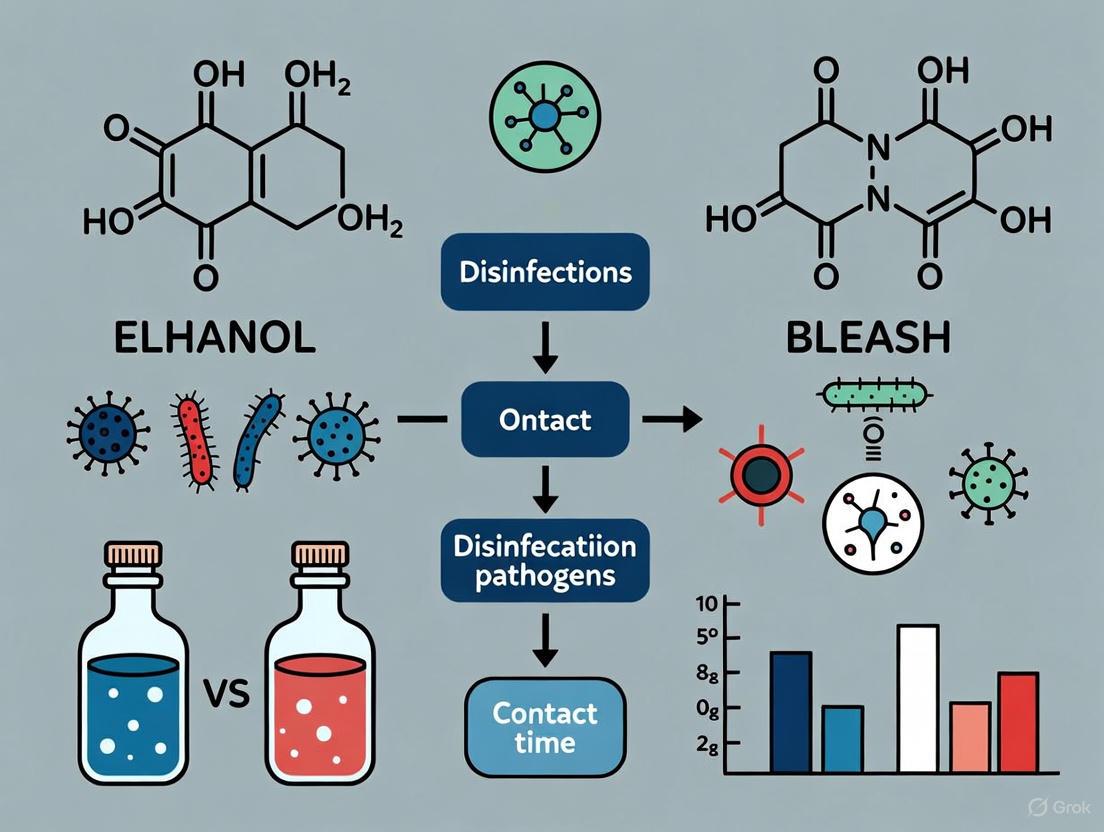
This article provides a systematic review for researchers and drug development professionals on the comparative efficacy of ethanol and sodium hypochlorite (bleach) as surface disinfectants.
Ethanol vs. Bleach: A Comprehensive Efficacy Comparison for Biomedical Disinfection
Abstract
This article provides a systematic review for researchers and drug development professionals on the comparative efficacy of ethanol and sodium hypochlorite (bleach) as surface disinfectants. It covers the foundational mechanisms of action against a spectrum of pathogens, including multidrug-resistant bacteria, spores, and viruses. Methodological considerations for application and testing in laboratory and clinical settings are detailed. The review also addresses common challenges, such as corrosion, evaporation, and organic matter interference, and explores optimization strategies like formulation enhancements. Finally, it presents a critical validation of laboratory findings against real-world performance data, offering evidence-based recommendations for selecting and using these disinfectants effectively in biomedical research and development.
Mechanisms of Action: How Ethanol and Bleach Inactivate Pathogens
Within infection control and microbial management, the efficacy of disinfectants is paramount. This guide objectively compares the antimicrobial performance of ethanol against other common disinfectants, with a particular focus on bleach (sodium hypochlorite). The evaluation is framed within a broader research thesis on disinfectant efficacy, providing researchers, scientists, and drug development professionals with a synthesized analysis of experimental data. Ethanol's action, primarily through protein denaturation and membrane disruption, represents a powerful, broad-spectrum mechanism, yet its performance varies significantly with concentration and organism type when contrasted with oxidizing agents like bleach. The following sections detail the molecular mechanisms, provide comparative efficacy data in structured tables, outline standard experimental protocols, and visualize key concepts to support laboratory research and development.
Mechanisms of Antimicrobial Action
The antimicrobial activity of ethanol is a multi-faceted process that physically and chemically compromises essential microbial structures. Its effectiveness stems from the synergistic action of several mechanisms.
Protein Denaturation: Ethanol molecules penetrate microbial cells and disrupt the tertiary and quaternary structures of proteins. They bind to hydrophobic regions of proteins, breaking the hydrogen bonds and other non-covalent interactions that maintain the protein's functional three-dimensional shape. This leads to the unfolding and coagulation of proteins, resulting in the irreversible inactivation of critical enzymes and structural components, causing metabolic collapse [1] [2].
Membrane Disruption and Lysis: The phospholipid bilayer of the cell membrane is a primary target. Ethanol acts as a lipid solvent, dissolving the membrane's lipid components. This compromises membrane integrity, increasing its fluidity and permeability. The loss of selective barrier function leads to the leakage of essential intracellular components, such as ions, nucleotides, and metabolites, and allows the uncontrolled influx of external harmful substances, rapidly accelerating cell death [1].
Cellular Dehydration: At very high concentrations (typically >80%), ethanol exerts a potent dehydrating effect. It rapidly extracts water from the microbial cell, leading to the precipitation of cytoplasmic proteins and the cessation of all metabolic activities that require an aqueous environment. It is crucial to note that this effect can be counterproductive; extremely high concentrations cause the immediate coagulation of surface proteins, potentially forming a protective layer that hinders deeper penetration of the alcohol into the cell [1].
The following diagram synthesizes these interconnected mechanisms into a coherent visual pathway of ethanol's antimicrobial action.
Comparative Efficacy Data
The theoretical mechanisms of ethanol translate into variable practical efficacy, which is best understood through direct comparison with other disinfectants like bleach across different microorganisms. The following tables consolidate quantitative experimental data to facilitate this objective comparison.
Table 1: Comparative Log Reduction of Disinfectants Against Bacterial Species
This table summarizes efficacy data from multiple studies, expressed as log reduction, a standard metric in antimicrobial testing. A 1-log reduction equals a 90% kill rate.
| Disinfectant | Concentration | Staphylococcus aureus | Pseudomonas aeruginosa | Escherichia coli | Contact Time |
|---|---|---|---|---|---|
| Ethanol | 70% (v/v) | ~5 log [3] | ~5 log [3] | ~5 log [3] | 30 sec [3] |
| Ethanol | 100% (v/v) | 10.00±1.00 mm ZOI [4] | 12.00±2.65 mm ZOI [4] | N/A | *Agar Diffusion |
| Bleach | 1% NaOCl | ~6 log [5] | ~6 log [5] | ~6 log [5] | 10 min [5] |
| Bleach | 100% (v/v) | 26.33±1.53 mm ZOI [4] | 20.67±0.58 mm ZOI [4] | N/A | *Agar Diffusion |
| H2O2 | 0.2% | ~4-5 log [6] | ~4-5 log [6] | ~4-5 log [6] | 5 min [6] |
| CHG-IPA | 2% CHG in 70% IPA | ~4.4 log [7] | N/A | N/A | 15 sec [7] |
Note: ZOI (Zone of Inhibition) in mm; method (Agar Well Diffusion) differs from log reduction studies. N/A: Data not available in the provided search results.
Table 2: Efficacy Against Fungi and Specific Experimental Conditions
Disinfectant performance can vary significantly across microbial kingdoms and is highly dependent on experimental parameters.
| Disinfectant | Concentration | Aspergillus niger (Log Reduction) | Surface Type Tested | Key Experimental Finding |
|---|---|---|---|---|
| AAHPA (Acetic Acid/H2O2/Peracetic Acid) | Not Specified | >5 log in 5 min [6] | Petri plates, Smooth, Rough | Superior efficacy on all surfaces, especially rough ones [6]. |
| Ethanol | 70-75% | Limited data; more effective against vegetative bacteria/fungi than spores [1] | Skin, Small surfaces [5] | Rapid action (seconds); ineffective against bacterial spores [1]. |
| Bleach | 0.05% NaOCl | Effective [5] | Hard Surfaces [5] | Broad-spectrum efficacy including viruses; easily inactivated by organic matter [5]. |
| Isopropyl Alcohol | 70% | N/A | Needleless Connectors [7] | No significant difference in efficacy compared to CHG-IPA or alcohol caps for NC decontamination [7]. |
Detailed Experimental Protocols
To enable replication and critical evaluation, this section outlines the standard methodologies used in the cited studies for evaluating disinfectant efficacy.
Agar Well Diffusion Assay
This common protocol was used to generate the comparative Zone of Inhibition (ZOI) data in [4].
- Bacterial Inoculation: Pure, confirmed isolates of test organisms (e.g., S. aureus, P. aeruginosa) are suspended in a sterile saline solution. The turbidity is adjusted to a standard McFarland index. A sterile swab is dipped into the suspension and used to evenly lawn the entire surface of a Mueller-Hinton agar plate.
- Well Creation: A sterile cork borer is used to punch uniform wells (approximately 6-8 mm in diameter) in the solidified inoculated agar.
- Disinfectant Application: Different concentrations (e.g., 25%, 50%, 75%, 100% v/v) of the test disinfectants (ethanol, bleach) are introduced into the respective wells, ensuring all wells are filled to the same volume.
- Incubation and Measurement: The plates are sealed and incubated at 37°C for 18-24 hours. Following incubation, the diameter of the clear zone around each well (Zone of Inhibition) is measured in millimeters using a precision caliper. The entire process is performed in multiple replicates (e.g., n=9) to ensure statistical reliability [4].
The workflow for this method is standardized, as visualized below.
Surface Decontamination and Log Reduction Study
This protocol, reflective of methods used in [6] and [7], assesses efficacy on inanimate surfaces.
- Surface Inoculation: Test surfaces (e.g., petri plates, smooth plastic, rough surfaces) are contaminated with a known concentration (e.g., 10^6-10^8 CFU/mL) of the test organism (A. niger, E. coli, S. aureus).
- Disinfectant Exposure: The disinfectant (e.g., AAHPA, 70% IPA, 10% bleach) is applied to the contaminated surface for a predetermined contact time (e.g., 0.5, 1, 5 minutes).
- Neutralization: After the contact time, a neutralizing solution (e.g., Dey-Engley neutralising broth) is used to immediately stop the action of the disinfectant. This is a critical step to avoid overestimating efficacy.
- Viable Count Analysis: The neutralized solution is serially diluted and spread-plated onto non-selective agar like Tryptic Soy Agar. Plates are incubated, and the number of surviving colony-forming units (CFU) is counted. The log reduction is calculated by comparing the CFU from the treated sample to the CFU from a positive control (inoculated but not disinfected) [6] [7].
The Scientist's Toolkit: Essential Research Reagents
This section details key materials and reagents required for conducting rigorous disinfectant efficacy research, as referenced in the experimental protocols.
Table 3: Essential Reagents for Disinfectant Efficacy Testing
| Item | Function/Description | Example Use Case |
|---|---|---|
| Dey-Engley Neutralizing Broth | A general-purpose growth medium containing multiple neutralizing agents (e.g., lecithin, sodium thiosulfate) to inactivate a wide range of disinfectants after contact time. | Critical for accurate log reduction calculations in surface decontamination studies to prevent residual disinfectant action during viability plating [7]. |
| Tryptic Soy Agar (TSA) | A general-purpose, non-selective growth medium suitable for the cultivation of a wide variety of fastidious and non-fastidious microorganisms. | Used as the primary recovery medium for viable count analysis after neutralization of disinfectants [7]. |
| Mueller-Hinton Agar (MHA) | A standardized, well-defined medium that demonstrates good batch-to-batch reproducibility, making it ideal for antimicrobial susceptibility testing. | The recommended medium for conducting agar well diffusion assays due to its reliability and consistency [4]. |
| Sterile Saline Solution (0.85-0.9%) | An isotonic solution used for diluting microbial cultures without causing osmotic shock to the cells. | Used for standardizing bacterial inoculum turbidity to a specific McFarland standard prior to inoculation [4]. |
| Ethanol (Laboratory Grade, 95-99%) | The active ingredient stock for preparing various test concentrations (e.g., 70%, 75%, 100% v/v) using sterile purified water. | Serves as the benchmark/test article for ethanol-specific efficacy studies and comparative assays [4] [1]. |
| Sodium Hypochlorite (Bleach, 5-10%) | The active ingredient stock for preparing diluted bleach solutions (e.g., 0.05%, 1%) as per manufacturer or institutional guidelines. | Serves as the benchmark/test article for bleach-specific and oxidative disinfectant efficacy studies [4] [5]. |
The synthesized data and protocols provide a clear, evidence-based comparison of ethanol and alternative disinfectants. Ethanol (70-75%) is characterized by its rapid, broad-spectrum action against vegetative bacteria and fungi, primarily through protein denaturation and membrane disruption, making it ideal for swift surface and skin decontamination where organic load is low [1] [5]. However, its inability to eradicate bacterial spores and its variable performance on rough surfaces are notable limitations [6] [1]. In contrast, bleach, as an oxidizing agent, offers broader efficacy, including against spores and viruses, and demonstrates superior performance in quantitative tests against bacteria like S. aureus and P. aeruginosa [4] [5]. Its drawbacks include corrosiveness, inactivation by organic matter, and requirement for longer contact times.
For researchers, the choice of disinfectant in a laboratory or clinical setting must be guided by the target organism, the nature of the surface, the required speed of action, and safety considerations. This analysis underscores that no single disinfectant is universally superior. Future research should focus on optimizing formulations, such as combining ethanol with other agents like chlorhexidine or peracetic acid, which can leverage synergistic effects to enhance spectrum of activity, overcome sporicidal limitations, and improve efficacy on complex surfaces [6] [7].
In the realm of microbial control, disinfectants serve as crucial tools for eradicating pathogenic microorganisms from environmental surfaces and medical equipment. The efficacy of these agents varies significantly based on their chemical composition and mechanism of action. This article objectively compares two predominant disinfectant categories: oxidizing agents represented by sodium hypochlorite (bleach) and alcohols exemplified by ethanol. While both are widely employed in clinical and research settings, their fundamental modes of action differ substantially. Bleach operates primarily through protein oxidation and chlorination, inducing irreversible damage to microbial cellular components. Ethanol, conversely, functions mainly through protein denaturation and membrane disruption. Understanding these distinct mechanisms is critical for researchers and drug development professionals when selecting appropriate disinfectants for specific applications, particularly against resilient microbial forms such as bacterial biofilms.
The comparative efficacy of these disinfectants extends beyond mere planktonic cells to complex microbial communities. Biofilms, structured aggregates of bacteria embedded in a self-produced matrix, pose significant challenges in both healthcare and industrial settings due to their enhanced resistance to antimicrobial agents. Recent investigations have revealed substantial differences in how bleach and ethanol penetrate and disrupt these complex structures, findings that carry important implications for infection control protocols and sterilization techniques in pharmaceutical manufacturing environments.
Chemical Mechanisms of Action
Bleach (Sodium Hypochlorite): Oxidative Damage and Chlorination
Sodium hypochlorite (NaClO) dissociates in water to yield hypochlorous acid (HClO), a potent oxidizing agent that serves as the primary active component responsible for microbial destruction. Hypochlorous acid is a small, uncharged molecule with remarkable membrane-penetrating capability [8]. Its antimicrobial action unfolds through three distinct yet interconnected molecular mechanisms:
Protein Oxidation: HClO irreversibly oxidizes sulfhydryl groups and disulfide bonds in microbial proteins and enzymes, disrupting essential metabolic functions including sugar metabolism by destroying bacterial phosphodehydrogenase [9]. This oxidation cascade leads to the catastrophic collapse of cellular biochemistry.
Amino Acid Chlorination: The chlorination of amino groups on proteins and peptides generates chloramines, compounds that interfere with critical cellular processes including metabolism and membrane transport [9]. This halogenation represents a unique mechanism not shared by non-chlorine-based disinfectants.
Cell Membrane Disruption: As a small, neutral molecule, HClO efficiently penetrates the microbial cell wall and membrane, targeting internal structures and causing widespread leakage of cellular contents [10]. This membrane compromise leads to rapid cell death.
The potent bactericidal activity of hypochlorite stems from this multifaceted attack on essential cellular components, resulting in irreversible damage that microbes struggle to develop resistance against.
Ethanol: Protein Denaturation and Membrane Disruption
Ethanol's disinfectant properties follow a different biochemical pathway, primarily centered on physical disruption rather than chemical alteration:
Protein Denaturation: Ethanol induces structural changes in microbial proteins by disrupting the hydrogen bonds that maintain their tertiary structure [9]. This denaturation process occurs rapidly upon contact, inactivating critical enzymes and cellular machinery.
Membrane Lipid Dissolution: As a solvent, ethanol effectively dissolves the lipid components of bacterial cell membranes and the viral envelope of many viruses [9]. This dissolution compromises membrane integrity, leading to cellular content leakage and eventual cytolysis.
Enzyme Inhibition: Through its dehydrating effect and direct interaction with active sites, ethanol inhibits numerous bacterial enzymes essential for metabolism and replication [4]. However, unlike bleach, this inhibition may be reversible in some circumstances.
A critical limitation of ethanol lies in its concentration dependence. Optimal efficacy occurs at 70-75% concentration, as higher concentrations cause rapid protein coagulation at the cell surface, potentially preventing further penetration into the cell interior [9]. This phenomenon explains why 70% ethanol often demonstrates superior bactericidal activity compared to absolute ethanol.
Table 1: Fundamental Mechanisms of Bleach versus Ethanol
| Disinfectant | Primary Mechanism | Molecular Targets | Chemical Byproducts | Cellular Consequences |
|---|---|---|---|---|
| Bleach (Sodium Hypochlorite) | Protein oxidation and chlorination | Sulfhydryl groups, amino acids, nucleotides | Chloramines, hydrochloric acid | Irreversible enzyme inactivation, metabolic disruption |
| Ethanol | Protein denaturation and membrane disruption | Hydrogen bonds, lipid bilayers | Acetaldehyde (minimal) | Membrane integrity loss, enzyme dysfunction |
Comparative Efficacy Data
Efficacy Against Planktonic Bacteria
Multiple controlled investigations have directly compared the efficacy of sodium hypochlorite and ethanol against planktonic (free-floating) bacterial forms. A comprehensive study utilizing agar well diffusion methods demonstrated that 100% (v/v) bleach concentration produced inhibition zones of 26.33±1.53 mm and 20.67±0.58 mm against Staphylococcus aureus and Pseudomonas aeruginosa, respectively [4]. In stark contrast, 100% (v/v) ethanol generated significantly smaller inhibition zones of 10.00±1.00 mm and 12.00±2.65 mm against the same organisms [4]. This substantial difference in zone size indicates superior diffusion and antimicrobial activity of bleach under identical test conditions.
The minimum inhibitory concentration (MIC) assessments further highlighted the potency differential between these disinfectants. Bleach effectively suppressed bacterial growth at concentrations as low as 50% (v/v) for both test organisms, whereas ethanol failed to achieve complete inhibition even at full concentration against some bacterial strains [4]. This fundamental efficacy gap underscores bleach's robust antimicrobial properties against planktonic bacteria in standardized laboratory conditions.
Efficacy Against Bacterial Biofilms
The performance disparity between bleach and ethanol becomes even more pronounced when confronting bacterial biofilms—structured communities of microorganisms embedded in a protective matrix that exhibit significantly enhanced resistance to antimicrobial agents. A seminal 2018 study published in the American Journal of Infection Control specifically evaluated this scenario, revealing that 0.6% sodium hypochlorite demonstrated significantly superior efficacy (P = 0.004) against biofilm populations of Staphylococcus aureus clinical isolates compared to 70% ethanol [11].
Scanning electron microscopy (SEM) examinations provided visual evidence of the disruptive power of bleach, showing that sodium hypochlorite induced "significant formation of craters and irregular depressions" on the surface of strong biofilm formers [11]. These structural deformations indicate extensive matrix degradation and cellular damage at the ultrastructural level. Notably, the study found no significant difference in the activity of either disinfectant against strong versus weak biofilm formers, suggesting that bleach maintains its effectiveness regardless of biofilm maturation level [11].
Table 2: Quantitative Comparison of Disinfectant Efficacy Against Planktonic vs. Biofilm States
| Bacterial State | Disinfectant | Concentration | Efficacy Metric | Result | Study |
|---|---|---|---|---|---|
| Planktonic S. aureus | Sodium Hypochlorite | 100% (v/v) | Zone of Inhibition | 26.33±1.53 mm | [4] |
| Planktonic S. aureus | Ethanol | 100% (v/v) | Zone of Inhibition | 10.00±1.00 mm | [4] |
| Planktonic P. aeruginosa | Sodium Hypochlorite | 100% (v/v) | Zone of Inhibition | 20.67±0.58 mm | [4] |
| Planktonic P. aeruginosa | Ethanol | 100% (v/v) | Zone of Inhibition | 12.00±2.65 mm | [4] |
| Biofilm S. aureus | Sodium Hypochlorite | 0.6% | Colony Forming Unit Reduction | Significantly superior (P=0.004) | [11] |
| Biofilm S. aureus | Ethanol | 70% | Colony Forming Unit Reduction | Less effective than hypochlorite | [11] |
Experimental Protocols and Methodologies
Biofilm Susceptibility Testing
The comparative assessment of disinfectant efficacy against bacterial biofilms requires standardized methodologies to ensure reproducible and meaningful results. The following protocol, adapted from the 2018 study published in the American Journal of Infection Control, details the essential steps for evaluating bleach and ethanol against biofilm-forming microorganisms [11]:
Biofilm Cultivation: Inoculate 1×10^8 CFU/mL of test organisms (e.g., Staphylococcus aureus clinical isolates) in 96-well flat-bottom polystyrene tissue culture plates. Incubate for 48 hours at 37°C to facilitate biofilm formation. Replace growth media every 24 hours to maintain nutrient availability while preventing overgrowth of planktonic cells.
Biofilm Confirmation: After incubation, carefully remove planktonic cells by washing each well three times with sterile phosphate-buffered saline (PBS; pH 7.2-7.4). Fix a representative subset of wells with 2.5% glutaraldehyde for scanning electron microscopy analysis to visually confirm biofilm architecture and density prior to disinfectant exposure.
Disinfectant Exposure: Prepare fresh dilutions of test disinfectants - 0.6% sodium hypochlorite and 70% ethanol in sterile distilled water. Apply 200μL of each disinfectant to the pre-washed biofilm wells. Include positive controls (biofilm without disinfectant) and negative controls (sterile medium only). Incubate at room temperature for specified contact intervals (typically 1-30 minutes based on experimental objectives).
Viability Assessment: Following disinfectant exposure, carefully aspirate test solutions and neutralize any residual disinfectant activity using appropriate neutralizing agents (e.g., sodium thiosulfate for bleach). Detach biofilm-associated cells using ultrasonic vibration or mechanical scraping. Serially dilute the resulting suspension in sterile PBS and plate on appropriate agar media. Enumerate viable colonies after 24-48 hours of incubation at 37°C.
Data Analysis: Calculate disinfectant efficacy by comparing CFU counts from treated samples against untreated controls. Express results as log reduction values. Perform appropriate statistical analyses (e.g., Student's t-test, ANOVA) to determine significant differences between disinfectant treatments.
Agar Well Diffusion Assay
For comparative assessment against planktonic bacteria, the agar well diffusion method provides a reliable and straightforward approach [4]:
Inoculum Preparation: Adjust turbidity of overnight bacterial cultures (e.g., Staphylococcus aureus and Pseudomonas aeruginosa) to 0.5 McFarland standard (approximately 1×10^8 CFU/mL) in sterile saline.
Agar Plating: Aseptically swab the standardized inoculum evenly over the entire surface of Mueller-Hinton agar plates. Allow the inoculum to dry for 5-15 minutes under laminar flow.
Well Preparation: Using sterile cork borers or pipette tips, create 6-8mm diameter wells in the inoculated agar plates. Space wells adequately (approximately 24mm between centers) to prevent overlapping zones of inhibition.
Disinfectant Application: Pipette fixed volumes (typically 50-100μL) of test disinfectants at various concentrations (e.g., 25%, 50%, 75%, 100% v/v) into respective wells. Include appropriate positive and negative controls.
Incubation and Measurement: Allow plates to stand for approximately 30 minutes at room temperature for disinfectant diffusion, then incubate at 37°C for 18-24 hours. Measure zones of inhibition (including well diameter) to the nearest millimeter using calipers or a ruler.
The Researcher's Toolkit: Essential Reagents and Materials
Table 3: Essential Research Reagents for Disinfectant Efficacy Studies
| Reagent/Material | Specifications | Research Application | Key Considerations |
|---|---|---|---|
| Sodium Hypochlorite | 0.6% working concentration; Pharmaceutical grade | Primary test disinfectant for oxidative mechanisms | Must prepare fresh daily; Concentration verified by iodometric titration |
| Ethanol | 70-75% v/v in distilled water; USP grade | Reference disinfectant for alcohol-based comparisons | Denatured ethanol avoided to prevent confounding effects |
| Biofilm-Producing Strains | Clinical isolates with characterized biofilm formation (e.g., S. aureus ATCC 35556) | Substrate for disinfectant challenge assays | Include both strong and weak biofilm formers for comparative analysis |
| Cell Culture Plates | 96-well, flat-bottom with low evaporation lids | Biofilm cultivation platform | Polystyrene surface with tissue culture treatment enhances adhesion |
| Neutralizing Buffer | 0.5% sodium thiosulfate in D/E Neutralizing Broth | Quenching residual disinfectant activity after exposure | Validation required to confirm neutralization without toxic effects |
| Scanning Electron Microscopy (SEM) | Fixation in 2.5% glutaraldehyde; Critical point drying | Ultrastructural analysis of disinfectant damage | Provides visual evidence of matrix disruption and cellular damage |
Research Implications and Future Directions
The compelling experimental evidence demonstrating sodium hypochlorite's superior efficacy against both planktonic and biofilm states of pathogenic bacteria carries significant implications for disinfection protocols in research laboratories and pharmaceutical manufacturing environments. The findings suggest that bleach should be prioritized in scenarios where biofilm contamination is suspected or confirmed, particularly on environmental surfaces and processing equipment where microbial persistence poses contamination risks [11]. Ethanol remains valuable for applications requiring rapid evaporation and where corrosion concerns limit bleach usage, but researchers should recognize its limitations against structured microbial communities.
Future research directions should explore the molecular basis of bleach's enhanced antibiofilm activity, particularly its interaction with extracellular polymeric substance (EPS) components. Additionally, investigations into combination approaches utilizing sequential or simultaneous application of oxidative and alcoholic disinfectants might reveal synergistic effects, though researchers must heed warnings about generating toxic chlorine gas when mixing bleach with alcohol-based formulations [12]. Such chemical incompatibilities underscore the importance of understanding disinfectant chemistry in research settings where multiple agents are routinely employed.
The structural damage visualized through scanning electron microscopy—specifically the "craters and irregular depressions" on bleach-treated biofilms—provides a striking visual representation of oxidative disruption at the microbial level [11]. These morphological changes offer researchers tangible evidence of mechanism efficacy that complements quantitative culture-based assessments. As disinfectant research evolves, such multimodal verification approaches will continue to strengthen the scientific foundation of microbial control strategies in research and development environments.
The emergence of viral infectious diseases and the persistent threat of bacterial contamination pose severe public health challenges worldwide [13]. Within healthcare settings and community environments, effective disinfection remains a critical intervention strategy for breaking the chain of infection transmission. This guide provides a systematic comparison of two widely used disinfectant categories: ethanol and bleach (sodium hypochlorite). The evaluation is framed around their distinct spectra of activity against enveloped viruses, non-enveloped viruses, and bacteria, supported by experimental data and mechanistic insights. Understanding the efficacy profiles and limitations of these disinfectants enables researchers, scientists, and drug development professionals to make evidence-based decisions for infection control protocols and product development [14] [15].
Mechanisms of Action
Ethanol
Ethanol primarily functions as a protein denaturant and lipid solvent. Against enveloped viruses, its efficacy is high because it effectively dissolves the lipid bilayer envelope, causing structural disassembly and inactivation of the virus particle [13]. For bacteria, ethanol disrupts cellular membranes and denatures essential proteins [15]. However, its action against non-enveloped viruses is more limited, as these viruses lack a lipid envelope and possess protein capsids that are more resistant to ethanol's effects [16]. Higher concentrations and longer contact times are required to denature the robust protein structures of non-enveloped viruses [13].
Bleach (Sodium Hypochlorite)
Sodium hypochlorite, the active component in bleach, is a powerful oxidizing agent. It inactivates microorganisms by irreversibly oxidizing sulfhydryl groups in enzymes and proteins, destroying their functional integrity [17]. It also damages nucleic acids, preventing replication [15]. This broad mechanism of action makes it highly effective against a wide spectrum of pathogens, including resilient non-enveloped viruses and bacterial spores [15] [17]. Its efficacy, however, can be reduced in the presence of high organic load, which can consume the available chlorine [17].
Quantitative Efficacy Comparison
The following tables summarize the experimental data on the efficacy of ethanol and bleach against different pathogen classes, based on suspension tests.
Table 1: Efficacy of Ethanol Against Pathogens
| Pathogen Class | Specific Examples | Effective Concentration | Contact Time | Log10 Reduction | Key Notes |
|---|---|---|---|---|---|
| Enveloped Viruses | SARS-CoV-2, Influenza virus, HIV [13] [14] | ≥35% - 80% [13] [14] | ≥30 seconds - 1 min [13] [14] | ≥4 log10 [13] [14] | Highly effective at relatively low concentrations. |
| Non-enveloped Viruses | Adenovirus type 5, Murine Norovirus (MNV) [13] [14] | 70% - 90% [14] | 30 seconds - 1 min [14] | ≥4 log10 [14] | Susceptibility varies by virus type. |
| Poliovirus, Feline Calicivirus (FCV), Hepatitis A Virus (HAV) [14] | ≥95% [14] | ≥1 - 5 min [14] | Often insufficient at lower concentrations [14] | Highly resistant; may require additives (e.g., acids) for effective inactivation [14]. | |
| Bacteria (Non-spore-forming) | E. coli, S. aureus, P. aeruginosa [18] | 60% - 80% [15] | 30 seconds - 1 min | ≥4 log10 (inferred) | Considered broadly effective. |
| Bacterial Spores | Clostridioides difficile [15] | 70% - 80% | 30 seconds - 10 min | Minimal (e.g., 0.2 log10 in 30 min) [15] | Not considered an effective sporicide. |
Table 2: Efficacy of Bleach (Sodium Hypochlorite) Against Pathogens
| Pathogen Class | Specific Examples | Effective Concentration | Contact Time | Log10 Reduction | Key Notes |
|---|---|---|---|---|---|
| Enveloped Viruses | SARS-CoV-2 [19] | ~0.1% (1000 ppm) [15] | 1 min (inferred) | Effective (specific LRV varies) | Broadly effective, but specific log reduction data for enveloped viruses was less prominent in the search results. |
| Non-enveloped Viruses | Poliovirus [17] | 0.52% - 0.63% (5200-6300 ppm) [17] | 1 - 2 min [17] | 6 - >10 log10 [17] | Highly effective even against the most resistant viruses; efficacy depends on concentration and organic load. |
| Bacteria (Non-spore-forming) | E. coli, S. aureus [18] | ~0.1% (1000 ppm) [15] | 1 min (inferred) | Effective (specific LRV varies) | Considered broadly effective. |
| Bacterial Spores | Clostridioides difficile [15] | 0.26% - 1% Peracetic Acid / Glutaraldehyde [15] | 5 - 20 min [15] | >4 log10 [15] | High-concentration chlorine-based disinfectants are recommended for sporicidal activity [15]. |
Key Experimental Protocols
To ensure reproducibility and validate efficacy claims, it is essential to understand standard testing methodologies.
European Standard EN 14476 for Virucidal Activity
This quantitative suspension test is a benchmark for evaluating virucidal activity in the European Union [14] [16].
- Procedure: A mixture of the disinfectant product, an interfering substance (like bovine serum albumin to simulate organic matter), and the virus suspension is incubated for a specified contact time (e.g., 30 seconds, 1 minute) at a defined temperature [16]. The reaction is halted by adding a neutralizing broth (e.g., Dey-Engley broth) [16]. The remaining infectious viral titer is quantified using cell culture-based assays, such as plaque assay or the 50% tissue culture infectious dose (TCID50) method [13] [16].
- Analysis: The log10 reduction value (LRV) is calculated by comparing the viral titer before and after treatment. A product is considered sufficiently effective if it achieves a ≥4 log10 reduction (a 99.99% reduction in infectivity) under the test conditions [14].
Surface Decontamination Test for Bleach
This test evaluates efficacy on inanimate surfaces, which is critical for fomite transmission control.
- Procedure: A high-titer virus suspension, potentially with added protein load, is dried onto representative surfaces (e.g., plastic, stainless steel) [17]. The disinfectant is applied for the specified contact time. For high-level inactivation, a protocol involving two 1-minute treatments, 5 minutes apart, has been demonstrated to achieve a >10 log10 reduction of poliovirus [17].
- Analysis: The virus is recovered from the surface after treatment, neutralized, and titrated to determine the remaining infectious particles and calculate the LRV [17].
Visualizing Disinfectant Selection and Mechanism
The following diagrams illustrate the decision pathway for selecting a disinfectant based on the target pathogen and the synergistic mechanism of an enhanced ethanol formulation.
Decision Workflow for Disinfectant Selection
Enhanced Ethanol Inactivation Mechanism
The Scientist's Toolkit: Essential Research Reagents
This table outlines key reagents and materials required for conducting disinfectant efficacy tests, as referenced in the cited studies.
Table 3: Key Research Reagents for Disinfectant Efficacy Testing
| Reagent / Material | Function / Purpose | Example Usage in Protocols |
|---|---|---|
| Ethanol (Absolute) | Active ingredient; diluted to required concentrations (e.g., 70%, 80%, 95%) for testing [13] [16]. | Used as the primary virucidal agent in suspension tests [13]. |
| Sodium Hypochlorite | Active ingredient; diluted to specific concentrations (e.g., 0.1%, 0.5%) from commercial bleach stocks [17]. | Used for surface decontamination tests against resistant viruses like poliovirus [17]. |
| Bovine Serum Albumin (BSA) | Interfering substance; simulates the presence of organic matter (e.g., blood, soil) that can impact disinfectant efficacy [16]. | Added to the test suspension in EN 14476 protocol to create "dirty conditions" [16]. |
| Dey-Engley (D/E) Neutralizing Broth | Neutralizing agent; stops the disinfectant's action at the end of the contact time to allow accurate titration of surviving microbes [16]. | Used to quench the reaction after the exposure time in virucidal tests [16]. |
| Cell Lines (e.g., HeLa, CRFK) | Host systems for propagating viruses and quantifying infectious viral titer post-treatment via cytopathic effect (CPE) [16]. | Used in TCID50 and plaque assays to measure infectivity [16]. |
| Acid Additives (e.g., Citric Acid) | Synergistic agent; enhances the efficacy of ethanol against resistant non-enveloped viruses by lowering pH and destabilizing capsids [14] [16]. | Formulated with ethanol and urea to create a more effective virucidal solution [16]. |
The comparative analysis reveals a clear spectrum of activity for both ethanol and bleach. Ethanol excels as a fast-acting, user-acceptable disinfectant against enveloped viruses and most common bacteria at concentrations of 60-80% [13] [14] [18]. Its major limitation is its variable and often inadequate efficacy against non-enveloped viruses and bacterial spores [14] [15]. This weakness can be mitigated by formulating ethanol with synergistic agents like citric acid and urea, which enhance capsid disruption [16], or by using it at very high concentrations (≥95%), though this impacts user acceptability [14].
In contrast, bleach is a broad-spectrum powerhouse, capable of inactivating the most resistant pathogens, including non-enveloped viruses like poliovirus and bacterial spores, provided appropriate concentrations (e.g., >0.5%) and contact times are used [15] [17]. Its drawbacks include corrosiveness, potential for generating toxic fumes, and susceptibility to inactivation by organic matter [15] [17].
In conclusion, the selection between ethanol and bleach is not a matter of superiority but of application-specific suitability. Ethanol-based formulations are ideal for hand hygiene and rapid surface disinfection where user safety and compliance are paramount, and the target pathogens are primarily enveloped. Bleach-based disinfectants are indispensable for outbreak control of hardy non-enveloped viruses, for decontaminating surfaces in high-risk medical settings, and for ensuring sporicidal activity. Future research will continue to optimize formulations, such as ethanol with synergistic additives, to broaden the spectrum of activity while maintaining safety and practicality [16] [15].
Disinfectant efficacy varies significantly across microbial groups, with bacterial spores and certain fungi presenting formidable challenges to chemical inactivation. This guide provides a comparative analysis of ethanol and bleach, focusing on their limitations against resilient microorganisms. Experimental data confirm that while bleach (sodium hypochlorite) demonstrates superior sporicidal and fungicidal activity when properly formulated and applied, ethanol-based formulations show limited efficacy against these targets despite their broad-spectrum activity against vegetative bacteria and enveloped viruses. Understanding these limitations is crucial for researchers and drug development professionals in selecting appropriate disinfectants for specific applications and developing enhanced formulations to overcome current constraints.
Bacterial spores and certain fungal species represent the most disinfectant-resistant forms of microorganisms, necessitating specialized approaches for effective inactivation. Bacterial spores, such as those produced by Clostridioides difficile and Bacillus species, possess complex multilayer structures that prevent disinfectant penetration and protect core genetic material [15]. Similarly, fungi including Aspergillus niger and Cryptococcus neoformans exhibit intrinsic resistance to many disinfectants due to their chitin-containing cell walls and structural adaptations [15]. This resilience poses significant challenges in healthcare, pharmaceutical manufacturing, and research laboratories where effective decontamination is critical.
The disinfectants most commonly employed against these resilient microorganisms include chlorine-based compounds like sodium hypochlorite (bleach) and alcohols, primarily ethanol and isopropyl alcohol. While both categories have broad antimicrobial applications, their efficacy against spores and fungi differs substantially. This article provides a systematic comparison of ethanol and bleach, focusing on their limitations and effectiveness against these challenging microorganisms, supported by experimental data and mechanistic insights to guide appropriate selection and application in research and development contexts.
Mechanisms of Action and Resistance
Understanding the fundamental mechanisms of disinfectant action and microbial resistance is prerequisite to evaluating efficacy limitations against bacterial spores and fungi.
Disinfectant Mechanisms of Action
Ethanol primarily exerts its antimicrobial effect through protein denaturation and membrane disruption. The presence of water in alcohol solutions (typically 60-90%) facilitates protein denaturation by allowing better penetration into microorganisms [20]. Ethanol effectively disrupts cellular membranes, leading to rapid cell lysis. However, its action is primarily surface-level, lacking the ability to penetrate complex protective structures.
Bleach (sodium hypochlorite) functions through oxidation of cellular components. The primary active agent, hypochlorous acid (HOCl), chlorinates amino acids and other vital cellular structures, leading to irreversible damage [21]. This oxidative mechanism enables bleach to degrade a wider range of cellular targets compared to alcohol, including more resistant structures.
Microbial Resistance Mechanisms
Figure 1: Microbial Resistance Mechanisms. Bacterial spores employ multilayer physical barriers and chemical protection, while fungi utilize structural and adaptive resistance mechanisms.
Bacterial spores employ multiple protection strategies that confer exceptional disinfectant resistance. Their complex structure includes a cortex, coat, and sometimes exosporium that physically block disinfectant penetration [15]. Additionally, spores contain dipicolinic acid (DPA) and small acid-soluble spore proteins (SASPs) that protect DNA from damage [21]. Core dehydration and efficient DNA repair mechanisms further enhance resistance, allowing survival against chemical disinfectants that rapidly kill vegetative cells [15].
Fungal resilience stems from structural and biochemical adaptations. The fungal cell wall, composed of chitin, glucans, and glycoproteins, provides a robust physical barrier against disinfectants [15]. Some fungi produce melanin and other pigments that confer additional protection against chemical agents. Dimorphism (the ability to switch between yeast and mold forms) enhances environmental adaptability and complicates disinfection protocols [15].
Comparative Efficacy Data
Efficacy Against Bacterial Spores
Table 1: Comparative Sporicidal Efficacy of Ethanol and Bleach
| Disinfectant | Concentration | Contact Time | Test Organism | Log Reduction | Reference |
|---|---|---|---|---|---|
| Ethanol | 70% | 30 minutes | C. difficile | 0.2 log | [15] |
| Isopropyl Alcohol | 70% | 30 minutes | C. difficile | 0.2 log | [15] |
| Sodium Hypochlorite | 6,500 ppm | 1 minute | C. difficile | Variable (0.28-≥4 log)* | [22] |
| Sodium Hypochlorite | 6,500 ppm | 3 minutes | C. difficile | >4 log (all isolates) | [22] |
| Sodium Hypochlorite | 5,000 ppm (pH 7.0) | 10 minutes | B. cereus | 4-5 log | [21] |
| Sodium Hypochlorite | 5,000 ppm (pH 11.9) | 10 minutes | B. cereus | <1 log | [21] |
*Reduction varied by isolate at 1 minute, with 5 of 18 isolates showing <4 log reduction
Experimental data consistently demonstrate the limitation of ethanol against bacterial spores. A 30-minute exposure to 70% ethanol or isopropyl alcohol achieved only 0.2-log reduction of C. difficile spores, indicating minimal sporicidal activity [15]. In contrast, sodium hypochlorite at 6,500 ppm achieved a >4-log reduction of all 18 environmental C. difficile isolates tested, but only when applied for the full recommended 3-minute contact time [22]. Notably, efficacy after 1-minute exposure varied significantly between isolates, highlighting the importance of adhering to recommended contact times.
The critical role of pH in hypochlorite efficacy is demonstrated by the dramatic difference in sporicidal activity against B. cereus at different pH levels. While 5,000 ppm hypochlorite at pH 7.0 achieved 4-5 log reduction in 10 minutes, the same concentration at pH 11.9 (typical of diluted household bleach) showed less than 1-log reduction, emphasizing that unadjusted bleach solutions have limited sporicidal efficacy [21].
Efficacy Against Fungi
Table 2: Comparative Fungicidal Efficacy Against Resistant Fungi
| Disinfectant | Concentration | Contact Time | Test Organism | Efficacy Outcome | Reference |
|---|---|---|---|---|---|
| Ethanol | 70% | Not specified | A. niger, C. neoformans | Limited efficacy | [15] |
| Sodium Hypochlorite | 1-5% | Not specified | Fungi (general) | Recommended | [15] |
| Acetic Acid/H₂O₂/Peracetic Acid | 2.65%/3%/0.1% | 5 minutes | A. niger | Superior performance | [23] |
| Isopropyl Alcohol | 70% | 5 minutes | A. niger | Lower efficacy | [23] |
| Sodium Hypochlorite | 10% | 5 minutes | A. niger | Intermediate efficacy | [23] |
Ethanol demonstrates limited efficacy against resilient fungi such as A. niger and C. neoformans due to their protective cellular structures [15]. Comparative studies show that a formulation containing acetic acid, hydrogen peroxide, and peracetic acid (AAHPA) achieved significantly higher log reduction against A. niger on petri plates in 5 minutes compared to conventional disinfectants including 70% isopropyl alcohol and 10% sodium hypochlorite [23]. On smooth and rough surfaces, AAHPA exhibited exceptional efficacy, demonstrating the highest log and percentage reduction against A. niger at 0.5, 1, and 5-minute intervals, surpassing other disinfectants [23].
The Centers for Disease Control and Prevention (CDC) recommends specific disinfectants for fungi, including ≥2% aqueous solutions of glutaraldehyde, 0.5% accelerated hydrogen peroxide, 200-500 ppm peracetic acid, or 1-5% sodium hypochlorite, notably excluding alcohol-based formulations as first-line choices for fungal decontamination [15].
Experimental Protocols and Methodologies
Standard Quantitative Carrier Disk Test Method
The American Society for Testing and Materials (ASTM) Standard Quantitative Carrier Disk Test Method (ASTM E-2197-02) provides a validated approach for evaluating disinfectant efficacy against bacterial spores [22]. This protocol involves:
- Spore Preparation: Spores are harvested from cultured organisms and purified through centrifugation and washing steps to remove vegetative cells and debris.
- Carrier Inoculation: Sterile carrier disks (typically stainless steel) are inoculated with a standardized spore suspension (e.g., 10-100 μL containing ~10⁶ spores).
- Disinfectant Application: A specified volume of disinfectant is applied to inoculated carriers to ensure complete coverage.
- Neutralization: After predetermined contact times, disinfectant action is halted by transferring carriers to neutralizer solution.
- Viability Assessment: Neutralized samples are serially diluted, plated on appropriate media, and incubated for colony counting.
- Log Reduction Calculation: Reduction in viability is calculated by comparing test results to untreated controls.
This method was employed in testing sodium hypochlorite (6,500 ppm) against environmental C. difficile isolates, demonstrating the importance of complete contact time for effective spore elimination [22].
Modified Quantitative Surface Disinfection Test
For evaluating disinfectant efficacy on various surfaces, a modified quantitative surface disinfection test can be applied [23]. This methodology includes:
- Surface Preparation: Representative smooth (e.g., stainless steel) and rough (e.g., flooring material) surfaces are sterilized before testing.
- Surface Contamination: Surfaces are inoculated with standardized microbial suspensions (e.g., 100 μL containing ~10⁶ CFU/mL).
- Disinfectant Application: Test disinfectants are applied to contaminated surfaces according to manufacturer instructions.
- Contact Time Variation: Multiple contact times (e.g., 0.5, 1, and 5 minutes) are tested to establish time-dependent efficacy.
- Microbial Recovery: After contact time, surviving microorganisms are recovered using neutralizer solutions and surface scraping.
- Quantification: Recovered suspensions are serially diluted, plated, and incubated for colony counting.
- Efficacy Calculation: Log reduction values are calculated by comparing test results to untreated contaminated controls.
This approach was used to demonstrate the superior performance of AAHPA formulation against A. niger on different surface types compared to conventional disinfectants including 70% isopropyl alcohol and 10% sodium hypochlorite [23].
Research Reagent Solutions
Table 3: Essential Research Reagents for Disinfectant Efficacy Testing
| Reagent/Equipment | Function/Application | Example Use |
|---|---|---|
| Sodium Hypochlorite Solutions | Chlorine-based disinfectant testing | Sporicidal efficacy studies at various concentrations (500-6,500 ppm) [22] [21] |
| Ethanol/Isopropanol Solutions | Alcohol-based disinfectant controls | Efficacy comparison against spores and fungi [15] [23] |
| Neutralizer Solutions (e.g., 0.03% sodium thiosulfate) | Quenching disinfectant activity after contact time | Preventing continued antimicrobial action during viability assessment [23] |
| Calcium Dipicolinic Acid (CaDPA) | Spore germination and resistance studies | Mechanism of action investigations [21] |
| Sabouraud Dextrose Agar (SDA) | Fungal culture and enumeration | Antifungal efficacy testing [23] |
| Tryptic Soy Agar (TSA) | Bacterial culture and enumeration | Bactericidal and sporicidal efficacy testing [23] |
| American Type Culture Collection (ATCC) Strains | Standardized reference microorganisms | A. niger ATCC 16888, E. coli ATCC 25922, S. aureus ATCC 6538 [23] |
The comparative analysis of ethanol and bleach reveals significant limitations in ethanol-based formulations against bacterial spores and resilient fungi, while bleach demonstrates substantially greater efficacy when properly formulated and applied. Critical factors influencing bleach efficacy include concentration (≥1,000 ppm for spores), contact time (≥3 minutes for C. difficile), and pH adjustment (optimal ~7.0-9.5 for sporicidal activity). Ethanol's rapid evaporation, poor spore penetration, and limited fungicidal activity restrict its application against these resistant microorganisms.
These findings have important implications for research and drug development settings where effective decontamination is paramount. Selection of appropriate disinfectants should be guided by target microorganisms rather than assuming broad-spectrum efficacy. For environments with potential spore or fungal contamination, bleach-based formulations with proper pH optimization or specialized sporicides like peroxygen compounds represent more reliable choices than alcohol-based disinfectants. Future research should focus on enhancing ethanol formulations with synergistic additives and optimizing bleach stability and efficacy through pH modification and stabilization technologies.
Practical Application: Effective Use in Laboratory and Clinical Settings
In laboratory research, pharmaceutical development, and clinical settings, the selection and application of surface disinfectants are critical for maintaining aseptic conditions and ensuring experimental integrity. Among the myriad of available agents, ethanol and bleach (sodium hypochlorite) stand as two of the most widely utilized and studied disinfectants. The efficacy of these compounds is not merely a function of their inherent antimicrobial properties but is profoundly influenced by their precise concentration, which dictates their mechanism of action and overall biocidal performance. This guide provides a detailed, evidence-based comparison of 70% ethanol and 0.5-10% bleach solutions, framing them within the context of disinfectant efficacy research for scientists and drug development professionals. The optimal concentrations of these agents represent a critical balance between maximum microbial lethality and practical considerations such as material compatibility, operator safety, and stability.
Understanding the science behind these specific concentration ranges is fundamental for establishing robust disinfection protocols in research laboratories, cleanrooms, and production facilities. This document synthesizes current research findings and experimental data to objectively compare the performance of these disinfectants against various microbial challenges, providing a scientific foundation for their application in controlled environments.
Comparative Efficacy Data: Quantitative Analysis
The antimicrobial efficacy of ethanol and bleach varies significantly across different microbial groups. The following tables summarize key experimental data and performance metrics from recent studies, providing a quantitative basis for comparison.
Table 1: Microbial Efficacy Profiles of Ethanol and Bleach
| Microbial Target | 70% Ethanol Efficacy | 0.5% Bleach Efficacy | Key Research Findings |
|---|---|---|---|
| Gram-positive Bacteria (e.g., S. aureus) | Effective [20] | Effective [24] | Ethanol is bactericidal; 60-95% concentrations kill in 10 seconds [20]. |
| Gram-negative Bacteria (e.g., E. coli, P. aeruginosa) | Effective [20] [15] | Effective [24] | 70% ethanol effective against P. aeruginosa and E. coli in 10 seconds [20]. |
| Mycobacterium tuberculosis | Effective (Tuberculocidal) [20] | Effective [25] | 70% isopropanol killed tubercle bacilli in 5 minutes in mucin-loop test [20]. |
| Enveloped Viruses (e.g., HIV, Influenza, SARS-CoV-2) | Highly Effective [20] [15] | Highly Effective [19] [26] | Alcohols disrupt lipid envelopes; effective against H1N1 influenza [15]. |
| Non-enveloped Viruses (e.g., Adenovirus, Norovirus) | Limited/Moderate Efficacy [20] [15] | Highly Effective [20] [25] | Ethanol more effective than IPA against non-enveloped viruses like adenovirus [15]. |
| Fungal Spores (e.g., C. neoformans) | Effective [20] [15] | Effective [15] | 70% ethanol effective against tissue phase of C. neoformans [20]. |
| Bacterial Spores (e.g., C. difficile) | Not Effective [15] [27] | Effective at higher concentrations (5-10%) [15] | 70% ethanol resulted in only 0.2-log reduction of C. difficile spores [15]. |
Table 2: Key Parameters and Practical Considerations
| Parameter | 70% Ethanol | 0.5-10% Bleach |
|---|---|---|
| Optimal Concentration Range | 60-90% (v/v) in water [20] | 0.5% for general bactericidal; 5-10% for sporicidal [15] [24] |
| Typical Contact Time | 10 seconds to 5 minutes (varies by organism) [7] [20] | 30 seconds to 10 minutes (varies by organism and concentration) [24] [25] |
| Mechanism of Action | Protein denaturation, membrane disruption [20] [27] | Oxidative damage to proteins, lipids, and nucleic acids [20] |
| Impact of Organic Matter | Moderately affected | Highly inactivated; pre-cleaning required [20] |
| Material Corrosiveness | Low (can damage some plastics and rubber) [20] | High, especially at higher concentrations [20] |
| Stability | Evaporates rapidly; stable if sealed [20] [15] | Degrades over time; requires fresh preparation [20] |
| Toxicity Concerns | Flammable; minimal residue [20] | Respiratory irritant; can form toxic gases if mixed improperly [20] [28] |
Experimental Protocols and Methodologies
Efficacy Testing of 0.5% Sodium Hypochlorite
A 2025 study evaluating the efficacy of sodium hypochlorite at a hospital burn unit provides a robust methodological framework for bleach testing [24].
- Surface Sampling: Researchers collected samples from high-touch surfaces (benches, door handles, sinks, trolleys) using sterile cotton swabs moistened with normal saline. Both pre- and post-disinfection samples were taken.
- Disinfection Protocol: Surfaces were disinfected with a 5% sodium hypochlorite solution, which was diluted to 0.5% for laboratory testing. A 30-minute contact time was used in the routine disinfection protocol.
- Microbiological Analysis: Samples were processed via serial dilution and plated on Plate Count Agar (PCA) and Blood Agar (BA). Colonies were enumerated after incubation at 37°C for 24 hours.
- Organism Identification: Isolates were identified using Gram staining and biochemical tests (catalase, coagulase, oxidase). The MINIBACT-E system was used for Gram-negative rods.
- Susceptibility Testing: The Kirby-Bauer method was employed to test bacterial susceptibility to sodium hypochlorite, determining the Minimum Inhibitory Concentration (MIC) and Minimum Bactericidal Concentration (MBC) using the broth dilution method.
- Key Finding: The study confirmed that a properly prepared 0.5% sodium hypochlorite solution was effective against all isolated organisms, including Staphylococcus aureus, Pseudomonas spp., and Klebsiella pneumoniae [24].
Efficacy Testing of 70% Ethanol and Enhanced Formulations
Recent research has detailed both standard and novel methodologies for evaluating alcohol-based disinfectants.
- Standard Efficacy Testing: The bactericidal activity of ethanol is often tested against representative organisms like Staphylococcus aureus and Pseudomonas aeruginosa. A classic study demonstrated that 60-95% ethyl alcohol concentrations killed these pathogens in just 10 seconds [20].
- Time-Dependent Viability Assays: A 2025 study on salt-enhanced alcohol disinfectants used time-dependent viability assays to measure activity against a broad spectrum of pathogens, including MRSA, E. coli, C. difficile spores, H1N1 influenza, adenovirus, Aspergillus niger, and Cryptococcus neoformans [15].
- Surface Material Testing: The same study evaluated the biocidal activity of formulated disinfectants on different surfaces, including plastics, stainless steel, and glass, after spraying, to simulate real-world application [15].
- Key Finding: While 70% ethanol is highly effective against vegetative bacteria and enveloped viruses, it has limited efficacy against bacterial spores (e.g., a 30-minute exposure to 70% ethanol resulted in only a 0.2-log reduction of C. difficile spores) [15].
Mechanisms of Action: A Molecular Workflow
The disinfectant action of ethanol and bleach operates through distinct biochemical pathways. The following diagrams visualize these mechanisms and a general experimental workflow for evaluating disinfectant efficacy.
Diagram 1: Mechanism of 70% Ethanol
Diagram 2: Mechanism of 0.5-10% Bleach
Diagram 3: Disinfectant Efficacy Testing Workflow
The Scientist's Toolkit: Essential Research Reagents
Selecting appropriate reagents and materials is fundamental to designing disinfectant efficacy studies and implementing validated protocols.
Table 3: Essential Reagents for Disinfectant Efficacy Research
| Reagent/Material | Function in Research | Application Note |
|---|---|---|
| Sodium Hypochlorite (5-6% stock) | Source for preparing diluted bleach solutions; broad-spectrum efficacy [20] [24]. | Must be diluted to target concentration (e.g., 0.5%) with sterile distilled water; freshness critical [24]. |
| Absolute Ethanol (99%+) | Source for preparing diluted ethanol solutions; rapid action against vegetative bacteria and enveloped viruses [20] [27]. | Must be diluted to 60-90% (typically 70% v/v) with sterile water for optimal efficacy [20]. |
| Dey-Engley Neutralizing Broth | Neutralizes residual disinfectant on samples after contact time to prevent carry-over effect [7]. | Crucial for accurate microbiological testing after disinfection; validates that killing occurred during contact time. |
| Tryptic Soy Agar (TSA) | General-purpose growth medium for bacterial enumeration and culture [7]. | Used for spread-plating after neutralization to determine viable bacterial counts. |
| Plate Count Agar (PCA) | Standard method for the enumeration of viable microorganisms [24]. | Used in surface disinfection studies to quantify microbial load before and after treatment. |
| Sterile Saline Solution | Diluent for microbial suspensions and for moistening swabs during surface sampling [24]. | Provides an isotonic environment to maintain microbial viability during sample processing. |
| Inoculated Carriers (e.g., stainless steel, plastic discs) | Standardized surfaces for testing disinfectant efficacy under controlled conditions [25]. | Allows for reproducible testing on materials commonly found in lab and healthcare settings. |
Discussion: Navigating Disinfectant Selection
The experimental data clearly delineates the respective niches for ethanol and bleach as laboratory disinfectants. 70% ethanol serves as an excellent choice for routine disinfection of surfaces where rapid action against vegetative bacteria, fungi, and enveloped viruses is required, and where material compatibility is a concern. Its rapid evaporation minimizes residue but also limits the contact time. Conversely, bleach solutions offer a broader spectrum of activity, including potency against non-enveloped viruses and, at higher concentrations (5-10%), bacterial spores. The central challenge with bleach lies in its reactivity; it is readily inactivated by organic matter, necessitates pre-cleaning of dirty surfaces, and poses risks of material corrosion and operator exposure to irritating fumes [20] [25].
The emergence of alcohol-tolerant strains presents a new challenge for disinfection science. A 2025 study demonstrated that incorporating salt additives into alcohol solutions can significantly enhance their biocidal efficacy against a wide range of pathogens, including spore-forming bacteria and non-enveloped viruses, offering a promising strategy to overcome current limitations [15]. This highlights the dynamic nature of disinfectant research and the need for ongoing innovation.
For researchers and drug development professionals, the choice between ethanol and bleach is not a matter of superiority but of context. The establishment of a rigorous disinfection protocol must be guided by the specific microbial challenges of the workspace, the nature of the surfaces and equipment, and the required safety profile. A combination of both agents, used judiciously for different applications, often constitutes the most effective strategy for maintaining a controlled and aseptic research environment.
In the scientific and drug development communities, the efficacy of a disinfectant is not solely a function of its chemical composition but is fundamentally governed by a key parameter: contact time. Defined as the duration a disinfectant must remain wet on a surface to inactivate target microorganisms, contact time is the bridge between theoretical efficacy and practical success in decontamination protocols. A profound disparity exists among common laboratory disinfectants, with required contact times ranging from less than a minute to over ten minutes. This guide provides a rigorous, data-driven comparison of two widely used disinfectants—ethanol and bleach—focusing on the critical role of contact time within a broader research context. Understanding these temporal requirements is essential for developing effective decontamination strategies against biohazards encountered in research and development settings, from routine bench work to the handling of pathogenic agents.
The selection of an appropriate disinfectant is a multifaceted decision-making process that must account for the specific microorganisms present, the nature of the surface or item to be treated, the corrosivity and hazards of the chemical agent, and practical considerations of ease of use [29] [30]. Failure to adhere to validated contact times can lead to incomplete decontamination, potentially compromising experimental results, patient safety, and the well-being of laboratory personnel. This guide synthesizes experimental data and established guidelines to empower researchers, scientists, and drug development professionals with the evidence needed to make informed decisions in their disinfection protocols.
Comparative Analysis: Ethanol vs. Bleach
Mechanism of Action and Spectrum of Efficacy
The fundamental difference in how ethanol and bleach achieve microbial killing explains much of the variation in their required contact times and appropriate applications.
Ethanol (70-80%) acts primarily by denaturing proteins and disrupting cellular membranes [29] [20]. The presence of water in aqueous solutions is crucial, as it slows evaporation and facilitates the coagulation process, making 70% solutions often more bactericidal than absolute alcohol [20]. Alcohols are rapidly bactericidal against vegetative forms of bacteria; they are also tuberculocidal, fungicidal, and virucidal. However, they do not destroy bacterial spores and their cidal activity drops sharply when diluted below 50% concentration [20]. A significant limitation is that alcohols are not effective in the presence of significant organic matter and their evaporative nature often makes it difficult to achieve the necessary contact time on surfaces [29] [30].
Sodium Hypochlorite (Bleach, typically used at 0.05%-0.5%) works through the action of free available chlorine, which combines with cellular contents, leading to microorganism death [29] [30]. The primary biocidal agent is believed to be undissociated hypochlorous acid (HOCl) [20]. Bleach is a broad-spectrum disinfectant, effective in inactivating vegetative bacteria, fungi, lipid and non-lipid viruses, Coxiella burnetii, and TB. It also has some effect against bacterial spores, especially at higher concentrations (>1000 ppm) [29]. While its efficacy is also reduced by organic matter, it possesses superior penetrating ability compared to alcohol [20].
Quantitative Contact Time and Efficacy Data
The following tables summarize key experimental data and recommended contact times for ethanol and bleach against various microbial agents, highlighting the critical role of exposure duration.
Table 1: Experimentally Determined Contact Times for Microbial Inactivation
| Disinfectant | Microorganism | Concentration | Contact Time | Efficacy / Log Reduction | Experimental Context |
|---|---|---|---|---|---|
| Ethanol | Pseudomonas aeruginosa | 30% - 100% (v/v) | 10 seconds | Killed [20] | In vitro suspension test |
| Ethanol | Staphylococcus aureus | 60% - 95% (v/v) | 10 seconds | Killed [20] | In vitro suspension test |
| Ethanol | M. tuberculosis | 95% | 15 seconds | Killed [20] | Sputum/water suspension |
| Isopropyl Alcohol | M. tuberculosis | 70% (v/v) | 5 minutes | Complete destruction [20] | Mucin-loop test (severe test) |
| Bleach | General Surface Decon. | 0.5% (5000 ppm) | 10 minutes | Broad-spectrum inactivation [29] [30] | Laboratory surface protocol |
| Bleach | Bacterial Spores | >1000 ppm | >10 minutes | Good sporicidal effect [29] [30] | Laboratory surface protocol |
| Bleach | Blood Decontamination | 0.5% (5000 ppm) | 10 minutes | Recommended for spills [29] | Spill cleanup protocol |
Table 2: DNA Decontamination Efficiency on Different Surfaces (from In Vitro Study) Percentage of Recovered DNA Relative to Untreated Control [31]
| Cleaning Strategy | Plastic | Metal | Wood |
|---|---|---|---|
| 70% Ethanol | ~30% | ~0.4% | ~15% |
| Fresh 0.54% Sodium Hypochlorite | ~0.3% | ~0.3% | ~0.3% |
| 1% Virkon | ~0.8% | ~0.2% | ~0.2% |
The data in Table 2 illustrates a critical point: while ethanol is a potent biocide, its effectiveness at removing or degrading DNA contamination—a paramount concern in molecular biology and forensic laboratories—can be significantly lower than that of bleach-based disinfectants, with efficiency heavily dependent on the surface material [31].
Table 3: Summary of Disinfectant Properties and Guidelines
| Characteristic | 70-80% Ethanol | 0.05-0.5% Sodium Hypochlorite (Bleach) |
|---|---|---|
| Recommended Contact Time | Minutes (e.g., 5-10 min for TB) [20] | 10 minutes [29] [30] [5] |
| Microbial Spectrum | Vegetative bacteria, TB, fungi, lipid viruses, some hydrophilic viruses [20] | Broad-spectrum: bacteria, TB, fungi, viruses, some bacterial spores [29] |
| Effect on DNA | Less effective for DNA decontamination [31] | Highly effective for DNA decontamination [31] |
| Corrosivity | Can swell/harden rubber/plastics; damages lensed instruments [20] | Corrosive to metals (e.g., stainless steel, aluminum) [29] [20] |
| Inactivation by Organic Matter | Yes [29] [30] | Yes [29] [20] [5] |
| Solution Stability | Stable | Unstable; degrades with time, light, heat; fresh solutions must be prepared frequently (e.g., daily) [20] [30] [5] |
| Primary Hazard | Flammable [29] [5] | Irritant to mucous membranes, skin, airways; corrosive [29] [5] |
Experimental Protocols for Disinfectant Efficacy Testing
To critically evaluate and validate disinfectant efficacy, researchers often employ standardized experimental methodologies. The following protocol, adapted from a contemporary study on DNA decontamination, provides a framework for comparing cleaning strategies.
Protocol for Evaluating Decontamination Efficiency on Laboratory Surfaces
Objective: To quantify the efficiency of different disinfectants in removing contaminating DNA molecules from various laboratory surfaces [31].
Materials (The Scientist's Toolkit):
- Surfaces: Plastic (e.g., document folders), metal (e.g., aluminum foil), and painted wood to mimic common laboratory materials.
- Contaminants: Cell-free DNA (e.g., 60 ng in 10 μL) and whole blood (10 μL) to represent different biological challenges.
- Disinfectants: Test solutions including 70% aqueous ethanol, 0.4-0.54% sodium hypochlorite (freshly diluted and stored), and other commercial agents (e.g., Virkon, Trigene).
- Application Tools: Calibrated spray bottles to ensure consistent application volume.
- Sampling Tools: Cotton swabs moistened with 0.9% sodium chloride for standardized sample collection.
- Analysis Method: DNA extraction kit (e.g., DNeasy Blood and Tissue Kit) and highly sensitive real-time PCR for mitochondrial DNA quantification to detect trace-level residues [31].
Workflow:
- Surface Contamination: Deposit a controlled volume (e.g., 10 μL) of cell-free DNA or whole blood onto marked, replicate areas of each test surface. Allow to dry completely (e.g., for 2 hours).
- Application of Disinfectant: Apply the test disinfectant using a calibrated spray bottle, ensuring consistent coverage.
- Contact Time: Adhere strictly to the manufacturer's or experimental protocol's specified contact time (e.g., 10 minutes for bleach). For ethanol, note the challenge of maintaining a wet surface for the desired contact time due to rapid evaporation.
- Wiping and Drying: Wipe the treated area in a standardized pattern (e.g., three circular motions) using dust-free paper. Allow the area to dry fully.
- Residual DNA Sampling: Swab the entire treated area thoroughly with a moistened cotton swab to collect any residual, non-degraded DNA.
- DNA Quantification: Extract DNA from the swabs and perform real-time PCR quantification. Compare the quantity of recovered DNA to that from no-treatment controls to calculate the percentage of DNA removal for each disinfectant and surface combination [31].
This methodology highlights the importance of controlling variables such as application method, contact time, and surface type to generate reliable, comparable data on disinfectant performance.
Visualizing Disinfectant Selection and Experimental Workflow
To aid in the conceptual understanding and application of the data presented, the following diagrams map the decision-making process for disinfectant selection and the experimental workflow for efficacy testing.
Diagram 1: Disinfectant Selection Logic Flow. This diagram outlines the critical factors (Microorganisms, Surface, Organic Matter, Time, Hazards) that guide the choice between ethanol and bleach, leading to their respective operational considerations.
Diagram 2: Experimental Workflow for Disinfectant Efficacy Testing. This workflow visualizes the key steps in a standardized protocol to evaluate how well disinfectants remove DNA from surfaces, highlighting the maintenance of contact time as a critical phase.
The experimental data and guidelines clearly demonstrate that contact time is a non-negotiable variable in effective decontamination. The contrast between ethanol and bleach is stark: ethanol can achieve microbial kill in seconds to minutes against vegetative organisms in suspension but struggles with surface decontamination due to evaporation and is ineffective against spores [29] [20]. Bleach, requiring a standardized 10-minute contact time for broad-spectrum efficacy including some sporicidal activity, offers more reliable surface decontamination but demands careful management due to its corrosivity and instability [29] [30] [5].
For researchers and drug development professionals, this evidence mandates a disciplined, context-aware approach:
- For rapid disinfection of clean, small, non-critical items where full immersion or prolonged wetness is achievable, 70-80% ethanol remains a valuable and rapid-acting agent.
- For surface decontamination, spill management, and situations involving hardy pathogens or critical DNA removal, a 0.05-0.5% sodium hypochlorite solution with a strict 10-minute wet contact time is the more reliable choice. To prevent corrosion of metal surfaces like biosafety cabinet workstations, a rinse with water or ethanol after the contact time is recommended [30] [32].
- Protocols must be evidence-based. The selection of a disinfectant and its stipulated contact time should be guided by the specific biohazards in the laboratory and validated data, such as that from the EPA-registered product lists [32].
In conclusion, there is no universal "best" disinfectant, only the most appropriate one for a given biological agent, surface, and set of operational constraints. The critical difference between a 30-second wipe and a 10-minute decontamination protocol can be the difference between contamination control and experimental failure. A rigorous understanding and application of contact time principles are, therefore, fundamental to the integrity of scientific research and the safety of the laboratory environment.
In pharmaceutical, bioprocessing, and medical device facilities, maintaining surface integrity while ensuring effective disinfection presents a significant challenge. Disinfectants must achieve microbial lethality without damaging critical equipment surfaces. Bleach (sodium hypochlorite) and ethanol represent two widely used disinfectant classes with distinct material compatibility profiles. Bleach is renowned for its broad-spectrum efficacy but is known for corrosive effects on metals [33]. Ethanol provides rapid antimicrobial action but can adversely affect certain plastics, with its evaporation rate influencing contact time and effectiveness [15] [34]. This guide objectively compares the surface compatibility of these disinfectants, providing experimental data to inform selection protocols for research and development professionals who must balance biocidal efficacy with material preservation. Understanding these interactions is fundamental to designing sustainable disinfection protocols that maintain surface integrity across repeated application cycles.
Bleach Corrosion on Metal Surfaces
Mechanisms and Experimental Evidence
Bleach corrodes metals through an electrochemical process where sodium hypochlorite (NaOCl) solutions facilitate oxidation. The hypochlorous acid (HOCl) formed in solution is highly reactive, penetrating passive oxide layers on stainless steels and initiating pitting corrosion [33] [35]. This process is accelerated by bleach's chemical composition, which typically includes sodium hydroxide and sodium chloride alongside sodium hypochlorite, creating a complex corrosive environment [33].
An eight-week laboratory study investigated bleach corrosion on two common stainless steel grades: 304L and 316. Coupons (2" x 2" x 1/8") were immersed in various solutions, including household bleach dilutions (1:10 and 1:50) and sodium dichloroisocyanurate (NaDCC) solutions. Specimens were inspected daily for visual changes, with documented observations including color changes, rust formation, pitting, gas evolution, and metal deposition on container walls [33].
The results demonstrated dramatic differences in corrosion progression, detailed in Table 1.
Table 1: Progression of Bleach-Induced Corrosion on Stainless Steel
| Time Frame | 304L in 1:10 Bleach | 316 in 1:10 Bleach | 304L in Undiluted Bleach | Both Grades in NaDCC |
|---|---|---|---|---|
| 4 Days | Definite corrosion, pitting, and staining | Visible corrosion, less extensive than 304L | - | No corrosion observed |
| 11 Days | Rust contamination on glass beaker | - | - | No corrosion observed |
| 2 Weeks | Notable pitting spreading across surface | Pitting and corrosion | Pitting and corrosion | No corrosion observed |
| 3 Weeks | Rust floating in solution | - | Pitting beginning on edges | No corrosion observed |
| 4 Weeks | - | - | Gas evolution (bubbles from coupon) | No corrosion observed |
| 5-7 Weeks | - | Metal deposition on glass beaker | Metal deposition; hole formation in coupon | No corrosion observed |
| 3 Months | - | - | Rust at bottom of beaker | No corrosion observed |
The experimental data reveals that 304L stainless steel exhibited greater susceptibility to bleach corrosion compared to 316 stainless steel, attributable to 316's higher molybdenum content enhancing corrosion resistance [33]. Notably, NaDCC—an alternative chlorine-based disinfectant—caused no observable corrosion on either stainless steel type, suggesting its potential as a corrosion-preserving alternative [33].
Experimental Protocol: Bleach Corrosion Testing
Objective: To evaluate and compare the corrosive effects of bleach solutions on different grades of stainless steel over time.
Materials:
- Stainless steel coupons (304L and 316 grades), 2" x 2" x 1/8"
- Household bleach (e.g., Clorox)
- Sodium dichloroisocyanurate (NaDCC) tablets
- Deionized water (18 MΩ RODI)
- 400-mL glass beakers
- Plastic wrap for covering
Methodology:
- Prepare six solutions daily using deionized water: 1:10 bleach, 1:50 bleach, undiluted bleach, NaDCC (187 ppm active chlorine), NaDCC (937 ppm active chlorine), and water control.
- Submerge three coupons of each stainless steel type in 250 mL of test solution in separate beakers, ensuring complete coverage.
- Cover beakers with plastic wrap and maintain under ISO Class 7 environment.
- Remove coupons daily, wipe dry, and document visual observations (color changes, rust, pitting, gas evolution).
- Prepare fresh solutions daily before returning coupons to beakers.
- Continue observations for minimum of eight weeks, documenting corrosion progression [33].
Diagram: Bleach Corrosion Experimental Workflow
Ethanol Effects on Plastic Materials
Material Compatibility and Evaporation Dynamics
Ethanol's interaction with plastics involves both physical absorption and potential chemical degradation, effects influenced by ethanol concentration, exposure duration, and the polymer's molecular structure. Alcohol-based disinfectants are particularly effective against enveloped pathogens but can compromise plastic integrity [15]. The evaporation rate of ethanol, which is slower than isopropanol, provides longer surface contact time that enhances efficacy but may extend plastic exposure duration [15].
Recent research has quantified these effects through systematic testing. A comprehensive study evaluated the chemical resistance of common 3D printing polymers, representing materials used in laboratory equipment and device components. Specimens were immersed in various chemicals, including ethanol (EtOH) and isopropyl alcohol (IPA), with material properties measured after exposure intervals from 1 hour to 7 days. Results were quantified through tensile strength (ISO 527) and impact toughness (ISO 179) measurements, with changes calculated as percentages relative to unexposed controls [36].
Table 2: Chemical Resistance of Plastics to Alcohol Exposure
| Plastic Material | Exposure Condition | Tensile Strength Change | Impact Toughness Change | Resistance Rating |
|---|---|---|---|---|
| PLA | IPA (>24 hours) | Gradual decrease | Slight increase initially | Poor |
| PLA | Fridex (ethylene glycol) | Rapid decrease after 1 hour | Pronounced decrease | Does not resist |
| PETG | Acetone | Significant change | Not specified | Poor |
| PETG | Ethanol/IPA | Deviation by few percent | Minimal change | Good |
| PVB | Ethanol/IPA/Acetone | Test body collapsed (1 hour) | Structure completely disrupted | Does not resist |
| ASA | Various alcohols | Minimal changes | Minimal changes | Good |
Molecular structure determines plastic resistance. Polymers with amorphous (disordered) structures generally exhibit lower chemical resistance than semi-crystalline (partially ordered) polymers. Crystalline segments provide structural integrity that resists chemical penetration [36]. Temperature significantly influences degradation rates, with most diffusion processes accelerating at higher temperatures [36].
Experimental Protocol: Plastic Chemical Resistance Testing
Objective: To evaluate the effects of ethanol and other chemicals on the mechanical properties of plastic materials.
Materials:
- Plastic test specimens (PLA, PVB, PETG, ASA, PC-Blend)
- Ethanol (EtOH), isopropyl alcohol (IPA 75% and 99%)
- Additional test substances (water, vinegar, table salt, citric acid, Fridex, Savo)
- Universal testing machine (tensile strength)
- Impact toughness measurement equipment (Charpy)
Methodology:
- Print >400 test specimens for each material using standardized parameters (100% infill, 2 perimeters, 0.2mm layer height).
- Expose specimens to chemical environments at room temperature (~23°C) for four time intervals: 1 hour, 7 hours, 24 hours, and 7 days.
- Conduct tensile strength measurements according to ISO 527 on universal testing machine.
- Perform impact toughness measurements according to ISO 179.
- Convert obtained values to percentages comparing to unexposed control specimens.
- Track property changes (strength, toughness) relative to exposure time and chemical environment [36].
Diagram: Ethanol-Plastic Interaction Mechanisms
Comparative Disinfectant Efficacy
Antimicrobial Performance Profiles
While surface compatibility differs significantly between bleach and ethanol, their antimicrobial efficacy varies across pathogen types. Alcohol-based disinfectants like ethanol demonstrate rapid action against bacteria and enveloped viruses but limited efficacy against spore-forming bacteria and non-enveloped viruses [15]. Bleach offers broad-spectrum activity but with significant material compatibility constraints [33] [35].
Enhanced formulations have been developed to address these limitations. Recent research demonstrates that incorporating salt additives into alcohol-based disinfectants significantly improves their biocidal efficacy against spore-forming bacteria, non-enveloped viruses, and fungi [15]. Table 3 compares the efficacy profiles of standard and enhanced formulations.
Table 3: Disinfectant Efficacy Comparison Against Pathogen Types
| Pathogen Type | Bleach (1:10) | Ethanol (70-90%) | Salt-Enhanced Ethanol | Key Considerations |
|---|---|---|---|---|
| Gram-negative Bacteria (e.g., E. coli, P. aeruginosa) | High efficacy [33] | High efficacy [15] | Enhanced efficacy [15] | Ethanol effective against alcohol-tolerant strains with salt addition |
| Gram-positive Bacteria (e.g., S. aureus) | High efficacy [33] | High efficacy [15] | Enhanced efficacy [15] | - |
| Enveloped Viruses (e.g., H1N1, SARS-CoV-2) | High efficacy [19] [35] | High efficacy [15] | High efficacy [15] | CDC recommends ≥60% EtOH or 70% IPA [15] |
| Non-enveloped Viruses (e.g., adenovirus) | High efficacy [35] | Limited efficacy [15] | Significant improvement [15] | EtOH more effective than IPA; bleach recommended [15] |
| Spore-forming Bacteria (e.g., C. difficile) | High efficacy [15] | Limited efficacy [15] | Significant improvement [15] | 70% IPA resulted in only 0.2-log reduction in C. difficile spores [15] |
| Fungi (e.g., A. niger, C. neoformans) | High efficacy [15] | Variable efficacy | Enhanced efficacy [15] | Fungal cell wall complexity requires potent disinfectants |
Bleach's broad-spectrum efficacy stems from its mechanism of action: hypochlorous acid penetrates and oxidizes cellular components, simultaneously altering osmotic pressure to destroy pathogens [35]. The high reactivity that enables this efficacy also drives its corrosivity toward metals [33].
The Scientist's Toolkit: Research Reagent Solutions
Table 4: Essential Materials for Disinfectant Compatibility Testing
| Reagent/Material | Specifications | Research Application |
|---|---|---|
| Stainless Steel Coupons | 304L and 316 grades, 2" x 2" x 1/8" | Standardized specimens for quantifying metallic corrosion [33] |
| 3D Printing Polymers | PLA, PETG, ASA, PC-Blend, PVB | Representative materials for plastic chemical resistance testing [36] |
| Household Bleach | Sodium hypochlorite (5-12% available chlorine) | Standard corrosive disinfectant for compatibility comparison [33] |
| NaDCC Tablets | Sodium dichloroisocyanurate (187-937 ppm active chlorine) | Corrosion-resistant chlorine-based disinfectant alternative [33] |
| Ethanol Solutions | 70-90% concentration, with/without salt additives | Alcohol-based disinfectant for efficacy and compatibility testing [15] |
| Universal Testing Machine | ISO 527 compliance | Quantifies tensile strength changes after chemical exposure [36] |
| Impact Toughness Tester | Charpy method, ISO 179 compliance | Measures material brittleness changes after disinfectant exposure [36] |
The experimental data presented demonstrates that bleach and ethanol present distinct compatibility profiles requiring strategic consideration in research and pharmaceutical settings. Bleach provides broad-spectrum efficacy but corrodes stainless steel, with 304L grade particularly vulnerable. Ethanol offers rapid bactericidal action but compromises some plastics, with evaporation kinetics influencing both efficacy and material exposure. Salt-enhanced alcohols and NaDCC emerge as promising alternatives balancing efficacy with improved material compatibility. Researchers must prioritize material-disinfectant compatibility alongside antimicrobial performance to ensure both equipment longevity and effective contamination control.
ASTM E2197 is a standardized quantitative disk carrier test method designed to evaluate the bactericidal, virucidal, fungicidal, mycobactericidal, and sporicidal activities of liquid chemical germicides on hard, non-porous surfaces [37] [38]. This method employs 1 cm diameter brushed stainless steel disks as carriers, which provide a representative model for environmental surfaces commonly found in healthcare, food service, and industrial settings [37]. The test is recognized by the U.S. Environmental Protection Agency (EPA) for substantiating efficacy claims for disinfectants, including those against endospores of Clostridium difficile [37].
A key differentiator of ASTM E2197 is its closed-system design, which prevents the loss of viable microorganisms through wash-off during the testing process [37] [38]. This design enables the production of statistically valid data using fewer test carriers compared to methods based on most probable number (MPN) estimates [38]. The method's stringency is derived from the use of a standardized soil load, the microtopography of the brushed stainless steel surface, and a low ratio of test substance to surface area that reflects typical disinfectant application scenarios [39] [38].
Experimental Protocol and Workflow
The ASTM E2197 methodology follows a precise, multi-step procedure to ensure consistent and reproducible results across different laboratories and testing scenarios [37] [39].
Key Steps in the Testing Process
- Carrier Inoculation: A small, precise volume (typically 10 μL) of the test microorganism suspension is applied to the center of each brushed stainless steel disk carrier [37] [38].
- Drying Phase: The inoculated carriers are dried under vacuum at room temperature to fix the microbial inoculum to the surface [37] [39].
- Test Substance Application: After drying, carriers are individually placed into sterile vessels, and a measured volume of test substance (typically 50 μL) is added directly to the center of each carrier, covering the dried inoculum [37] [38].
- Exposure Period: The test substance remains in contact with the inoculated carrier for a predetermined duration without agitation, rubbing, or wiping, simulating a static disinfection process [37] [38].
- Neutralization and Elution: After the contact time, a neutralizer and elution medium (typically 10 mL) is added to each vessel to stop the disinfectant's action and recover surviving microorganisms [37] [38].
- Viable Microorganism Quantification: The eluate is serially diluted, passed through a membrane filter, and rinsed to remove inhibitory residues. The filter is placed on appropriate growth agar, and surviving microorganisms are enumerated after incubation [37] [39].
- Data Analysis: Log10 reduction and percent reduction calculations are performed by comparing viable counts from treated carriers to the averaged initial numbers from untreated control carriers [37] [39].
ASTM E2197 Experimental Workflow
The following diagram illustrates the key stages in the ASTM E2197 testing methodology:
Application in Disinfectant Efficacy Comparison: Ethanol vs. Bleach
The ASTM E2197 standard provides a rigorous framework for comparing the efficacy of different disinfectants, such as ethanol and bleach, against relevant pathogens. While the search results do not contain a specific study that used ASTM E2197 to compare ethanol and bleach directly, they do provide relevant efficacy data from other methodological approaches that illustrate the type of comparisons this standard can facilitate.
Comparative Efficacy Against Common Pathogens
Table 1: Comparative Efficacy of Bleach and Ethanol Against Test Organisms
| Disinfectant | Concentration | Test Organism | Efficacy Measurement | Result |
|---|---|---|---|---|
| Bleach | 100% (v/v) | Staphylococcus aureus | Zone of Inhibition (mm) | 26.33 ± 1.53 [4] |
| Bleach | 100% (v/v) | Pseudomonas aeruginosa | Zone of Inhibition (mm) | 20.67 ± 0.58 [4] |
| Bleach | 25% (v/v) | Staphylococcus aureus | Zone of Inhibition (mm) | Least inhibition [4] |
| Ethanol | 100% (v/v) | Pseudomonas aeruginosa | Zone of Inhibition (mm) | 12.00 ± 2.65 [4] |
| Ethanol | 100% (v/v) | Staphylococcus aureus | Zone of Inhibition (mm) | 10.00 ± 1.00 [4] |
| Ethanol | 25% (v/v) | Both test organisms | Resistance | Resistant [4] |
| Bleach | 50% (v/v) | Staphylococcus aureus and Pseudomonas aeruginosa | Minimum Inhibitory Concentration | Effective [4] |
Table 2: Disinfectant Efficacy by Microorganism Type in ASTM E2197
| Disinfectant Type | Bacterial Spores | Mycobacteria | Vegetative Bacteria | Viruses | Fungi |
|---|---|---|---|---|---|
| Bleach-based | High efficacy [37] | High efficacy [39] | High efficacy [4] | High efficacy [39] | High efficacy [39] |
| Ethanol-based | Lower efficacy [39] | Variable efficacy [39] | Moderate efficacy [4] | Effective [39] | Effective [39] |
Key Findings from Comparative Studies
Research comparing disinfectant efficacy reveals important patterns in how different chemistries perform:
Bleach (Sodium Hypochlorite) demonstrates broad-spectrum efficacy against a wide range of microorganisms. One study found that 100% concentration bleach produced significantly larger zones of inhibition (26.33mm for S. aureus; 20.67mm for P. aeruginosa) compared to ethanol [4]. Bleach achieved a minimum inhibitory concentration at 50% dilution against both test organisms, whereas test organisms were resistant to ethanol at all concentrations in the same study [4].
Ethanol showed more variable performance across studies. While it demonstrated efficacy at higher concentrations (70-100%), one study reported it showed "least sensitivity on both test organisms as compared to Bleach" [4]. Another study noted that 70% concentration provided the highest effect against Staphylococcus aureus compared to other ethanol concentrations [40].
Concentration dependence is a critical factor for both disinfectants. For bleach, efficacy decreases substantially with dilution, while ethanol typically shows optimal efficacy in the 60-85% range rather than at absolute concentrations [4] [40].
Essential Research Reagents and Materials
Successful implementation of ASTM E2197 requires specific materials and reagents to maintain methodological integrity and generate reproducible results.
Table 3: Essential Research Reagents for ASTM E2197 Testing
| Reagent/Material | Specification | Function in Testing Protocol |
|---|---|---|
| Stainless Steel Carriers | 1 cm diameter, brushed finish [37] [38] | Represents hard, non-porous environmental surfaces for testing |
| Soil Load | Mixture of proteins (high and low molecular weight) and mucous material [38] | Simulates body secretions/excretions to create realistic challenge |
| Neutralization Media | Validated chemical neutralizers in elution media [37] [38] | Stops disinfectant action immediately after contact time |
| Membrane Filters | Pore size appropriate for microbial retention [37] [39] | Captures viable microorganisms for quantification and removal of inhibitory residues |
| Hard Water | Specified hardness (≥300 ppm as CaCO₃ recommended) [38] | Standardized water quality for preparing disinfectant use-dilutions |
| Culture Media | Organism-specific growth agars [37] [39] | Supports recovery and enumeration of surviving microorganisms |
Advantages and Limitations in Disinfectant Comparison
Strengths of ASTM E2197
The ASTM E2197 method offers several significant advantages for disinfectant efficacy testing:
Realistic Surface Representation: The brushed stainless steel carriers provide a surface topography that closely mimics real-world environmental surfaces found in hospitals, kitchens, and industrial settings [37].
Reduced Variability: The standardized methodology for microorganism concentration, inoculation, drying, and treatment minimizes test-to-test variability, enhancing result reliability [37].
Statistical Efficiency: The closed-system design prevents loss of viable organisms through wash-off, enabling statistically valid data with fewer test carriers compared to other methods [37] [38].
Broad Compatibility: The metal disk carriers are compatible with a wide variety of disinfectant actives, allowing for comprehensive comparison of different chemical formulations [38].
Limitations and Considerations
Despite its strengths, researchers should be aware of certain limitations:
Stringent Challenge: Germicides with borderline efficacy in traditional methods may fail ASTM E2197 due to low test substance volumes, high microorganism concentrations, and absence of mechanical action [37].
No Mechanical Action: The protocol excludes wiping or rubbing actions, making it unsuitable for evaluating pre-soaked wipes or disinfectants requiring mechanical assistance for efficacy [39] [38].
Inter-laboratory Variability: Recent round-robin testing has revealed surprisingly high variability between different laboratories, particularly when testing less-efficacious product concentrations [37].
ASTM E2197 provides a standardized, quantitative framework for evaluating disinfectant efficacy on hard, non-porous surfaces. Its rigorous methodology offers a meaningful assessment of disinfectant performance under conditions that simulate real-world applications. When applied to comparative studies of disinfectants like ethanol and bleach, this method can generate reliable, statistically valid data to inform selection and use recommendations.
For researchers comparing ethanol versus bleach, ASTM E2197 enables direct comparison under controlled conditions, revealing important differences in spectrum of activity, concentration dependence, and contact time requirements. The methodology's comprehensive approach to addressing factors such as soil load, carrier surface, and neutralization validity contributes significantly to the generation of reliable data for disinfectant selection in healthcare, industrial, and community settings.
Overcoming Limitations and Enhancing Disinfectant Performance
The efficacy of a disinfectant is not just a function of its chemical composition but is profoundly challenged by the presence of complex organic soils like blood and serum. For researchers and drug development professionals, understanding and mitigating this neutralizing effect is critical for developing robust decontamination protocols, especially in biomedical settings. This guide provides a comparative analysis of how organic load impacts common disinfectants, with a focused examination of experimental data on ethanol and bleach.
The Neutralizing Power of Blood and Serum: Mechanisms of Action
Blood and serum are not merely physical barriers; they actively neutralize disinfectants through several biochemical mechanisms. Their composition includes proteins, lipids, salts, and various blood-derived antimicrobial compounds (AMCs), all of which can interfere with germicidal activity [41].
- Protein Coagulation and Binding: Proteins in blood and serum can bind directly to active disinfectant molecules, effectively sequestering them and preventing contact with microbial targets. They can also form a protective layer around microorganisms [19].
- Enzymatic Inactivation and Chemical Reaction: Specific components in serum can chemically neutralize disinfectants. For instance, unfractionated heparin, a polyanionic drug, has been shown to dose-dependently decrease the activity of blood-derived AMCs [41]. This neutralization restores the activity of endotoxins (lipopolysaccharides, LPS) and results in higher bacterial concentrations of pathogens like Acinetobacter baumannii, Escherichia coli, Klebsiella pneumoniae, and Pseudomonas aeruginosa [41].
- Physical Barrier and Quenching: The organic material acts as a physical absorbent, reducing the concentration of the free, active disinfectant available for microbial inactivation. This is a primary reason why pre-cleaning to remove gross organic matter is a cornerstone of effective disinfection protocols.
Comparative Disinfectant Efficacy Under Organic Load
The susceptibility to neutralization by organic matter varies significantly between different classes of disinfectants. The table below summarizes the key differences, with a special focus on ethanol and bleach.
Table 1: Comparative Analysis of Disinfectant Efficacy Under Organic Load
| Disinfectant | Primary Mechanism of Action | Impact of Blood/Serum Organic Load | Spectrum of Activity Considerations |
|---|---|---|---|
| Ethanol (Alcohol) | Denaturation of proteins, disruption of cell membrane integrity [20]. | Highly susceptible to protein coagulation and absorption; efficacy drops sharply in presence of organic matter [42]. | Broad-spectrum against vegetative bacteria and enveloped viruses; not sporicidal and slow against non-enveloped viruses [15]. |
| Sodium Hypochlorite (Bleach) | Oxidation of cellular components, destruction of protein structure [43]. | Susceptible to inactivation by reaction with organic matter, which consumes the available chlorine [20]. | Broad-spectrum, including spores and non-enveloped viruses [44]. |
| Chlorhexidine | Disruption of cell membrane integrity [42]. | Activity can be reduced by organic matter and certain surfactants [42]. | Bactericidal against Gram-positive and Gram-negative bacteria [42]. |
| Hydrogen Peroxide | Oxidation via free radical production, damaging lipids, proteins, and DNA [43]. | Less affected by organic matter compared to quaternary ammonium compounds and chlorhexidine [44]. | Broad-spectrum, including bacteria, viruses, fungi, and bacterial spores at higher concentrations [45]. |
| Quaternary Ammonium Compounds | Disruption of lipid bilayers, denaturation of proteins [43]. | Highly susceptible to neutralization by organic matter and anionic surfactants [44]. | Primarily bactericidal and fungicidal; less effective against non-enveloped viruses and spores [44]. |
Key Experimental Findings: Ethanol vs. Bleach
- Ethanol's Limitations: A 2022 study assessing commercial disinfectants confirmed that alcohol-based formulations, while effective at reducing microbial growth, show higher minimum inhibitory concentrations (MICs) and minimum bactericidal concentrations (MBCs) against clinical bacterial isolates compared to reference strains, indicating a reduced effect in more challenging, real-world conditions [42]. Furthermore, alcohol-based disinfectants are notoriously ineffective against spore-forming bacteria like Clostridioides difficile and non-enveloped viruses due to the protective structures of these pathogens [15].
- Bleach's Superior Degradation Capability: A key 2022 study directly evaluated the ability of commercial disinfectants to degrade free nucleic acids—a critical action for preventing PCR cross-contamination. The results were stark: only dilute chlorine bleach and a hypochlorite-based commercial disinfectant significantly degraded various types of free nucleic acid. Hydrogen peroxide and quaternary-ammonium-based disinfectants yielded less than 1-log reduction after 4 minutes for all targets [44]. This highlights a critical advantage of bleach's oxidizing power in molecular biology settings, even in the presence of organic load, which was shown to have little impact on its nucleic acid degradation efficacy [44].
Essential Experimental Protocols for Challenging Disinfectants
To accurately gauge the real-world efficacy of disinfectants, researchers employ standardized protocols that incorporate organic load. The following workflow and detailed methods are critical for generating comparable and meaningful data.
Quantitative Surface Test with Organic Interference
This methodology, based on standards like EN 13697, is a quantitative, non-porous surface test used to evaluate bactericidal and/or fungicidal activity [46].
- Step 1: Surface and Inoculum Preparation. A test surface (e.g., stainless steel coupon) is contaminated with a defined volume of a microbial suspension (e.g., Pseudomonas aeruginosa, Staphylococcus aureus) containing a standardized concentration of organic soil, such as 3 g/L bovine serum albumin (BSA) or sterile serum [46] [44]. The inoculum is dried onto the surface.
- Step 2: Disinfectant Application. The disinfectant (ethanol, bleach, etc.) is applied to the contaminated surface at a specific volume and for a predetermined contact time (e.g., 1-5 minutes).
- Step 3: Neutralization. After the contact time, the disinfectant is immediately neutralized using a validated neutralizing agent. Common neutralizing media include Letheen Broth or D/E Neutralizing Broth, which contain lecithin and polysorbate to inactivate residual disinfectant like quaternary ammonium compounds, phenols, and chlorhexidine [47].
- Step 4: Microbial Quantification. The surviving microorganisms are recovered from the surface, plated on appropriate culture media, and incubated. Colony-forming units (CFUs) are counted and compared to counts from untreated control surfaces.
- Step 5: Data Analysis. The log10 reduction is calculated using the formula: Log10 Reduction = Log10(Control CFU) - Log10(Treated CFU). A reduction of at least 4-log10 (99.99%) is typically required to claim bactericidal efficacy under dirty conditions.
Endotoxin-Neutralizing Activity Assay
This protocol assesses how blood components and disinfectants interact with bacterial endotoxins (LPS), which are potent inflammatory triggers [41].
- Step 1: Serum and Heparin Pre-incubation. Serum samples from healthy donors are pre-incubated with increasing concentrations of unfractionated heparin (e.g., 5-150 IU/mL) for different time periods (0-6 hours) to neutralize native antimicrobial compounds [41].
- Step 2: LPS Challenge. The pre-treated serum is spiked with a known concentration of LPS (e.g., 50 ng/mL from E. coli or P. aeruginosa) and incubated [41].
- Step 3: Quantification. The remaining LPS activity is quantified using the kinetic chromogenic Limulus amebocyte lysate (LAL) assay. The pro-inflammatory cytokine response (TNF-α, IL-6) can also be measured from immune cell cultures exposed to the treated serum [41].
The Scientist's Toolkit: Key Research Reagents
Table 2: Essential Reagents for Disinfectant Efficacy Testing
| Research Reagent | Function in Experimental Protocol |
|---|---|
| Bovine Serum Albumin (BSA) | A standardized organic soil added to inocula to simulate protein-rich biological contamination [46]. |
| Letheen Broth / D/E Neutralizing Media | Growth media containing neutralizers (e.g., lecithin, polysorbate) to stop disinfectant action after contact time, preventing carryover toxicity during microbial quantification [47]. |
| Unfractionated Heparin | A polyanionic drug used to investigate the neutralization of blood-derived antimicrobial compounds (AMCs) in serum, allowing for the study of disinfectant efficacy in a compromised serum matrix [41]. |
| Limulus Amebocyte Lysate (LAL) | A highly sensitive assay derived from horseshoe crab blood used to detect and quantify bacterial endotoxins (LPS), critical for evaluating endotoxin-neutralizing capacity [41]. |
| Biological Indicators (BIs) | Standardized preparations of highly resistant bacterial spores (e.g., Bacillus atrophaeus) used as the "gold standard" to verify true germicidal efficacy of a disinfection process, especially for low-level disinfectants like ethanol [45]. |
The confrontation between disinfectants and organic load is a defining factor in infection control. The experimental data clearly demonstrates that bleach retains a broader spectrum of activity and a unique capability to degrade nucleic acids, even when challenged with organic material [44]. While ethanol is rapidly effective against vegetative bacteria and enveloped viruses in clean conditions, its utility is significantly compromised by proteins and its inherent lack of sporicidal activity [42] [15].
For researchers and pharmaceutical professionals, this underscores the necessity of a context-dependent disinfectant selection process. Protocols must be validated using rigorous standardized tests that incorporate organic load to ensure that laboratory efficacy translates into real-world performance, particularly in blood-rich environments like surgical suites, trauma centers, and biomedical laboratories. The ongoing development of formulations, such as salt-additive-enhanced alcohols, promises to improve the resilience of disinfectants against the potent neutralizing effects of blood and serum [15].
Bleach, an aqueous solution of sodium hypochlorite (NaOCl), is a widely used disinfectant and bleaching agent across household, healthcare, and industrial settings. Its efficacy is directly proportional to its available chlorine content. However, a fundamental challenge that compromises its reliability is the inherent instability of sodium hypochlorite solutions. From the moment of production, bleach begins to decompose, leading to a progressive and often rapid decline in its disinfectant potency. This degradation is not a linear process but follows an exponential rate, with the most significant loss of active chlorine typically occurring within the first week after production [48]. Understanding the factors that drive this decomposition and developing strategies to mitigate it are therefore critical for ensuring that disinfection protocols are both effective and reproducible, particularly in scientific and clinical environments where consistent microbial control is paramount.
This guide objectively examines the stability profile of bleach in comparison to alternative disinfectants, such as ethanol, within the context of disinfectant efficacy research. It synthesizes experimental data on degradation kinetics, provides protocols for stability assessment, and offers evidence-based strategies for fresh preparation and stabilization to aid researchers and drug development professionals in maintaining reagent integrity.
Mechanisms and Factors in Bleach Degradation
The decomposition of sodium hypochlorite is a complex chemical process primarily driven by its disproportionation. The initial reaction produces chlorate and chloride, but the pathway is highly sensitive to environmental conditions.
Primary Decomposition Reaction
The principal decomposition reaction can be summarized as: 3NaOCl → NaClO₃ + 2NaCl This reaction is accelerated by several key factors, which can drastically shorten the useful shelf life of the solution, even under ostensibly optimal storage conditions [48].
Factors Accelerating Decomposition
Heat: Elevated temperature is a major accelerant of bleach decomposition. The relationship is so pronounced that for every 10°C increase in temperature, the shelf life of the solution is reduced by approximately half [49]. This makes temperature control one of the most critical factors in maintaining bleach stability.
Light Exposure: Ultraviolet (UV) light acts as a powerful catalyst for the breakdown of hypochlorite ions. Exposure to UV radiation, particularly direct sunlight, triggers the release of chlorine gas and a rapid decline in available chlorine [49]. Storing bleach in transparent containers can lead to a complete loss of potency in a very short time.
pH Shifts: Sodium hypochlorite is stable only in highly alkaline conditions. Maintaining a high pH (between 11 and 13) is essential for stability. As the pH decreases, the equilibrium shifts to favor the formation of hypochlorous acid (HOCl), which subsequently decomposes more readily, often releasing chlorine gas. Acidic conditions can cause this decomposition to occur rapidly [49].
Metal Ion Contamination: The presence of certain metal ions, such as copper (Cu²⁺), nickel (Ni²⁺), and iron (Fe²⁺/Fe³⁺), has a catalytic effect on decomposition. These ions, even at concentrations below 0.1 ppm, can initiate and accelerate deleterious reactions that lead to the loss of active chlorine and the formation of oxygen gas [49]. This is a particular concern when using water containing metal impurities to dilute bleach or when storing it in metal containers.
Impurities and Organic Matter: The presence of soil, organic residues, or other impurities can consume available chlorine through oxidative reactions, thereby reducing the effective concentration and accelerating the solution's decline [49].
Table 1: Key Factors Affecting Sodium Hypochlorite Stability and Their Impact
| Factor | Effect on Stability | Mechanism | Practical Implication |
|---|---|---|---|
| Heat | Decreases exponentially | Increases kinetic energy and reaction rate | Shelf life halves per 10°C temperature increase [49] |
| Light (UV) | Severely decreases | Provides energy to break chemical bonds | Opaque containers are essential; clear bottles lead to rapid failure [49] |
| Low pH | Severely decreases | Shifts equilibrium to unstable hypochlorous acid and chlorine gas | High alkalinity (pH 11-13) must be maintained [49] |
| Metal Ions | Decreases | Catalyzes decomposition pathways | Use deionized water and plastic equipment; avoid metal contacts [49] |
| Concentration | Varies | Higher concentration solutions decompose faster | 12.5% solution can lose ~2.5% chlorine in a week [48] |
Stabilization Strategies for Fresh Preparation
Counteracting the inherent instability of bleach requires a multi-faceted approach focused on controlling the environmental factors that drive decomposition. The following strategies, derived from industrial and laboratory practices, are essential for extending the functional shelf life of sodium hypochlorite solutions.
Stringent Temperature Control: Storage temperature is arguably the most critical control point. Solutions should be stored in a cool, dark environment, with ideal temperatures ranging from 5°C to 15°C [49]. Refrigerated storage is highly recommended for stock solutions intended for critical applications, as it dramatically slows decomposition kinetics.
Complete Light Exclusion: All bleach solutions must be stored in opaque, light-impermeable containers. Dark amber glass bottles or containers made of black or blue high-density polyethylene (HDPE) are optimal [49]. Transparent or translucent containers should be avoided entirely, as they permit UV-induced degradation.
Active pH Maintenance: The alkalinity of the solution must be vigilantly preserved. During production or dilution, the addition of a slight excess of sodium hydroxide (NaOH), typically around 1-2%, is standard practice to ensure the pH remains between 11 and 13 [48] [49]. This high pH suppresses the formation of hypochlorous acid and chlorine gas.
Use of High-Purity Water: To prevent metal-ion-catalyzed decomposition, bleach should be diluted and prepared only with softened or deionized water [49]. This minimizes the introduction of catalytic metal ions such as copper, nickel, and iron.
Proper Material Selection: All equipment used for handling, storing, and dispensing bleach—including storage tanks, tubing, and valves—should be constructed from corrosion-resistant, non-catalytic materials. Suitable options include specific grades of plastic (e.g., HDPE) or titanium [49]. Contact with metals must be scrupulously avoided.
Inventory Management (FIFO): Due to the inevitable decomposition, a First-In, First-Out (FIFO) inventory system is crucial [49]. All containers should be clearly labeled with the date of preparation or opening. For critical research applications, it is advisable to prepare smaller, more frequent batches rather than storing large volumes for extended periods. Concentrated sodium hypochlorite (12.5-15%) is particularly unstable and is best used within 30 days, even under good storage conditions [48].
Comparative Efficacy: Bleach vs. Ethanol
Within the context of a broader thesis on disinfectant efficacy, a direct comparison between bleach and ethanol is essential. Both are potent biocides but possess distinct mechanisms of action, stability profiles, and spectra of activity, which are summarized in the experimental data below.
Experimental Data from Comparative Studies
Table 2: Comparative Efficacy of Bleach and Ethanol Against Nosocomial Organisms
| Disinfectant | Test Organism | Experimental Model | Key Finding on Efficacy | Reference |
|---|---|---|---|---|
| Ethanol | E. coli, S. aureus, P. aeruginosa | Field samples from hospital surfaces | Most effective against available selected nosocomial organisms [18] | Nakachwa et al., 2021 |
| Bleach | E. coli, S. aureus, P. aeruginosa | Field samples from hospital surfaces | Less effective than ethanol against the tested organisms [18] | Nakachwa et al., 2021 |
| Bleach | S. aureus, P. aeruginosa | Agar well diffusion, diluted concentrations | Mean zone of inhibition on P. aeruginosa: 15.00±0.00mm with 28.5%v/v [50] | Emmanuel, 2020 |
| Ethanol | S. aureus, P. aeruginosa | Agar well diffusion, absolute concentration | No activity was observed with the absolute ethanol on the test organisms [50] | Emmanuel, 2020 |
| 70% Ethanol | Human Norovirus GII.4 | In vitro propagation system in iPSC-derived IECs | Effectively suppressed GII.4 replication [51] | Yuri et al., 2020 |
| 70% Ethanol | Human Norovirus GII.17, GII.3, GII.6, GI.7 | In vitro propagation system in iPSC-derived IECs | No significant effect on replication [51] | Yuri et al., 2020 |
| 70% EtOH + 1% Citric Acid | Human Norovirus GII.17, GII.3, GII.6, GI.7 | In vitro propagation system in iPSC-derived IECs | Sufficient for complete inactivation of all tested genotypes [51] | Yuri et al., 2020 |
Analysis of Comparative Findings
The data reveals critical nuances in disinfectant performance. A 2021 hospital-based study concluded that ethanol was the most effective agent against selected nosocomial bacteria (E. coli, S. aureus, P. aeruginosa) found on hospital surfaces, outperforming bleach and liquid soap [18]. Conversely, a 2020 laboratory study using an agar well diffusion method found that while diluted bleach produced measurable zones of inhibition, absolute ethanol showed no activity against the same bacterial species [50]. This stark contradiction highlights the profound impact of methodology, concentration, and the nature of the test surface on experimental outcomes.
Against viruses, the efficacy is highly genotype-dependent. Research on human norovirus (HuNoV) demonstrated that 70% ethanol alone was only effective against the GII.4 genotype, having no significant effect on other prevalent genotypes like GII.17 [51]. However, when ethanol was acidified with citric acid (forming acid-alcohol), it achieved complete inactivation of all tested HuNoV genotypes within 30 seconds [51]. This indicates that pH modification can dramatically alter and enhance the virucidal spectrum of alcohol-based disinfectants.
Experimental Protocols for Stability and Efficacy Testing
To ensure the reliability of disinfectant research, standardized protocols for assessing both stability and efficacy are indispensable.
Protocol 1: Assessing Bleach Stability Over Time
This protocol outlines a method to quantify the degradation rate of sodium hypochlorite solutions under different storage conditions.
- Objective: To determine the rate of decomposition of sodium hypochlorite solutions stored under varying conditions of temperature and light exposure.
- Materials:
- Sodium hypochlorite solution (e.g., 5-6% initial concentration)
- Opaque HDPE bottles and clear glass bottles
- Refrigerator (4°C) and incubator (40°C)
- Iodine (I₂) solution
- Sodium thiosulfate (Na₂S₂O₃) titrant
- Starch indicator
- Acetic acid
- Potassium iodide (KI)
- Method:
- Sample Preparation: Dispense the sodium hypochlorite solution into two types of containers: opaque HDPE bottles and clear glass bottles.
- Storage Conditions: Store samples in triplicate under the following conditions:
- A: Opaque bottle, 4°C
- B: Opaque bottle, 40°C
- C: Clear bottle, 4°C
- D: Clear bottle, 40°C
- Sampling and Titration (Iodometric Titration): At predetermined time points (e.g., day 0, 7, 14, 30), withdraw aliquots from each condition.
- Dilute the sample appropriately.
- Add excess potassium iodide (KI) and acidify with acetic acid. The hypochlorite ion oxidizes iodide to iodine: OCl⁻ + 2I⁻ + 2H⁺ → I₂ + Cl⁻ + H₂O
- Titrate the liberated iodine with standardized sodium thiosulfate solution until the yellow/brown color of iodine fades.
- Add a few drops of starch indicator (which turns blue-black in the presence of iodine) and continue titration until the blue color disappears.
- Calculation: The available chlorine content is calculated based on the volume and concentration of sodium thiosulfate used. The results are plotted over time to compare degradation rates across different storage conditions.
- Expected Outcome: Solutions stored in clear bottles and at elevated temperatures (Condition D) will show the most rapid decline in available chlorine, demonstrating the synergistic negative effects of light and heat.
Protocol 2: Agar Well Diffusion Assay for Disinfectant Efficacy
This is a standard qualitative method for screening the antibacterial activity of disinfectants and comparing their relative potency [50].
- Objective: To compare the inhibitory effects of different disinfectants (e.g., bleach, ethanol, phenol) on standard bacterial strains.
- Materials:
- Pure cultures of test organisms (e.g., Staphylococcus aureus ATCC 25923, Pseudomonas aeruginosa ATCC 27853)
- Mueller-Hinton Agar (MHA) plates
- Sterile saline solution (0.85%)
- McFarland standard for turbidity adjustment
- Sterile cotton swabs
- Sterile cork borer or tip (6-8 mm diameter)
- Test disinfectants at various concentrations (e.g., 100%, 50%, 25%)
- Method:
- Inoculum Preparation: Adjust the turbidity of fresh bacterial broth cultures to match a 0.5 McFarland standard, which equates to approximately 1-2 x 10⁸ CFU/mL.
- Lawn Culture: Using a sterile swab, inoculate the entire surface of the MHA plate uniformly with the adjusted bacterial suspension to create a confluent lawn.
- Well Creation: Using a sterile cork borer or tip, bore wells (typically 6-8 mm in diameter) into the solidified agar.
- Application of Disinfectants: Pipette a fixed volume (e.g., 50-100 µL) of each disinfectant concentration into separate wells. Include a negative control (e.g., sterile water).
- Incubation and Measurement: Allow the plates to stand at room temperature for about 30 minutes for pre-diffusion. Then, incubate them at 37°C for 18-24 hours. Following incubation, measure the diameter of the zones of inhibition (including the well diameter) in millimeters using a caliper.
- Expected Outcome: The disinfectant will diffuse into the agar, inhibiting the growth of the test organism and producing a clear, circular zone. The diameter of this zone is indicative of the agent's relative efficacy, with larger zones generally correlating with greater susceptibility of the organism.
The Scientist's Toolkit: Key Research Reagents and Materials
Table 3: Essential Materials for Disinfectant Stability and Efficacy Research
| Item | Function/Application | Key Considerations |
|---|---|---|
| Sodium Hypochlorite Solution | Primary test agent for stability and efficacy studies. | Document initial concentration and date of manufacture/mixing; verify concentration via titration upon receipt [48]. |
| Ethanol (Absolute and 70% v/v) | Comparative disinfectant agent; also used as a solvent. | Efficacy is concentration-dependent; 70% is often more bactericidal than absolute [18] [50]. |
| Sodium Thiosulfate | Key titrant in iodometric titration for quantifying available chlorine. | Standardize solution frequently for accurate and reproducible results. |
| Deionized Water | Diluent for preparing disinfectant solutions and reagents. | Essential for minimizing metal ion contamination that catalyzes bleach decomposition [49]. |
| Opaque HDPE Containers | Standard for storing light- and air-sensitive disinfectants like bleach. | Prevents UV-induced degradation; HDPE is chemically resistant [49]. |
| Mueller-Hinton Agar | Standardized medium for antimicrobial susceptibility testing (e.g., agar diffusion). | Provides reproducible results for comparative assays [50]. |
| Reference Bacterial Strains | Quality control organisms for efficacy assays (e.g., S. aureus ATCC 25923). | Use of standard strains ensures inter-laboratory comparability of results [50]. |
| pH Meter and Buffers | Monitoring and adjusting the pH of disinfectant solutions. | Critical for bleach stability studies, which require pH >11 [49]. |
The rapid degradation of bleach is an inescapable chemical reality that poses a significant challenge to its reliability as a disinfectant. Factors such as heat, light, low pH, and metal ions act synergistically to accelerate the loss of active chlorine, with decomposition being most pronounced immediately after production [48] [49]. While ethanol presents a more stable alternative with demonstrated efficacy against a range of bacteria and some viruses, its activity is not universal and can be enhanced by pH modification [18] [51]. The choice between these disinfectants, therefore, cannot be made in absolute terms but must be context-dependent, considering the target pathogen, the application environment, and the feasibility of implementing strict storage protocols.
For researchers and professionals, the imperative is clear: rigorous stability testing and strict adherence to stabilization strategies—cool, dark, alkaline, and metal-free storage—are non-negotiable for ensuring that bleach-based interventions perform as intended. Future research should continue to refine stabilization techniques, explore the mechanisms of pH-enhanced disinfection, and develop standardized, real-world efficacy tests that bridge the gap between laboratory findings and clinical or industrial outcomes.
In the fields of disinfection, dust control, and material science, the quest for more effective and efficient formulations is relentless. While active ingredients like alcohols or surfactants provide a foundational level of performance, their efficacy can be significantly limited when used alone. Formulation enhancements, particularly the strategic combination of surfactants and salt additives, have emerged as a powerful method to overcome these limitations, boosting performance beyond what any single component can achieve. This guide objectively compares the enhanced performance of such formulations against standard alternatives, framing the analysis within a broader thesis on efficacy comparison of different disinfectants, with a specific focus on ethanol- versus bleach-based research. The synergistic interactions between components can lead to improvements in critical parameters such as microbicidal activity, wetting performance, and structural stability, providing valuable insights for researchers and product developers aiming to optimize functional outputs.
Mechanisms of Action: How Enhancers Work
Synergistic Interactions with Surfactants
Surfactants function by adsorbing at interfaces, significantly reducing surface or interfacial tension. This action is crucial for processes like wetting, emulsification, and penetration through biological membranes. Their efficacy is intrinsically linked to their critical micelle concentration (CMC). The addition of inorganic salts to surfactant solutions can profoundly alter their physical properties and performance. Salts reduce the CMC by shielding the repulsive forces between the ionic head groups of surfactants, facilitating micelle formation at a lower concentration and enhancing surface activity [52]. For non-ionic surfactants, the salting-out effect can drive the surfactant toward the interface, further increasing adsorption efficiency. This synergy is not merely additive but multiplicative, leading to performance levels unattainable by either component alone.
Pathogen Inactivation with Salt-Alcohol Formulations
Alcohols, such as ethanol and isopropanol, primarily act by denaturing proteins and disrupting cellular membranes [20]. However, their effectiveness, particularly against non-enveloped viruses and bacterial spores, is limited. The incorporation of salts, such as sodium chloride (NaCl), introduces a dual-mechanism inactivation process. As the alcohol-solution droplet evaporates, the salt within it recrystallizes. This physical process is believed to mechanically damage the pathogen's outer structure, compromising its integrity in a way that pure alcohol cannot [53]. This is particularly critical for tackling resilient pathogens like norovirus, where alcohol's efficacy is variable. Furthermore, the ionic environment created by the salt can influence the electric double layer around microbial cells, potentially enhancing the penetration of the active biocide [15].
Table 1: Mechanisms of Action for Key Formulation Enhancers
| Enhancer Category | Primary Mechanism | Impact on Formulation | Key Pathogens/Applications Targeted |
|---|---|---|---|
| Inorganic Salts (e.g., NaCl, CaCl₂) | Reduces critical micelle concentration (CMC) of surfactants; induces salt recrystallization. | Enhances surface activity, wetting performance, and introduces physical pathogen disruption. | Alcohol-tolerant bacteria [53], non-enveloped viruses [51], coal dust [52]. |
| Acid Additives (e.g., Citric Acid) | Lowers pH, altering the charge state of viral capsid proteins. | Significantly boosts alcohol's virucidal activity against human norovirus [51]. | Human norovirus (multiple genotypes) [51]. |
| Double-Chain Quaternary Ammonium Salts | Incorporates two hydrophobic chains and a sugar-based head group. | Improves surface activity, micelle formation, and reduces toxicity compared to single-chain variants [54]. | Broad-spectrum bacteria; used in "green" surfactant development [54]. |
Diagram 1: Synergistic enhancement mechanism.
Comparative Efficacy Data: Experimental Evidence
Enhanced Disinfectant Performance
The enhancement of alcohol-based disinfectants with salts presents a compelling alternative to traditional bleach-based solutions. Experimental data demonstrates that the addition of NaCl to isopropanol (IPA) solutions induces salt recrystallization during drying, leading to stronger biocidal effects against a wide range of pathogens on various surfaces, including glass, polystyrene, and stainless steel [53]. This salt-activated alcohol formulation has shown enhanced efficacy against gram-positive and gram-negative bacteria, influenza virus, human coronavirus, and critically, alcohol-tolerant strains of E. coli [53].
Comparative studies on human norovirus (HuNoV) have revealed that while 70% ethanol alone was effective only against the GII.4 genotype, adjusting the pH with citric acid to create an acid-alcohol solution rendered it effective against multiple other genotypes (GII.3, GII.6, GI.7) within 30 seconds [51]. This pH-dependent enhancement highlights a crucial formulation parameter that can be optimized.
When compared to bleach, which is a powerful virucide and sporicide, salt-enhanced alcohols offer distinct advantages. Bleach is corrosive to metals, inactivated by organic matter, and releases toxic gases upon mixing with ammonia or acids [5] [20]. In contrast, salt-alcohol formulations are generally safer for surfaces and users, though it is critical to note that bleach remains the recommended agent for spore-forming bacteria like C. difficile due to alcohol's inherent lack of sporicidal activity [55] [20].
Table 2: Comparative Efficacy of Disinfectant Formulations Against Pathogens
| Pathogen Type | 70% Alcohol (Baseline) | Salt-Enhanced Alcohol | Bleach (0.05%-0.5%) | Key Research Findings |
|---|---|---|---|---|
| Enveloped Viruses(e.g., H1N1, Coronavirus) | Effective [20] | Enhanced efficacy, broader surface compatibility [53] | Effective [5] [20] | Both are effective; salt-alcohol offers a safer profile for surfaces. |
| Non-Enveloped Viruses(e.g., Norovirus, Adenovirus) | Variable / Ineffective [20] [51] | Effective (especially acid-alcohol) [51] | Effective [5] [20] | Acid-pH is a critical enhancer for alcohol against Norovirus [51]. |
| Gram-Negative Bacteria(e.g., P. aeruginosa, E. coli) | Effective [20] | Effective against alcohol-tolerant strains [53] | Effective [20] | Salt-additives can overcome emerging alcohol tolerance [53]. |
| Bacterial Spores(e.g., C. difficile) | Not Effective [20] | Not Effective | Effective [55] [20] | Bleach is the chemical sterilant of choice for spores. |
Enhanced Surfactant Performance in Industrial Applications
Beyond disinfection, the surfactant-salt synergy is critical in industrial applications like dust control. Research on the non-ionic surfactant OP-10 demonstrated that the addition of inorganic salts (NaCl, Na₂SiO₃, Na₂SO₄, CaCl₂) significantly improved its performance. The salts reduced the surface tension of the solution at low surfactant concentrations and dramatically accelerated the wetting rate of coal dust in reverse osmosis experiments [52]. This enhancement directly translated to a measurable improvement in practical outcomes, with dust reduction efficiency via spraying increasing from below 60% with water to over 85% with optimized OP-10 and additive solutions [52].
The type and concentration of salt are critical factors. For instance, in the OP-10 study, NaCl and CaCl₂ showed the most significant improvements in water retention, a key property for prolonged dust suppression [52]. Similarly, in the synthesis of double-chain quaternary ammonium surfactants, the length of the hydrocarbon chain was found to directly influence the CMC, wettability on PTFE surfaces, and emulsification performance, with C12DDGPB showing the best emulsification results [54].
Table 3: Impact of Salt Additives on Surfactant (OP-10) Performance [52]
| Performance Metric | Water (Control) | OP-10 Alone | OP-10 + NaCl | OP-10 + CaCl₂ |
|---|---|---|---|---|
| Surface Tension (mN/m)(at low OP-10 concentration) | ~72 | ~30 | Further reduction observed | Further reduction observed |
| Time for Full Wetting (s)(Reverse osmosis test) | >600 | ~180 | ~45 | ~60 |
| Dust Reduction Efficiency (%)(Total dust) | ~60% | ~77% | ~85% | ~87% |
Experimental Protocols and Methodologies
Protocol for Evaluating Salt-Alcohol Disinfectant Efficacy
This protocol is adapted from methodologies used to test broad-spectrum antimicrobial activities [15] [53].
- Objective: To determine the log reduction in viable pathogen count after treatment with a salt-alcohol formulation compared to alcohol alone.
- Materials:
- Test Formulations: Isopropanol (e.g., 70% v/v) and Isopropanol with dissolved NaCl (e.g., 1-5% w/v).
- Pathogens: Gram-positive (e.g., S. aureus) and Gram-negative (e.g., P. aeruginosa) bacteria, enveloped virus (e.g., H1N1).
- Surfaces: Glass slides, polystyrene Petri dishes, stainless steel coupons.
- Equipment: Microplate reader, incubator, colony counter.
- Method:
- Surface Contamination: Apply a standardized inoculum (e.g., 10⁵-10⁶ CFU) of the test pathogen onto the chosen surface and allow it to air-dry.
- Disinfectant Application: Apply the test formulation (e.g., 100 µL) to the contaminated surface, ensuring complete coverage.
- Contact Time: Allow the droplet to evaporate completely at ambient temperature to ensure salt recrystallization occurs.
- Neutralization & Recovery: Neutralize the disinfectant using an appropriate neutralizing agent (e.g., D/E Neutralizing Broth) and recover the remaining viable pathogens by vortexing or scraping.
- Quantification: Serially dilute the recovered solution, plate on appropriate agar, incubate, and count the resulting colonies (for bacteria) or perform a plaque assay (for viruses).
- Analysis: Calculate the log reduction compared to an untreated control. Compare the results of the salt-alcohol formulation against alcohol alone.
Protocol for Evaluating Surfactant-Salt Wetting Performance
This protocol is based on standard tests for coal dust wetting but can be adapted for other powders [52].
- Objective: To measure the improvement in wetting speed and efficiency of a surfactant solution upon the addition of salt additives.
- Materials:
- Test Formulations: Surfactant solution (e.g., OP-10 at 0.1% w/v) and the same solution with added inorganic salt (e.g., NaCl at 1% w/v).
- Substrate: Standardized, dry powder (e.g., coal dust of specific particle size).
- Equipment: Reverse osmosis testing apparatus, surface tensiometer, stopwatch.
- Method:
- Surface Tension Measurement: Measure the equilibrium surface tension of all test formulations using a tensiometer.
- Reverse Osmosis Test:
- Place a fixed mass of powder in a filter paper cone.
- From a constant height, allow a fixed volume of test solution to drip onto the powder bed.
- Measure the time required for the liquid to fully penetrate and wet the entire powder column.
- Water Retention Test: (Optional) Place a container with a wet cake of the powder and monitor weight loss over time to determine moisture retention.
- Analysis: Compare the wetting time and surface tension of the surfactant-salt solution to the surfactant-alone and water controls.
Diagram 2: General experimental workflow.
The Scientist's Toolkit: Essential Research Reagents
Table 4: Key Reagents for Formulation Enhancement Research
| Reagent / Solution | Function in Research | Key Considerations |
|---|---|---|
| Ethanol & Isopropanol | Base disinfectant agent; denatures proteins and disrupts membranes. | Concentration is critical (60%-90% v/v optimum); efficacy drops sharply below 50% [20]. |
| Sodium Hypochlorite (Bleach) | Broad-spectrum comparison disinfectant; active against spores and viruses. | Easily inactivated by organic matter; corrosive; requires precise dilution (e.g., 0.05% for surfaces) [5] [20]. |
| Inorganic Salts (NaCl, CaCl₂) | Enhances surfactant CMC and disinfectant efficacy via recrystallization. | Type and concentration are key variables; impacts solubility and ionic strength [52] [53]. |
| pH Modifiers (Citric Acid) | Boosts alcohol efficacy against non-enveloped viruses by altering capsid proteins. | Low pH (e.g., pH ~3.1) is crucial for effect against norovirus genotypes [51]. |
| Non-Ionic Surfactants (e.g., OP-10) | Base wetting agent for industrial applications; reduces surface tension. | Environmentally friendly, non-toxic options are often preferred for field use [52]. |
| Double-Chain Quaternary Ammonium Salts | Cationic surfactants with enhanced bactericidal and surface activity. | Offer lower toxicity and better biodegradability than traditional quats; superior micelle formation [54]. |
| Neutralizing Broth (e.g., D/E Neutralizing Broth) | Crucial for stopping disinfectant action at the end of contact time in efficacy tests. | Prevents false low counts by residual disinfectant; validation is required [15]. |
The strategic enhancement of formulations with surfactants and salt additives represents a sophisticated approach to overcoming the inherent limitations of single-component systems. Experimental data consistently shows that these enhancements are not merely incremental but can be transformative, enabling alcohol-based formulations to tackle resistant pathogens and surfactant solutions to achieve superior wetting and dust suppression. The comparison with bleach underscores a trade-off: while bleach remains unmatched for sporicidal activity, enhanced alcohol formulations offer a broader-spectrum, material-compatible, and safer alternative for many applications, particularly against non-enveloped viruses and alcohol-tolerant bacteria.
Future research should focus on optimizing salt and surfactant combinations for specific use cases, exploring novel enhancers like double-chain quaternary ammonium salts, and conducting direct, large-scale comparative studies in real-world settings. A deeper understanding of the molecular-level interactions during salt recrystallization and its disruptive effect on pathogens will also be crucial. For researchers and drug development professionals, these formulation enhancement strategies offer a powerful toolkit for developing the next generation of high-performance disinfectants, industrial additives, and functional material solutions.
Sodium hypochlorite, or bleach, is a powerful oxidizing agent widely utilized for its broad-spectrum biocidal activity in laboratory settings. Its efficacy against bacteria, fungi, and viruses, including enveloped viruses like influenza, is well-documented [5] [15]. However, its practical application on sensitive equipment is fraught with challenges, primarily due to its corrosive nature. Bleach can corrode metals, damage painted surfaces, and its residue can interfere with sensitive biological or chemical assays [5]. Furthermore, improper use, including mixing with other household detergents, can cause dangerous chemical reactions [5]. Consequently, establishing robust protocols for the complete rinsing of bleach from sensitive equipment is not merely a procedural step but a critical component of maintaining equipment integrity and ensuring experimental validity. This guide objectively compares bleach with ethanol-based alternatives, providing researchers with the experimental data and methodologies needed to make informed disinfection decisions.
Disinfectant Comparison: Bleach vs. Ethanol
The choice between bleach and ethanol often hinges on a trade-off between ultimate efficacy and material compatibility. The following table summarizes their key properties, supported by experimental findings.
Table 1: Comparative Analysis of Bleach and Ethanol-Based Disinfectants
| Property | Bleach (Sodium Hypochlorite) | Ethanol (70-80%) |
|---|---|---|
| Spectrum of Activity | Broad-spectrum; bactericidal, virucidal (enveloped & non-enveloped), fungicidal, and sporicidal [5] [15] [56]. | Broad-spectrum; bactericidal, virucidal (effective on enveloped, less on non-enveloped), fungicidal, but not sporicidal [57] [15] [56]. |
| Material Compatibility & Corrosivity | Corrosive to metals, can damage painted surfaces, and may cause discoloration or degradation [5]. Requires rinsing. | Generally compatible with most hard surfaces; can cause discoloration, swelling, or cracking of certain plastics and rubbers with prolonged use [5] [57]. |
| Residue | Leaves salt residues upon drying, necessitating a rinse-free step for sensitive applications [56]. | Evaporates completely, leaving no residue, making it suitable for equipment that cannot be rinsed [57] [56]. |
| Experimental Efficacy (Log Reduction) | ≥5.5 log₁₀ reduction of MRSA, VRE, and E. coli on carriers [57]. Effective against non-enveloped viruses and spores with appropriate contact time [15]. | ≥5.5 log₁₀ reduction of MRSA, VRE, and E. coli on steel disk carriers in 30 seconds [57]. Less effective against non-enveloped viruses and inactive against spores [15]. |
| Key Advantage | Unmatched sporicidal activity and effectiveness against resilient non-enveloped viruses. | Rapid action, no-rinse/residue-free property, and better material compatibility for routine use. |
| Key Disadvantage | High corrosivity and the necessity for a validated rinsing protocol to prevent equipment damage. | Limited efficacy against bacterial spores and some non-enveloped viruses. |
Experimental Data and Protocols
Quantifying Efficacy and Material Effects
Supporting data for Table 1 comes from controlled laboratory studies. A key study compared a bleach germicidal cleaner (Clorox Healthcare Bleach Germicidal Cleaner) against a 30% ethanol-based spray (Purell Healthcare Surface Disinfectant) on steel disk carriers using a standard quantitative carrier disk test method (ASTM E-2197-02). Both disinfectants achieved a ≥5.5 log₁₀ reduction in pathogens like MRSA and VRE after a 30-second contact time, demonstrating equivalent high efficacy against vegetative bacteria under these conditions [57].
Regarding material compatibility, the same study highlighted a critical practical difference: the bleach product caused visible staining on clothing sections tested, whereas the ethanol product did not [57]. This underscores bleach's potential for damaging sensitive surfaces. Furthermore, the World Health Organization (WHO) notes that bleach is "easily inactivated by organic material," necessitating that surfaces be cleaned of visible soil before disinfection, adding a step to the decontamination workflow [5].
Developing a Rinsing Verification Protocol
Given the necessity of rinsing bleach, validating the rinsing process itself is crucial. A model protocol, inspired by studies using colored wipes for validation, can be implemented to ensure no residual bleach or its by-products remain [58].
Objective: To verify the complete removal of bleach residue from a sensitive equipment surface after a rinsing procedure. Methodology:
- Application: Apply a known volume/area of a diluted bleach solution (e.g., 0.05% sodium hypochlorite) to the target surface as per standard disinfection protocol [5] [59].
- Contact Time: Allow the bleach to remain on the surface for the recommended contact time (e.g., at least 1 minute) [59].
- Rinsing: Execute the proposed rinsing protocol (e.g., wiping with sterile water-saturated wipes for a specified number of passes).
- Detection: Use a residual chlorine test strip on the final rinse water or directly on the damp, rinsed surface. These strips provide a semi-quantitative measure of free chlorine, a marker for bleach residue.
- Validation Criterion: The test strip must indicate "0" ppm free chlorine to confirm successful decontamination. A positive reading necessitates a repeat of the rinsing cycle.
This protocol provides an empirical, data-driven method to confirm the absence of reactive chlorine species that could compromise equipment or experiments.
The Scientist's Toolkit: Essential Research Reagents & Materials
Table 2: Key Materials for Disinfection and Rinsing Protocol Research
| Item | Function/Application |
|---|---|
| Sodium Hypochlorite Solution (5-9%) | The active agent in bleach; used to prepare diluted disinfecting solutions as per CDC or manufacturer guidelines [5] [59]. |
| 70-80% Ethanol or Isopropanol | Alternative disinfectant for surfaces incompatible with bleach; valued for its rapid evaporation and residue-free properties [5] [57] [15]. |
| Neutralizing Broth (e.g., Dey-Engley) | Critical for in vitro efficacy studies; neutralizes the biocidal activity of disinfectants at the end of contact time to allow accurate microbial quantification [57]. |
| Residual Chlorine Test Strips | Used in rinsing verification protocols to detect the presence of free chlorine, confirming the effectiveness of rinse steps in removing bleach residue. |
| Quantitative Carrier Disks (e.g., Stainless Steel) | Standardized surfaces (per ASTM E-2197-02) used to quantitatively evaluate the log reduction efficacy of disinfectants in a controlled laboratory setting [57]. |
Workflow for Disinfectant Selection and Rinsing Validation
The following diagram illustrates the logical decision-making process for selecting a disinfectant and, if bleach is chosen, implementing the necessary rinsing and validation protocol.
Head-to-Head Efficacy: Validating Laboratory Results with Clinical Data
Multidrug-resistant (MDR) pathogens, particularly methicillin-resistant Staphylococcus aureus (MRSA) and vancomycin-resistant Enterococcus faecium (VRE), represent a critical challenge in healthcare settings globally. Contaminated environmental surfaces serve as significant reservoirs for these organisms, facilitating transmission and causing healthcare-associated infections (HAIs) [60] [61]. Quantitative log reduction analysis provides a standardized metric to evaluate and compare the efficacy of disinfectant active ingredients against these persistent pathogens. This comparative guide examines experimental data on common disinfectant classes—including alcohols, chlorine compounds, quaternary ammonium compounds (QACs), and peroxides—to objectively assess their performance against MDR pathogens under varied test conditions. Understanding the quantitative efficacy of these disinfectants is essential for developing effective infection prevention and control strategies in clinical and research environments.
Experimental Protocols for Disinfectant Efficacy Testing
Quantitative Carrier Test Method
The quantitative method (QM) for disinfectant testing employs a standardized approach using stainless-steel carriers. Bacteria are grown in broth culture, mixed with a 3-part soil load (mucin, Bovine Serum Albumin (BSA), and yeast extract) to simulate organic matter encountered in real-world conditions, dried on the carriers, and then exposed to different disinfectant concentrations corresponding to low, intermediate, and high efficacy treatments [62]. After specified contact times, neutralizers are applied to stop disinfectant action, and viable bacteria are recovered and enumerated to calculate log10 reduction values [62]. This method provides consistent cell recovery in the range of 5.5-6.0 Log10 bacteria per carrier for control sets, establishing a reliable baseline for efficacy measurements [62].
Quantitative Suspension Test Method
Following European Standard EN14885, this method evaluates disinfectant efficacy in suspension with and without organic load (3% bovine serum albumin) [63]. Bacterial suspensions are exposed to disinfectants at manufacturer-specified concentrations and contact times, followed by neutralization and enumeration of surviving organisms. The method calculates log10 reduction (LR) values and determines minimum bactericidal concentrations (MBCs) [63]. This protocol also facilitates investigations into how sub-lethal disinfectant exposures influence key virulence traits, including biofilm formation and secretion of proteases, phospholipases, lipases, and haemolysins [63].
Surface Disinfection Test Procedure
This method assesses disinfectant performance on various environmental surfaces. Test surfaces (glass, steel, tile, carpet, and cotton fabric) are inoculated with approximately 10^6 CFU/mL of target organisms, allowed to dry, and exposed to disinfectants via mist application or wiping [60]. After designated contact times (e.g., 1 hour), bacteria are recovered using neutralizing agar or eluent, and viability is determined [60]. This approach effectively replicates clinical application scenarios and evaluates efficacy across materials with different properties.
Quantitative Efficacy Comparison of Disinfectant Classes
Comparative Log Reduction Across Disinfectant Classes
Table 1: Log Reduction Values of Disinfectant Classes Against MDR Pathogens
| Disinfectant Class | Specific Formulation | Pathogen | Contact Time | Log Reduction | Test Conditions | Reference |
|---|---|---|---|---|---|---|
| Ethanol | 85% (w/w) hand gel | MRSA | 15 seconds | >5.0 | Quantitative suspension test | [64] |
| Ethanol | 85% (w/w) hand gel | VRE | 15 seconds | >5.0 | Quantitative suspension test | [64] |
| Sodium Hypochlorite | Reagent grade | MRSA | Not specified | High (comparable to MSSA) | Carrier test with soil load | [62] |
| Sodium Hypochlorite | Reagent grade | MSSA | Not specified | High (comparable to MRSA) | Carrier test with soil load | [62] |
| Hydrogen Peroxide | Reagent grade | MRSA | Not specified | Enhanced sensitivity (2.0 higher LR) | Carrier test with soil load | [62] |
| Hydrogen Peroxide | Reagent grade | MSSA | Not specified | Standard efficacy | Carrier test with soil load | [62] |
| QACs | Quaternary Ammonium Compound | MRSA | Not specified | High (comparable to MSSA) | Carrier test with soil load | [62] |
| QACs | Quaternary Ammonium Compound | MSSA | Not specified | High (comparable to MRSA) | Carrier test with soil load | [62] |
| Chlorine Dioxide + QAC | Commercial formulation (Cryocide20) | MRSA | 1 hour | Significant reduction | Surface test on multiple materials | [60] |
| Chlorine Dioxide + QAC | Commercial formulation (Cryocide20) | VRE | 1 hour | Significant reduction | Surface test on multiple materials | [60] |
Efficacy Against Gram-Positive and Gram-Negative MDR Pathogens
Table 2: Comparative Efficacy Against Diverse MDR Pathogens
| Disinfectant Category | Formulation Details | MDR Pathogens Tested | Key Efficacy Findings | Impact of Organic Load | Reference |
|---|---|---|---|---|---|
| Alcohol-based | 85% ethanol (w/w) gel | MRSA, VRE, MDR A. baumannii, MDR E. coli, MDR K. pneumoniae | >5 LR against all Gram-positive and Gram-negative pathogens in 15s | Not specified | [64] |
| Hydrogen Peroxide-based | Commercial in-use formulation | ESKAPE pathogens (K. pneumoniae, A. baumannii, P. aeruginosa, MRSA, VRE) | ≥5 LR at manufacturer specifications; reduced efficacy at halved contact time | Significantly impaired efficacy with 3% BSA | [63] |
| Chlorine-based | Commercial in-use formulation | ESKAPE pathogens (K. pneumoniae, A. baumannii, P. aeruginosa, MRSA, VRE) | ≥5 LR at manufacturer specifications; reduced efficacy at halved contact time | Significantly impaired efficacy with 3% BSA | [63] |
| QAC-based | Universal disinfectant wipe | MRSA | Hospital acquisitions reduced from 20.7 to 9.4 per 100,000 patient bed days | Effective in clinical environment | [61] |
| Bleach | Sodium hypochlorite | Pseudomonas aeruginosa | >5.6 log10 reduction | Not specified | [65] |
Factors Influencing Disinfectant Efficacy
Table 3: Impact of Application Variables on Disinfectant Efficacy
| Factor | Impact on Disinfectant Efficacy | Experimental Evidence | Practical Implications |
|---|---|---|---|
| Contact Time | Halving contact time significantly reduces efficacy | Hydrogen peroxide and chlorine formulations dropped below ≥5 LR when contact time was halved [63] | Strict adherence to manufacturer contact times is essential |
| Organic Load | Protein-rich soil neutralizes oxidizers and QACs | 3% bovine serum albumin significantly impaired hydrogen peroxide- and chlorine-based disinfectants' activity [63] | Pre-cleaning of visibly soiled surfaces required for optimal disinfection |
| Surface Type | Varies with material porosity and composition | Log10 reduction tended to be higher on steel, tile, and carpet than glass or cotton [60] | Disinfectant selection should account for surface materials |
| Concentration | Reduced concentration compromises efficacy | Dilution of alcohol-based disinfectant to ≥25% permitted recovery of up to 10^5 CFU cm⁻² [63] | Avoid dilution unless specified by manufacturer |
| Biofilm Formation | Enhances resistance to disinfectants | A. baumannii biofilms are more resistant than planktonic bacteria to benzalkonium chloride and chlorhexidine gluconate [66] | Biofilm-disrupting strategies may be needed in chronic contamination areas |
Comparative Analysis of Disinfectant Performance
Alcohol-Based Formulations
Ethanol-based formulations demonstrate exceptional rapid activity against MDR pathogens. Testing of an 85% ethanol hand gel achieved >5 log10 reduction against both MRSA and VRE within just 15 seconds of contact time in suspension tests [64]. This formulation also maintained efficacy against a broad spectrum of other MDR pathogens, including multidrug-resistant Acinetobacter baumannii, Escherichia coli, Klebsiella pneumoniae, and Pseudomonas aeruginosa [64]. The rapid activity profile makes alcohol-based formulations particularly suitable for hand hygiene applications where compliance depends on quick drying times and practical implementation in fast-paced clinical settings.
Oxidizing Agents: Bleach and Hydrogen Peroxide
Hydrogen peroxide exhibits interesting differential activity against MRSA compared to methicillin-sensitive S. aureus (MSSA). At high treatment levels, MRSA displayed enhanced sensitivity to hydrogen peroxide, showing 2 log10 higher reduction compared to MSSA [62]. This suggests that antibiotic resistance mechanisms in MRSA do not confer cross-resistance to peroxide-based disinfectants and may even increase susceptibility under certain conditions.
Chlorine-based disinfectants (e.g., sodium hypochlorite, chlorine dioxide) demonstrate consistent efficacy against both MRSA and MSSA strains [62]. When applied as a stabilized chlorine dioxide combined with QAC, these formulations achieved significant reduction of MRSA and VRE on various environmental surfaces including both hard non-porous surfaces (glass, steel, tile) and soft porous surfaces (carpet, cotton fabric) [60]. The combination of chlorine dioxide and QAC proved particularly effective on steel, tile, and carpet surfaces, though efficacy was somewhat lower on glass and cotton fabrics [60].
Quaternary Ammonium Compounds (QACs)
QACs demonstrate comparable efficacy against both MRSA and MSSA strains across different treatment levels [62]. The implementation of a universal disinfection wipe containing QAC in a large UK teaching hospital resulted in a significant reduction in MRSA acquisition rates, decreasing from 20.7 to 9.4 per 100,000 patient bed days following the transition from a two-step cleaning process (detergent followed by alcohol wipe) to a single-step QAC-based wipe system [61]. This demonstrates the practical effectiveness of properly implemented QAC formulations in real-world clinical environments.
Research Reagent Solutions for Disinfectant Testing
Table 4: Essential Research Reagents for Disinfectant Efficacy Studies
| Reagent/Material | Function in Experimental Protocols | Application Examples | Key Considerations |
|---|---|---|---|
| 3-Part Soil Load | Simulates organic challenge in real-world conditions | Mixture of mucin, BSA, and yeast extract used in carrier tests [62] | Validates disinfectant efficacy under clinically relevant conditions |
| Bovine Serum Albumin (BSA) | Organic load component for challenging disinfectants | 3% BSA solution used in suspension tests to simulate protein contamination [63] | Particularly impacts oxidizers and QACs; less effect on alcohols |
| Neutralizing Broth | Stops disinfectant action to permit accurate enumeration | Dey/Engley (D/E) neutralizing broth contains lecithin, polysorbate, histidine, etc. [64] | Essential for distinguishing bactericidal from bacteriostatic effects |
| Stainless Steel Carriers | Standardized non-porous test surfaces | 2cm diameter discs used in quantitative carrier tests [62] [60] | Represents common clinical surfaces (bed rails, instrument trays) |
| Neutralizing Agar | Recovery medium containing disinfectant neutralizers | BHI agar with 0.6% lecithin and 0.7% sodium thiosulfate [60] | Allows accurate quantification of surviving organisms after disinfectant exposure |
| Reference Bacterial Strains | Quality control and standardization | ATCC strains including MRSA ATCC 33592, S. aureus ATCC 6358 [62] | Ensures reproducibility and comparability across studies |
Experimental Workflow for Log Reduction Analysis
The following diagram illustrates the standard experimental workflow for quantitative log reduction analysis of disinfectants against MDR pathogens:
Diagram 1: Experimental Workflow for Disinfectant Efficacy Testing. This standardized methodology illustrates the sequential process from pathogen preparation through log reduction calculation, as employed in quantitative carrier tests [62] [60].
This log reduction analysis demonstrates that major disinfectant classes—including alcohols, chlorine compounds, hydrogen peroxide, and QACs—can achieve ≥5 log10 reductions against MDR pathogens like MRSA and VRE when applied at manufacturer-recommended concentrations and contact times. Alcohol-based formulations provide the most rapid action, achieving significant kill within 15 seconds, while oxidizing agents and QACs show consistent efficacy across multiple pathogen types and surface materials. Critical to successful disinfection is strict adherence to manufacturer specifications for concentration, contact time, and application methodology, as efficacy drops markedly when these parameters are compromised. The relationship between antibiotic resistance and disinfectant sensitivity appears complex, with MRSA showing comparable or even enhanced sensitivity to certain disinfectants compared to MSSA strains. These findings underscore the importance of evidence-based disinfectant selection and protocol implementation in healthcare settings to effectively combat the persistent threat of multidrug-resistant pathogens.
In the field of infection control, the efficacy of disinfectants is paramount. While standardized carrier tests provide essential, controlled data for regulatory approval, there is a critical need to understand how these laboratory findings translate to real-world performance on high-touch surfaces. This guide objectively compares the performance of two widely used disinfectants—ethanol and bleach (sodium hypochlorite)—by examining data from both controlled experiments and applied surface studies. The analysis is framed for researchers, scientists, and drug development professionals, with a focus on supporting evidence-based disinfection strategies in practical settings.
Quantitative Efficacy Comparison: Ethanol vs. Bleach
The following tables summarize key experimental data on the efficacy of ethanol and bleach against various pathogens, drawn from multiple studies.
Table 1: Efficacy against Bacteria
| Pathogen | Disinfectant | Test Context | Key Efficacy Finding | Reference |
|---|---|---|---|---|
| Staphylococcus aureus (Biofilm) | 70% Ethanol | Clinical isolates, Biofilm state | Significant reduction, but less effective than bleach | [11] |
| Staphylococcus aureus (Biofilm) | 0.6% Sodium Hypochlorite | Clinical isolates, Biofilm state | Superior efficacy compared to 70% ethanol; caused structural damage to biofilms | [11] |
| Staphylococcus aureus (Planktonic) | 70% Ethanol | Clinical isolates, Planktonic state | Effective, but significantly less so than bleach | [11] |
| Staphylococcus aureus (Planktonic) | 0.6% Sodium Hypochlorite | Clinical isolates, Planktonic state | Superior efficacy compared to 70% ethanol | [11] |
| Mycobacterium tuberculosis | 0.1% Bleach (1000 ppm) | Quantitative suspension test, 10 min contact | Inefficient (Log Reduction < 4.4) | [67] |
| Mycobacterium tuberculosis | 0.1% Bleach (1000 ppm) | Quantitative suspension test, 15 min contact | Effective (Log Reduction ≥ 5) | [67] |
| Mycobacterium tuberculosis | 0.5% Bleach (5000 ppm) | Quantitative suspension test, 10 min contact | Effective (Log Reduction ≥ 5) | [67] |
Table 2: Efficacy against Viruses
| Virus | Disinfectant | Test Context | Key Efficacy Finding | Reference |
|---|---|---|---|---|
| Human Coronavirus (HCoV) | 62%-80% Ethanol | Dried on porcelain/ceramic, 15-sec contact | Very efficient inactivation | [68] |
| Human Coronavirus (HCoV) | 95% Ethanol | Dried on porcelain/ceramic, 15-sec contact | Dehydration; survival of infectious virus | [68] |
| Human Coronavirus (HCoV) | 62%-80% Isopropanol | Dried on porcelain/ceramic, 15-sec contact | Very efficient inactivation | [68] |
| SARS-CoV-2 | CDC Bleach (1:10 dilution) | Spray & Wipe on various materials | Low efficacy with spray alone; efficacy increased with mechanical wiping | [69] |
| SARS-CoV-2 | Clorox Total 360 (Quaternary Ammonium) | Spray & Wipe on various materials | >3-log reduction on non-porous and porous surfaces with wiping | [69] |
Table 3: Efficacy against Spores and Fungi
| Pathogen | Disinfectant | Test Context | Key Efficacy Finding | Reference |
|---|---|---|---|---|
| Clostridioides difficile (Spores) | 70% IPA or EtOH | 30-minute exposure | Low efficacy (0.2-log reduction) | [15] |
| Clostridioides difficile (Spores) | 2% Glutaraldehyde | 30-minute exposure | High efficacy (>4-log reduction) | [15] |
| Aspergillus niger & Cryptococcus neoformans | 70% Ethanol | Time-dependent viability assays | Lower efficacy; requires higher concentrations or longer contact | [15] |
| Aspergillus niger & Cryptococcus neoformans | 1–5% Sodium Hypochlorite | Recommended guideline | Effective | [15] |
Experimental Protocols for Key Studies
This study compared the effectiveness of 70% ethanol and 0.6% sodium hypochlorite against both planktonic and biofilm states of clinical S. aureus isolates.
- Methodology: Ten clinical isolates of S. aureus, characterized as strong and weak biofilm formers, were used. The effect of the disinfectants was determined on both planktonic and biofilm states.
- Assessment: Changes in viable bacteria were estimated by colony-forming unit (CFU) counts and absorbance values. Morphological changes in biofilms following disinfectant exposure were observed using scanning electron microscopy (SEM).
- Key Findings: Sodium hypochlorite demonstrated statistically superior efficacy against both planktonic and biofilm states compared to ethanol. SEM analysis revealed that sodium hypochlorite induced significant structural damage, including the formation of craters and irregular depressions on the surface of strong bioforms.
This study evaluated the operational efficacy of several EPA-registered disinfectants against SARS-CoV-2 on materials common in community settings.
- Methodology: The study tested three EPA-registered disinfectants and a CDC-recommended bleach solution on material coupons, including stainless steel (non-porous) and styrene-butadiene rubber, painted wallboard, and seat fabric (porous).
- Application Methods: Two application methods were used: "Spray" (no-touch with contact time) and "Spray & Wipe" (wipe immediately post-application). Surfaces were tested immediately and 2 hours post-contamination.
- Assessment: Efficacy was evaluated by measuring infectious virus titer reduction, with a subset tested for viral RNA (vRNA) recovery.
- Key Findings: Efficacy was highly dependent on surface material, disinfectant chemical, and procedure. The CDC bleach solution showed low efficacy (<1.7 log reduction) with the "Spray" method unless combined with immediate wiping ("Spray & Wipe"). Mechanical wiping alone significantly increased the removal of infectious virus from surfaces. The study also noted that vRNA recovery post-disinfection did not correlate well with infectious virus, suggesting PCR-based surveillance may overestimate infection risk.
This study determined the virucidal efficacy of various concentrations of ethanol, isopropanol, and sodium hypochlorite against high concentrations of human coronavirus dried onto hard surfaces.
- Methodology: High titers of infectious human coronavirus were dried onto porcelain and ceramic tiles to simulate contaminated public surfaces. The surfaces were then treated with various concentrations of disinfectants with short contact times (15 seconds, 30 seconds, and 1 minute).
- Assessment: Reductions in viral titers were measured using the tissue culture infectious dose 50 (TCID50) assay.
- Key Findings: Ethanol and isopropanol at concentrations between 62% and 80% were highly effective at inactivating the dried virus, even with a contact time as short as 15 seconds. In contrast, 95% alcohol was less effective, likely because it dehydrates the virus, allowing it to survive. The recommended dilutions of sodium hypochlorite were also efficient at inactivating the virus.
Visualizing Disinfectant Testing Workflows
The following diagrams illustrate the logical flow of the experimental protocols used in the cited studies, highlighting the comparison between standardized tests and real-world surface evaluations.
Standardized Carrier Test Workflow
Real-World Surface Test Workflow
The Scientist's Toolkit: Key Research Reagents and Materials
Table 4: Essential Materials for Disinfectant Efficacy Testing
| Item | Function in Experimental Context | Example from Search Results |
|---|---|---|
| Sodium Hypochlorite (Bleach) | Active ingredient in oxidative disinfectant; effective against a broad spectrum of pathogens including spores and mycobacteria. | 0.6% for biofilm eradication [11]; 0.5% (5000 ppm) for tuberculocidal activity [67]. |
| Ethanol / Isopropanol | Active ingredient in alcohol-based disinfectants; denatures proteins and disrupts lipid membranes. | 70% for surface disinfection [11]; 62%-80% for human coronavirus inactivation [68]. |
| Quantitative Suspension Test | Standardized method to determine basic bactericidal/virucidal activity of a disinfectant in a liquid suspension. | Used to establish tuberculocidal efficacy of bleach [67] and review efficacy of ethanol/PVP-I [70]. |
| Surface Coupons | Representative samples of materials (e.g., stainless steel, plastic, fabric) used to test disinfectant efficacy on real-world surfaces. | Stainless steel, styrene-butadiene rubber, painted wallboard, seat fabric tested against SARS-CoV-2 [69]. |
| Neutralizing Buffer | Halts the action of the disinfectant at the end of the contact time to prevent continued microbial kill during analysis. | Phosphate buffer used to neutralize bleach in MTBC efficacy tests [67]. |
| Cell Culture & Media | Used for the propagation of viruses and host cells for virucidal assays. | Vero E6 cells cultured for SARS-CoV-2 propagation and titration [69]. |
| ATP Bioluminescence / Fluorescent Markers | Tools for rapid, indirect monitoring of cleaning completeness and surface hygiene in operational settings. | Fluorescent marker and ATP assay used to measure cleaning failure rates in an intervention study [71]. |
The comparative analysis between ethanol and bleach reveals a complex efficacy profile that is highly dependent on context. Bleach demonstrates broader spectrum activity, including superior efficacy against biofilms, mycobacteria, and bacterial spores, though its performance can be compromised by organic matter and it requires careful concentration and contact time management [29] [15] [67]. Ethanol provides rapid, effective action against enveloped viruses and vegetative bacteria on hard surfaces but shows limitations against non-enveloped viruses, spores, and biofilms [29] [15] [11].
Critically, the method of application—specifically, the addition of mechanical wiping—is a major determinant of real-world success, particularly on porous or irregular surfaces where liquid disinfectants may not achieve complete coverage or sufficient contact time [69]. Therefore, an effective disinfection strategy must integrate the strengths of each chemical with a clear understanding of the target pathogens, the nature of the surface to be treated, and the practical procedures required for reliable results.
In the scientific and drug development communities, the selection of disinfectants is a critical decision that balances microbial efficacy with practical safety and material compatibility. Ethanol and sodium hypochlorite (bleach) represent two widely used chemical classes with distinct properties and applications in research and healthcare settings. This guide provides an objective comparison of these disinfectants, drawing on recent scientific evidence to outline their appropriate use in controlled environments. The analysis focuses on quantifiable efficacy data against relevant pathogens while addressing often-overlooked factors of material corrosion, user safety, and operational limitations that impact both research integrity and cost-effectiveness.
Table 1: Fundamental Characteristics of Ethanol and Bleach
| Characteristic | 70-90% Ethanol | 5.25-6.15% Sodium Hypochlorite (Bleach) |
|---|---|---|
| Primary Mode of Action | Protein denaturation [20] | Oxidation; reaction with cellular contents [29] |
| Optimum Concentration | 60-90% solutions in water (v/v) [20] | 0.05-0.5% (500-5000 ppm) for most surfaces [29] [5] |
| Recommended Contact Time | Several minutes (evaporates quickly) [29] | 10-60 minutes [5] |
| Spectrum of Activity | Bactericidal, tuberculocidal, fungicidal, virucidal (lipophilic viruses). Not sporicidal [20]. | Broad-spectrum: bactericidal, virucidal, fungicidal, and sporicidal at higher concentrations/contact times [29] [21]. |
Experimental Efficacy Data and Protocols
A clear understanding of disinfectant performance requires examining data from standardized tests. The following section summarizes quantitative efficacy data and describes common experimental protocols used for evaluation.
Quantitative Efficacy Comparison
Recent studies provide direct comparisons of disinfectant efficacy against various pathogens on different surfaces.
Table 2: Log Reduction Achieved by Disinfectants on Different Surfaces
| Disinfectant | Test Microorganism | Surface Type | Contact Time | Log Reduction | Citation |
|---|---|---|---|---|---|
| 70% Isopropyl Alcohol | Staphylococcus aureus, Escherichia coli | Stainless Steel (Smooth) | 10 minutes | ~5.68 [72] | |
| 0.2% Hydrogen Peroxide | Escherichia coli, Staphylococcus aureus | Petri Plates | 5 minutes | Slightly more effective than a superior HPPA formulation in some cases [6] | |
| 5.25% Sodium Hypochlorite (1:10 Dilution) | Escherichia coli, Staphylococcus aureus | Stainless Steel (Smooth) | 10 minutes | Comparable to alcohols (~5.50-5.68) [72] | |
| AAHPA Formulation | Aspergillus niger | Petri Plates | 5 minutes | Significantly higher than 70% alcohol, 1.5% chlorhexidine, and 10% bleach [6] | |
| Benzalkonium Chloride-based (0.1%) | Staphylococcus aureus (Planktonic) | In suspension | 5 minutes | 100% Germicidal Effect [73] | |
| Peracetic Acid-based (0.1%) | Escherichia coli (Planktonic) | In suspension | 5 minutes | 100% Germicidal Effect [73] |
Key Experimental Protocols
The data presented in Table 2 is generated through controlled, replicable laboratory methodologies. Key protocols include:
Quantitative Suspension Test (DGHM Method): This standard protocol determines a disinfectant's efficacy against planktonic (free-floating) microorganisms [73]. A bacterial suspension (e.g., adjusted to the 1.0 McFarland standard, ~3 × 10⁸ CFU/mL) is inoculated directly with the test disinfectant. After a specified exposure time (e.g., 5 or 10 minutes), the mixture is neutralized using agents like lecithin and polysorbate 80. The number of surviving microorganisms is determined using the standard colony counting technique on an agar plate like Tryptone Soy Agar (TSA). The germicidal effect (GE) is calculated as GE = log (Nc) - log (Nd), where Nc is the count in the untreated control and Nd is the count after disinfection [73].
Modified Quantitative Surface Disinfection Test: This method evaluates efficacy on actual surfaces [72]. Test surfaces (e.g., stainless steel for smooth surfaces, ceramic tiles for rough surfaces) are sterilized and experimentally contaminated with a standardized microbial suspension. After a drying period, the disinfectant is applied with a sterile cotton gauge for a set contact time (e.g., 10 minutes). Microorganisms from both disinfected and non-disinfected control surfaces are recovered by swabbing, transferred to a neutralizing broth, serially diluted, and plated to count viable cells. The log reduction is calculated from the difference in counts between the control and disinfected surfaces.
Biofilm Efficacy Testing: This assesses disinfectant efficacy against resilient biofilm populations [73]. Biofilms are grown on surfaces like 96-well polystyrene plates for 48 hours. The resulting biofilms are treated with disinfectants. Efficacy is determined by staining (e.g., with crystal violet to measure total biomass) and by using the colony counting technique to determine the reduction in viable cells entrapped in the biofilm, which are often significantly more tolerant than planktonic cells [73].
Figure 1: Generalized workflow for quantitative disinfectant efficacy testing, applicable to suspension, surface, and biofilm protocols.
The Researcher's Toolkit: Essential Reagents and Materials
Successful disinfection and validation in a research setting require specific reagents and materials. The following table details key items and their functions.
Table 3: Essential Research Reagents and Materials for Disinfectant Testing
| Item | Function/Application |
|---|---|
| Dey-Engley (D/E) Neutralizing Broth | A general-purpose neutralizing broth used to stop the action of disinfectants immediately after the contact time, allowing for accurate counting of surviving microorganisms [7]. |
| Lecithin and Polysorbate 80 | Neutralizing agents added to culture media to inactivate specific disinfectants like quaternary ammonium compounds and phenolics [73]. |
| Tryptone Soy Agar/Broth (TSA/TSB) | A general-purpose culture medium used for the growth and enumeration of a wide variety of non-fastidious microorganisms [73]. |
| Crystal Violet (CV) Stain | A dye used in the quantitative crystal violet test to assess total biofilm biomass on surfaces like microtiter plates [73]. |
| Stainless Steel Coupons | Standardized, non-porous test surfaces used in carrier tests to evaluate disinfectant efficacy on hard, smooth surfaces simulating medical equipment and benchtops [72] [44]. |
| Polystyrene Microtiter Plates | Used in high-throughput assays for growing biofilms in multiple wells simultaneously for disinfectant efficacy screening [73]. |
Analysis of Material Damage and User Safety
Beyond microbial kill claims, the practical cost-benefit analysis must incorporate the potential for damage to equipment and harm to users.
Material Compatibility and Corrosivity
- Ethanol: Generally considered less corrosive than many alternatives. However, prolonged and repeated use can damage certain materials, causing swelling, hardening, and cracking of rubber and certain plastics [20] [5]. It can also damage the shellac mountings of lensed instruments and bleach rubber and plastic tiles [20].
- Bleach (Sodium Hypochlorite): Notorious for its corrosive properties, especially at high concentrations. It is corrosive to metals, including stainless steel and aluminum, and can damage painted surfaces [29] [5]. This corrosivity is a significant factor in its total cost of ownership, potentially leading to expensive equipment replacement.
User Safety and Operational Hazards
- Ethanol: Presents a significant flammability hazard and must be stored in a cool, well-ventilated area [20] [29]. Its rapid evaporation makes achieving sufficient contact time difficult and can increase airborne exposure risks in poorly ventilated spaces [29]. It is also an eye and skin irritant [29].
- Bleach (Sodium Hypochlorite): Poses substantial respiratory and mucous membrane hazards. It is a skin, eye, and airway irritant [5]. A critical safety concern is its potential to produce toxic chlorine gas when mixed with acidic detergents or other cleaning agents, which can cause serious injury or death [20] [5]. Furthermore, its shelf life is limited, as it decomposes under heat and light, and diluted solutions must be prepared fresh daily to ensure efficacy [5].
Figure 2: Primary operational and safety concerns associated with ethanol and bleach disinfectants.
The choice between ethanol and bleach is not a matter of identifying a singular "best" disinfectant, but rather of selecting the most appropriate tool for a specific application within the research environment.
- For Critical Instrument and Small Surface Disinfection: 70-90% Ethanol is a rapid and effective broad-spectrum germicide for surfaces not soiled with organic matter. Its primary advantages are rapid action and relatively low corrosivity to metals. However, researchers must account for its flammability, its inability to kill bacterial spores, and its potential to damage sensitive materials like rubber and plastics over time.
- For Broad-Spectrum Decontamination Including Spores: Diluted Bleach (0.05-0.5%) is the superior choice when the target includes resilient pathogens like bacterial spores [21] or when decontaminating surfaces potentially contaminated with nucleic acids to prevent PCR contamination [44]. Its drawbacks—corrosivity, reactivity, and user safety risks—mandate careful handling, the use of personal protective equipment (PPE), and strict adherence to preparation and storage protocols.
A comprehensive cost-benefit analysis must extend beyond the unit price of the disinfectant. Researchers and safety officers should factor in the long-term costs of material degradation, the potential for research disruption due to equipment damage, and the investment required for safety training and PPE. In many modern research settings, this analysis has led to the adoption of alternative formulations, such as those based on hydrogen peroxide and peracetic acid, which aim to offer a more favorable balance of broad-spectrum efficacy, including against biofilms [73], and material compatibility [6]. Ultimately, a risk-assessed approach, aligned with the specific experimental and safety protocols of the laboratory, is essential for effective disinfection.
The widespread use of alcohol-based disinfectants, particularly following the COVID-19 pandemic, represents a cornerstone of modern infection control practices. However, emerging scientific evidence reveals an alarming trend: the selection and proliferation of bacterial pathogens demonstrating tolerance to alcohols and associated cross-resistance to antibiotics. This review objectively examines the experimental evidence for this emerging resistance, comparing the efficacy of alcohol-based disinfectants with alternative agents, notably bleach (sodium hypochlorite), within the broader context of disinfectant efficacy research. Understanding these dynamics is critical for researchers, scientists, and drug development professionals working to mitigate the global threat of antimicrobial resistance.
Documented Evidence of Alcohol Tolerance
Contamination of Hand Sanitizer Dispensers and Pathogen Isolation
A pivotal study investigating operational automatic hand sanitizer dispensers (HSDs) from 52 clinical, public, and food industry locations revealed that nearly 50% were microbiologically contaminated, with bacterial loads ranging from 10³ to 10⁶ bacteria/mL [74] [75]. The dispensing nozzle, despite being in constant contact with alcohol, was the primary site of colonization.
Table 1: Bacterial Pathogens Isolated from Alcohol-Based Hand Sanitizer Dispensers
| Bacterial Pathogen | Relative Prevalence (%) | Key Characteristics |
|---|---|---|
| Bacillus cereus | 29% | Gram-positive, spore-forming bacterium [74] [75] |
| Staphylococcus spp. | Not Specified | Gram-positive, common nosocomial pathogen [75] |
| Enterobacter cloacae | 2% | Gram-negative, alcohol-tolerant [74] [75] |
The isolation of spore-forming B. cereus as the most frequent contaminant is particularly significant. Bacterial endospores possess protective layers that prevent alcohol from penetrating and denaturing essential proteins, conferring innate resistance [15]. Furthermore, the finding of E. cloacae, a Gram-negative bacterium, indicates that mechanisms beyond sporulation can also confer alcohol tolerance.
Experimental Validation of Tolerance and Virulence
Selected isolates of B. cereus and E. cloacae from HSDs underwent rigorous laboratory evaluation. In rapid killing assays, these isolates and their associated biofilms demonstrated survival rates of up to 70% upon exposure to alcohol [74] [75]. This tolerance is not merely a laboratory curiosity; it has direct clinical implications. These same bacterial isolates exhibited resistance to multiple classes of antibiotics and showed higher virulence in a Caenorhabditis elegans infection model compared to standard laboratory strains [74] [75]. This suggests that the environmental pressure of ubiquitous alcohols may be co-selecting for more dangerous, multidrug-resistant pathogens.
Efficacy Comparison: Alcohol vs. Bleach
Mechanistic Basis of Disinfection
The fundamental difference in efficacy between alcohol and bleach lies in their mechanism of action.
- Alcohols (Ethanol & Isopropanol): Primarily act by denaturing proteins and disrupting cellular membranes. Their activity is highly dependent on concentration; for example, 70% ethanol is more effective than higher concentrations because the presence of water slows evaporation and improves penetration [15]. However, their effect is limited against non-enveloped viruses and spore-forming bacteria due to the inability to effectively penetrate protective structures like protein capsids or spore coats [15].
- Bleach (Sodium Hypochlorite): Functions as a potent oxidizing agent. In solution, it dissociates into sodium and hypochlorite ions, with the latter forming hypochlorous acid (HOCl) [76]. Hypochlorous acid penetrates microbial cells and causes widespread, irreversible damage by oxidizing sulfhydryl groups in enzymes, breaking DNA strands, and destroying other essential cellular structures [76] [77]. This multi-target attack makes it exceptionally difficult for microbes to develop resistance.
Comparative Efficacy Against Diverse Pathogens
Table 2: Comparative Efficacy of Alcohol and Bleach Against Various Pathogens
| Pathogen Type | Example | Alcohol (e.g., 70% IPA/EtOH) Efficacy | Bleach (e.g., Clorox Healthcare) Efficacy |
|---|---|---|---|
| Gram-positive Bacteria | Staphylococcus aureus | Effective [78] | Effective (30 sec - 1 min contact time) [79] |
| Gram-negative Bacteria | Pseudomonas aeruginosa | Effective [15] | Effective (1 min contact time) [79] |
| Bacterial Spores | Clostridioides difficile | Not effective; 70% IPA resulted in only 0.2-log CFU reduction in 30 min [15]. | Highly effective; EPA-registered for 2-3 min sporicidal contact time [79]. |
| Enveloped Viruses | SARS-CoV-2, Influenza H1N1 | Effective [15] | Effective (1 min contact time) [79] |
| Non-enveloped Viruses | Adenovirus, Norovirus | Slow action, less effective [15] | Effective (1 min contact time) [79] |
| Fungi | Aspergillus niger | Variable, less effective [15] | Effective [79] [15] |
The data reveals a consistent pattern: while alcohols are broadly effective against vegetative bacteria and enveloped viruses, they fail against bacterial spores. Bleach, however, demonstrates broad-spectrum, rapid efficacy across all microbial categories, including the most resilient spores and non-enveloped viruses.
Efficacy Against Antibiotic Resistance Genes
A critical advancement in disinfectant research involves assessing the ability to degrade antibiotic resistance genes (ARGs) themselves, not just inactivate bacterial cells. ARGs can persist in the environment after bacterial death and be taken up by other bacteria via horizontal gene transfer, perpetuating the cycle of resistance [80]. A 2025 study evaluated nine common disinfectants against antibiotic-resistant bacteria like MRSA and their ARGs.
Table 3: Efficacy of Disinfectants Against Bacterial Cells and Antibiotic Resistance Genes (ARGs)
| Disinfectant | Efficacy Against Bacterial Cells | Efficacy in Degrading Antibiotic Resistance Genes (DNA) |
|---|---|---|
| Ethanol | High | Negligible impact; DNA survives largely intact [80] |
| Benzalkonium Chloride (QAC) | High | Negligible impact [80] |
| Hydrogen Peroxide | High | Negligible impact [80] |
| Chlorine (Bleach) | High | Less effective than anticipated against DNA [80] |
| Phenol | High | Relatively effective in some cases [80] |
| UV Light | High | Most effective at damaging ARGs [80] |
This research highlights a significant limitation of many liquid disinfectants, including bleach and alcohol: their inability to reliably destroy the genetic basis of antibiotic resistance. UV irradiation emerged as the most effective method for damaging ARGs, suggesting a potential role for integrated disinfection strategies in high-risk settings [80].
Experimental Protocols for Investigating Disinfectant Efficacy
Standardized Biocidal Efficacy Testing
The following methodologies are commonly employed to generate quantitative data on disinfectant efficacy.
- Minimum Inhibitory Concentration (MIC) Assays: Performed according to Clinical and Laboratory Standards Institute (CLSI) guidelines. Bacteria are cultivated in broth media with serial dilutions of the disinfectant. The MIC is defined as the lowest concentration that completely inhibits visible bacterial growth after a standardized incubation period [74] [75] [78].
- Time-Dependent Viability (Killing) Assays: Bacterial cultures are exposed to a disinfectant at a specific concentration for varying time intervals (e.g., 10 seconds to 30 minutes). The reaction is neutralized at the end of each interval, and surviving bacteria are enumerated using colony-forming unit (cfu) assays on agar plates to determine the rate of killing [74] [75].
- Biofilm Eradication Assay: Biofilms are grown on surfaces like peg lids (e.g., using the Calgary Biofilm Device). The mature biofilms are then exposed to disinfectants. After exposure, biofilm cells are disaggregated via sonication and vortexing, and viability is quantified by cfu counts [75].
Figure 1: Experimental Workflow for Evaluating Disinfectant Efficacy and Associated Bacterial Phenotypes. HSD: Hand Sanitizer Dispenser; MALDI-TOF MS: Matrix-Assisted Laser Desorption/Ionization-Time of Flight Mass Spectrometry; MIC: Minimum Inhibitory Concentration; CFU: Colony Forming Unit.
Advanced Molecular Analysis
To address the challenge of persistent antibiotic resistance genes, researchers are now incorporating molecular techniques:
- DNA Degradation Assessment: After disinfectant treatment, bacterial DNA is extracted. The integrity of specific antibiotic resistance genes is assessed using molecular methods like quantitative PCR (qPCR) to quantify gene survival, or gel electrophoresis to visualize DNA fragmentation [80].
- Horizontal Gene Transfer Potential: The functional potential of surviving ARGs is evaluated by exposing them to competent, susceptible bacterial cells to determine if resistance can be successfully transferred, even after disinfectant treatment [80].
The Scientist's Toolkit: Key Research Reagents and Materials
Table 4: Essential Reagents for Disinfectant Efficacy Research
| Reagent/Material | Function in Experimental Protocol |
|---|---|
| Letheen Broth/Neutralizing Buffer | Critical for quenching disinfectant activity at the end of exposure times to prevent continued antimicrobial action during viability plating [75]. |
| MALDI-TOF Mass Spectrometry | Provides high-confidence, rapid identification of bacterial isolates recovered from disinfection assays or environmental sampling [75]. |
| Calgary Biofilm Device (CBD) | Standardized tool for growing reproducible, high-density bacterial biofilms for testing disinfectant efficacy against this resistant life form [75]. |
| Mueller-Hinton Broth/Agar | Standardized culture medium specified by CLSI guidelines for performing antibiotic susceptibility and MIC testing [75] [78]. |
| Caenorhabditis elegans Model | A nematode infection model used to evaluate the in vivo virulence potential of disinfectant-tolerant bacterial isolates [74] [75]. |
The body of evidence unequivocally demonstrates that alcohol-tolerant bacterial strains are an emerging reality, facilitated by innate survival mechanisms like sporulation and potentially adaptive responses to ubiquitous alcohol-based disinfectants. These strains often present a dangerous phenotype of multidrug resistance and enhanced virulence. While alcohols remain effective for many routine hygiene purposes, their limitations are clear: they are not sporicidal and may select for tolerant populations.
In contrast, bleach-based disinfectants offer a broader spectrum of activity, including rapid sporicidal action, with no documented bacterial resistance under normal usage conditions due to its non-specific, oxidizing mechanism of action. However, recent findings that neither alcohol nor bleach reliably degrades antibiotic resistance genes underscore a complex challenge. This highlights the need for ongoing research into optimized disinfection protocols, which may include the use of synergistic formulations (e.g., alcohol with salt additives) [15] or integrated approaches combining chemical disinfectants with modalities like UV light to target genetic material [80]. For researchers and public health professionals, a thorough, evidence-based understanding of disinfectant strengths and limitations is paramount in the ongoing battle against antimicrobial resistance.
Conclusion
The choice between ethanol and bleach is not a matter of one being universally superior, but rather a strategic decision based on the specific application. Ethanol, particularly at 60-90% concentrations, offers rapid action and good material compatibility, making it ideal for quick disinfection of clean surfaces and instruments. However, its efficacy is significantly compromised by organic matter, it evaporates quickly, and it is ineffective against bacterial spores. Bleach, with its broad-spectrum, sporicidal activity at appropriate concentrations, is indispensable for managing high-consequence contamination and outbreaks involving spore-forming organisms like C. difficile. Its drawbacks include corrosivity, instability, and potential for user irritation. Future research should focus on developing optimized formulations that enhance the efficacy of lower alcohol concentrations and improve the material compatibility of bleach, alongside rigorous real-world studies to bridge the gap between standardized lab tests and clinical outcomes. For robust infection control protocols, a tiered approach that leverages the strengths of each disinfectant while mitigating their weaknesses is recommended.
References
- 1. 酒精如何杀灭细菌 [https://health.baidu.com/m/detail/ar_6671041556607694033]
- 2. Acquired Resistance to Severe Ethanol Stress in Saccharomyces cerevisiae Protein Quality Control - PMC [https://pmc.ncbi.nlm.nih.gov/articles/PMC8105026/]
- 3. 消毒劑(Antiseptics)常用的抗菌成分 [https://www.drugoffice.gov.hk/eps/do/tc/consumer/news_informations/knowledge_on_medicines/antiseptics.html]
- 4. Comparative Study of Disinfectant Efficacy of Bleach (JIK) ... [https://inter-publishing.com/index.php/IJBEA/article/view/116]
- 5. Use of disinfectants: alcohol and bleach - NCBI [https://www.ncbi.nlm.nih.gov/books/NBK214356/]
- 6. Comparative Evaluation of a Disinfectant Formulation ... [https://pubmed.ncbi.nlm.nih.gov/40599609/]
- 7. Evaluating the efficacy of disinfectant agents and ... [https://www.sciencedirect.com/science/article/pii/S2468045125000598]
- 8. 次氯酸 [https://cloud.kepuchina.cn/newSearch/imgText?id=7294165028561039360]
- 9. 中学化学常见的消毒剂_臭氧_过氧化物- 次氯酸 [https://www.sohu.com/a/640353333_121635155]
- 10. 次氯酸的性质与特点 [https://www.chemicalbook.com/NewsInfo_21927.htm]
- 11. Sodium hypochlorite is more effective than 70% ethanol ... [https://pubmed.ncbi.nlm.nih.gov/29398071/]
- 12. 84和酒精混合会产生氯气?仔细研究后我发现这不是谣言 [https://www.thepaper.cn/newsDetail_forward_6000626]
- 13. Sensitivity Evaluation of Enveloped and Non- ... [https://pmc.ncbi.nlm.nih.gov/articles/PMC10963467/]
- 14. Efficacy of ethanol against viruses in hand disinfection - PMC [https://pmc.ncbi.nlm.nih.gov/articles/PMC7132458/]
- 15. Enhanced biocidal efficacy of alcohol based disinfectants ... [https://www.nature.com/articles/s41598-025-87811-0]
- 16. Chemical inactivation of two non-enveloped viruses results in ... [https://bmcmicrobiol.biomedcentral.com/articles/10.1186/s12866-024-03565-1]
- 17. Decontamination efficacy of sodium hypochlorite solutions ... [https://www.sciencedirect.com/science/article/pii/S1045105620300877]
- 18. Assessing The Effect of Selected Cleaning Agents (Bleach ... [https://sjhresearchafrica.org/index.php/public-html/article/view/33]
- 19. Soap and water cleaning versus bleach-based cleaners for ... [https://pmc.ncbi.nlm.nih.gov/articles/PMC12138657/]
- 20. Chemical Disinfectants | Infection Control [https://www.cdc.gov/infection-control/hcp/disinfection-sterilization/chemical-disinfectants.html]
- 21. Boosting hypochlorite's disinfection power through pH ... [https://pmc.ncbi.nlm.nih.gov/articles/PMC11869716/]
- 22. Effectiveness of sodium hypochlorite against spores of 18 ... [https://www.sciencedirect.com/science/article/abs/pii/S019665532500714X]
- 23. Comparative Evaluation of a Disinfectant Formulation ... [https://pmc.ncbi.nlm.nih.gov/articles/PMC12213054/]
- 24. Evaluating the Efficacy of 0.5% Sodium Hypochlorite ... [https://pmc.ncbi.nlm.nih.gov/articles/PMC12153068/]
- 25. A systematic review of chlorine-based surface disinfection ... [https://www.sciencedirect.com/science/article/pii/S0196655320303114]
- 26. Soap and water cleaning versus bleach-based cleaners for ... [https://publichealthinafrica.org/index.php/jphia/article/view/612/1307]
- 27. Ethanol - StatPearls - NCBI Bookshelf - NIH [https://www.ncbi.nlm.nih.gov/books/NBK556147/]
- 28. Cleaning products: Their chemistry, effects on indoor air ... [https://www.sciencedirect.com/science/article/pii/S0160412024004227]
- 29. Comparing Different Disinfectants [https://ehs.stanford.edu/reference/comparing-different-disinfectants]
- 30. Disinfection | Environmental Health & Safety (EHS) [https://ehs.virginia.edu/Biosafety/Disinfection]
- 31. Evaluation of Different Cleaning Strategies for Removal ... [https://pmc.ncbi.nlm.nih.gov/articles/PMC8775027/]
- 32. Laboratories: Choosing an Appropriate Disinfectant [https://research.wayne.edu/oehs/bio-safety/disinfectant-selection-lab]
- 33. Does bleach corrode stainless steel? [https://www.rdworldonline.com/are-your-stainless-steel-surfaces-being-corroded-by-repeated-bleach-use/]
- 34. Evaporation of Ethanol from Liquid Ethanol and Water ... [https://pubmed.ncbi.nlm.nih.gov/40929692/]
- 35. Recent progress in electrochemical synthesis of ... [https://pubs.rsc.org/en/content/articlehtml/2025/qm/d5qm00299k]
- 36. Chemical resistance of 3D printing materials [https://prusament.com/chemical-resistance-of-3d-printing-materials/]
- 37. ASTM E2197 - Quantitative Disk Carrier Test [https://microchemlab.com/test/astm-e2197-quantitative-disk-carrier-test/]
- 38. E2197 Standard Quantitative Disk Carrier Test Method for ... [https://www.astm.org/e2197-17e01.html]
- 39. ASTM E2197 - Quantitative Disk Carrier Test [https://microbe-investigations.com/https-microbe-investigations-com-astm-e2197-quantitative-disk-carrier-test/]
- 40. Comparative study of disinfectant efficiency of ethanol ... [https://blazingprojects.com/postgraduate_thesis/detail.php?dept=Mechanical+engineering&id=15147]
- 41. The neutralizing effect of heparin on blood-derived ... [https://www.frontiersin.org/journals/immunology/articles/10.3389/fimmu.2024.1373255/full]
- 42. Assessment of disinfectant efficacy in reducing microbial growth [https://pmc.ncbi.nlm.nih.gov/articles/PMC9236243/]
- 43. Antiseptics and Disinfectants: Activity, Action, and Resistance [https://pmc.ncbi.nlm.nih.gov/articles/PMC88911/]
- 44. Evaluation of the ability of commercial disinfectants to ... [https://www.sciencedirect.com/science/article/pii/S0195670122003863]
- 45. Five Methods of Testing Disinfection Efficacy in the Real ... [https://breezymed.com/news/five-methods-of-testing-disinfection-efficacy-in-the-real-world]
- 46. Validex™: A Comprehensive Data Package for Disinfectant ... [https://www.ecolab.com/articles/2025/04/validex-a-comprehensive-data-package-for-disinfectant-efficacy-evaluation]
- 47. Neutralization of Germicides | Infection Control [https://www.cdc.gov/infection-control/hcp/disinfection-sterilization/germicide-neutralization.html]
- 48. The Stability Of Chlorine Bleach Solutions [https://www.solenis.com/en/resources/blog/the-stability-of-chlorine-bleach-solutions/]
- 49. How To Stabilize Sodium Hypochlorite Solution?-Shine HOCl [https://www.hoclshine.com/industry-news/keep-bleach-fresh.html]
- 50. Comparative Study Of Disinfectant Efficacy Of Bleach ... [https://repository.mouau.edu.ng/work/view/comparative-study-of-disinfectant-efficacy-of-bleach-phenol-and-ethanol-on-pseudomonas-aeruginosa-and-staphylococcus-aureus]
- 51. Alcohol abrogates human norovirus infectivity in a pH- ... [https://www.nature.com/articles/s41598-020-72609-z]
- 52. Experimental study on the improvement of wetting ... [https://www.sciencedirect.com/science/article/abs/pii/S1309104220300568]
- 53. Highly Effective Salt-Activated Alcohol-Based Disinfectants ... [https://pubmed.ncbi.nlm.nih.gov/37639494/]
- 54. Synthesis and Performance of Double-Chain Quaternary ... [https://pmc.ncbi.nlm.nih.gov/articles/PMC9000696/]
- 55. Disinfectant Comparison Chart [https://berkshire.com/disinfectant-comparison-chart/?srsltid=AfmBOoqRazbCTfL5f1DbbGauaTDaX9oEFJErKGPAI45ANu4FsEL20lO5]
- 56. Disinfectant Comparison Chart [https://berkshire.com/disinfectant-comparison-chart/?srsltid=AfmBOopdtqJz7cI01Wx2DsNW45eg__ZBQtIvVR9Tx-QoJaXjCmW35zid]
- 57. Evaluation of a Novel Alcohol-Based Surface Disinfectant ... [https://pmc.ncbi.nlm.nih.gov/articles/PMC5419292/]
- 58. Visualization of Effectiveness: The Use of a Set of Colored ... [https://www.mdpi.com/2673-947X/4/2/15]
- 59. Cleaning and Disinfecting with Bleach [https://www.cdc.gov/hygiene/about/cleaning-and-disinfecting-with-bleach.html]
- 60. Inactivation of Methicillin-Resistant Staphylococcus aureus ... [https://pmc.ncbi.nlm.nih.gov/articles/PMC7196689/]
- 61. Wiping out MRSA: effect of introducing a universal disinfection ... [https://aricjournal.biomedcentral.com/articles/10.1186/s13756-018-0445-7]
- 62. Comparative disinfectant sensitivity of methicillin-resistant ... [https://pubmed.ncbi.nlm.nih.gov/40983304/]
- 63. Comprehensive evaluation of the bactericidal and anti ... [https://pmc.ncbi.nlm.nih.gov/articles/PMC12492593/]
- 64. Comprehensive bactericidal activity of an ethanol-based hand ... [https://pmc.ncbi.nlm.nih.gov/articles/PMC2259358/]
- 65. Is the combination of UV-C light and bleach less effective ... [https://www.sciencedirect.com/science/article/pii/S2590088923000409]
- 66. Evaluating the Effectiveness of Hospital Antiseptics on ... [https://www.mdpi.com/2079-6382/11/5/614]
- 67. Evaluation of the efficacy of bleach routinely used in health ... [https://pmc.ncbi.nlm.nih.gov/articles/PMC4671544/]
- 68. Ethanol and isopropanol inactivation of human coronavirus ... [https://www.sciencedirect.com/science/article/abs/pii/S0195670120304515]
- 69. Efficacy of chemical disinfectants against SARS-CoV-2 on ... [https://pmc.ncbi.nlm.nih.gov/articles/PMC10577401/]
- 70. Bactericidal and virucidal activity of ethanol and povidone‐ ... [https://pmc.ncbi.nlm.nih.gov/articles/PMC7520996/]
- 71. A multiphase intervention of novel color additive for bleach ... [https://www.sciencedirect.com/science/article/pii/S0196655321007380]
- 72. Comparative efficacy evaluation of disinfectants routinely ... [https://pmc.ncbi.nlm.nih.gov/articles/PMC3506067/]
- 73. Comparison of the Efficiency of Selected Disinfectants ... [https://www.mdpi.com/2076-2607/11/6/1593]
- 74. Prevalence of alcohol-tolerant and antibiotic-resistant ... [https://www.sciencedirect.com/science/article/abs/pii/S0195670122001815]
- 75. Prevalence of alcohol-tolerant and antibiotic-resistant ... [https://pmc.ncbi.nlm.nih.gov/articles/PMC9176178/]
- 76. What is the mechanism of Sodium Hypochlorite? [https://synapse.patsnap.com/article/what-is-the-mechanism-of-sodium-hypochlorite]
- 77. Mechanisms of killing of Bacillus subtilis spores by ... [https://pubmed.ncbi.nlm.nih.gov/12807454/]
- 78. THE EFFICACY OF COMMONLY USED DISINFECTANT ... [https://projectshelve.com/item/the-efficacy-of-commonly-used-disinfectant-against-staphylococcus-aureus-dg38454uot?srsltid=AfmBOoopsKcQbCZME_sjOqMwMiRwI3J42wLCEiRsUgOy90hiz6S2-3Ne]
- 79. Bleach Facts: Killing Viruses to Defend Against Pathogens [https://www.cloroxpro.com/resource-center/bleach-facts/]
- 80. UW researchers test common disinfectants' abilities to fight ... [https://www.washington.edu/news/2025/08/11/test-common-disinfectants-fight-antibiotic-resistance-genetic-level-bacteria-hospitals-health-care/]