Manual vs. Automated Annotation: A Precision-Focused Analysis for Biomedical AI
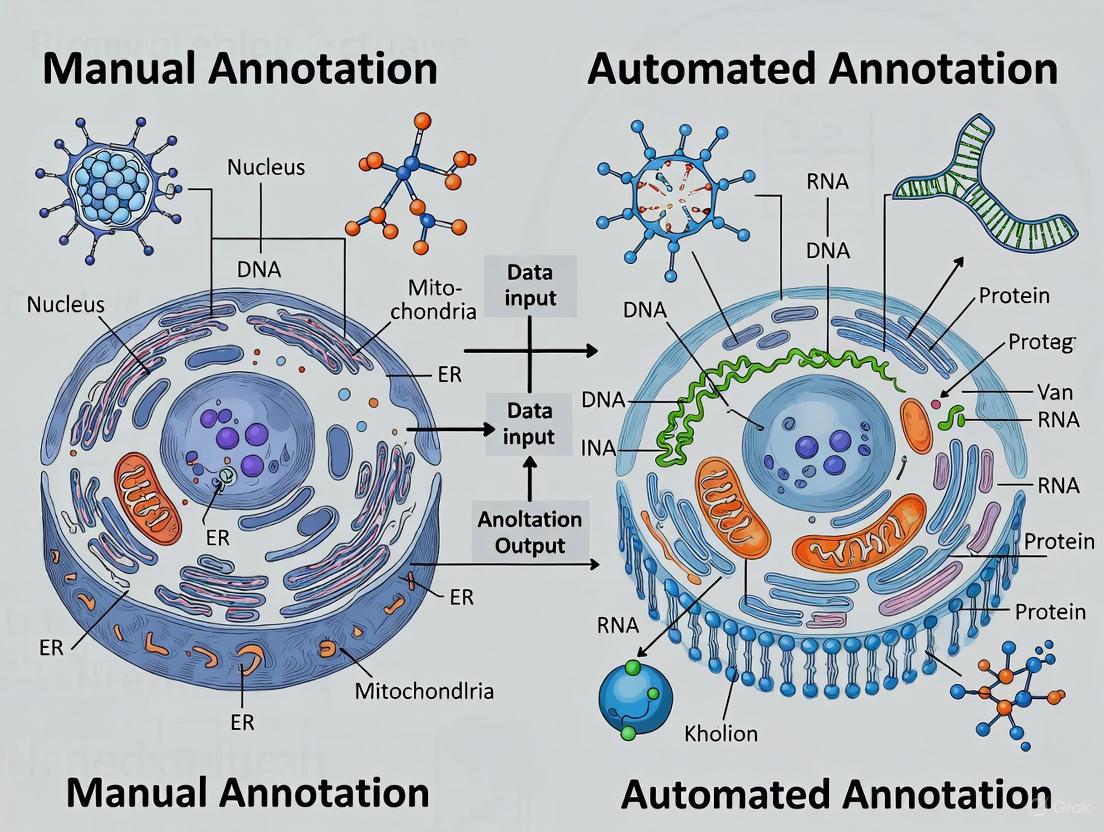
This article provides a comprehensive comparison of manual and automated data annotation accuracy, tailored for researchers and professionals in drug development and biomedical science.
Manual vs. Automated Annotation: A Precision-Focused Analysis for Biomedical AI
Abstract
This article provides a comprehensive comparison of manual and automated data annotation accuracy, tailored for researchers and professionals in drug development and biomedical science. It explores the foundational principles of data annotation, examines methodological applications in real-world research scenarios, addresses critical challenges like bias and inconsistency, and presents rigorous validation frameworks. By synthesizing evidence from recent studies and industry practices, the content offers a strategic guide for selecting and optimizing annotation methodologies to ensure the reliability of AI models in high-stakes clinical and research environments.
The Critical Role of Annotation Accuracy in Biomedical AI
Data annotation is the critical process of labeling raw data—whether images, text, audio, or video—to create the ground truth that enables supervised machine learning models to learn and make accurate predictions [1] [2]. The choice between manual and automated annotation methods directly impacts the quality, efficiency, and success of AI projects, a decision particularly salient in research and drug development where precision is paramount [1] [3].
This guide objectively compares the performance of manual and automated data annotation, presenting supporting experimental data and methodologies relevant to scientific applications.
Experimental Protocols for Assessing Annotation Accuracy
Research into annotation accuracy employs rigorous methodologies to quantify performance and ensure the reliability of resulting datasets. The following protocols are standard in the field.
Protocol 1: Measuring Inter-Annotator Agreement (IAA)
IAA metrics assess the consistency of labels across multiple annotators, serving as a key indicator of annotation quality and guideline clarity [4].
- Objective: To quantify the consistency and reliability of annotations by measuring the agreement between multiple human annotators or between human annotators and an automated system.
- Procedure:
- Sample Selection: A representative subset of data is selected from the entire dataset.
- Multiple Annotations: The same data sample is independently annotated by two or more trained annotators (or by an automated system and a human expert).
- Statistical Analysis: Agreement is calculated using metrics like Cohen's Kappa or Fleiss' Kappa, which account for agreement occurring by chance [4]. For classification tasks, a confusion matrix is often used to visualize disagreements [4].
- Key Metrics:
- Cohen's Kappa (κ): Values range from -1 (complete disagreement) to 1 (perfect agreement). A score above 0.8 is typically considered excellent agreement, indicating high-quality, consistent annotations [4].
- F1 Score: The harmonic mean of precision and recall, providing a balanced measure of a model's annotation performance [4].
Protocol 2: Performance Benchmarking with Control Tasks
This method uses a "gold standard" dataset to benchmark the accuracy of new annotations [4].
- Objective: To evaluate labeling accuracy by testing annotators against a predefined set of questions with known correct labels.
- Procedure:
- Gold Standard Creation: A set of control tasks is meticulously labeled by domain experts to establish a ground truth.
- Integration and Evaluation: These control tasks are randomly interspersed within the main annotation workload. Annotators' responses are compared against the gold standard answers.
- Performance Tracking: Individual annotator accuracy is tracked, and systematic errors are identified for corrective feedback or guideline refinement [4].
Protocol 3: Tiered Quality Control and Validation
A multi-layered quality assurance (QA) framework is implemented to maintain high annotation standards throughout a project [2].
- Objective: To implement a multi-layered validation system that catches errors at various stages of the annotation pipeline.
- Procedure:
- Initial Validation: Automated checks for completeness and basic conformity [2].
- Peer Review: A second annotator reviews a sample of completed work to identify errors or guideline misinterpretations [2] [5].
- Expert Review: Domain experts review challenging cases and random samples to ensure domain-specific accuracy, a crucial step in fields like medical imaging [2] [5].
- Statistical Analysis: Automated detection of outlier patterns or inconsistencies across the dataset [2].
The following workflow diagram illustrates how these protocols and methods can be integrated into a robust annotation pipeline for a research setting.
Quantitative Comparison: Manual vs. Automated Annotation
The table below summarizes the comparative performance of manual and automated annotation across key metrics, synthesizing data from experimental protocols and industry benchmarks [1] [6] [7].
| Metric | Manual Annotation | Automated Annotation |
|---|---|---|
| Inherent Accuracy | Very high, especially for complex/nuanced data [1] [7] | Moderate to high; struggles with complexity and context [1] [6] |
| Typical Consistency (IAA Score) | High with rigorous training & guidelines (κ > 0.8) [4] | Perfect consistency on simple tasks; can be inconsistent on novel data [1] |
| Best-Suited Data Complexity | Excellent for complex, ambiguous, or subjective data (e.g., medical imagery) [1] [8] | Excellent for simple, repetitive tasks with clear patterns [1] |
| Experimental Control Task Performance | High accuracy (>95%) on domain-specific tasks with expert annotators [4] | High on training-like data; performance drops on edge cases and new distributions [7] |
| Impact on Model Performance | Can improve final model accuracy by up to 20% with high-quality labels [3] | Enables rapid iteration; model ceiling limited by annotation accuracy [1] |
| Scalability | Limited by human resources; difficult and costly to scale [1] [7] | Highly scalable; can process massive datasets rapidly [1] [6] |
| Cost & Time Efficiency | Time-consuming and costly due to labor [1] [6] | Cost-effective for large volumes after initial setup [1] [6] |
The Researcher's Toolkit: Essential Annotation Solutions
For scientists and drug development professionals, selecting the right tools and approaches is critical. The following table details key solutions and their applications in a research context.
| Research Reagent Solution | Function & Application |
|---|---|
| Specialized Annotation Platforms (e.g., Encord, Labelbox) | Support multimodal data (e.g., medical images DICOM), custom workflows, and MLOps integration for production-grade datasets [9]. |
| Active Learning Frameworks | Machine learning methods that identify the most informative data points for annotation, optimizing the time of expert annotators [8] [10]. |
| Inter-Annotator Agreement (IAA) Metrics | Quantitative measures (Cohen's Kappa, Fleiss' Kappa) to statistically validate annotation consistency and guideline clarity across a team [4]. |
| Hierarchical Labeling Systems | Organizes labels into a structured, multi-level framework (e.g., "Vehicle" -> "Car" -> "Sedan") to improve accuracy and contain errors within branches [5]. |
| Pre-Trained & Foundational Models | Models like T-Rex2 or DINO-X provide AI-assisted pre-annotation, significantly speeding up initial labeling for common objects [9]. |
| Quality Control (QC) & Benchmarking Suites | Integrated software features for creating control tasks, performing tiered reviews, and tracking quality metrics over time [2] [4]. |
Analysis of Experimental Data and Research Trends
Experimental data confirms that manual annotation, while slower, provides superior accuracy on complex and nuanced tasks, which is critical for applications like medical image analysis where error costs are high [1] [3]. The high IAA scores achievable with trained experts make this the gold standard for creating reliable ground truth datasets [4].
Conversely, automated annotation excels in throughput and scalability. Its performance is highly dependent on the quality and similarity of its training data to the target dataset. Performance can degrade significantly with domain shift—when new data differs from the training distribution—a common challenge in research [8] [7].
The emerging paradigm that addresses these trade-offs is Human-in-the-Loop (HITL) automation [1] [2]. This hybrid approach leverages AI for initial, high-volume labeling and reserves human expertise for complex edge cases, quality control, and reviewing the most uncertain predictions. This strategy balances efficiency with the high accuracy required for scientific model development.
In the rapidly evolving field of artificial intelligence, the precision of data annotation directly dictates the performance of machine learning models. While automated annotation offers compelling advantages in speed and scalability for large datasets, manual annotation—the human-driven process of labeling data—remains indispensable for tasks requiring nuanced judgment, contextual understanding, and domain-specific expertise [1] [6]. This is particularly true in high-stakes fields like healthcare and scientific research, where accuracy is paramount and errors can have significant consequences [11]. This guide objectively compares the performance of manual and automated annotation, presenting supporting experimental data that underscores the human advantage in managing complexity and ambiguity. The evidence confirms that in scenarios demanding sophisticated judgment, manual annotation provides a level of quality and reliability that automation has yet to surpass.
Experimental Evidence: Manual Annotation in Action
The superiority of manual annotation is not merely theoretical; it is demonstrated through rigorous experiments and practical applications across complex domains. The following case studies provide quantitative and qualitative evidence of its critical role.
Case Study 1: Medical Image Annotation for AI-Assisted Diagnosis A 2025 study on constructing a thyroid nodule ultrasound database quantified the value of human expertise in medical imaging [12]. The research established a two-stage manual annotation protocol: initial annotation by junior physicians, followed by review and correction by senior physicians (associate chief physicians or chief physicians). This process created a high-quality "gold standard" dataset for training a YOLOv8 AI model. The study found that even when using an AI model pre-trained on augmented data to assist junior physicians, it only saved approximately 30% of their manual annotation workload for a small dataset of 1,360 images [12]. This highlights that expert human judgment remains the backbone of creating reliable medical imaging datasets, a task too critical for full automation.
Case Study 2: A Scalable, Rule-Based Method for Clinical Alarm Annotation Research into reducing "alarm fatigue" in Intensive Care Units (ICUs) faced the challenge of labeling the actionability of millions of patient monitoring alarms [13]. A purely manual, case-by-case approach was deemed too slow and resource-intensive. The solution was an interdisciplinary, consensus-based manual process to develop a rule-based annotation method. Clinicians and researchers manually defined a set of eight rules and mapping tables to classify alarms as actionable or non-actionable based on data from the Patient Data Management System [13]. This methodology enabled the semiautomatic annotation of a large number of alarms retrospectively and quickly. This case demonstrates that manual expertise is crucial for establishing the foundational logic and rules that can later be scaled with technology.
Case Study 3: Curating a Precision Cancer Drug Combination Database The OncoDrug+ database, a 2025 resource for precision combinatorial therapy, was built entirely through manual curation [14]. To create this knowledge base, researchers systematically integrated data from FDA databases, clinical guidelines, trials, case reports, and biomedical literature. This process required professionals to interpret and synthesize complex, context-dependent information from disparate sources—a task fundamentally reliant on human discernment. The result was a highly annotated resource covering 7,895 data entries, 77 cancer types, and 1,200 biomarkers [14]. This project exemplifies manual annotation's unparalleled flexibility and ability to handle unstructured, multi-source information where automated tools would struggle.
Comparative Performance Data
The following tables synthesize experimental data and key differentiators between manual and automated annotation, illustrating why the choice of method is context-dependent.
Table 1: Quantitative Results from Medical Imaging Study Workload Reduction [12]
| Dataset Size | Annotation Method | Workload Reduction for Junior Physicians | Classification Accuracy vs. Junior Physicians |
|---|---|---|---|
| 1,360 images | AI Pre-annotation + Human Review | ~30% | Not Reported |
| 6,800+ images | AI Pre-annotation + Human Review | Not Required | Very Close |
Table 2: Key Differentiators Between Manual and Automated Annotation [1] [6] [7]
| Criterion | Manual Annotation | Automated Annotation |
|---|---|---|
| Accuracy & Complexity | High accuracy, especially for complex, nuanced, or subjective data [1]. | Lower accuracy for complex data; consistent for simple, repetitive tasks [1]. |
| Handling Novel Data | Highly flexible; humans adapt quickly to new challenges and edge cases [6]. | Limited flexibility; requires retraining for new data types, struggles with edge cases [1]. |
| Domain Expertise | Essential for specialized fields (medical, legal) [6]. | Minimal expertise needed; operates on pre-defined patterns. |
| Best-Suited Project Size | Small to medium datasets, or large datasets where quality is critical [7]. | Large to massive datasets (millions of instances) with tight deadlines [1] [7]. |
The Researcher's Toolkit: Protocols for High-Quality Manual Annotation
Successful manual annotation requires more than just human effort; it demands structured protocols, specialized tools, and careful management to ensure quality and consistency.
Detailed Experimental Protocols The methodologies from the cited experiments provide a blueprint for robust manual annotation:
- Two-Stage Review with Expert Oversight (Medical Imaging): This protocol involves initial annotation by trained personnel (e.g., junior physicians), followed by a mandatory review and correction cycle by senior domain experts. This creates a verified "gold standard" dataset and mitigates individual error [12].
- Interdisciplinary Rule-Set Development (Clinical Alarms): This method involves convening a multidisciplinary team (e.g., clinicians, data scientists) to manually analyze a problem domain. Through consensus, the team defines a logical rule set and mapping tables. This transforms human expertise into a scalable, rule-based annotation system [13].
- Systematic Data Curation and Integration (Drug Database): This protocol entails manually collecting data from multiple, heterogeneous sources (databases, literature, patient records). Professionals then interpret, synthesize, and integrate this information based on pre-defined evidence scores and inclusion criteria, ensuring a comprehensive and evidence-based final resource [14].
Essential Research Reagent Solutions The following tools and concepts are fundamental to executing a manual annotation project.
Table 3: Key Solutions for Manual Annotation Research
| Solution / Tool | Function / Description |
|---|---|
| Two-Stage Expert Review | A quality control process where initial annotations are reviewed and corrected by senior experts to establish a gold standard [12]. |
| Interdisciplinary Teams | Groups comprising domain experts (e.g., physicians) and data specialists to define annotation rules and standards [13]. |
| Annotation Guidelines & Rule Sets | Formally documented instructions that define classes, labels, and processes to ensure consistency across human annotators [13]. |
| Platforms like Encord & CVAT | Software tools that provide interfaces for manual labeling (e.g., drawing bounding boxes), workflow management, and collaboration for visual data [15]. |
Visualizing Annotation Workflows
The diagrams below illustrate the core methodologies derived from the featured research, providing a clear visual representation of the structured processes that underpin high-quality manual annotation.
Diagram 1: Two-stage medical annotation workflow with expert oversight.
Diagram 2: Consensus-driven process for creating a scalable rule-based annotation system.
The experimental data and case studies presented affirm that manual annotation holds a decisive advantage in scenarios where data is complex, ambiguous, or domain-specific. The human capacity for nuanced judgment, contextual understanding, and adaptive learning makes it an indispensable component in the development of reliable AI, particularly in critical fields like healthcare and drug development. While automated annotation excels in processing large volumes of standardized data, the evidence clearly shows that for tasks requiring deep expertise and complex judgment, manual annotation is not just a preference—it is a necessity. The most effective future path lies not in choosing one over the other, but in leveraging a hybrid approach, using automation for scale and speed while relying on human expertise to guide, correct, and handle the edge cases that define true intelligence.
In the development of artificial intelligence (AI) and machine learning (ML) models, data annotation serves as the critical foundation, transforming raw data into structured, machine-readable information. The choice between manual and automated annotation methods directly influences the accuracy, efficiency, and scalability of AI systems, particularly in sensitive fields like drug development and clinical research. Manual annotation relies on human expertise to label datasets, offering superior contextual understanding but operating under significant constraints of time and scalability. Conversely, automated annotation employs algorithms and AI-assisted tools to accelerate the labeling process, enabling rapid processing of large-scale datasets while facing challenges in handling nuanced or complex data. Understanding the mechanisms, accuracy, and appropriate applications of each approach is paramount for researchers and scientists aiming to build reliable, high-performing models for biomedical applications.
This guide provides a comprehensive, evidence-based comparison of manual versus automated data annotation, synthesizing current research findings and empirical data. It details specific experimental protocols from clinical benchmark studies, presents structured quantitative comparisons, and outlines the essential toolkit for implementing these methodologies in research environments. The analysis is particularly framed within the context of drug development and clinical research, where annotation accuracy directly impacts patient safety and therapeutic efficacy.
Comparative Accuracy: Quantitative Analysis
Empirical assessments across multiple studies demonstrate significant differences in error rates and performance metrics between manual and automated data annotation methods. The following tables synthesize quantitative findings from clinical research, computer vision applications, and large-scale data processing studies.
Table 1: Data Processing Error Rates in Clinical Research A systematic review and meta-analysis of data quality in clinical studies revealed substantial variability in error rates across processing methods. The analysis, which categorized 93 papers published from 1978 to 2008, calculated pooled error rates using meta-analysis of single proportions based on the Freeman-Tukey transformation method [16].
| Data Processing Method | Pooled Error Rate (%) | 95% Confidence Interval | Error Range (per 10,000 fields) |
|---|---|---|---|
| Medical Record Abstraction (MRA) | 6.57 | 5.51 - 7.72 | 200 - 2,784 |
| Optical Scanning | 0.74 | 0.21 - 1.60 | 21 - 160 |
| Single-Data Entry | 0.29 | 0.24 - 0.35 | 24 - 35 |
| Double-Data Entry | 0.14 | 0.08 - 0.20 | 8 - 20 |
Medical Record Abstraction, a primarily manual process, demonstrated both the highest and most variable error rate (6.57%, 95% CI: 5.51-7.72), with reported errors ranging from 200 to 2,784 per 10,000 fields [16]. This error rate exceeds thresholds known to impact statistical power and potentially necessitate sample size increases in clinical trials. In contrast, automated and semi-automated methods showed significantly lower error rates, with double-data entry achieving the highest accuracy at 0.14% (95% CI: 0.08-0.20) [16].
Table 2: Performance Metrics in specialized annotation tasks Studies in specialized domains reveal distinct performance patterns for manual and automated approaches, particularly in handling complex data types.
| Domain | Task Type | Manual Annotation Performance | Automated Annotation Performance | Key Metrics |
|---|---|---|---|---|
| Radiographic Landmark Identification | Pelvic tilt annotation | Maximum angular disagreement: 9.51°-16.55° (cloud size: 6.04mm-17.90mm) | Requires established benchmark for comparison | Landmark cloud size at 95% threshold [17] |
| Medication Error Analysis | Named Entity Recognition | Gold-standard dataset creation | F1-score: 0.97 | Cross-validation [18] |
| Medication Error Analysis | Intention/Factuality Analysis | Gold-standard dataset creation | F1-score: 0.76 | Cross-validation [18] |
| General Complex Data Handling | Contextual understanding | Superior accuracy | Struggles with nuance | Qualitative assessment [1] |
In clinical imaging annotation, a benchmark dataset for pelvic tilt landmarks revealed substantial human annotator variability, with landmark cloud sizes of 6.04 mm-17.90 mm at a 95% dataset threshold, corresponding to 9.51°–16.55° maximum angular disagreement in clinical settings [17]. This variability highlights the inherent challenges in establishing "ground truth" for ambiguous anatomical landmarks, whether for human annotators or AI systems.
For medication error analysis, automated annotation achieved remarkably high performance in Named Entity Recognition (F1-score: 0.97) but showed more moderate performance in the more complex intention/factuality analysis (F1-score: 0.76) based on cross-validation exercises [18]. This pattern demonstrates the current capabilities and limitations of automated systems in handling layered linguistic tasks.
Experimental Protocols and Methodologies
Clinical Radiographic Landmark Annotation Study
A clinical benchmark study established a methodology for quantifying annotation accuracy in pelvic tilt radiographic measurements, providing a framework for comparing human and AI annotation performance [17].
Objective: To quantify inter-annotator variability in pelvic tilt landmark identification and create a probabilistic benchmark dataset for validating AI annotation methods.
Imaging Dataset: Researchers sourced 115 consecutive sagittal radiographs (EOS Imaging, France) from 93 unique patients (62 males, 31 females, average age 64.6 ± 11.4 years) awaiting hip surgeries. The dataset was ethically approved (2019/ETH09656, St Vincent's Hospital Human Research Ethics Committee, Sydney, Australia) and shared under a CC-BY license [17].
Annotation Protocol:
- Five independent annotators (one senior surgeon, two orthopedic fellows, two orthopedic engineers) received equal training for labeling points defining pelvic tilt using a custom-designed MATLAB GUI program.
- Two pelvic tilt definitions were annotated: anatomical pelvic tilt (defined by anterior pelvic plane) and mechanical pelvic tilt (defined by line connecting midpoint of sacral plate and center of two femoral heads).
- Before annotation, images were zoomed until the anatomical structures filled the screen to ensure precision.
Probabilistic Model Calculation:
- Image-specific length parameters scaled skeletal sizes across different images using a standardized factor (η).
- Annotation coordinates were transformed to represent orientation of interest (θ) using coordinate transformation equations.
- Landmark accuracy was calculated from maximum impact of point cloud diameter of k% data points from two landmark ends, representing angular and length disagreements.
- The centroid of annotations from multiple annotators was considered the "ground-truth" point for benchmark establishment.
This methodology produced a quantified point cloud dataset for each landmark corresponding to different probabilities, enabling assessment of directional annotation distribution and parameter-wise impact [17].
Medication Error Incident Report Annotation Study
A large-scale study created an annotated corpus of medication error reports to develop and validate automated information extraction systems for patient safety applications [18].
Objective: To develop a machine annotator for extracting medication error-related information from unstructured clinical narrative reports and create a large annotated corpus for model training.
Data Source: 58,568 annotatable free-text medication error reports from the Japan Council for Quality Health Care's "Project to Collect Medical Near-Miss/Adverse Event Information" (2010-2020). The corpus included 478,175 medication error-related named entities [18].
Annotation Scheme:
- Named Entity Recognition (NER): Annotation of drug-related entities including 'drug', 'form', 'strength', 'duration', 'timing', 'frequency', 'date', 'dosage', and 'route'.
- Intention/Factuality Analysis (I&F): Labeling named entities as 'intended and actual' (IA), 'intended and not actual' (IN), or 'not intended and actual' (NA), with IN and NA indicating medication errors.
- Incident Type Classification: Determining error type based on which named entities were intended versus actual.
Machine Annotation Pipeline:
- Pre-training: A BERT model with SentencePiece tokenizer was pre-trained on Japanese Wikipedia and Twitter corpora, then further pre-trained on the full JQ incident report corpus of 121,244 free-text documents.
- Fine-tuning: The model was fine-tuned with rule-based annotated data, using a list of unique drug names based on Japan's Ministry of Health, Labour and Welfare 2022 standard drug list.
- Validation: The model achieved F1-scores of 0.97 for NER and 0.76 for intention/factuality analysis in cross-validation exercises.
This workflow produced the world's largest publicly available body of annotated incident reports covering concepts and attributes related to drug errors [18].
Workflow Comparison: Manual vs Automated Annotation
The fundamental processes of manual and automated annotation differ significantly in their operational sequences, quality control mechanisms, and human involvement requirements. The following diagram illustrates the core workflows for each approach:
The Researcher's Annotation Toolkit
Implementing effective annotation workflows requires specialized tools and platforms tailored to research needs. The following table details key solutions and their applications in scientific contexts.
Table 3: Essential Annotation Tools for Research Applications
| Tool/Platform | Type | Primary Research Applications | Key Features | Best For |
|---|---|---|---|---|
| Encord | Commercial | Medical imaging, DICOM annotation | AI-assisted labeling, active learning pipelines, HIPAA compliance | Medical image annotation with specialized file format support [19] |
| Labelbox | Commercial | Multi-modal data annotation | Automated labeling, project management, multi-user workflows | Large-scale projects requiring flexible annotation across data types [1] [20] |
| CVAT | Open-source | Computer vision research | Semantic segmentation, bounding boxes, object tracking | Academic and industry computer vision projects with limited budgets [20] |
| Amazon SageMaker Ground Truth | Commercial | Large-scale clinical data processing | Built-in ML model integration, managed labeling workforce | Teams integrated with AWS ecosystem needing scalable solutions [1] [20] |
| SuperAnnotate | Commercial | Medical imaging, video annotation | AI-assisted image segmentation, automated quality checks | Computer vision projects requiring precise, high-volume annotations [1] [20] |
| Custom MATLAB GUI | Research-specific | Radiographic landmark annotation | Custom-designed interface for specific measurement tasks | Specialized clinical measurement tasks requiring tailored interfaces [17] |
| BERT-based NLP Pipeline | Research-specific | Medication error extraction | Multi-task BERT model, intention/factuality analysis | Natural language processing of clinical narratives and reports [18] |
Tool selection should align with specific research requirements, including data type (medical images, clinical text), compliance needs (HIPAA, SOC 2), scalability requirements, and integration with existing research workflows. Open-source solutions like CVAT offer flexibility for academic settings, while commercial platforms typically provide enhanced security features and specialized functionality for regulated clinical research environments [20].
The comparative analysis of manual and automated annotation reveals a complex landscape where methodological choice significantly impacts research outcomes. Manual annotation delivers superior accuracy for complex, nuanced tasks but faces limitations in scalability and consistency. Automated annotation offers dramatic efficiency gains for large datasets but requires careful validation, particularly in ambiguous domains. The emerging hybrid paradigm—combining AI-assisted pre-labeling with human expert oversight—represents a promising direction for biomedical research, leveraging the strengths of both approaches while mitigating their respective limitations.
Future directions in annotation methodology will likely focus on enhancing AI capabilities for contextual understanding, developing more sophisticated benchmark datasets for validation, and creating specialized tools for domain-specific applications in drug development and clinical research. As AI systems continue to evolve, the establishment of rigorous, standardized evaluation frameworks remains essential for ensuring annotation quality and, consequently, the reliability of AI models in critical healthcare applications.
In modern drug discovery, artificial intelligence (AI) and machine learning (ML) models have become indispensable tools, capable of compressing discovery timelines from years to months [21]. The performance of these models is not merely a function of their algorithms but is fundamentally dependent on the quality of the training data from which they learn [6]. This training data acquires its predictive power through annotation—the process of labeling raw, unstructured data to identify meaningful entities and relationships [6] [1]. In the context of drug discovery, this can include labeling protein structures, molecular interactions, or clinical outcomes. The accuracy and consistency of these annotations create the foundational reality that AI models internalize. Consequently, the choice between manual and automated annotation methodologies carries profound implications for the entire research and development pipeline, influencing everything from initial target identification to clinical trial success rates [6] [1]. This guide provides an objective comparison of manual versus automated annotation, supporting drug development professionals in making evidence-based decisions for their AI initiatives.
Manual vs. Automated Annotation: A Comparative Analysis
The decision between manual and automated annotation is multifaceted, involving trade-offs between accuracy, speed, cost, and scalability. The table below summarizes the key performance characteristics of each method, synthesized from comparative studies.
Table 1: Performance Comparison of Manual vs. Automated Annotation
| Performance Criterion | Manual Annotation | Automated Annotation |
|---|---|---|
| Accuracy | Very high; excels with complex, nuanced data [6] [1] | Moderate to high; best for clear, repetitive patterns [6] |
| Speed | Slow; human-limited throughput [6] [1] | Very fast; processes thousands of data points per hour [6] |
| Cost | High, due to skilled labor costs [6] [1] | Lower long-term cost; high initial setup investment [6] [1] |
| Scalability | Limited; requires hiring and training [6] | Excellent; scales effortlessly with computing power [6] |
| Adaptability | Highly flexible to new tasks and taxonomies [6] | Limited flexibility; requires retraining for new data [1] |
| Consistency | Prone to human error and subjective bias [1] | High consistency for well-defined tasks [6] |
| Best-Suated For | Complex, small-scale, or mission-critical tasks (e.g., medical imaging, legal documents) [6] [1] | Large-scale, repetitive tasks with simple patterns (e.g., virtual screening) [6] [1] |
The Qualitative Trade-Offs
- Contextual Understanding: Manual annotation, performed by domain experts such as medicinal chemists or biologists, provides irreplaceable contextual and causal reasoning. This is critical for interpreting ambiguous data in areas like toxicology or patient stratification [6]. Automated systems, while consistent, operate on pre-defined rules and patterns and can struggle with novel or highly specialized content [6] [1].
- Bias and Validation: Human annotators can introduce unconscious bias, but can also be trained to identify and mitigate it. Automated models, however, can perpetuate and even amplify biases present in their training data, requiring rigorous human-in-the-loop oversight for quality control [6] [1].
Experimental Protocols for Assessing Annotation Quality
To objectively determine the optimal annotation strategy for a given project, researchers should implement controlled experiments that measure key performance indicators. The following protocols outline methodologies for benchmarking quality and its downstream impact on AI model performance.
Protocol 1: Benchmarking Annotation Accuracy
This protocol measures the intrinsic quality of the annotations themselves before they are used for model training.
- Dataset Curation: Select a gold-standard benchmark dataset relevant to the drug discovery task (e.g., a publicly available protein-ligand binding affinity database). Manually curate and verify a "ground truth" subset to use as the evaluation benchmark [22].
- Experimental Arms:
- Arm A (Manual): Provide the raw dataset to a team of expert annotators (e.g., PhD-level chemists). Implement a multi-level validation process where a subset of annotations is peer-reviewed by a second expert [6].
- Arm B (Automated): Process the same raw dataset using the chosen automated annotation tool (e.g., a graph neural network for molecular property prediction) [23] [24].
- Arm C (Hybrid): Process the dataset with the automated tool, then have expert annotators review and correct the outputs [6] [1].
- Quality Metrics: Compare the outputs of each arm against the ground truth benchmark. Calculate:
- Precision/Recall: To measure correctness and completeness.
- F1-Score: The harmonic mean of precision and recall.
- Inter-Annotator Agreement (IAA): For manual annotation, use Fleiss' Kappa to measure consistency among experts. For automated vs. manual, use Cohen's Kappa [6].
Protocol 2: Downstream Model Performance
This protocol evaluates how the quality of annotations from different methods ultimately affects the performance of a drug discovery AI model.
- Training Set Generation: Use the finalized annotated datasets from each arm of Protocol 1 (Manual, Automated, Hybrid) as separate training sets.
- Model Training: Train three identical AI models—for example, a Graph Neural Network (GNN) for predicting drug-target interactions—each on one of the three training sets. Keep all model architectures and hyperparameters constant [23] [24].
- Performance Evaluation: Test all three models on the same, pristine, held-out test set. Evaluate using domain-specific metrics:
- Area Under the Curve (AUC) of the Receiver Operating Characteristic (ROC) curve for classification tasks (e.g., active/inactive compound) [24].
- Mean Squared Error (MSE) for regression tasks (e.g., predicting binding affinity) [22].
- Success Rate in Virtual Screening: The top candidates identified by each model can be validated in wet-lab experiments, with the hit-rate serving as a final performance measure [24] [25].
Table 2: Key Reagent Solutions for Annotation and AI Modeling in Drug Discovery
| Research Reagent / Solution | Function in Annotation & AI Modeling |
|---|---|
| FAIR Data Repositories (e.g., ChEMBL, PubChem) [22] | Provides structured, accessible data for training automated annotation models and establishing benchmark ground truth. |
| Graph Neural Networks (GNNs) [23] [24] | AI models that naturally represent molecules as graphs for highly accurate property prediction and virtual screening. |
| Computer-Assisted Synthesis Planning (CASP) Tools [22] | Automates the annotation of viable synthetic pathways for AI-designed molecules, critical for the "Make" step in DMTA cycles. |
| High-Throughput Experimentation (HTE) [22] | Generates large-scale, high-quality experimental data for training and validating automated annotation systems in chemistry. |
| AI-Powered Visualization Platforms (e.g., Labelbox, SageMaker) [1] | Provides interfaces for human experts to perform manual annotation and quality control efficiently. |
The relationship between annotation methodology, data quality, and final model performance is a causal chain. The following diagram visualizes this workflow and the critical points of quality decision-making.
Diagram 1: Annotation workflow and impact on model performance.
The choice between manual and automated annotation is not about finding a universally superior option, but rather the contextually optimal one. The evidence demonstrates that manual annotation is unparalleled for complex, small-scale, or high-stakes tasks where accuracy and nuanced understanding are paramount, such as in early-stage lead optimization for a first-in-class drug target [6] [22]. Conversely, automated annotation is essential for leveraging large-scale datasets, such as in virtual screening of billion-compound libraries, where its speed and consistency provide a decisive advantage [6] [24].
For most modern drug discovery pipelines, a hybrid strategy offers the most robust path forward. This approach uses automated tools for bulk processing and initial labeling, reserving scarce and expensive expert manual labor for quality control, edge cases, and the most critical data subsets [6] [1]. This creates a synergistic loop where human expertise trains and refines the automated systems, which in turn augment human productivity. By strategically aligning annotation methodology with project goals—prioritizing accuracy for foundational models and scalability for exploratory research—drug development professionals can build higher-performing AI models, ultimately accelerating the delivery of novel therapeutics.
Strategic Implementation: Choosing the Right Annotation Method for Your Research
Optimal Use Cases for Manual Annotation in Biomedical Research
In the development of artificial intelligence (AI) for biomedical applications, the creation of high-quality training datasets through annotation is a foundational step. This process, which involves labeling raw data such as medical images or clinical text to provide context for machine learning models, is performed through two primary methodologies: manual annotation by human experts and automated annotation via algorithms. While automated approaches offer compelling advantages in speed and scalability, manual annotation remains indispensable for numerous complex biomedical tasks. This guide objectively compares the performance of manual and automated annotation, framing the discussion within broader research on annotation accuracy to delineate the specific, optimal scenarios where the precision of human experts is not just beneficial but essential.
Manual vs. Automated Annotation: A Comparative Framework
The choice between manual and automated annotation is not a question of which is universally superior, but which is optimal for a specific project's goals, constraints, and data characteristics. The decision hinges on the trade-off between the scalability of automation and the nuanced understanding of human intelligence.
The table below summarizes the core performance characteristics of each method based on comparative analyses [26] [1] [27]:
| Performance Criterion | Manual Annotation | Automated Annotation |
|---|---|---|
| Accuracy & Precision | Very high, especially for complex/nuanced data [26] [1] | Moderate to high for clear, repetitive patterns; struggles with subtlety [26] [27] |
| Contextual Understanding | Excellent; can interpret ambiguity, jargon, and cultural nuance [28] | Limited; operates on pre-defined rules and patterns [26] |
| Speed & Throughput | Slow; human-limited and time-consuming [26] [1] | Very fast; can process thousands of data points in hours [26] [27] |
| Scalability | Limited and costly to scale [26] | Excellent; scales effortlessly with computing resources [26] [28] |
| Adaptability & Flexibility | Highly flexible; can adjust to new guidelines and edge cases in real-time [26] | Low flexibility; requires retraining or reprogramming for new tasks [1] |
| Operational Cost | High due to skilled labor and time [26] [28] | Lower long-run cost; high initial setup investment [26] [27] |
| Consistency | Prone to inter-annotator variability and subjective bias [29] [28] | High consistency in applying labeling rules [26] |
The Critical Challenge of Inter-Annotator Variability
A significant factor unique to manual annotation is inter-annotator variability—the inconsistency that arises when different experts label the same phenomenon. This is not merely a result of error but often stems from inherent differences in expert judgment, a source of "noise" in the system [29].
A landmark 2023 study extensively investigated this issue in a real-world clinical setting [29]. The experiment involved 11 Intensive Care Unit (ICU) consultants independently annotating a common dataset of 60 patient instances based on six clinical variables, assigning a severity score (A-E). The resulting classifiers, built from each consultant's annotations, showed only "fair" agreement internally (Fleiss' κ = 0.383). More critically, when these models were validated on an external ICU dataset, their classifications showed only "minimal" agreement (average Cohen's κ = 0.255). This demonstrates that the "ground truth" can shift significantly depending on which expert provides the labels, potentially leading to unpredictable model behavior in real-world clinical decision-support systems [29].
Optimal Use Cases for Manual Annotation
The strengths of manual annotation make it the preferred or required method in several high-stakes biomedical scenarios.
Complex and Subjective Data Interpretation
Human experts excel at tasks requiring deep contextual understanding and judgment that is difficult to codify into rules.
- Sentiment and Intent Analysis in Patient Data: Understanding patient-reported outcomes or sentiments in clinical notes often involves interpreting sarcasm, cultural nuance, and ambiguous phrasing, a task where human annotators significantly outperform automated tools [1] [27].
- Rhetorical Classification in Scientific Literature: Identifying the function of sentences in publications (e.g., "self-acknowledged limitations") requires understanding scientific argumentation. A 2018 study achieved good inter-annotator agreement (Krippendorff’s α = 0.781) using manual annotation, which was then used to train a rule-based classifier. The human-defined rules ultimately yielded the highest classification accuracy (91.5%), underscoring the value of human insight for setting up automated systems [30].
Mission-Critical Applications in Clinical and Diagnostic Fields
In domains like medicine, where annotation errors can have direct consequences for patient care, the accuracy of manual annotation is paramount.
- Medical Imaging Analysis: Annotating radiology scans or pathology slides to identify subtle disease markers requires a level of expertise and nuanced judgment that automated systems cannot reliably replicate. Manual annotation is the gold standard for creating training data in these fields [1] [28].
- Clinical Decision Support Systems: As evidenced by the ICU study, clinical judgment is variable. For building models that classify patient severity or predict outcomes, manual annotation by domain experts is essential, though consensus-building among multiple annotators is critical to mitigate individual bias [29].
Specialized Domains with Complex Jargon and Ontologies
Biomedical sub-fields often possess highly specialized terminologies and conceptual relationships.
- Legal and Regulatory Document Analysis: Interpreting complex language in clinical trial protocols or patient consent forms demands a human understanding of legal and regulatory context [27].
- Ontology Mapping and Relation Extraction: Mapping biological sample labels to standardized ontologies is a complex task. A 2025 study found that even a fine-tuned GPT-4 model achieved a precision of only 47-64% for annotating cell lines and types, indicating a continued strong need for expert curation to ensure validity [31]. Tools like MetaTron have been developed specifically to support biomedical experts in the manual and semi-automatic annotation of complex relations, integrating ontologies to aid this process [32].
Small, High-Value Datasets and Edge Cases
For pilot studies, rare diseases, or projects with limited, highly valuable data, the cost of setting up an automated system is not justified. Manual annotation ensures that every data point is labeled with the highest possible accuracy [1]. Furthermore, human annotators are uniquely equipped to identify and correctly label unusual or unexpected edge cases that fall outside the patterns an automated model was trained on [28].
Experimental Protocols and Performance Data
To move from theoretical comparison to empirical evidence, we examine specific experimental protocols that benchmark manual against automated or semi-automated methods.
Experiment 1: Digital Pathology Annotation Benchmark
A 2024 study provided a direct benchmark of manual versus semi-automated annotation in computational pathology, a domain requiring extreme precision [33].
- Objective: To compare the working time, reproducibility, and precision of manual (using a mouse or touchpad) and semi-automated (AI-assisted Segment Anything Model - SAM) methods for annotating renal tissue structures.
- Methodology:
- Annotations: Two pathologists annotated 57 tubules, 53 glomeruli, and 58 arteries from a PAS-stained whole slide image (WSI).
- Methods: Each used three methods: mouse, touchpad, and SAM (which uses a rough bounding box from the annotator to generate a fine outline).
- Metrics: Time to annotate, reproducibility (measured by overlap fraction of pixels between annotators), and precision (a 0-10 score from expert nephropathologists).
- Results Summary: The quantitative results are summarized in the table below.
| Annotation Method | Average Time (min) | Time Variability (Δ) | Reproducibility (Overlap Fraction) | Key Finding |
|---|---|---|---|---|
| Semi-Automated (SAM) | 13.6 ± 0.2 | 2% | 0.96 (0.99 for Glomeruli) | Fastest, most reproducible for common structures. |
| Manual (Mouse) | 29.9 ± 10.2 | 24% | 0.96 (0.97 for Glomeruli) | 121% slower than SAM. |
| Manual (Touchpad) | 47.5 ± 19.6 | 45% | 0.94 (0.93 for Glomeruli) | 249% slower than SAM; highest variability. |
Conclusion: The semi-automated method was dramatically faster and showed superior inter-observer reproducibility for most structures. However, its performance dropped for more complex annotations (arteries, overlap=0.89), indicating that automation may still require expert refinement for certain tasks. Manual methods, while slower, provided a high-quality baseline [33].
Experimental Workflow: Pathology Annotation
Experiment 2: Quantifying Clinical Annotation Inconsistency
The previously mentioned 2023 study on ICU data provides a protocol for quantifying the impact of inter-annotator variability [29].
- Objective: To assess the impact of annotation inconsistencies among clinical experts on the performance of resulting AI models.
- Methodology:
- Annotations: 11 ICU consultants independently annotated an identical dataset of 60 patient instances, labeling a severity score based on six clinical variables.
- Model Building: A separate classifier was built from the dataset labeled by each consultant.
- Validation: Models underwent internal validation (agreement between themselves) and broad external validation on a separate ICU dataset (HiRID). Agreement was measured using Fleiss' κ and Cohen's κ.
- Results Summary:
- Internal Validation: Fair agreement (Fleiss' κ = 0.383).
- External Validation: Minimal agreement (average Cohen's κ = 0.255). Models disagreed more on discharge decisions (κ = 0.174) than on mortality predictions (κ = 0.267).
- Consensus Analysis: Standard consensus methods like majority voting led to suboptimal models. The study suggested assessing "annotation learnability" to determine a better consensus.
- Conclusion: The "ground truth" in clinical settings is often not unitary. Relying on a single expert's annotations can produce models that reflect that individual's bias. Optimal model development requires acknowledging and managing this variability, for instance, through learnability-weighted consensus from multiple experts [29].
Logical Flow: ICU Annotation Inconsistency
The Scientist's Toolkit: Research Reagent Solutions
Selecting the right tools is critical for executing a successful manual or semi-automated annotation project. The following table details key solutions based on tool evaluations and experimental protocols [32] [34] [33].
| Tool / Resource | Primary Function | Application Context |
|---|---|---|
| MetaTron | Open-source, web-based annotation tool for biomedical texts. | Supports document-level and relation annotation with ontology integration; ideal for collaborative NLP projects [32]. |
| QuPath with SAM Extension | Digital pathology software with AI-assisted segmentation. | Used for semi-automated annotation of whole slide images; dramatically speeds up outlining structures like glomeruli [33]. |
| Segment Anything Model (SAM) | Foundation model for image segmentation. | Can be integrated into pipelines (e.g., in QuPath) to provide a "semi-automatic" annotation layer, reducing manual labor [33]. |
| brat | Web-based text annotation tool. | A widely-used, rapid annotation tool for structuring natural language data; common in NLP research [34]. |
| WebAnno | Web-based, customizable annotation tool. | Highly rated for linguistic annotation tasks; supports a wide range of project types and collaborative work [34]. |
| Medical-Grade Display (e.g., BARCO) | High-resolution, color-accurate monitor. | Essential for manual annotation of medical images where precision is critical; shown to impact annotation time and accuracy [33]. |
| Consensus Guidelines & Rubrics | Documented protocols for annotators. | Mitigates inter-annotator variability by providing clear, unambiguous rules for labeling complex or subjective data [29]. |
The empirical data clearly demonstrates that manual annotation is the optimal choice in biomedical research when the primary requirements are high contextual accuracy, the ability to interpret complex and subjective data, and domain expertise for tasks in clinical, diagnostic, or specialized fields. Its limitations in speed, scalability, and consistency due to human variability are significant.
The future of annotation in biomedicine does not lie in a binary choice but in hybrid, human-in-the-loop pipelines [28] [27]. In these workflows, automated tools like SAM are used for initial, rapid labeling of large datasets or straightforward tasks, which are then refined and validated by human experts who handle edge cases, complex judgments, and quality assurance. This approach leverages the scalability of automation while preserving the irreplaceable nuanced understanding of the human expert, thereby creating the most robust and reliable annotated corpora for powering the next generation of biomedical AI.
When to Leverage Automated Annotation for Scalable Analysis
For researchers, scientists, and drug development professionals, the quality of annotated data directly determines the performance of machine learning models that underpin modern scientific discovery. The choice between manual and automated annotation is particularly crucial in fields like drug development, where precision must be balanced against the need to process massive datasets at scale. While manual annotation has long been the gold standard for accuracy, automated annotation is increasingly becoming the solution for scalable analysis, particularly as AI models consume more data than ever before [35].
This guide objectively compares these approaches within the broader context of accuracy research, providing experimental data and methodologies to help scientific teams make evidence-based decisions for their annotation workflows. The central thesis is that a strategic hybrid approach—leveraging automation for scalability while retaining human oversight for complex judgments—delivers the optimal balance for research-grade data annotation.
Manual vs. Automated Annotation: A Quantitative Comparison
The table below summarizes core performance metrics between manual and automated annotation approaches, synthesizing data from multiple industry implementations and research studies.
Table 1: Performance Comparison of Manual vs. Automated Annotation
| Performance Metric | Manual Annotation | Automated Annotation | Experimental Context |
|---|---|---|---|
| Throughput Speed | Slow (human-limited) | Up to 5× faster [36] | Image annotation workflows with AI pre-labeling [36] |
| Accuracy Level | Very High (context-aware) | Moderate to High (pattern-based) | Complex data (e.g., medical texts) [6] [37] |
| Relative Cost | High (labor-intensive) | 30-35% lower at scale [36] | Large-scale dataset labeling [36] |
| Scalability | Limited (linear scaling) | Excellent (parallel processing) | Projects with millions of data points [6] [1] |
| Attribute Modeling Accuracy | Benchmark (Gold Standard) | >0.9 F-measure for many attributes [37] | Prescription regimen annotation study [37] |
Experimental Protocols: Methodologies for Annotation Research
Protocol 1: Hybrid Workflow Performance Assessment
Objective: To quantify the performance improvements of a human-in-the-loop (HITL) annotation system compared to purely manual or fully automated approaches [35] [36].
Methodology:
- Pre-labeling & Confidence Thresholding: An AI model pre-labels the dataset. Labels with high confidence scores are automatically approved, while low-confidence labels are routed for human review [35].
- Active Learning Integration: The system flags ambiguous or contentious data points for prioritized human review. Each correction made by a human annotator is fed back into the model as a training signal [35].
- Comparative Analysis: The same dataset is annotated using three different workflows: (a) purely manual, (b) fully automated, and (c) hybrid HITL. Throughput, accuracy, and cost are measured for each.
Key Workflow Diagram: The following diagram illustrates the core logical flow of this hybrid, AI-assisted annotation process.
Protocol 2: Automated Schema Modeling for Medical Texts
Objective: To evaluate the accuracy of automated annotation models in extracting structured information from complex medical texts, such as prescription regimens [37].
Methodology:
- Gold Standard Creation: A subset of a prescription corpus (e.g., 1,746 instructions) is manually annotated by multiple human experts to create a ground-truth dataset. This process involves cross-validation and reconciliation between annotators to ensure high inter-annotator agreement [37].
- Model Training: Machine learning models, such as Conditional Random Fields (CRF), are trained on the manually annotated data to learn the annotation schema (e.g., tags for dose, frequency, route) [37].
- Accuracy Measurement: The automated model's output is compared against the held-out gold standard labels. Performance is measured using standard metrics like F-measure (the harmonic mean of precision and recall) for tag labels and spans, and accuracy for normalized attribute values [37].
Key Workflow Diagram: This diagram outlines the sequential stages of the experimental protocol used for modeling medical texts.
The Scientist's Toolkit: Essential Research Reagent Solutions
For researchers designing annotation experiments, the "reagents" are the platforms and tools that enable the work. The table below details key solutions and their primary functions in the context of annotation research and deployment.
Table 2: Key Research Reagent Solutions for Data Annotation
| Tool / Platform | Primary Function | Research Application |
|---|---|---|
| Encord | Unified platform for multimodal data annotation, curation, and model evaluation [38]. | Manages petabyte-scale datasets; features AI-assisted labeling (SAM2, GPT-4o) and HITL workflows, ideal for complex computer vision and medical AI projects [36] [38]. |
| CVAT (Computer Vision Annotation Tool) | Open-source tool for annotating images, videos, and 3D data [38]. | Provides a flexible, customizable environment for computer vision research with support for multiple annotation types and algorithmic assistance [38]. |
| Lightly | Data curation platform using active learning for smart data selection [38]. | Optimizes annotation budgets by identifying the most valuable data points to label, reducing redundant effort in large-scale projects [38]. |
| Scale AI | Enterprise-grade data labeling infrastructure and pipelines [35]. | Provides the strategic labeling infrastructure needed for large-scale, mission-critical AI pipelines in areas like autonomous systems [35]. |
| Conditional Random Fields (CRF) | Probabilistic model for segmenting and labeling sequence data [37]. | Effective for structured information extraction from textual data, such as annotating concepts in medical prescriptions [37]. |
The experimental data and methodologies presented confirm that automated annotation is no longer a fringe approach but a core component of scalable analysis in scientific research. The key is strategic implementation: leveraging automation for its unmatched speed, scalability, and cost-efficiency on large, well-structured datasets, while relying on human expertise for complex edge cases, nuanced judgments, and quality assurance [6] [36].
The emerging gold standard is the human-in-the-loop model, which creates a virtuous cycle where automation handles volume and humans train the model on harder cases, leading to progressively smarter systems [35]. For research teams in drug development and related fields, adopting this hybrid approach is not just an optimization—it is a strategic necessity for keeping pace with the exploding demands of data-intensive AI models.
In the field of AI and machine learning, particularly within data-intensive sectors like drug development, the debate between manual and automated data annotation is central to research and operational success. Data annotation—the process of labeling data to train AI models—directly dictates the performance, accuracy, and reliability of resulting algorithms. This guide objectively compares the performance of manual, automated, and hybrid annotation approaches, framing them within the broader thesis of accuracy research and providing the experimental data and protocols needed for scientific evaluation.
Data annotation is the foundational process of labeling raw data (images, text, audio, video) to create a structured dataset for training and validating machine learning models [6] [1]. In scientific domains such as drug development, the precision of these labels is paramount, as errors can propagate through models, leading to flawed predictions and unreliable outcomes.
The core methodologies are:
- Manual Annotation: A human-driven approach where experts label each data point individually. This method is prized for its high accuracy and ability to handle nuanced, complex, or subjective data [1].
- Automated Annotation: A technology-driven approach that uses algorithms and pre-trained models to label data with minimal human intervention. This method excels in speed, scalability, and cost-effectiveness for large, repetitive datasets [1].
- Hybrid Annotation: An integrated approach that strategically blends human expertise with automated efficiency. In this model, automation handles the bulk of initial, repetitive labeling, while human experts focus on complex edge cases, quality control, and continuous model refinement [39]. This synergy is the focus of this guide.
Quantitative Comparison of Annotation Methods
The choice between annotation strategies involves trade-offs between accuracy, cost, speed, and scalability. The following tables summarize key performance metrics derived from industry practices and research.
Table 1: Core Performance Metrics of Annotation Methods
| Criterion | Manual Annotation | Automated Annotation | Hybrid Annotation |
|---|---|---|---|
| Accuracy | 92-98% (High for complex data) [1] | 85-90% (Moderate, context-dependent) [1] | >95% (High, enhanced by human review) [39] |
| Relative Speed | Slow (Time-consuming) [6] | Very Fast (Thousands of data points/hour) [1] | Fast (Faster than manual, slightly slower than full auto) [39] |
| Scalability | Low (Limited by human resources) [1] | High (Easily scales with compute power) [6] | High (Efficiently scales through task allocation) [39] |
| Cost Profile | High (Labor-intensive) [6] | Low (After initial setup) [1] | Moderate (Optimizes human and compute costs) [39] |
Table 2: Operational and Qualitative Factors
| Criterion | Manual Annotation | Automated Annotation | Hybrid Annotation |
|---|---|---|---|
| Handling Complex Data | Excellent (Nuance, context, subjectivity) [1] | Struggles (Lacks contextual judgment) [1] | Excellent (Automates routine, humans handle complexity) [39] |
| Consistency | Prone to human error/inconsistency [1] | High (Uniform rules) [1] | High (Human oversight ensures consistency) [39] |
| Adaptability | Highly Flexible (Adapts quickly to new tasks) [6] | Low (Requires retraining for new data) [1] | High (Humans guide model adaptation) [39] |
| Best For | Small, complex datasets; high-stakes tasks (e.g., medical imaging) [1] | Large, repetitive datasets with clear patterns [1] | Most real-world projects, especially evolving or complex domains [39] |
Experimental Protocols for Annotation Accuracy Research
To generate comparable data on annotation performance, researchers can implement the following experimental protocols. These are designed to objectively measure the metrics outlined in the previous section.
Protocol 1: Controlled Accuracy Benchmarking
This experiment is designed to quantify the accuracy and error profiles of each annotation method against a verified ground truth dataset.
- Objective: To measure and compare the accuracy, precision, and recall of manual, automated, and hybrid annotation methods on a standardized dataset.
- Materials & Dataset:
- A pre-annotated, ground truth dataset (e.g., 1,000 medical images with confirmed pathology labels from a public repository like TCIA).
- For automated annotation: Access to a pre-trained model (e.g., from Roboflow, Encord) or training a model on a subset of the ground truth data [9].
- For manual annotation: A group of 3-5 expert annotators (e.g., biochemists or radiologists).
- For hybrid annotation: The same automated tool, with output reviewed by one expert annotator.
- Methodology:
- Step 1: Preparation. Withhold the ground truth labels from the test set (e.g., 200 images).
- Step 2: Execution.
- Manual Group: Provide the test set to expert annotators for independent labeling.
- Automated Group: Process the test set through the chosen automated annotation tool.
- Hybrid Group: Process the test set through the automated tool, then have a single expert reviewer correct the output labels.
- Step 3: Analysis. Compare all outputs against the ground truth. Calculate standard metrics: Accuracy, Precision, Recall, and F1-Score. Document the time taken by each method to complete the task.
- Expected Outcome: The manual and hybrid methods are expected to show superior accuracy (>95%) and F1-scores compared to the fully automated approach. The hybrid method should demonstrate a significant time saving over the purely manual process [1] [39].
Protocol 2: Scalability and Cost-Efficiency Workflow
This experiment assesses the operational efficiency of each method as the dataset volume increases, a critical factor for large-scale drug discovery projects.
- Objective: To analyze the scaling capabilities and cost structure of each annotation method as data volume grows exponentially.
- Materials & Dataset: A large, raw dataset of at least 10,000 data points (e.g., cell microscopy images or scientific papers).
- Methodology:
- Step 1: Baseline Establishment. Use a small subset (1,000 points) to estimate the per-unit time and cost for each method.
- Step 2: Scaling Simulation. Project the time and cost required to annotate the full 10,000-point dataset for each method. For the manual group, model linear scaling. For the automated group, model a high initial setup time followed by minimal marginal cost. For the hybrid group, model a setup time with sub-linear scaling of human review time.
- Step 3: Validation. If resources allow, execute a partial scaling run (e.g., on 5,000 points) to validate projections.
- Expected Outcome: The automated method will show the lowest cost and time at large scale, but with potential accuracy trade-offs. The hybrid approach will demonstrate a favorable balance, maintaining high accuracy while being significantly more scalable and cost-effective than the manual approach [6] [39].
Visualizing the Hybrid Workflow
The hybrid approach is not a simple sequential process but an integrated system with a continuous feedback loop. The diagram below illustrates this operational workflow and its self-improving nature.
The Scientist's Toolkit: Essential Research Reagent Solutions
For researchers embarking on annotation projects, selecting the right tools is as critical as choosing laboratory reagents. The following table catalogs key platforms that facilitate the hybrid annotation methodology.
Table 3: Key Data Annotation Tools for Research in 2025
| Tool Name | Primary Function | Key Features for Research | Typified Use Case |
|---|---|---|---|
| Encord [9] | Hybrid Annotation Platform | Supports multimodal data (DICOM, geospatial); custom workflows; robust API for integration; production-grade MLOps. | Annotating medical imaging datasets for a pathology detection model. |
| Labelbox [9] | End-to-End Data & Model Management | Active learning prioritization; elastic scalability; comprehensive SDK/API support. | Managing the entire lifecycle of a large-scale cell image classification project. |
| Roboflow [9] | Computer Vision Platform | Simple interface; automatic pre-annotation; easy dataset hosting and export. | Rapidly prototyping and validating a new object detection model on public datasets. |
| T-Rex Label [9] | AI-Assisted Annotation | Out-of-the-box browser operation; state-of-the-art visual prompt models (T-Rex2) for rare objects. | Efficiently annotating dense scenes or rare biological structures in microscopy images. |
| CVAT [9] | Open-Source Annotation Tool | Full control over workflow and data; plugin support; completely free. | Academic research teams with technical expertise needing a customizable, cost-free solution. |
The empirical data and experimental protocols presented demonstrate that the hybrid annotation approach is not merely a compromise but a superior methodology for scientific research and drug development. By integrating human expertise with automated efficiency, it systematically balances the high accuracy required for sensitive domains with the scalability demanded by modern big-data challenges. This synergy creates a continuous learning loop where automated tools increase throughput and human experts ensure reliability and context, ultimately accelerating the path from raw data to actionable scientific insights.
The global health crisis of antimicrobial resistance (AMR) necessitates advanced tools for rapidly identifying resistance genes in bacterial pathogens. Annotation tools that analyze whole-genome sequencing data are critical for this task, yet their performance varies significantly based on underlying algorithms and databases [40]. This comparative guide evaluates the performance of prominent AMR annotation tools, framing the analysis within a broader research thesis comparing manual curation versus automated annotation accuracy. As AMR prediction increasingly integrates machine learning (ML), establishing benchmark performance for tools that identify known resistance markers is essential [41]. This study provides an objective, data-driven comparison to assist researchers, scientists, and drug development professionals in selecting appropriate tools for specific genomic applications.
Comparative Performance Analysis of AMR Annotation Tools
Tool Selection and Evaluation Framework
This assessment is based on a recent large-scale study analyzing Klebsiella pneumoniae genomes, a pathogen known for its genomic diversity and role in shuttling resistance genes [41]. The study implemented a "minimal model" approach, using machine learning models built exclusively on known resistance determinants from annotation tools to predict binary resistance phenotypes for 20 major antimicrobials [41]. The core methodology involved:
- Data Collection: 18,645 K. pneumoniae samples from the BV-BRC public database were filtered for quality, resulting in 3,751 high-quality genomes with corresponding resistance data for 15 antibiotic classes [41].
- Sample Annotation: Eight commonly used annotation tools were applied: Kleborate, ResFinder, AMRFinderPlus, DeepARG, RGI, SraX, Abricate, and StarAMR [41].
- Machine Learning Modeling: Two ML models (Elastic Net logistic regression and XGBoost) were trained using presence/absence matrices of annotated AMR features to predict resistance phenotypes [41].
- Performance Benchmarking: Model performance was evaluated to identify where known mechanisms fail to explain observed resistance, highlighting knowledge gaps and tool-specific limitations [41].
Quantitative Performance Comparison
The following tables summarize key performance metrics and characteristics derived from the comparative assessment.
Table 1: Performance Metrics of Annotation Tools in AMR Prediction
| Annotation Tool | Primary Database | Key Strengths | Prediction Limitations |
|---|---|---|---|
| AMRFinderPlus | NCBI AMRFinder | Comprehensive coverage of genes and point mutations [41] | Varies by antibiotic; known markers insufficient for some drugs [41] |
| Kleborate | Species-specific | Optimized for K. pneumoniae; concise, less spurious hits [41] | Species-specific; limited to known K. pneumoniae variants [41] |
| ResFinder/PointFinder | ResFinder | Integrated gene and mutation detection; K-mer based rapid analysis [40] | Focuses on acquired genes and specific chromosomal mutations [40] |
| DeepARG | DeepARG | Machine learning-based; predicts novel/low-abundance ARGs [40] | In silico predictions may include unvalidated genes [40] |
| RGI (CARD) | CARD | Rigorous manual curation; ontology-based organization [40] | Limited to experimentally validated genes; slower updates [40] |
| Abricate | Multiple (CARD default) | Supports multiple databases; user-friendly [41] | Cannot detect point mutations with default settings [41] |
Table 2: Database Curation Approaches and Their Impacts
| Database | Curation Approach | Inclusion Criteria | Impact on Annotation Accuracy |
|---|---|---|---|
| CARD | Manual Expert Curation | Experimental validation & peer-review required [40] | High accuracy but potential gaps for emerging genes [40] |
| ResFinder | Manual Curation | Focus on acquired resistance genes [40] | High reliability for known acquired ARGs [40] |
| DeepARG | Automated ML Curation | In silico prediction of ARGs [40] | Broader coverage including novel ARGs, but may contain false positives [40] |
| NDARO/FARME | Consolidated Automated Curation | Integrates multiple data sources [40] | Wide coverage but potential consistency and redundancy issues [40] |
Experimental Protocols for Annotation Tool Assessment
Workflow for Comparative Tool Evaluation
The following diagram illustrates the experimental workflow for evaluating annotation tool performance, as implemented in the foundational case study.
Database Selection and Curation Pathways
The annotation tools rely on databases with fundamentally different curation philosophies, which significantly impact their performance characteristics.
Detailed Methodological Approach
The core experiment followed a rigorous protocol to ensure comparable results across tools:
Genome Quality Control: Initial K. pneumoniae genomes were filtered to exclude outliers with excessive contigs (>250) or abnormal lengths (<4.9 Mbp or >6.4 Mbp). Species typing was verified using Kleborate, removing 125 samples that matched other Klebsiella species [41].
Phenotype Data Processing: Antimicrobial susceptibility testing data for 76 antibiotics were filtered to include only those with data for ≥1800 samples, resulting in 3,751 genomes with reliable phenotype annotations. Binary resistance labels were used as provided by BV-BRC to maintain database consistency [41].
Feature Engineering: Positive identifications of resistance genes/variants were formatted into a presence/absence matrix (X_p×n ∈ {0,1}), where features represented unique AMR determinants and samples represented genomes. For antibiotics tested as combination therapies, gene sets were combined (e.g., amoxicillin-tetracycline included both amoxicillin and tetracycline gene sets) [41].
Machine Learning Implementation: The dataset was split 70/30 for training and testing. Models were evaluated on their ability to predict resistance phenotypes using only the known AMR markers identified by each annotation tool, creating a "minimal model" baseline for assessing the sufficiency of current knowledge [41].
Table 3: Essential Research Resources for AMR Annotation Studies
| Resource Category | Specific Tools/Databases | Primary Function in AMR Research |
|---|---|---|
| Manual Curation Databases | CARD [40], ResFinder/PointFinder [40], MEGARes [40] | Provide rigorously validated reference data for known resistance determinants with high reliability. |
| Automated/ML Databases | DeepARG [40], NDARO [40], SARG [40] | Enable discovery of novel resistance genes and broader resistome characterization through computational prediction. |
| Species-Specialized Tools | Kleborate [41], TBProfiler [41], Mykrobe [41] | Offer optimized detection for specific pathogens, reducing spurious annotations in targeted studies. |
| General Annotation Tools | AMRFinderPlus [41], Abricate [41], RGI [41] | Provide flexible, multi-organism annotation capabilities using various database backends. |
| Analysis & Validation Tools | BV-BRC [41], BUSCO [42], Proteomics (NP10 metric) [42] | Support genome quality assessment, data integration, and experimental validation of genomic predictions. |
This comparative assessment reveals significant variability in annotation tool performance, largely driven by their underlying databases' curation approaches. Manually curated resources like CARD and ResFinder provide high accuracy for known resistance determinants but may lack coverage for emerging threats [40]. In contrast, automated tools like DeepARG offer broader discovery potential at the possible cost of precision [40]. The "minimal model" approach demonstrates that for many antibiotics, even the best current tools cannot fully account for observed resistance phenotypes using known markers alone [41] [43]. This highlights critical knowledge gaps in AMR mechanisms and underscores the need for continued database refinement, tool development, and standardized benchmarking practices. Researchers should select annotation tools aligned with their specific goals—validated databases for clinical applications versus discovery-oriented tools for surveillance and research—while acknowledging the limitations of current methodologies in fully capturing the complex landscape of antimicrobial resistance.
Overcoming Annotation Challenges: Ensuring Data Quality and Consistency
Data annotation is a foundational process in developing AI and machine learning models, transforming raw data into structured, machine-readable information [1]. The choice between manual and automated annotation methods directly influences model performance, with implications for safety, reliability, and fairness [44] [7]. This guide objectively compares manual versus automated annotation accuracy by synthesizing current empirical research, with particular relevance for scientific and drug development applications where precision is paramount. Annotation quality fundamentally determines AI model success, as even minor errors can cascade into significant performance degradation, especially in complex domains like healthcare and pharmaceutical research [45] [44].
Quantitative Analysis of Annotation Errors
Research consistently identifies three core dimensions of annotation quality: completeness, accuracy, and consistency [44]. A comprehensive 2024 multi-organizational case study involving six companies and four research institutes analyzed annotation errors across the automotive supply chain, providing robust empirical data applicable to scientific domains [44].
Table 1: Annotation Error Taxonomy and Frequency Distribution
| Quality Dimension | Specific Error Type | Manual Prevalence | Automated Prevalence | Impact on Model Performance |
|---|---|---|---|---|
| Completeness | Attribute omission | Medium | Low | Reduced feature detection capability |
| Missing feedback loop | High | Medium | Prevents continuous improvement | |
| Privacy/compliance omission | Low | Medium | Regulatory non-compliance | |
| Edge-case omission | Low | Very High | Failure on rare scenarios | |
| Selection bias | Medium | Medium | Skewed model generalizations | |
| Accuracy | Wrong class label | Low | Medium | Direct misclassification |
| Bounding-box errors | Medium | Low | Imprecise object detection | |
| Granularity mismatch | Medium | Low | Oversimplified representations | |
| Insufficient guidance | High | N/A | Inconsistent interpretations | |
| Bias-driven errors | Medium | Medium | Amplified societal biases | |
| Consistency | Inter-annotator disagreement | High | N/A | Internal dataset contradictions |
| Ambiguous instructions | High | Low | Unreliable training patterns | |
| Lack of purpose knowledge | Medium | Very High | Contextually inappropriate labels | |
| Misaligned hand-offs | Medium | Low | Pipeline integration failures |
Experimental Protocols for Annotation Accuracy Assessment
Linguistic Pragmatic Competence Evaluation
A 2025 study directly compared manual versus automated annotation for assessing pragmatic competence in English language learners, providing a rigorous methodological framework [46].
Methodology:
- Participants: 85 intermediate English as a Foreign Language (EFL) learners
- Task Design: Discourse completion tasks (DCTs) evaluating pragmalinguistic and sociopragmatic knowledge
- Annotation Conditions:
- Manual: Expert human annotators using detailed guidelines
- Automated: GPT-4 with standardized prompt engineering
- Analysis: Statistical comparison using Cohen's Kappa for agreement rates and ANOVA for accuracy differences
Key Findings: Automated annotation demonstrated significantly higher consistency (F=6.62, p<.05) for well-defined linguistic features but struggled with nuanced sociopragmatic elements requiring cultural contextualization [46].
Large-Scale Industrial Image Annotation
The multi-organizational automotive study employed qualitative analysis of 19 expert interviews (20 hours of transcripts) to identify error propagation patterns across complex supply chains [44].
Methodology:
- Data Collection: Semi-structured interviews with 19 experts from OEMs, Tier-1, and Tier-2 suppliers
- Thematic Analysis: Six-phase qualitative analysis identifying ≈50 recurring error types
- Triangulation: Multi-level validation through case study data and expert review
- Quality Dimensions: Framework assessment across completeness, accuracy, and consistency
Key Findings: Manual annotation excelled in complex, ambiguous scenarios but exhibited significant inter-annotator disagreement, while automated systems demonstrated stronger consistency but critical failures in edge cases [44].
Comparative Analysis of Bias Propagation
Table 2: Bias Vulnerability Across Annotation Methods
| Bias Type | Manual Manifestation | Automated Manifestation | Mitigation Strategies |
|---|---|---|---|
| Selection Bias | Limited dataset diversity from resource constraints | Training data representation gaps | Purposeful sampling; data augmentation [45] |
| Annotation Bias | Subjective interpretations influenced by personal beliefs | Amplification of biases in training data | Diverse annotator pools; bias-aware training [47] [48] |
| Contextual Bias | Cultural misinterpretations | Failure on ambiguous/sarcastic content | Human-in-the-loop review [49] |
| Domain Bias | Specialist knowledge variability | Poor transfer learning to new domains | Domain expert validation [49] |
| Automation Bias | Over-reliance on pre-labeling | Confidence miscalibration on edge cases | Confidence threshold routing [49] |
Hybrid Annotation Frameworks: Optimizing Accuracy
Research consistently demonstrates that hybrid approaches combining automated efficiency with human oversight achieve optimal results [47] [49]. The human-in-the-loop (HITL) model integrates both methods throughout the annotation lifecycle.
Diagram 1: Hybrid annotation workflow with confidence-based routing. This HITL approach maintains automated speed while preserving human accuracy for ambiguous cases [49].
Research Reagent Solutions: Annotation Tools and Platforms
Table 3: Essential Annotation Infrastructure
| Tool Category | Representative Platforms | Primary Function | Accuracy Considerations |
|---|---|---|---|
| Automated Annotation | Roboflow, T-Rex Label | AI-powered pre-labeling | Rapid processing but requires verification [9] |
| Human-in-the-Loop | Encord, Labelbox | Hybrid workflow management | Optimizes human-AI collaboration [9] |
| Open Source | CVAT | Customizable annotation | Full control but requires technical expertise [9] |
| Quality Metrics | Cohen's Kappa, F1 Score | Inter-annotator agreement | Quantifies consistency and accuracy [48] |
| Bias Detection | AI-driven bias detection tools | Identifying skewed data segments | Flags underrepresented data [45] |
The choice between manual and automated annotation involves fundamental trade-offs between accuracy, scalability, and cost [1] [6] [7]. Manual annotation delivers superior accuracy for complex, nuanced, or domain-specific tasks but faces scalability and consistency challenges [44] [49]. Automated annotation provides rapid processing and cost efficiency at scale but struggles with edge cases, contextual ambiguity, and novel scenarios [1] [49].
For scientific and drug development applications where precision is critical, evidence supports a hybrid human-in-the-loop approach that leverages automated pre-labeling with confidence-based human review [47] [49]. This framework maintains auditability while preventing error propagation, particularly for safety-critical applications [44]. Future annotation workflows should implement continuous quality monitoring with feedback loops to address data drift and maintain annotation integrity throughout the model lifecycle [45].
In the rigorous fields of scientific and drug development research, the performance of an AI model is inextricably linked to the quality of its training data. High-quality, precisely labeled data is the foundation for developing AI systems that can accurately interpret information and generate reliable results [50]. Quality control (QC) frameworks for data annotation, therefore, are not merely administrative steps but are critical scientific protocols designed to ensure dataset integrity, minimize bias, and produce models whose predictions can be trusted in high-stakes environments [1] [51]. Without robust QC, annotated data can introduce hallucinations, false positives, and biased predictions, compromising the validity of any downstream AI application [51].
The debate between manual and automated data annotation is fundamentally a question of balancing accuracy, scalability, and cost, with the optimal choice often being dictated by project-specific needs such as data complexity and required throughput [1] [6]. Manual annotation, driven by human expertise, offers superior accuracy and the ability to handle nuanced, complex, or domain-specific data, such as medical images or legal documents [7]. Its primary limitations are slower speed, higher costs, and challenges in scaling for large datasets [1]. In contrast, automated annotation uses algorithms to label data rapidly and consistently, excelling at processing massive volumes of information cost-effectively [35] [6]. However, it often struggles with ambiguous or complex data and is highly dependent on the quality of its initial training data [7].
This guide objectively compares the performance of these approaches through the lens of established QC frameworks, focusing on quantitative metrics like Inter-Annotator Agreement (IAA) and qualitative methods like expert audits. It is structured to provide researchers and scientists with the experimental protocols and empirical data necessary to make informed decisions for their AI and machine learning projects.
Core Quality Control Metrics and Methods
Inter-Annotator Agreement (IAA)
Inter-Annotator Agreement (IAA) is a foundational statistical method for measuring the consistency and reliability of data annotations. It quantifies the degree to which different annotators agree when labeling the same data, serving as a direct indicator of dataset quality and annotation guideline clarity [52]. High IAA signifies that the annotation process is consistent and reproducible, which is crucial for building trustworthy AI models [53].
Key Statistical Metrics for IAA
Researchers employ several statistical metrics to calculate IAA, each with specific applications and interpretations. The table below summarizes the primary metrics used in the field.
Table: Key Statistical Metrics for Measuring Inter-Annotator Agreement
| Metric | Best For | Interpretation Range | Core Function |
|---|---|---|---|
| Cohen's Kappa [52] | Measuring agreement between two annotators; useful for unbalanced datasets. | -1 (No agreement) to 1 (Perfect agreement). ≥0.8 is considered reliable [52]. | Measures agreement between two raters, accounting for agreement by chance. |
| Fleiss' Kappa [52] | Measuring agreement between more than two annotators. | -1 (No agreement) to 1 (Perfect agreement). | Extends Cohen's Kappa to multiple raters, also correcting for chance. |
| Krippendorff's Alpha [52] | A universal metric for any number of raters and various data types (nominal, ordinal, interval, ratio); can handle missing data. | 0 to 1. A value of 0.8 is a common reliability threshold [52]. | A highly versatile measure of agreement that works with multiple data types and missing values. |
Experimental Protocol for Measuring IAA
Implementing IAA measurement requires a structured experimental design.
- Annotator Selection and Training: Select a pool of annotators whose expertise matches the project's domain. Provide comprehensive training on the annotation guidelines, using examples of both correct and incorrect labels [50] [52].
- Create a Gold Standard Set: Develop a "gold dataset," a smaller subset of data that has been meticulously labeled by domain experts. This set serves as the ground truth for evaluating annotator performance and model output [51].
- Annotation Task: Have each annotator independently label the same subset of data. The size of this subset should be statistically significant, often ranging from hundreds to thousands of items, depending on the dataset's overall size and complexity.
- Calculation and Analysis: Calculate the chosen IAA metric (e.g., Fleiss' Kappa for multiple annotators) on the results. Analyze the scores to determine the overall consistency. A low score indicates a need for improved guidelines or retraining [52].
- Iterative Refinement: Use the results to identify points of disagreement. Refine the annotation guidelines to address these ambiguities and retrain annotators as necessary. This feedback loop is essential for achieving high reliability [52].
The following diagram illustrates this cyclical process of IAA measurement and refinement.
Expert Audits and Review Processes
While IAA provides quantitative measures of consistency, expert audits deliver qualitative, in-depth quality assessment. An expert audit involves a senior annotator or domain specialist reviewing a sample of labeled data to evaluate its accuracy against the gold standard and the project's specific requirements [6] [50]. This method is particularly vital for identifying subtle errors, contextual misunderstandings, and biases that IAA metrics might not capture.
Expert reviews often form the final layer of a multi-tiered QC workflow. In manual annotation, this can be a built-in process involving peer reviews and expert audits [6]. In automated annotation, the "human-in-the-loop" (HITL) model is the standard, where humans perform quality control on the AI's output, focusing on complex or low-confidence cases [35] [54]. This hybrid approach ensures that human judgment is applied where it is most impactful.
Protocol for Conducting an Expert Audit
- Sampling: Define a statistically significant random sample of the annotated dataset for audit. The sample size should be determined based on the dataset's total size and the desired confidence level.
- Review: A domain expert meticulously reviews each data point in the sample, comparing the assigned label to the established gold standard and project guidelines.
- Error Categorization: The expert categorizes any discrepancies, noting the type and severity of errors (e.g., major misclassification vs. minor attribute error).
- Metric Calculation: Calculate the audit score, typically as the percentage of items in the sample that were correctly labeled. This score is a direct measure of accuracy.
- Corrective Action: If the audit score falls below a pre-defined threshold (e.g., 95-98% for high-stakes projects), a root cause analysis is initiated. This may lead to large-scale data re-annotation, guideline refinement, or annotator retraining.
Comparative Performance Analysis
The efficacy of quality control frameworks is ultimately reflected in the performance of the annotation methods they govern. The following tables synthesize quantitative and qualitative data to compare manual, automated, and hybrid approaches against key performance indicators.
Table 1: Quantitative Performance Comparison of Annotation Methods
| Performance Indicator | Manual Annotation | Automated Annotation | Hybrid (AI-Assisted) Annotation |
|---|---|---|---|
| Throughput Speed | Slow; human-paced [1] | Very fast; processes millions of data points [7] | Up to 5x faster than manual workflows [54] |
| Accuracy on Complex Data | Very High; excels with nuance [1] [7] | Lower; struggles with context and ambiguity [1] | High; maintains quality via human review of edge cases [54] |
| Cost Efficiency | High labor cost [1] | Cost-effective at scale [1] [6] | ~30-35% cost savings vs. manual [54] |
| Scalability | Limited by human resources [7] | Easily scalable [1] | Highly scalable with efficient human resource use [35] |
| Reported Accuracy Gains | N/A (Baseline) | N/A | +30% annotation accuracy [54] |
Table 2: Qualitative & Operational Comparison
| Aspect | Manual Annotation | Automated Annotation | Hybrid (AI-Assisted) Annotation |
|---|---|---|---|
| Best-Suited Project Type | Small/medium, complex datasets (e.g., medical, legal) [1] [7] | Large-scale, repetitive tasks with simple patterns [1] [6] | Large, complex datasets requiring speed and high accuracy [35] [54] |
| Flexibility | Highly flexible; adapts to new tasks quickly [6] [7] | Limited flexibility; requires retraining for new tasks [1] | Flexible; humans can guide and adapt the AI's focus |
| Inherent Limitations | Prone to human error, fatigue, and subjective bias [7] | Limited complex data handling, dependent on training data quality [7] | Requires managing both human and AI workflows |
| IAA & Audit Role | Core QC: IAA is essential to ensure consistency across human annotators [52]. | Model Validation: Audits are used to measure the AI's output quality and identify failure modes. | Integrated QC: IAA guides human training; audits validate both human and AI output. |
The Scientist's Toolkit: Essential Research Reagents for Annotation QC
Implementing robust QC frameworks requires a set of methodological "reagents" and tools. The following table details the essential components for a research-grade annotation project.
Table: Essential "Research Reagents" for Data Annotation QC
| Tool / Reagent | Function in Annotation QC |
|---|---|
| Gold Dataset [51] | A benchmark dataset with expert-verified labels, used to evaluate annotator performance and calibrate automated tools. |
| Comprehensive Annotation Guidelines [50] [52] | A detailed protocol document that defines labels, rules, and examples, ensuring consistency and reducing subjective interpretation. |
| IAA Statistical Metrics (Kappa, Alpha) [52] | Quantitative assays for measuring the reliability and consistency of the annotation process itself. |
| AI-Assisted Labeling Platform (e.g., Encord, LabelBox) [54] | Tools that provide automation (e.g., pre-labeling) integrated with human review interfaces, enabling scalable hybrid workflows. |
| Quality Control Dashboards [54] | Integrated analytics that provide real-time monitoring of annotator throughput, error rates, and confidence scores. |
| Feedback Loop Mechanism [50] [52] | A structured process for providing annotators with regular feedback on their performance, facilitating continuous improvement. |
The empirical data and experimental protocols presented confirm that there is no single superior annotation method; rather, the choice is dictated by a project's specific constraints and goals. Manual annotation, governed by IAA and expert review, remains the gold standard for accuracy in small, complex, and high-risk domains like medical imaging and drug development [1] [7]. Automated annotation offers unparalleled speed and scalability for large, well-defined datasets, with its QC focused on auditing output and refining models [35].
However, the current state-of-the-art, as demonstrated by real-world performance metrics, lies in hybrid, AI-assisted workflows [54]. This approach synthesizes the strengths of both methods: it leverages automation for speed and scale while retaining human expertise for quality control, complex judgment, and handling edge cases. By integrating IAA to maintain human annotator consistency and using expert audits to validate the final output, the hybrid framework provides a comprehensive QC strategy. It enables research teams to achieve the high-throughput, cost-effective labeling required for modern AI, without compromising the rigorous data integrity demanded by the scientific method.
Mitigating Human Error and Subjectivity in Clinical Annotations
In the rapidly evolving landscape of AI-driven healthcare, data annotation serves as the foundational process that converts raw medical data into structured, labeled datasets capable of training diagnostic algorithms. The quality of these annotations directly influences model performance, with human error and subjectivity presenting significant challenges for clinical applications. These challenges manifest as inconsistent labeling across annotators, fatigue-induced mistakes, and the inherent difficulty of applying objective standards to complex, nuanced medical data. As healthcare increasingly relies on AI for applications ranging from medical imaging to clinical documentation, establishing robust methods to mitigate these vulnerabilities becomes paramount for ensuring patient safety, improving diagnostic accuracy, and accelerating biomedical research.
The core dilemma facing researchers and clinicians lies in choosing between manual annotation, which leverages human expertise and contextual understanding but introduces variability, and automated annotation, which offers speed and consistency but may struggle with nuance and complexity. This comparison guide objectively examines the performance of these approaches through the lens of recent scientific evidence, providing a structured analysis of their respective capabilities, limitations, and optimal applications within clinical and research environments. By synthesizing quantitative data from controlled studies and real-world implementations, this analysis aims to equip healthcare professionals and researchers with the evidence needed to select appropriate annotation strategies for their specific use cases.
Comparative Performance Analysis: Manual vs. Automated Annotation
Evaluating the efficacy of annotation methods requires examining their performance across multiple dimensions, including accuracy, reliability, and applicability to different data types. The following synthesis of recent research findings provides a evidence-based comparison.
Quantitative Comparison of Annotation Modalities
Table 1: Performance metrics of manual versus automated clinical annotation approaches
| Metric | Manual Annotation | Automated Annotation | Context & Notes |
|---|---|---|---|
| Technical Skill Performance | 62.9 ± 1.0 [55] | Not Directly Reported | Score with traditional methods; improves to 81.9 ± 1.0 with digital cognitive aids [55] |
| Non-Technical Skill Performance | 75.2 ± 1.2 [55] | Not Directly Reported | Score with traditional methods; improves to 84.9 ± 1.0 with digital cognitive aids [55] |
| Blastocyst Prediction Sensitivity | Superior [56] | Lower [56] | Manual annotation assigned ratings to 97% of embryos vs. 88.9% for automated [56] |
| Total Human Error Reduction | Baseline | Not Directly Measured | Customizable digital cognitive aids reduced error by 75% from manual baseline [55] |
| Noise Tolerance Threshold | Not Applicable | ~10% [57] | Performance drops when noisy labels exceed this percentage [57] |
| Classification Performance (F1-Score) | Comparable [57] | Comparable [57] | Automated labels achieved F1-scores of 0.906, 0.757, and 0.833 on three classification tasks [57] |
| Typical Application Context | Subjective, nuanced tasks [58] | Structured, repetitive tasks [58] | Ideal use cases differ significantly between approaches [58] |
Key Insights from Comparative Studies
Error Reduction Potential: The integration of customizable digital cognitive aids (cDCAs) within manual annotation workflows demonstrates the significant potential for process improvement. One pooled analysis of five randomized trials showed these tools reduced total human error by 75% by addressing both systematic deviations from standards and inter-individual variability [55]. This suggests that the baseline performance of manual annotation can be substantially enhanced with appropriate technological support.
Context-Dependent Performance: Research indicates that no single approach dominates across all scenarios. A prospective study comparing automated versus manual annotation of time-lapse markers in human preimplantation embryos found manual annotation superior, assigning a rating to a higher proportion of embryos (97% vs. 88.9%) and demonstrating greater sensitivity for blastocyst prediction [56]. Conversely, in whole slide image classification, automated labels were found to be as effective as manual labels provided the percentage of noisy labels remained below approximately 10% [57].
The Subjectivity Challenge: Manual annotation maintains an advantage in contexts requiring nuance and contextual understanding. Studies indicate that human annotators outperform automated systems for tasks involving sentiment analysis, sarcasm detection, and complex medical imaging where ambiguity exists [58]. This subjectivity, while sometimes a strength, also represents a primary source of the variability and error that necessitates mitigation strategies.
Detailed Experimental Protocols and Methodologies
Understanding the experimental designs that generate comparative performance data is crucial for interpreting results and assessing their applicability to specific research contexts.
Protocol: Digital Cognitive Aids for Error Reduction
Table 2: Methodology for evaluating digital cognitive aids in clinical annotation
| Aspect | Protocol Details |
|---|---|
| Study Design | Pooled analysis of five randomized high-fidelity simulation trials [55] |
| Participants | 370 healthcare professionals across diverse clinical settings and experience levels [55] |
| Intervention | Use of customisable digital cognitive aids (cDCAs) providing real-time protocol-tailored support [55] |
| Comparison | Traditional methods without cDCAs [55] |
| Primary Metrics | - Total Human Error (THE): Sum of systematic deviation (bias²) and inter-individual variability (variance)- Technical Skills (TS) score- Non-Technical Skills (NTS) score [55] |
| Analytical Method | Bootstrap resampling to model distributions of TS and NTS, quantifying impact on clinical competence and THE [55] |
| Key Findings | - 75% reduction in THE- Significant improvement in TS (81.9 vs. 62.9) and NTS (84.9 vs. 75.2)- Revelation of ~25% residual error threshold termed Irreducible Human Error (IHE) [55] |
Protocol: Automated vs. Manual Embryo Annotation
Table 3: Methodology for comparing annotation methods in embryo assessment
| Aspect | Protocol Details |
|---|---|
| Study Design | Prospective cohort study [56] |
| Sample Size | 1,477 embryos cultured in the Eeva system (8 microscopes) [56] |
| Duration | August 2014 to February 2016 [56] |
| Annotation Methods | - Automated: Eeva version 2.2 assigning blastocyst prediction ratings (High, Medium, Low, Not Rated) based on P2 and P3 markers- Manual: Annotation of the same video images by 10 certified embryologists [56] |
| Adjudication | If automated and manual ratings differed, a second embryologist independently annotated the embryo [56] |
| Primary Metrics | - Proportion of embryos assigned ratings- Sensitivity for blastocyst prediction- Discordance rates between methods- Correlation coefficients (Spearman's ρ, ICC) [56] |
| Key Findings | - Manual annotation rated higher proportion of embryos (97% vs. 88.9%)- Manual annotation showed higher sensitivity for blastocyst prediction- 30% discordance rate between methods [56] |
Experimental Workflow Visualization
The following diagram illustrates the typical comparative evaluation workflow for manual versus automated annotation approaches, as implemented in the studies discussed:
Experimental Workflow for Comparing Annotation Methods
The Researcher's Toolkit: Essential Annotation Solutions
Selecting appropriate tools and methodologies is critical for implementing effective clinical annotation strategies. The following table catalogs key solutions referenced in recent literature.
Table 4: Essential research reagents and solutions for clinical annotation
| Tool/Category | Primary Function | Key Applications | Notable Features |
|---|---|---|---|
| Customizable Digital\nCognitive Aids (cDCAs) [55] | Real-time protocol-tailored support to reduce human error | Clinical procedure guidance, surgical checklists, emergency protocols | Adaptive interfaces, minimal cognitive load, harmonizes practices [55] |
| iMerit Medical\nAnnotation Platform [59] | Comprehensive medical text annotation with clinical expertise | Radiology reports, oncology datasets, clinical trials, digital health | Physician-led teams, multi-level QA, HIPAA/GDPR compliance [59] |
| Eeva System [56] | Automated time-lapse annotation for embryo assessment | Embryo viability prediction, IVF treatment support | Automated image analysis, morphokinetic parameter measurement [56] |
| John Snow Labs [59] | Clinical NLP for healthcare text analysis | EHR data extraction, clinical documentation, research data mining | Pre-trained clinical NLP models, customizable healthcare NLP pipelines [59] |
| MD.ai [59] | Integrated annotation for radiology | Radiology AI development, imaging biomarker identification | Unified medical imaging and text annotation, radiology-specific workflows [59] |
| CHUN CPT\nAnnotation Technique [60] | Manual coding methodology for medical billing | CPT code annotation, medical billing accuracy | Circle, Highlight, Underline, Notate system; improves coding accuracy [60] |
| Powerdrill Bloom [61] | Deep research AI for evidence synthesis | Literature review, data analysis, research reporting | Multi-source synthesis, analytical insights, data visualization [61] |
| Semantic Knowledge\nExtractor Tool [57] | Automatic concept extraction for labeling | Whole slide image classification, data preprocessing | Extracts concepts from data for use as automatic labels [57] |
Analysis of Signaling Pathways and Conceptual Frameworks
The relationship between annotation methodologies and clinical outcomes can be conceptualized as a system where inputs are processed through various pathways to generate results. The following diagram maps this conceptual framework:
Conceptual Framework of Clinical Annotation Pathways
The evidence presented demonstrates that both manual and automated clinical annotation approaches have distinct and often complementary roles in mitigating error and subjectivity. Manual annotation, particularly when enhanced with customizable digital cognitive aids (cDCAs), maintains superiority in complex, nuanced tasks requiring clinical judgment and contextual understanding. The demonstrated 75% reduction in total human error through cDCAs represents a significant advance in leveraging technology to enhance human capabilities rather than simply replacing them [55].
Automated annotation systems excel in high-volume, repetitive tasks and can achieve performance comparable to manual methods in structured domains like whole slide image classification, provided label noise remains controlled [57]. The emerging paradigm of human-in-the-loop hybrid approaches represents the most promising direction, combining the scalability of automation with the nuanced judgment of human expertise [58].
For researchers and drug development professionals, selection criteria should include dataset characteristics, error tolerance thresholds, available expertise, and regulatory considerations. Future innovation will likely focus on developing more sophisticated hybrid frameworks that dynamically allocate annotation tasks based on complexity, uncertainty, and cost-benefit analysis. As AI systems grow more advanced, the definition of "irreducible human error" may continue to evolve, but the fundamental goal remains constant: ensuring that clinical annotations maximize both accuracy and consistency to support improved patient outcomes and scientific discovery.
In the rapidly advancing field of artificial intelligence, automated data annotation is often celebrated for its speed and scalability. However, a growing body of research reveals significant limitations in its ability to handle contextual nuance and complex domains. This guide objectively compares manual and automated annotation approaches, synthesizing current research to provide researchers, scientists, and drug development professionals with evidence-based insights for selecting appropriate annotation methodologies. The performance gap between automation and human judgment remains particularly pronounced in specialized fields requiring domain expertise, contextual understanding, and nuanced interpretation [1] [62]. By examining quantitative metrics, experimental protocols, and real-world applications, this analysis provides a framework for making informed decisions about annotation strategies in research environments where accuracy is paramount.
Quantitative Performance Comparison
Numerous studies have systematically evaluated the performance characteristics of manual versus automated annotation approaches. The table below synthesizes key findings across multiple dimensions relevant to research applications.
Table 1: Comprehensive Comparison of Manual vs. Automated Annotation
| Performance Metric | Manual Annotation | Automated Annotation |
|---|---|---|
| General Accuracy | High accuracy, especially for complex and nuanced data [1] | Lower accuracy for complex data but consistent for simple tasks [1] |
| Accuracy in Specialized Domains | Maintains high accuracy with domain experts [6] | Struggles with specialized terminology and contextual understanding [6] |
| Precision/Recall Profile | Balanced precision and recall [62] | Significantly stronger in recall than precision (20 of 27 tasks) [62] |
| Complex Data Handling | Excellent for complex, ambiguous, or subjective data [1] | Struggles with complex data, better suited for simple tasks [1] |
| Processing Speed | Time-consuming due to human involvement [1] [6] | Fast and efficient, ideal for large datasets [1] [6] |
| Consistency | Prone to human error, leading to inconsistencies [1] | Consistent results for repetitive tasks [1] |
| Adaptability | Highly flexible; humans adapt quickly to new challenges [1] [6] | Limited flexibility; requires retraining for new data types [1] [6] |
| Scalability | Difficult to scale without adding more human resources [1] | Easily scalable with minimal additional resources [1] |
| Cost Structure | Expensive due to labor costs [1] | Cost-effective, especially for large-scale projects [1] |
A detailed evaluation of GPT-4 performance across 27 diverse annotation tasks revealed substantial variation in automated annotation quality. While the median accuracy across tasks reached 0.850 and median F1 score was 0.707, a concerning one-third of tasks fell below 0.5 on either precision or recall metrics [62]. This performance inconsistency underscores the necessity of task-specific validation, particularly for research applications where annotation errors can propagate through entire analytical pipelines.
Experimental Protocols and Methodologies
Large-Scale Validation of Automated Text Annotation
A rigorous 2024 study established a comprehensive framework for evaluating automated annotation performance across diverse tasks [62]. The protocol was designed to test generalization capabilities while minimizing contamination effects from pretraining data.
Table 2: Experimental Protocol for LLM Annotation Validation
| Protocol Component | Implementation Details |
|---|---|
| Model Selection | GPT-4 (highest-performing generative LLM at time of analysis) [62] |
| Task Selection | 27 annotation tasks across 11 password-protected datasets from recently published computational social science articles [62] |
| Dataset Criteria | Non-public datasets from high-impact journals to reduce contamination risk [62] |
| Task Types | Binary classification derived from original annotation procedures [62] |
| Comparison Baseline | Fine-tuned BERT classifiers on varying training sample sizes [62] |
| Evaluation Metrics | Direct label-to-label comparisons against human-annotated ground truth; accuracy, precision, recall, F1 scores [62] |
| Optimization Tests | Prompt optimization, temperature tuning, confidence assessment strategies [62] |
The experimental design addressed a critical limitation in prior research: the potential for data contamination in publicly available benchmarks. By utilizing password-protected datasets from recent publications, researchers ensured that strong performance reflected genuine reasoning capability rather than memorization of pretraining data [62]. This methodology is particularly relevant for drug development professionals concerned about the generalizability of automated annotation systems to proprietary research data.
Inter-Annotator Agreement Assessment
Measuring consistency between annotators provides crucial insights into annotation quality and reliability. Standardized metrics employed in manual annotation workflows include:
- Percent (Simple) Agreement: Basic percentage of cases where annotators provide identical labels [63]
- Krippendorff's Alpha: Chance-corrected measure applicable to multiple annotators, incomplete data, and various measurement levels [63]
- Gwet's AC2: Alternative coefficient addressing Cohen's Kappa limitations with imbalanced categories [63]
Industry best practices recommend establishing IAA metrics during early project stages to refine annotation guidelines and provide additional annotator guidance [63]. For research applications, maintaining a consistent practice of periodically assessing IAA throughout long-term projects helps ensure stable annotation quality [63].
Error Taxonomy and Classification
A comprehensive 2025 multi-organizational case study developed a detailed taxonomy of data annotation errors through thematic analysis of interviews with 19 experts across companies and research institutes [64]. The taxonomy categorizes approximately 18 recurring error types across three data-quality dimensions:
- Completeness Errors: Attribute omission, missing feedback loop, privacy/compliance omission, edge-case omission, selection bias [64]
- Accuracy Errors: Wrong class label, bounding-box errors, granularity mismatch, insufficient guidance, bias-driven errors [64]
- Consistency Errors: Inter-annotator disagreement, ambiguous instructions, lack of purpose knowledge, misaligned hand-offs [64]
Practitioners validated this taxonomy as valuable for root-cause analysis, supplier quality reviews, and optimizing annotation guidelines [64]. The systematic classification enables proactive quality assurance rather than reactive error correction.
Visualization of Annotation Workflows
Human-Centered Automated Annotation Framework
This human-centered workflow illustrates how automated systems can be integrated with human oversight to balance efficiency and quality. The framework routes low-confidence predictions for human review while automatically accepting high-confidence labels, creating a continuous feedback loop for model improvement [35] [62]. This approach is particularly valuable for drug development applications where complete automation remains unreliable but pure manual annotation is impractical at scale.
Multi-Stage Annotation Pipeline
This multi-stage pipeline leverages the distinct performance characteristics of automated and manual annotation. Research has demonstrated that GPT-4 exhibits significantly stronger recall than precision across diverse tasks (20 of 27 tasks in one study) [62]. This makes automated systems well-suited for initial screening phases where capturing all potential positives is prioritized, followed by human review to eliminate false positives—an approach particularly valuable in drug development for literature mining and adverse event detection.
The Researcher's Toolkit: Annotation Solutions
Table 3: Essential Research Reagents and Tools for Data Annotation
| Tool Category | Representative Solutions | Research Applications |
|---|---|---|
| Automated Annotation Platforms | T-Rex Label, Roboflow, Encord [9] | AI-assisted pre-annotation with human review; specialized models for rare objects [9] |
| Open-Source Annotation Tools | CVAT, Label Studio, LabelImg [65] [9] | Cost-effective solutions for technical teams; customizable workflows [65] [9] |
| Quality Assessment Metrics | Krippendorff's Alpha, Gwet's AC2, F1 Score [63] [66] | Measuring inter-annotator agreement; validating automated annotation quality [63] [66] |
| Human Annotation Management | Amazon Mechanical Turk, Professional Annotation Services [67] | Crowdsourcing for large-scale projects; domain expert recruitment [67] |
| Validation Protocols | Golden Standards, Spot Checking, Error Tracking [66] [65] | Establishing ground truth; continuous quality monitoring [66] [65] |
The limitations of automated annotation are not merely technical constraints but fundamental challenges in replicating human contextual understanding and nuanced judgment. While automation excels at scale, speed, and consistency for well-defined tasks, its performance significantly degrades when faced with complexity, ambiguity, and domain specialization [1] [6] [62]. The most effective annotation strategies for research applications adopt a human-centered approach that leverages the complementary strengths of both methods [35] [62]. This is particularly crucial in drug development and scientific research, where annotation errors can directly impact research validity and outcomes. As annotation technologies continue to evolve, the optimal path forward lies not in replacing human expertise but in developing sophisticated frameworks that strategically integrate human judgment where it matters most.
Benchmarking Performance: A Rigorous Comparison of Annotation Accuracy
In the rigorous field of drug development and biomedical research, the shift towards data-driven decision-making has placed immense importance on the quality of annotated data used to train machine learning models. Whether annotating medical images for pathology detection or labeling chemical compound data for activity prediction, the choice between manual and automated data annotation strategies is pivotal. Manual annotation, performed by human experts, is praised for its high accuracy and ability to grasp complex, nuanced contexts, but it is time-consuming, costly, and can be influenced by human error and subjective bias [27] [1]. Automated annotation, which leverages algorithms to label data, offers superior speed, scalability, and cost-effectiveness for large datasets but may struggle with tasks requiring deep contextual understanding and can propagate errors from its initial training data [7].
To objectively compare these approaches and move beyond subjective claims, researchers require robust, quantitative metrics. Simple percent agreement is an intuitive measure but is fundamentally flawed as it fails to account for agreement that would occur purely by chance [68]. This article focuses on three key metrics that provide a more sophisticated analysis: Cohen's Kappa, Fleiss' Kappa, and the F1 Score. These metrics are essential for any scientific study aiming to validate the reliability of annotated datasets, as they offer different lenses through which to measure agreement and accuracy, each with specific strengths and ideal use cases within the research pipeline.
Metric Fundamentals: Formulas and Theoretical Frameworks
To effectively deploy these metrics in experimental protocols, a clear understanding of their calculation and theoretical basis is required.
Core Metric Formulas
The following table summarizes the key components and formulas for each metric.
Table 1: Fundamental Formulas for Key Accuracy Metrics
| Metric | Core Formula | Key Components | Correction For Chance |
|---|---|---|---|
| Cohen's Kappa (κ) | ( κ = \frac{Po - Pe}{1 - P_e} ) [69] [70] | ( Po ) = Observed Agreement( Pe ) = Expected Agreement by Chance [71] | Yes |
| Fleiss' Kappa | ( κ = \frac{\bar{P} - \bar{Pe}}{1 - \bar{Pe}} ) [70] | ( \bar{P} ) = Overall Observed Agreement( \bar{P_e} ) = Overall Expected Agreement by Chance [72] | Yes |
| F1 Score | ( F1 = 2 \times \frac{Precision \times Recall}{Precision + Recall} ) [70] | Precision = ( \frac{TP}{TP+FP} )Recall = ( \frac{TP}{TP+FN} ) [73] | No |
Mathematical Explanation:
- Cohen's Kappa quantifies the level of agreement between two raters (or a model and a ground truth) that exceeds what would be expected by random chance [68] [69]. The observed agreement ((Po)) is the simple proportion of items on which the raters agree. The expected agreement ((Pe)) is calculated from the marginal probabilities of each rater's classifications, representing the likelihood of agreement if their ratings were statistically independent [71].
- Fleiss' Kappa is a generalization of Cohen's Kappa for three or more raters [72] [70]. It follows the same logic of correcting for chance agreement but uses averaged values to compute the overall observed and expected agreement across multiple raters.
- F1 Score is the harmonic mean of precision and recall, two metrics critical in binary classification [73]. It does not account for chance agreement but provides a single score that balances the trade-off between false positives (captured by precision) and false negatives (captured by recall) [70].
Inter-Rater Reliability Workflow
The following diagram illustrates the standard workflow for applying these metrics in a study comparing manual and automated annotation accuracy.
Metric Interpretation and Comparative Analysis
Choosing the right metric depends on the experimental design, and correctly interpreting the resulting values is crucial for drawing valid scientific conclusions.
Interpretation Guidelines
A critical step after calculation is interpreting the resulting values. While context is important, established guidelines provide a reference point.
Table 2: Standard Interpretation Scales for Agreement Metrics
| Value Range | Cohen's & Fleiss' Kappa Interpretation | Strength of Agreement |
|---|---|---|
| < 0 | Poor / No agreement | Less than chance agreement |
| 0.01 - 0.20 | Slight | Minimal |
| 0.21 - 0.40 | Fair | Weak |
| 0.41 - 0.60 | Moderate | Moderate |
| 0.61 - 0.80 | Substantial | Strong |
| 0.81 - 1.00 | Almost Perfect | Very Strong [69] |
For the F1 Score, which lacks a universal categorical scale, the value is directly interpretable: a score of 1 indicates perfect precision and recall, while a score of 0 indicates a complete failure of the model on one or both measures [70]. In practice, an F1 Score should be evaluated relative to the performance of a baseline model or the specific requirements of the application.
Comparative Strengths, Weaknesses, and Applications
The following table provides a detailed comparison to guide metric selection in research design.
Table 3: Comprehensive Comparison of Accuracy Metrics
| Characteristic | Cohen's Kappa | Fleiss' Kappa | F1 Score |
|---|---|---|---|
| Primary Use Case | Agreement between two raters [72] [74] | Agreement among three or more raters [72] [70] | Performance of a binary classifier [73] |
| Handles Chance Agreement? | Yes, it is a key feature [68] [69] | Yes, it is a key feature [70] | No, it is based on classification outcomes [70] |
| Ideal for Annotation Context | Comparing one manual annotator vs. ground truth, or one model vs. one human [72] | Measuring consensus among a team of expert annotators [72] | Evaluating the output of an automated annotation model against a ground truth [70] |
| Key Advantage | More robust than percent agreement; useful for imbalanced classes [71] [69] | Extends Cohen's logic to multiple raters, common in research settings [72] | Balances the trade-off between precision (false positives) and recall (false negatives) [73] |
| Key Limitation | Only for two raters; can be paradoxically low with high agreement and imbalanced marginals [72] [70] | Can produce paradoxical results; categories reordering can change the value [72] | Does not consider true negatives; can be misleading for multi-class problems without modification [70] |
| Data Requirement | Two raters and identical items rated by both [72] | A fixed number of raters, but they can rate different items [72] | A single set of predictions and corresponding ground truth labels |
Experimental Protocols for Annotation Studies
To ensure reproducible and scientifically valid results, researchers should adhere to structured experimental protocols when employing these metrics.
Protocol 1: Validating an Automated Annotator against a Gold Standard
This protocol is standard for assessing the performance of a new automated annotation tool or model.
- Establish Ground Truth: A "golden standard" dataset is compiled, typically by a senior data scientist or domain expert who understands precisely what the data needs to achieve. This dataset serves as the objective benchmark [70].
- Run Automated Annotation: The automated model or tool is used to annotate the entire golden standard dataset.
- Calculate Metrics: The model's annotations are compared against the ground truth.
- F1 Score is calculated to understand the model's balance of precision and recall in identifying each specific class [70].
- Cohen's Kappa is calculated to measure the agreement between the model and the ground truth, correcting for chance. This is especially valuable if the class distribution in the dataset is imbalanced [69].
- Interpret Results: A high F1 Score and Kappa value (e.g., >0.8) indicate that the automated annotator is reliable and could be considered for deployment, depending on the task's criticality.
Protocol 2: Measuring Inter-Annotator Agreement for Manual Labeling
This protocol is used to ensure consistency and quality control among a team of human annotators, a common scenario in large-scale research projects.
- Select Sample & Raters: A representative sample of data is selected from the full dataset. Three or more annotators are assigned to label this same sample independently [68].
- Annotation: The annotators label the sample based on the predefined guidelines, without consulting each other to ensure independence.
- Calculate Fleiss' Kappa: The annotations are compiled, and Fleiss' Kappa is calculated to assess the overall level of agreement among all raters, accounting for chance [72] [70].
- Analyze and Refine: If the Kappa score falls below the acceptable threshold (e.g., "Moderate" agreement of 0.41 [69]), the annotation guidelines are reviewed, refined, and annotators are retrained. The process is repeated until satisfactory agreement is achieved, ensuring high-quality manual annotation before scaling up.
Essential Research Reagent Solutions
The following table details key components required to execute the aforementioned experimental protocols effectively.
Table 4: Essential Research Reagents and Materials for Annotation Studies
| Item / Solution | Function in Experimental Protocol |
|---|---|
| Golden Standard Dataset | Serves as the objective, expert-verified benchmark against which automated models or other human annotators are compared. It is the foundation for calculating all metrics [70]. |
| Annotation Guidelines | A detailed document defining labeling rules, category definitions, and examples of edge cases. It is critical for minimizing subjective interpretation and maximizing consistency among human annotators [27]. |
| Human Annotator Pool | A group of trained individuals, potentially with domain-specific expertise (e.g., in biology or medicine), who perform manual annotation. Their consensus is used to create the gold standard and measure inter-rater reliability [1] [7]. |
| Automated Annotation Model | The algorithm or AI tool (e.g., based on computer vision or NLP) whose annotation accuracy is being quantified and validated against the golden standard [27] [1]. |
| Statistical Computing Environment | Software (e.g., R, Python with scikit-learn) capable of implementing the formulas for F1, Cohen's Kappa, and Fleiss' Kappa to compute the metrics from the collected annotation data. |
The rigorous comparison of manual and automated data annotation is not a matter of declaring one method universally superior, but of strategically aligning method selection with research goals and constraints. Manual annotation, validated through Fleiss' Kappa for multi-rater consensus, remains the gold standard for complex, nuanced, or high-stakes tasks like medical image labeling, where its accuracy and contextual understanding justify the cost [1] [7]. Automated annotation, efficiently evaluated using the F1 Score and Cohen's Kappa against a ground truth, offers a powerful solution for scaling to large datasets, provided the task is well-defined and the potential for error in less-critical categories is acceptable [1].
The most robust approach for mission-critical research, particularly in fields like drug development, often involves a hybrid model. In this framework, automated tools handle the bulk of initial annotation, while human experts focus on quality control, complex edge cases, and curating the golden standards [27]. This synergy, continuously monitored with the appropriate metrics, ensures that the annotated data fueling scientific discovery and model development is both scalable and trustworthy.
This guide provides an objective comparison of manual and automated data annotation, analyzing their performance across the critical dimensions of accuracy, speed, cost, and scalability. The analysis is framed within broader research on annotation accuracy and is supported by contemporary data and experimental findings from 2024-2025.
Data annotation, the process of labeling raw data to make it understandable for machine learning models, is a foundational step in AI development [1] [7]. The choice between manual and automated annotation methods directly influences the performance, efficiency, and economic viability of AI projects, particularly in high-stakes fields like drug development and scientific research [7] [28]. This comparative analysis examines the core characteristics of each method, supported by quantitative data and experimental protocols, to inform the strategic decisions of researchers and development professionals.
Manual data annotation relies on human effort to label datasets, emphasizing high accuracy and nuanced understanding [1] [6]. Conversely, automated data annotation uses algorithms and AI tools to label data rapidly, prioritizing speed and scalability for large-volume projects [1] [54]. A hybrid approach, which combines automated pre-labeling with human review and quality control, is increasingly adopted to balance the strengths of both methods [54] [28].
The table below summarizes the fundamental differences between these approaches across key performance indicators.
Table 1: Core characteristics of manual and automated data annotation
| Criterion | Manual Annotation | Automated Annotation |
|---|---|---|
| Accuracy | Very high, especially for complex, nuanced, or ambiguous data [1] [6] [7]. | Moderate to high for simple, well-defined tasks; struggles with complexity and context [1] [6] [75]. |
| Speed | Time-consuming and slow due to human speed limits [1] [6]. | Very fast; processes large datasets in minutes to hours [1] [76]. |
| Cost | High due to labor costs [1] [77]. | Cost-effective at scale; setup costs can be offset by volume [1] [76]. |
| Scalability | Difficult and resource-intensive to scale [1] [7]. | Highly scalable with minimal additional resources [1] [6]. |
| Handling Complex Data | Excellent; humans interpret context, subjectivity, and domain-specific nuances [1] [7]. | Poor to moderate; requires retraining for new or ambiguous data types [1] [7]. |
| Consistency | Prone to human error and subjective inconsistencies [1] [7]. | High consistency for repetitive, well-defined tasks [1] [6]. |
| Best For | Small, complex datasets, domain expertise tasks, and high-stakes applications [1] [7] [28]. | Large, repetitive datasets, rapid prototyping, and projects with tight deadlines [1] [6]. |
Quantitative Performance Data
Accuracy and Model Performance
Benchmarking studies provide quantitative measures of annotation performance. Research from 2025 evaluating zero-shot auto-labeling—where models generate labels without human-provided examples—compared its output to human-labeled ground truth using the F1 score (a measure of accuracy balancing precision and recall) [76].
Table 2: Zero-shot auto-labeling accuracy (F1 score) vs. human performance on public datasets
| Dataset | Top Auto-Labeling Model (F1 Score) | Human-Level Performance Benchmark |
|---|---|---|
| PASCAL VOC (General Imagery) | 0.785 (YOLO-World) | ≈1.0 (Assumed) |
| COCO (Common Objects) | ~0.640 | ≈1.0 (Assumed) |
| LVIS (Complex, Long-Tail Objects) | 0.215 | ≈1.0 (Assumed) |
In a critical downstream test, models were trained from scratch using only auto-labels and then evaluated on mean Average Precision (mAP), a key metric for object detection. On the PASCAL VOC dataset, models trained with auto-labels achieved an mAP50 of 0.768, achieving 94% of the performance (0.817 mAP50) of models trained on human-labeled data [76].
Cost and Speed Analysis
The economic and temporal disparities between the methods are profound. A 2025 study quantified the cost of auto-labeling 3.4 million objects on a single GPU, comparing it to estimated costs for manual labeling via a commercial platform [76].
Table 3: Comparative cost and speed analysis for labeling 3.4 million objects
| Metric | Verified Auto-Labeling | Traditional Manual Labeling | Ratio |
|---|---|---|---|
| Cost | $1.18 | ~$124,092 (AWS SageMaker Estimate) | 100,000x cheaper |
| Time | ~1 hour | ~7,000 hours | 5,000x faster |
For manual annotation, costs are also influenced by data and task type. In 2025, per-label pricing for basic 2D image annotation (e.g., bounding boxes) can range from $0.03 to $1.00, while complex tasks like semantic segmentation can cost $0.05 to $5.00 per label [77]. Projects requiring deep domain expertise, such as medical imaging, can see costs 3 to 5 times higher than for general imagery [77].
Experimental Protocols and Methodologies
Protocol: Benchmarking Auto-Labeling Accuracy
A key 2025 study established a protocol to evaluate the quality of auto-labels without using any human-labeled seed data [76].
- Objective: To measure the quality and practical utility of labels generated by zero-shot foundation models.
- Models Evaluated: Leading vision-language models (VLMs) including YOLO-World and Grounding DINO.
- Datasets: Four public benchmarks: PASCAL VOC, COCO, LVIS, and Berkeley Deep Drive (BDD), covering a range from general to complex objects.
- Methodology:
- Label Generation: VLMs were used to infer labels directly on the raw datasets without any human guidance or pre-existing labels for those sets.
- Quality Assessment (F1 Score): The auto-generated labels were compared against human-annotated ground truth labels to calculate precision, recall, and F1 score.
- Downstream Utility Test: A separate, lightweight detection model was trained from scratch using only the auto-generated labels. This model's performance (mAP) was then evaluated on a standard test set and compared to the performance of a model trained on human-labeled data.
- Key Finding: This protocol demonstrated that auto-labels could achieve 90-95% of the downstream model performance of human labels on several datasets, at a fraction of the cost [76].
Protocol: Hybrid Annotation Workflow
Case studies from industry illustrate a effective hybrid methodology that integrates both automated and manual processes [54] [28].
- Objective: To optimize the trade-off between the speed of automation and the accuracy of human oversight.
- Workflow:
- AI-Powered Pre-labeling: An initial automated system processes the raw dataset to generate preliminary labels.
- Confidence Scoring & Prioritization: The system assigns a confidence score to each auto-generated label. Labels with low confidence are automatically flagged for human review.
- Human-in-the-Loop (HITL) Refinement: Human annotators focus their efforts exclusively on reviewing, correcting, and refining the low-confidence labels and complex edge cases.
- Quality Assurance and Model Retraining: The corrected labels are fed back into the system, often used to improve the pre-labeling model for future cycles.
- Key Finding: Organizations using this hybrid workflow, such as OnsiteIQ, reported a 5x improvement in data throughput while maintaining high-quality annotations [54].
Visualizing the Hybrid Annotation Workflow
The following diagram illustrates the logical flow of the hybrid annotation methodology, which combines automated and manual processes for optimal efficiency and accuracy.
The Scientist's Toolkit: Key Research Reagents and Platforms
For researchers designing annotation experiments, selecting the right tools and platforms is critical. The following table details essential solutions available in 2025.
Table 4: Key data annotation platforms and research reagents
| Tool / Platform | Type / Function | Key Characteristics for Research |
|---|---|---|
| Encord [9] [54] | AI-Assisted Annotation Platform | Supports multimodal data (medical, satellite, video). Features integrated MLOps, active learning, and analytics dashboards for performance tracking. |
| Labelbox [1] [9] | End-to-End Data Platform | Integrates data annotation, model training, and analysis. Supports active learning to prioritize impactful data. |
| T-Rex Label [9] | AI-Assisted Annotation Tool | Specializes in efficient annotation via state-of-the-art models (T-Rex2). Excels in rare object recognition and dense scenes. |
| CVAT [9] | Open-Source Annotation Tool | Provides full control and customization for technical teams. A cost-effective solution for groups with in-house engineering support. |
| Voxel51 FiftyOne [76] | Dataset Curation & Analysis | Focuses on dataset quality and "Verified Auto Labeling." Integrates dataset curation with QA workflows and confidence scoring. |
| Grounding DINO / YOLO-World [76] | Vision-Language Models (VLMs) | Foundational models used for zero-shot auto-labeling. Act as the core "reagent" for generating initial labels from raw data. |
The comparative analysis demonstrates that the choice between manual and automated data annotation is not a binary one but is dictated by project-specific requirements. Manual annotation remains superior for accuracy in complex, niche, or high-stakes domains where contextual understanding is paramount. In contrast, automated annotation delivers unmatched speed, scalability, and cost-efficiency for large-scale projects with well-defined parameters. The emerging paradigm, supported by robust experimental evidence, is a hybrid workflow. This approach leverages AI for scalability while incorporating human expertise for quality control, effectively balancing the competing demands of accuracy, speed, cost, and scalability in modern AI research and development.
The Impact of Inconsistent Annotations on Clinical AI Model Performance
In supervised machine learning, the model's performance is fundamentally constrained by the quality of its training labels. In clinical settings, these labels are often provided by human experts, and inconsistencies in their annotations—a phenomenon known as annotation noise or interrater variability—directly compromise model reliability and clinical utility [78]. While the existence of such inconsistencies is relatively well-known, their implications are largely understudied in real-world settings where supervised learning is applied to such 'noisy' labelled data [78].
This guide objectively compares manual and automated annotation approaches within the context of clinical AI development, providing researchers and drug development professionals with experimental data, methodologies, and practical frameworks for selecting annotation strategies that maximize model performance and patient safety.
The Problem: Quantifying Annotation Inconsistency in Clinical Practice
Evidence from real-world clinical studies demonstrates that annotation inconsistency is a pervasive challenge, even among highly experienced specialists.
Experimental Evidence from ICU Settings
A landmark 2023 study published in npj Digital Medicine conducted extensive experiments on three real-world Intensive Care Unit (ICU) datasets [78]. In this study:
- Experimental Protocol: Eleven Glasgow Queen Elizabeth University Hospital ICU consultants independently annotated a common dataset of 60 patient instances described by six clinical features (Adrenaline, Noradrenaline, FiO2, SpO2, MAP, and HR) using a five-point ICU Patient Scoring System (ICU-PSS) scale [78].
- Internal Validation: Model performance estimates were compared through internal validation, revealing only fair agreement (Fleiss' κ = 0.383) among experts [78].
- External Validation: Broad external validation of these 11 classifiers on a HiRID external dataset showed even lower pairwise agreements (average Cohen's κ = 0.255, indicating minimal agreement) [78].
- Task-Specific Variance: Experts disagreed more on discharge decisions (Fleiss' κ = 0.174) than on predicting mortality (Fleiss' κ = 0.267) [78].
Broader Evidence Across Medical Specialties
This challenge extends across healthcare domains, with studies showing [78]:
- Pathology: Diagnosing breast proliferative lesions showed only 'fair' agreement (Fleiss' κ = 0.34) among pathologists.
- Psychiatry: Specialist psychiatrists agreed on 'major depressive disorder' diagnosis only 4–15% of the time (Fleiss' κ = 0.28).
- Radiology: Identifying pneumonia from chest x-ray reports showed almost no agreement between clinical annotators (Cohen's κ = 0.085).
Manual vs. Automated Annotation: A Comparative Analysis
Selecting an appropriate annotation strategy requires understanding the relative strengths and limitations of manual and automated approaches. The following experimental data and comparisons illustrate key performance differences.
Performance Comparison Framework
Table 1: Comprehensive Comparison of Manual vs. Automated Annotation Approaches
| Evaluation Criterion | Manual Annotation | Automated Annotation |
|---|---|---|
| Accuracy & Quality | Very high; excels with complex, nuanced data requiring contextual understanding [1] [6] | Moderate to high; struggles with complexity but offers consistency for simple tasks [1] [6] |
| Speed & Scalability | Time-consuming; difficult to scale without significant resources [1] [6] | Very fast; easily scalable to large datasets with minimal additional resources [1] [6] |
| Cost Efficiency | Expensive due to labor costs and specialist expertise requirements [1] [6] | Cost-effective long-term; reduces human labor with potential upfront setup costs [1] [6] |
| Handling Complex Data | Excellent for ambiguous, subjective, or specialized data (medical imaging, legal documents) [1] [6] | Limited effectiveness with nuanced data; better suited for repetitive, well-defined tasks [1] [6] |
| Flexibility & Adaptability | Highly flexible; humans adapt quickly to new requirements or edge cases [6] | Limited flexibility; requires retraining for new data types or project scope changes [6] |
| Consistency | Prone to human error and inter-annotator variability [78] [1] | High consistency for repetitive tasks with clear patterns [6] |
| Setup & Implementation | Minimal setup; can begin once annotators are onboarded [6] | Significant setup time; requires development, training, and fine-tuning [6] |
| Clinical Validation | Requires rigorous quality control but can achieve clinical-grade standards [79] | Emerging capability; requires extensive validation for clinical use [80] |
Experimental Data on Impact to Model Performance
Table 2: Experimental Outcomes of Annotation Approaches on Model Performance
| Experimental Metric | Manual Annotation Outcomes | Automated Annotation Outcomes |
|---|---|---|
| Inter-Annotator Agreement | Fair agreement (Fleiss' κ = 0.383) among ICU consultants [78] | Varies by model; AI-assisted approaches can improve consistency [35] |
| External Validation Performance | Minimal agreement (avg. Cohen's κ = 0.255) on external datasets [78] | Potential for more consistent performance across datasets with proper training [35] |
| Error Types | Judgment variations, cognitive biases, slips [78] | Fabrications/hallucinations, algorithmic biases, performance drift [81] |
| Optimal Consensus Approach | Assessing annotation learnability improves consensus quality [78] | Human-in-the-loop (HITL) checks essential for quality control [6] [35] |
| Impact on Model Complexity | Increased complexity of inferred models [78] | Can reduce complexity through consistent labeling patterns [6] |
Methodologies: Experimental Protocols for Annotation Research
Protocol for Evaluating Annotation Consistency
The ICU-PSS study exemplifies a rigorous approach for quantifying annotation inconsistency [78]:
- Dataset Preparation: Collect 60 ICU patient instances with six clinical features.
- Expert Recruitment: Engage multiple domain experts (11 ICU consultants) with similar expertise levels.
- Independent Annotation: Each expert labels all instances independently using standardized guidelines.
- Agreement Measurement: Calculate inter-annotator agreement using Fleiss' κ and Cohen's κ.
- Model Development: Train separate classifiers on each expert's annotations.
- Validation: Perform internal and external validation comparing model performance and classification agreement.
Protocol for AI-Assisted Annotation Implementation
Leading approaches in 2025 implement AI-assisted annotation through structured workflows [35]:
- Pre-labeling & Confidence Thresholding: Models pre-label data; high-confidence labels are automated while low-confidence cases route to human reviewers.
- Active Learning & Feedback Loops: Systems flag ambiguous data points for prioritized human review, creating continuous improvement cycles.
- Quality Control Implementation: Multi-stage validation including peer reviews, automated checks, and client feedback loops.
- Performance Monitoring: Regular assessment for quality drift and bias amplification with model retraining as needed.
AI-Assisted Clinical Annotation Workflow
The Researcher's Toolkit: Essential Solutions for Annotation Research
Table 3: Research Reagent Solutions for Clinical Annotation Studies
| Solution Category | Specific Tools & Methods | Research Function & Application |
|---|---|---|
| Annotation Platforms | Encord, Labelbox, T-Rex Label, CVAT, Roboflow [9] | Provide structured environments for manual and AI-assisted annotation with quality control features and collaboration capabilities |
| Quality Metrics | Fleiss' κ, Cohen's κ, Inter-rater reliability (IRR) [78] | Quantify agreement between multiple annotators and measure annotation consistency |
| Expert Recruitment | Clinical specialists, Radiologists, Pathologists [79] | Provide gold-standard references and specialized domain knowledge for complex annotation tasks |
| Standardized Protocols | Annotation guidelines, Taxonomies, Decision trees [79] | Minimize variability by establishing clear criteria for labeling decisions |
| Validation Frameworks | External validation datasets, Cross-validation, Clinical outcome correlation [78] [80] | Assess real-world performance and generalizability of models trained on annotated data |
| Bias Mitigation Tools | Diverse datasets, Statistical audits, Adversarial validation [79] [35] | Identify and address sampling biases, annotation biases, and representation gaps |
Hybrid Approaches: Optimizing Clinical Annotation Pipelines
Current evidence suggests that neither purely manual nor fully automated annotation delivers optimal results alone. The most effective clinical AI implementations in 2025 utilize human-in-the-loop (HITL) approaches that leverage the complementary strengths of both methods [6] [35].
Implementation Framework for Hybrid Annotation
Hybrid Annotation Strategy Integrating Human and Automated Strengths
Regulatory and Validation Considerations
Clinical AI models face heightened scrutiny regarding their validation and real-world performance. A 2025 JAMA Health Forum study examining 950 FDA-authorized AI medical devices revealed that 60 devices were associated with 182 recall events, with the most common causes being diagnostic or measurement errors [80]. Approximately 43% of all recalls occurred within one year of FDA authorization, and the "vast majority" of recalled devices had not undergone clinical trials [80].
These findings underscore the critical importance of robust annotation practices and thorough clinical validation, particularly for:
- Models using 510(k) clearance pathway: Many AI medical devices enter the market with limited or no clinical evaluation [80].
- Continuous performance monitoring: GenAI models can experience performance drift over time, where the same input leads to different outputs [81].
- Prospective clinical trials: Devices lacking clinical validation demonstrate higher recall rates [80].
Based on experimental evidence and current industry practices, researchers and drug development professionals should consider these strategic approaches:
- Implement tiered annotation strategies based on task complexity, using automated pre-labeling for straightforward tasks and expert manual review for complex judgments.
- Establish rigorous quality control protocols with multiple validation stages, including peer reviews, automated checks, and clinical correlation.
- Plan for continuous monitoring and model maintenance to address performance drift, particularly for GenAI solutions [81].
- Invest in comprehensive clinical validation beyond minimum regulatory requirements, especially for high-risk applications [80].
The impact of annotation inconsistencies on clinical AI model performance remains a critical challenge, but through strategic implementation of hybrid annotation approaches, rigorous validation methodologies, and continuous quality monitoring, researchers can develop more reliable, clinically valuable AI tools that enhance rather than compromise patient care.
For researchers and scientists in drug development, the choice between manual and automated data annotation is not merely an operational decision but a foundational one that directly impacts the integrity of downstream AI models. The prevailing evidence from 2025 indicates that a hybrid methodology, which strategically integrates human expertise with AI-assisted automation, delivers the optimal balance of accuracy and efficiency for complex, domain-specific tasks. This synthesis examines the quantitative evidence, detailed experimental protocols, and practical tooling that underpin this verdict, providing a structured framework for selecting annotation methodologies in scientific research.
In the development of AI models for scientific discovery, including drug target identification and medical image analysis, the quality of training data serves as the cornerstone of model reliability. Data annotation—the process of labeling raw data to make it interpretable by machines—is a critical step where methodological rigor is paramount [1]. The debate between manual and automated annotation is often framed as a trade-off between human precision and machine scalability. This guide moves beyond that dichotomy, presenting a data-driven analysis to help researchers make evidence-based decisions that align with their project's specific requirements for accuracy, complexity, and scale. The integrity of subsequent predictive models hinges on the annotations that form their foundational knowledge [58].
Comparative Analysis: Manual vs. Automated Annotation at a Glance
The following table synthesizes the core characteristics of each annotation methodology, drawing on comparative industry data [1] [6] [7].
Table 1: Core Methodology Comparison
| Criterion | Manual Annotation | Automated Annotation |
|---|---|---|
| Accuracy | Very high, especially for complex, nuanced, or novel data [1] [6] | Moderate to high for well-defined, repetitive tasks; struggles with edge cases and complexity [1] [7] |
| Best-Suited Data Complexity | High-complexity, ambiguous data requiring context and domain expertise (e.g., medical imagery, subjective text) [1] [58] | Low-to-medium complexity, structured data with clear, repetitive patterns [58] [6] |
| Typical Speed & Scalability | Slow and difficult to scale, limited by human labor [1] [7] | Very fast and highly scalable, ideal for large datasets [1] [6] |
| Cost Structure | High due to labor costs; suitable for smaller datasets where accuracy is critical [1] [58] | Lower cost per annotation at scale; requires initial investment in setup and training [1] [6] |
| Flexibility | Highly flexible; humans can adapt to new challenges and guidelines in real-time [6] | Limited flexibility; requires retraining or reprogramming to adapt to new data types or rules [1] |
Quantitative Benchmarks from real-world Experimental Data
Beyond high-level comparisons, empirical data from real-world implementations provides a more granular view of performance. The table below summarizes results from controlled experiments and large-scale case studies conducted in 2025 [54].
Table 2: Experimental Performance Benchmarks
| Metric | Manual Workflow | Automated Workflow | Hybrid (Human-in-the-Loop) Workflow |
|---|---|---|---|
| Throughput Speed | Baseline (1x) | Up to 5x faster for bulk, simple labeling [54] | Up to 5x faster than manual, with maintained quality [54] |
| Annotation Accuracy | High (Baseline) | Varies significantly; can be low on complex data | 30% increase over outsourced manual workflows in one case study [54] |
| Cost Efficiency | High cost, low scalability | Over 33% reduction in labeling costs for large-scale projects [54] | 30-35% cost savings reported while improving accuracy [54] |
| Impact on Downstream Model Performance | High model precision with quality data | Model performance can be compromised by labeling errors | 15% boost in robotic grasping precision directly linked to improved annotation quality [54] |
Insights from Experimental Data
The data indicates that while pure automation delivers unparalleled speed and cost benefits for suitable tasks, it carries a significant risk of accuracy loss on complex or novel data. The hybrid model consistently emerges as the most robust approach, leveraging automation for throughput while using human expertise to ensure accuracy, ultimately leading to superior performance in the final AI model [54].
Detailed Experimental Protocols for Annotation Methodology Evaluation
To ensure the validity and reproducibility of annotation studies, researchers must adhere to structured experimental protocols. The following workflow and detailed methodology outline how the benchmarks in Section 3 are typically generated and validated.
Workflow for Methodology Comparison
The above diagram outlines a generalized experimental workflow for comparing annotation methodologies. The process begins with a raw dataset, branches based on the methodology under test (pure manual, pure automated, or hybrid), and culminates in a quality assurance phase where key metrics are calculated for the final, quality-evaluated dataset.
Key Experimental Components and Metrics
- Dataset Preparation and Curation: Experiments begin with a representative sample of the raw data, often divided into training, validation, and test sets. For hybrid or automated approaches, a "seed" set of manually annotated data is required for initial model training [58] [54].
- Annotation Execution:
- Manual Protocol: Annotators, often with domain expertise, label data points according to a strict set of guidelines. This process typically involves multiple review cycles to establish an initial ground truth [6] [4].
- Automated Protocol: A pre-trained model is used to generate labels for the dataset. The model may be a general-purpose tool or one fine-tuned on the project's seed data [1] [82].
- Hybrid Protocol: An AI model performs initial pre-labeling. Human annotators then review these labels, focusing their efforts on correcting errors, handling low-confidence predictions, and addressing complex edge cases [58] [54].
- Quality Assurance and Metric Calculation: This is a critical phase for generating quantitative evidence. The following actions and measurements are standard:
- Control Tasks: Interspersing data points with known "gold standard" labels to continuously monitor annotator performance [4].
- Inter-Annotator Agreement (IAA): Measuring the consistency between multiple human annotators on the same task using metrics like Cohen's Kappa. A low IAA indicates ambiguous guidelines or data [4].
- Performance Metric Calculation: Comparing the final annotated dataset against a held-out ground truth test set. Key metrics include [4]:
- Labeling Accuracy: The proportion of total labels that are correct.
- Precision and Recall: Precision measures the correctness of identified positive labels, while recall measures the ability to find all relevant positive labels.
- F1 Score: The harmonic mean of precision and recall, providing a single balanced metric.
- Matthews Correlation Coefficient (MCC): A more robust metric for binary classification, especially with imbalanced class distributions [4].
The Scientist's Toolkit: Key Platforms and Quality Solutions
Selecting the right software platform is a practical necessity for implementing the methodologies described above. The following table catalogs key platforms and their relevance to research environments, particularly in drug development.
Table 3: Research Reagent Solutions: Annotation Platforms & Tools
| Platform / Tool | Primary Function | Relevance to Drug Development & Research |
|---|---|---|
| Encord | End-to-end AI-assisted platform for visual data | Specializes in complex medical imaging (DICOM), supports high-volume video and multimodal data with robust QA pipelines; ideal for medical image analysis [15] [54]. |
| SuperAnnotate | Enterprise-grade platform for multimodal AI | Offers highly customizable workflows, strong data security (HIPAA compliance), and expert annotation services, suitable for domain-specific research tasks [83]. |
| Labelbox | One-stop platform for data and model management | Facilitates active learning to prioritize informative data points for annotation, streamlining the iterative model improvement cycle [1] [83]. |
| CVAT (Computer Vision Annotation Tool) | Open-source image and video annotation | Provides a free, flexible solution for technical teams that require full control over their deployment and customization, useful for prototyping [9] [15]. |
| T-Rex Label | AI-assisted annotation with visual prompting | Excels in rare object recognition and dense scenes via its T-Rex2 model, potentially useful for identifying rare cellular structures or phenotypes [9]. |
| Labeling Accuracy Metric | Quality Assurance | The foundational metric for measuring the correctness of annotations against a ground truth, ensuring dataset reliability [4]. |
| Inter-Annotator Agreement (IAA) | Quality Assurance | A statistical measure (e.g., Cohen's Kappa) of consistency between human annotators, used to validate annotation guidelines and training [4]. |
| Control Tasks | Quality Assurance | Pre-labeled "gold standard" data points mixed into the annotation workflow to continuously monitor and evaluate annotator performance [4]. |
Integrated Hybrid Workflow: The Recommended Approach
The synthesis of evidence points to the hybrid human-in-the-loop model as the most effective strategy for scientific research. The following diagram details the operational flow of this integrated approach.
How the Integrated Hybrid Workflow Functions
This workflow creates a virtuous cycle of improvement:
- Seed Data Labeling: A small, high-quality subset of data is annotated manually by experts to establish a ground truth [58].
- Train Initial Model: This seed data is used to train an initial annotation model.
- AI Pre-Labels Full Dataset: The trained model is applied to the larger, unlabeled dataset to generate initial annotations rapidly [54].
- Human-in-the-Loop Review: Domain experts review the AI-generated labels, focusing their efforts on complex, ambiguous, or low-confidence predictions. This step corrects errors and captures nuance [58] [6].
- Model Retraining & Active Learning: The human-corrected labels are fed back into the model for retraining, improving its performance for future rounds. Active learning techniques can be employed to identify which data points would be most valuable for human review in the next cycle [54] [82]. This integrated approach effectively balances the scale of automation with the precision of human expertise, making it the recommended methodology for rigorous scientific research requiring high-fidelity annotated data.
Conclusion
The choice between manual and automated annotation is not a binary one but a strategic decision contingent on project-specific requirements for accuracy, scale, and domain complexity. For biomedical research, particularly in high-stakes areas like drug development and clinical diagnostics, manual annotation remains indispensable for tasks demanding nuanced expert judgment. However, automated methods offer unparalleled scalability for well-defined, large-volume tasks. The evidence strongly advocates for a hybrid, human-in-the-loop model, which leverages the precision of human experts to guide and validate automated processes. Future directions must focus on developing more sophisticated AI tools that can better capture clinical context, alongside standardized validation frameworks to ensure that annotation quality keeps pace with the evolving demands of biomedical AI, ultimately fostering more reliable and impactful research outcomes.
References
- 1. Manual vs Automated Data Annotation: 2025 Comparison [https://content-whale.com/us/blog/manual-vs-automated-data-annotation-best-choice/]
- 2. How Data Annotation Improve AI Model Accuracy [https://www.hitechdigital.com/blog/data-annotation-for-ai-model-accuracy]
- 3. How Accurate Data Annotation Drives AI Performance [https://www.enfuse-solutions.com/the-power-of-precision-how-accurate-data-annotation-drives-ai-performance/]
- 4. Annotation Quality Metrics: Measuring Labeling Accuracy [https://keylabs.ai/blog/annotation-quality-metrics-measuring-labeling-accuracy/]
- 5. Techniques to Enhance Data Annotation Accuracy [https://www.deasylabs.com/blog/techniques-to-enhance-data-annotation-accuracy]
- 6. Automated vs Manual Annotation: Which One Wins in 2025? [http://macgence.com/blog/automated-vs-manual-annotation-which-one-wins-in-2025/]
- 7. Manual vs Automated Data Annotation: Which is Better? [https://imerit.net/resources/blog/manual-vs-automated-data-annotation/]
- 8. Addressing annotation and data scarcity when designing ... [https://pmc.ncbi.nlm.nih.gov/articles/PMC10447257/]
- 9. The 5 Best Data Annotation Tools of 2025 [https://medium.com/@ideacvr2024/the-5-best-data-annotation-tools-of-2025-3f08d21e4a44]
- 10. Supervised Learning: Best Practices for ML Engineers [https://labelyourdata.com/articles/data-annotation/supervised-learning]
- 11. 5 Data Annotation Trends to keep an eye on in 2025 [https://humansintheloop.org/5-data-annotation-trends-to-keep-an-eye-on-in-2025/]
- 12. Significant reduction in manual annotation costs in ultrasound ... [https://pmc.ncbi.nlm.nih.gov/articles/PMC12208487/]
- 13. Developing a Scalable Annotation Method for Large ... [https://www.jmir.org/2025/1/e65961]
- 14. A highly annotated drug combination resource for ... [https://www.nature.com/articles/s41597-025-05630-4]
- 15. Best Data Annotation Tools for Physical AI in 2025 [https://encord.com/blog/best-data-annotation-tools-for-physical-ai/]
- 16. Error Rates of Data Processing Methods in Clinical Research [https://pmc.ncbi.nlm.nih.gov/articles/PMC10775420/]
- 17. Clinical benchmark dataset for AI accuracy analysis [https://www.nature.com/articles/s41597-024-04003-7]
- 18. A large dataset of annotated incident reports on medication ... [https://www.nature.com/articles/s41597-024-03036-2]
- 19. The Full Guide to Automated Data Annotation [https://encord.com/blog/automated-data-annotation-guide/]
- 20. Data Annotation Tools: Comparing Top Solutions [https://labelyourdata.com/articles/data-annotation/tools]
- 21. Artificial intelligence revolution in drug discovery [https://www.sciencedirect.com/science/article/pii/S037851732500626X]
- 22. Accelerating compound synthesis in drug discovery [https://pmc.ncbi.nlm.nih.gov/articles/PMC12560346/]
- 23. Graph neural networks driven acceleration in drug discovery [https://www.sciencedirect.com/science/article/pii/S2211383525006884]
- 24. Integrating artificial intelligence into small molecule ... [https://www.nature.com/articles/s44386-025-00029-y]
- 25. End to end drug discovery: Revolutionizing 2025 [https://lifebit.ai/blog/end-to-end-drug-discovery/]
- 26. : Key Differences Explained Automated vs Manual Annotation [https://macgence.com/blog/automated-vs-manual-annotation-which-one-wins-in-2025/]
- 27. When to Use Automatic . vs | Keylabs Manual Annotation [https://keylabs.ai/blog/when-to-use-automatic-vs-manual-annotation/]
- 28. Balancing AI Data Labeling: Automated vs. Manual ... [https://www.sapien.io/blog/balancing-ai-data-labeling]
- 29. The impact of inconsistent human annotations on AI driven ... [https://pmc.ncbi.nlm.nih.gov/articles/PMC9944930/]
- 30. Automatic recognition of self-acknowledged limitations in ... [https://pmc.ncbi.nlm.nih.gov/articles/PMC6016608/]
- 31. Annotation of biological samples data to standard ... [https://www.sciencedirect.com/science/article/pii/S2001037025001837]
- 32. MetaTron: advancing biomedical annotation empowering ... [https://bmcbioinformatics.biomedcentral.com/articles/10.1186/s12859-024-05730-9]
- 33. Improving the Annotation Process in Computational ... [https://pmc.ncbi.nlm.nih.gov/articles/PMC11950598/]
- 34. An extensive review of tools for manual annotation of documents [https://pmc.ncbi.nlm.nih.gov/articles/PMC7820865/]
- 35. Automated Data Labeling in 2025: Smarter, Faster, Reliable [https://cleverx.com/blog/automated-data-labeling-in-2025-how-to-deploy-ai-assisted-automation-without-losing-quality]
- 36. 2025 Data Labeling Platform Trends: Tools, Workflows ... [https://medium.com/@encord/2025-data-labeling-platform-trends-tools-workflows-and-automation-insights-for-ml-teams-1a6a2b065338]
- 37. An annotation and modeling schema for prescription ... [https://pubmed.ncbi.nlm.nih.gov/31151407/]
- 38. AI Annotation Platforms with the Best Data Curation (2025) [https://medium.com/@encord/ai-annotation-platforms-with-the-best-data-curation-2025-381722bffbcb]
- 39. Hybrid AI: Blending Human Expertise with ML [https://www.tredence.com/blog/hybrid-ai]
- 40. Identification of antibiotic resistance genes from whole ... [https://onehealthadv.biomedcentral.com/articles/10.1186/s44280-025-00079-x]
- 41. Comparative assessment of annotation tools reveals ... [https://www.nature.com/articles/s41598-025-24333-9]
- 42. Proteomics as a Metrological Tool to Evaluate Genome ... [https://pmc.ncbi.nlm.nih.gov/articles/PMC10531373/]
- 43. Comparative assessment of annotation tools reveals ... [https://www.amr-insights.eu/comparative-assessment-of-annotation-tools-reveals-critical-antimicrobial-resistance-knowledge-gaps-in-klebsiella-pneumoniae/]
- 44. Data Annotation Quality Problems in AI-Enabled ... [https://arxiv.org/html/2511.16410]
- 45. Top Challenges in Data Annotation And How To Overcome ... [https://www.labellerr.com/blog/how-to-overcome-challenges-in-data-annotation/]
- 46. Automated vs. manual linguistic annotation for assessing ... [https://www.sciencedirect.com/science/article/abs/pii/S2772766125000746]
- 47. How HITL Video Annotation Reduces AI Bias in Models (2025) [https://humansintheloop.org/how-hitl-video-annotation-reduces-ai-bias-in-models-2025/]
- 48. Best Practices for Text Annotation with LLMs - Ghost [https://latitude-blog.ghost.io/blog/best-practices-for-text-annotation-with-llms/]
- 49. Human Annotation: 3 Edge Cases Automation Misses [https://labelyourdata.com/articles/data-annotation/human-annotation]
- 50. Mastering Data Annotation for AI Projects in 2025 - Picsellia [https://www.picsellia.com/post/mastering-data-annotation-for-ai-projects-in-2025]
- 51. Data Annotation Guide: Definition, Types & Best Practices [https://www.sama.com/blog/data-annotation-guide]
- 52. Inter-Annotator Agreement: Building Datasets [https://keymakr.com/blog/measuring-inter-annotator-agreement-building-trustworthy-datasets/]
- 53. Inter-Annotator Agreement and Its Reflection in LLMs ... [https://journals.flvc.org/FLAIRS/article/view/139049]
- 54. 2025 Data Labeling Platform Trends: Tools, Workflows ... [https://encord.com/blog/data-labeling-platform-trends/]
- 55. Customisable digital cognitive aids cut total error by 75 ... [https://www.medrxiv.org/content/10.1101/2025.10.04.25337246v1]
- 56. Prospective study of automated versus manual annotation ... [https://pubmed.ncbi.nlm.nih.gov/28854587/]
- 57. Automatic labels are as effective as manual labels in digital ... [https://www.sciencedirect.com/science/article/pii/S2153353925000483]
- 58. How to Choose Between Manual vs. Automated Data ... [https://content-whale.com/us/blog/choose-manual-vs-automated-data-annotation/]
- 59. Top 8 Tools for Medical Text Annotation in 2025 [https://imerit.net/resources/blog/top-8-tools-for-medical-text-annotation-in-2025/]
- 60. CHUN CPT Annotation Technique for Effective Medical ... [https://www.amcicoding.com/blog/chun-cpt-annotation-technique]
- 61. Best ChatGPT Deep Research Alternatives in November, ... [https://powerdrill.ai/blog/best-chatgpt-deep-research-alternatives]
- 62. Human-Centered Automated Annotation with Generative AI [https://arxiv.org/html/2409.09467v1]
- 63. Annotation Metrics [https://prodi.gy/docs/metrics]
- 64. Data Annotation Quality Problems in AI-Enabled ... [https://arxiv.org/html/2511.16410v1]
- 65. Data Collection and Annotation Strategies for Computer ... [https://docs.ultralytics.com/guides/data-collection-and-annotation/]
- 66. Accuracy and Reliability of Automatic Annotation [https://keylabs.ai/blog/accuracy-and-reliability-of-automatic-annotation/]
- 67. A Guide for Manual Annotation of Scientific Imagery [https://arxiv.org/html/2508.14801v1]
- 68. Interrater reliability: the kappa statistic - PMC [https://pmc.ncbi.nlm.nih.gov/articles/PMC3900052/]
- 69. How to use Cohen's Kappa Statistic for ML Model verification. [https://medium.com/@jayamohanmohanan/how-to-use-cohens-kappa-statistic-for-ml-model-verification-6c66258b4ae9]
- 70. Four Key Metrics for Ensuring Data Annotation Accuracy [https://www.telusdigital.com/insights/data-and-ai/article/data-annotation-metrics]
- 71. Accuracy vs Cohen's Kappa vs ROC vs Precision and ... [https://my-hdr-blogs.shaveensingh.com/article/understanding-diagnostic-metrics-for-classifiers-accuracy-vs-cohens-kappa/]
- 72. Cohen's Kappa vs Fleiss Kappa [https://www.benchmarksixsigma.com/forum/topic/39414-cohens-kappa-vs-fleiss-kappa/]
- 73. Evaluation metrics for machine learning [https://deeplearning.lipingyang.org/evaluation-metrics-for-machine-learning/]
- 74. Cohen's Kappa and Fleiss' Kappa— How to Measure the ... [https://audhiaprilliant.medium.com/cohens-kappa-and-fleiss-kappa-how-to-measure-the-agreement-between-raters-9ec12edef121]
- 75. Comparing Manual and Automated Data Labeling: Pros ... [https://www.linkedin.com/pulse/comparing-manual-automated-data-labeling-pros-cons-objectways-hjfnc]
- 76. Verified Auto Labeling reduces annotation costs ... [https://voxel51.com/blog/zero-shot-auto-labeling-rivals-human-performance]
- 77. How Much Do Data Annotation Services Cost? The ... [https://www.basic.ai/blog-post/how-much-do-data-annotation-services-cost-complete-guide-2025]
- 78. The impact of inconsistent human annotations on AI driven ... [https://www.nature.com/articles/s41746-023-00773-3]
- 79. Top 5 Mistakes in Medical Data Annotation [https://meddare.ai/top-5-mistakes-in-medical-data-annotation/]
- 80. Keep an Eye on Clinical Validation Gaps in AI-Enabled ... [https://www.aha.org/aha-center-health-innovation-market-scan/2025-09-16-keep-eye-clinical-validation-gaps-ai-enabled-medical-devices]
- 81. Challenges for implementing generative artificial ... [https://pmc.ncbi.nlm.nih.gov/articles/PMC12240008/]
- 82. Best Data Annotation Tools 2025: Complete Platform Guide [https://www.labelvisor.com/best-data-annotation-tools-2025-complete-platform-guide/]
- 83. 30 best data labeling tools [2025 Q3 Updated] [https://www.superannotate.com/blog/best-data-labeling-tools]