Navigating High Sparsity in scRNA-seq Data: A Comprehensive Guide to Single-Cell Foundation Models
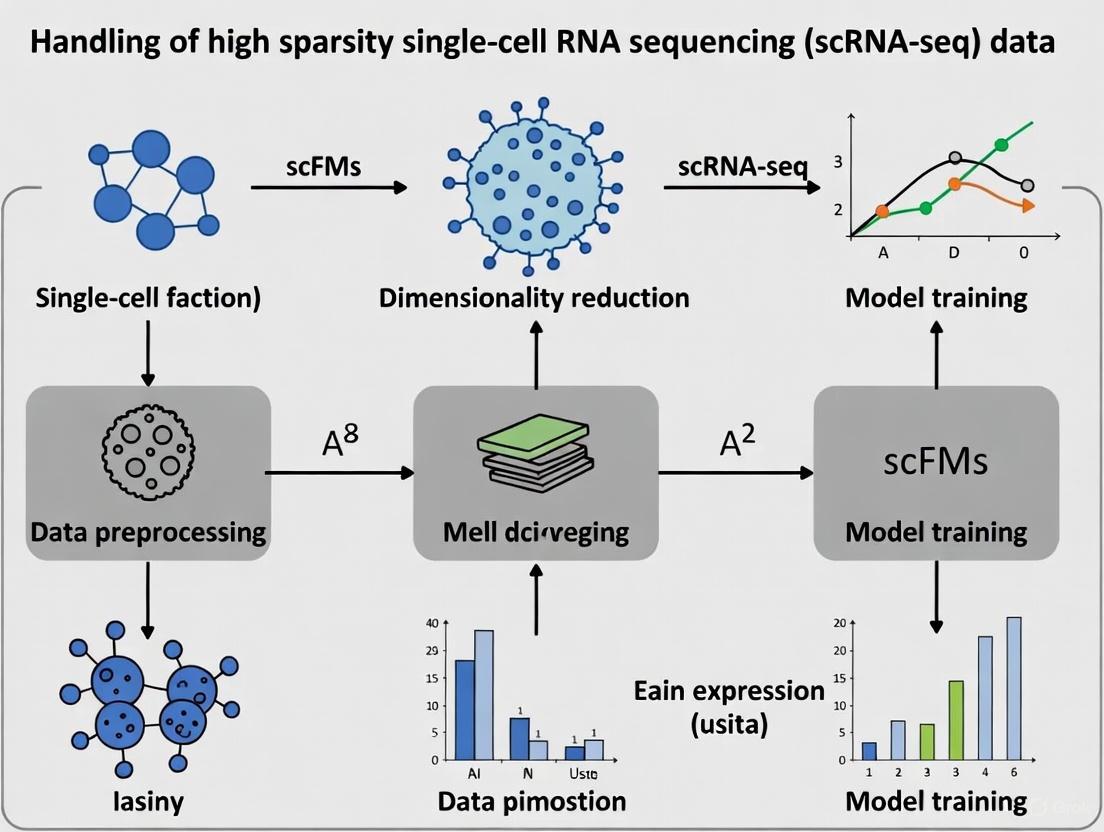
Single-cell RNA sequencing (scRNA-seq) has revolutionized biological research by enabling the study of gene expression at cellular resolution.
Navigating High Sparsity in scRNA-seq Data: A Comprehensive Guide to Single-Cell Foundation Models
Abstract
Single-cell RNA sequencing (scRNA-seq) has revolutionized biological research by enabling the study of gene expression at cellular resolution. However, the characteristic high sparsity of scRNA-seq data, with an abundance of zero values arising from both technical limitations ('dropouts') and true biological absence, presents significant analytical challenges. This article explores the emerging role of single-cell foundation models (scFMs) in overcoming these hurdles. We provide a foundational understanding of data sparsity, detail the architectural innovations of transformer-based scFMs like scGPT and Geneformer, and offer practical guidance for model selection, tuning, and application in tasks such as batch integration, cell type annotation, and perturbation response prediction. Through a critical evaluation of benchmarking studies and performance metrics, we equip researchers and drug development professionals with the knowledge to leverage scFMs effectively, thereby unlocking deeper biological insights from sparse single-cell data for advancements in biomedicine and clinical research.
The Sparsity Challenge and the Rise of scFMs
FAQ: Addressing Key Questions on scRNA-seq Zeros
What causes zeros in my scRNA-seq data?
Zeros, or "zero expression," in your single-cell RNA-sequencing data arise from two primary sources:
- Biological Zeros: These represent the true biological absence of gene expression. The gene is not transcribed in that particular cell.
- Technical Zeros (Dropout Events): These are measurement failures where a gene is expressed but not detected due to technical limitations like low sequencing depth, inefficient reverse transcription, or unsuccessful amplification [1] [2].
A key challenge is that you cannot directly distinguish these two types of zeros by simple observation [1].
Why is it critical to understand the source of these zeros?
Correctly interpreting the nature of zeros is fundamental because it directly impacts your downstream analysis and biological conclusions.
- Data Interpretation: Misinterpreting technical zeros as true biological absence can lead to incorrect conclusions about cell identity and function [1] [3].
- Analysis Strategy: The chosen method for handling sparsity—whether through specialized statistical models or data imputation—depends on the nature of the zeros in your dataset [1].
My dataset is very sparse. Should I impute the zeros?
Imputation can be a powerful tool, but it must be used with caution. Systematic evaluations have shown that while many imputation methods can help recover biological signals, they can also introduce spurious noise [4].
- When it can help: Imputation may improve analyses that rely on gene-gene relationships or when trying to recover a signal that is very close to the technical noise floor [4].
- When to be cautious: The majority of imputation methods did not consistently improve performance in common downstream tasks like clustering and trajectory inference compared to analyzing the non-imputed data. Some methods can create artificial correlations or patterns [4].
- Consider binarization: For extremely sparse datasets with very large cell numbers, an emerging and powerful alternative is to convert your data to a binary format (0 for zero, 1 for non-zero). This approach can capture most of the biological variation while offering massive computational savings [5].
How can I diagnose if my sparsity is a technical problem?
You can assess your data using several key quality control (QC) metrics. The following table summarizes the primary QC metrics used to identify technical issues leading to sparsity [6] [3]:
Table 1: Key QC Metrics for Diagnosing Technical Sources of Sparsity
| QC Metric | What It Measures | Indication of a Technical Problem |
|---|---|---|
| Count Depth | Total number of counts (UMIs/reads) per cell barcode. | Too low: Likely an empty droplet.Too high: Could be a doublet/multiplet. |
| Genes Detected | Number of genes detected per cell barcode. | Too low: Empty droplet or dying cell.Too high: Could be a doublet/multiplet. |
| Mitochondrial Count Fraction | Percentage of counts originating from mitochondrial genes. | Unusually high: Often indicates a stressed, dying, or low-quality cell whose cytoplasmic mRNA has leaked out. |
To visualize the logical process of diagnosing the source of zeros and selecting an analysis strategy, follow this workflow:
Are there analysis methods that work directly with sparse data without imputation?
Yes, this is often the preferred approach. Many modern statistical models are specifically designed to handle the inherent sparsity of scRNA-seq count data without the need for imputation [1].
- Best Practice: For differential expression analysis, use statistical models like negative binomial or zero-inflated models that are appropriate for sparse count data [1].
- Emerging Trend: For clustering, visualization, and other analyses, simply using a binary representation (0 for not detected, 1 for detected) of gene expression can yield results highly similar to count-based methods, especially as datasets grow larger and sparser [5].
The Scientist's Toolkit: Research Reagent Solutions
The following table lists key platforms and methods relevant to generating and analyzing scRNA-seq data in the context of sparsity.
Table 2: Key Platforms & Methods for scRNA-seq and Sparsity Analysis
| Item / Platform | Primary Function | Relevance to Sparsity |
|---|---|---|
| 10X Genomics Chromium | Droplet-based single-cell partitioning and barcoding. | A major source of high-throughput, often sparse, scRNA-seq data. Understanding its limitations is key [7] [8]. |
| UMIs (Unique Molecular Identifiers) | Molecular barcodes to label individual mRNA molecules. | Critical for mitigating technical noise and quantifying molecules accurately, which helps model sparsity [6] [8]. |
| SAVER | Model-based imputation method. | Uses a probabilistic model to recover gene expression values, primarily for technical zeros [4]. |
| MAGIC | Data-smoothing imputation method. | Uses diffusion-based smoothing to impute values and reduce sparsity by sharing information across similar cells [4]. |
| scBFA | Dimensionality reduction for binary data. | A specialized tool for analyzing binarized scRNA-seq data, an alternative approach to handling sparsity [5]. |
| scIALM | Matrix completion imputation method. | A recent (2024) method that treats dropout imputation as a low-rank matrix completion problem [2]. |
The Limitations of Traditional Analysis Methods in Sparse Environments
Frequently Asked Questions (FAQs)
1. Why do traditional clustering methods often fail on my sparse scRNA-seq data? Traditional clustering methods like K-means and hierarchical clustering struggle with the high dimensionality and extreme sparsity of scRNA-seq data. The prevalence of zero counts (dropouts) means that these algorithms often operate on incomplete information, leading to suboptimal cell grouping. Methods that rely on constructing complete graph Laplacian matrices also face significant computational and storage costs, making them inefficient for large, sparse datasets [9].
2. My data has substantial batch effects from multiple species. Why can't standard cVAE models correct them properly? Standard conditional Variational Autoencoders (cVAEs) use Kullback–Leibler (KL) divergence regularization, which does not distinguish between biological and technical variation. Increasing KL regularization strength to remove stronger batch effects simultaneously removes biological signals, resulting in uninformative latent dimensions being set close to zero. This leads to a loss of information crucial for downstream analysis rather than intelligent batch correction [10].
3. What is the risk of using adversarial learning for batch correction on datasets with unbalanced cell types? Adversarial learning aims to make batches indistinguishable in the latent space. However, if cell type proportions are unbalanced across batches, this approach is prone to forcibly mixing embeddings of unrelated cell types. For example, a rare cell type in one batch may be incorrectly aligned with an abundant but biologically distinct cell type from another batch, compromising the biological validity of your integration [10].
4. How does data sparsity specifically impact the identification of cell types and states? High sparsity increases the similarity between cells from distinct populations and the dissimilarity between cells from the same population. This obscures the true biological boundaries between cell types. Consequently, clustering algorithms may either over-cluster, creating spurious subpopulations from noise, or under-cluster, failing to distinguish genuine, biologically distinct cell states [9].
5. Are there specific quality control (QC) pitfalls linked to sparse data? Yes, sparse data complicates QC. It can be challenging to distinguish between low-quality cells (with low gene counts) and genuine small cell types (like platelets). Furthermore, tools for detecting doublets or ambient RNA must be specifically designed to account for high dropout rates to avoid misclassifying singlets as doublets or vice-versa [11].
Troubleshooting Guides
Issue 1: Poor Clustering Performance on Sparse Data
Problem: Your clustering results are inconsistent, fail to separate known cell types, or are not reproducible.
Solution: Implement deep learning-based clustering methods designed for sparse data.
- Recommended Tool: Use
scHSC, a method that employs hard sample mining via contrastive learning [9]. - Protocol:
- Preprocessing: Follow a standard pipeline using
Scanpy:- Filter cells and genes with
sc.pp.filter_cells(min_counts=1)andsc.pp.filter_genes(min_counts=1). - Normalize total counts per cell with
sc.pp.normalize_total(). - Apply a logarithmic transformation with
sc.pp.log1p(). - Identify highly variable genes and scale the data to zero mean and unit variance [9].
- Filter cells and genes with
- Graph Construction: Build a k-nearest neighbor (KNN) graph from the preprocessed data to capture cellular topology.
- Model Training: Apply
scHSC, which integrates gene expression and graph structure. It focuses on "hard" positive and negative sample pairs to learn a more robust embedding space that is resilient to dropouts [9].
- Preprocessing: Follow a standard pipeline using
Issue 2: Batch Effects Persist After Standard Integration
Problem: Technical differences between datasets (e.g., from different labs, species, or protocols) remain visible in your UMAP and are confounding biological analysis.
Solution: Utilize advanced integration models that go beyond standard alignment.
- Recommended Tool: Use
sysVI, a cVAE-based method enhanced with VampPrior and cycle-consistency constraints [10]. - Protocol:
- Model Selection: Choose
sysVIfor complex integration tasks, such as across species or between organoids and primary tissue. - Workflow: The model employs a VampPrior to better preserve biological variation and a cycle-consistency loss to ensure faithful translation of cell states between batches without mixing distinct types.
- Evaluation: Assess integration success using metrics like:
- iLISI: Measures batch mixing (higher is better).
- NMI: Measures cell type preservation (higher is better). Avoid relying solely on visual inspection of UMAP plots [10].
- Model Selection: Choose
Issue 3: Loss of Biological Signal After Batch Correction
Problem: After correcting for batch effects, key biological variations (e.g., differential responses to a treatment) have been removed.
Solution: Select a method that explicitly discriminates between technical and biological noise.
- Recommended Tools: Consider
sysVI(for its VampPrior) or contrastive learning frameworks [10] [9]. - Protocol:
- Avoid Over-Correction: Do not maximize batch correction strength blindly. Tools that use a single weight to regulate both biological and technical information (like KL divergence in simple cVAEs) will inevitably remove signal.
- Benchmark Biological Preservation: After integration, perform differential expression analysis on known marker genes for your cell types to ensure they remain distinct. Use metrics like Normalized Mutual Information (NMI) to quantify cell type separation [10].
- Leverage Structure: Methods like
scHSCthat use graph topology can help preserve the inherent biological structure of the data against the diluting effect of sparsity [9].
The following table summarizes the performance of various methods on key metrics relevant to sparse data analysis, as revealed by benchmark studies.
Table 1: Benchmarking Performance of scRNA-seq Analysis Methods
| Method | Type | Key Strategy | Performance on Sparsity | Performance on Batch Correction | Biological Preservation |
|---|---|---|---|---|---|
| K-means / Hierarchical Clustering [9] | Traditional Clustering | Distance-based partitioning | Struggles with high dropout rates; provides locally optimal results | Not designed for batch correction | Poor, due to sparsity and noise |
| Standard cVAE [10] | Deep Learning (VAE) | KL divergence regularization | Limited; no special mechanism for sparsity | Limited on substantial batch effects; removes biological signal | Low when KL weight is increased |
| Adversarial cVAE (ADV, GLUE) [10] | Deep Learning (VAE + Adversary) | Aligns batch distributions | Can be misled by sparsity-induced similarities | High, but may over-correct and mix distinct cell types | Low; prone to removing biological variation |
| scHSC [9] | Deep Contrastive Clustering | Hard sample mining & graph topology | High; focuses on informative, hard-to-distinguish cells | Not primarily a batch correction tool | High; designed for accurate cell type identification |
| sysVI (VAMP+CYC) [10] | Enhanced cVAE | VampPrior & cycle-consistency | Improved by better latent space modeling | High, even across substantial batch effects (e.g., species) | High; actively preserves biological states |
Experimental Workflow for Sparse Data
The diagram below outlines a robust experimental workflow designed to address the limitations of traditional methods when analyzing sparse scRNA-seq data.
Research Reagent Solutions
Table 2: Essential Computational Tools for scRNA-seq Analysis in Sparse Environments
| Tool / Resource | Function | Role in Addressing Sparsity & Batch Effects |
|---|---|---|
| Scanpy [9] [11] | Python-based toolkit | Provides the standard preprocessing workflow (normalization, log-transform, HVG selection) which is the critical first step in managing sparse data. |
| scHSC [9] | Deep Clustering | Uses contrastive learning and hard sample mining to improve clustering accuracy directly from sparse count data. |
| sysVI [10] | Data Integration | Integrates datasets with substantial technical/biological differences (batch effects) while preserving biological signals that are often lost. |
| Seurat [12] [11] | R-based toolkit | Offers comprehensive workflows for QC, normalization, clustering, and includes methods for data integration and batch correction. |
| scVI [12] | Deep Learning Framework | Uses variational inference to model gene expression, facilitating tasks like batch correction and clustering in a probabilistic manner. |
| Harmony [12] [13] | Batch Correction | Aligns subpopulations across datasets in a reduced space, effectively mixing batches while preserving biological variation. |
| ZINB Model [9] | Statistical Model | Used within autoencoders to model the zero-inflated nature of scRNA-seq data, explicitly accounting for dropouts. |
| SoupX / CellBender [11] | Ambient RNA Correction | Removes background noise from the count matrix, reducing one source of technical zeros and improving data quality. |
Core Concepts: Frequently Asked Questions
What is a Single-Cell Foundation Model (scFM)? A single-cell foundation model is a large-scale deep learning model pretrained on vast amounts of single-cell omics data, capable of being adapted to a wide range of downstream biological tasks. These models use self-supervised learning to extract fundamental patterns and principles of cellular biology, much like large language models learn the patterns of human language from extensive text corpora [14].
How do scFMs handle the high sparsity of scRNA-seq data? scFMs are designed to manage the high dimensionality and sparsity inherent to scRNA-seq data through their architecture and training strategies. Models employ techniques like masked gene modeling, where random genes in a cell's expression profile are masked, and the network is trained to predict them using the context of other genes. This process teaches the model the complex, co-varying relationships between genes, effectively learning to distinguish biological signals from technical noise and dropout events [14] [15].
What are the primary architectures used for scFMs? Most scFMs are built on the transformer architecture, which uses attention mechanisms to weight the importance of relationships between any pair of input tokens (genes). Two main variants are employed:
- Encoder-based models (e.g., scBERT): Use bidirectional attention, learning from the context of all genes in a cell simultaneously. They are often preferred for classification and embedding tasks [14].
- Decoder-based models (e.g., scGPT): Use a unidirectional masked attention mechanism, predicting genes in a sequential manner. These are often used for generation tasks [14]. Currently, no single architecture has emerged as clearly superior, and hybrid designs are being explored [14].
Why is tokenization important, and how is it done? Tokenization converts raw gene expression data into a structured format the model can process. Since gene expression data lacks a natural sequence, a key challenge is imposing an order. Common strategies include:
- Ranking genes within each cell by expression level, treating the ordered list as a "sentence" [14].
- Value binning, where expression values are categorized into bins [14].
- Including special tokens for cell identity or modality to provide additional biological context [14].
Troubleshooting Common Experimental Challenges
Challenge: Model fails to capture biologically meaningful relationships.
- Potential Cause: Inadequate data preprocessing or poor selection of input genes.
- Solution:
- Ensure rigorous quality control on your input data, including filtering low-quality cells and genes.
- For models requiring a fixed input size, use the recommended method for selecting genes (e.g., Highly Variable Genes or ranking by expression) as specified in the model's documentation [14] [16].
- Verify that the pretraining corpus of the scFM is relevant to your biological context (e.g., immune cells, cancer) [16].
Challenge: Batch effects persist after using scFM embeddings.
- Potential Cause: The model's pretraining data may not have covered the specific technical variation in your dataset.
- Solution:
- Consider fine-tuning the pretrained scFM on a portion of your data, which can help it adapt to specific technical biases [14].
- Explore models that are explicitly designed for multi-batch integration. Benchmarking studies suggest that some scFMs excel at removing complex batch effects while conserving biological variance [16] [17].
- As a baseline, compare the scFM's performance against specialized batch integration tools like Harmony or scVI [16].
Challenge: Choosing between a complex scFM and a simpler model.
- Decision Guide: The choice depends on your resources and task.
- Use scFMs when: You have a complex task (e.g., novel cell type discovery, drug sensitivity prediction), need a versatile model for multiple downstream analyses, or require biologically interpretable embeddings [16] [17].
- Consider simpler models when: Working with limited computational resources, analyzing a small, focused dataset, or performing a single, well-defined task where simpler methods like Seurat or Scanpy are sufficient [16] [15]. No single scFM consistently outperforms others across all tasks, so selection should be task-specific [16].
Performance Benchmarking of Select scFMs
The following table summarizes a comprehensive benchmark of six scFMs across various tasks, providing guidance for model selection [16] [17].
Table 1: Benchmarking scFMs Across Key Downstream Tasks
| Model Name | Primary Architecture | Key Strengths | Considerations |
|---|---|---|---|
| Geneformer [16] | Encoder | Effective for gene network analysis; uses gene ranking by expression. | Input is a ranked list of 2,048 genes. |
| scGPT [16] | Decoder | Versatile for multi-omics; supports generation and prediction tasks. | Uses 1,200 Highly Variable Genes (HVGs) as input. |
| UCE [16] | Encoder | Integrates protein sequence information via ESM-2 embeddings. | Uses a unique sampling of genes by expression and genomic position. |
| scFoundation [16] | Asymmetric Encoder-Decoder | Trained on a vast number of protein-coding genes. | Larger model scale requires more computational resources. |
| LangCell [16] | Encoder | Incorporates text (cell type labels) during pretraining. | Relies on the availability of high-quality textual annotations. |
| scCello [16] | Custom | Designed for single-cell resolution analysis. | Specialized architecture may be less general-purpose. |
Table 2: Overall Model Ranking Based on a Holistic Benchmark Study [16] [17]
| Overall Rank | Model | Notable Performance |
|---|---|---|
| 1 | scGPT | Robust and versatile across diverse tasks. |
| 2 | Geneformer | Strong performance in gene-level tasks. |
| 3 | scFoundation | Effective in large-scale data integration. |
| 4 | UCE | Good at leveraging protein context. |
| 5 | LangCell | Shows promise with text integration. |
| 6 | scCello | Specialized for certain analyses. |
Experimental Protocol: Zero-Shot Cell Embedding for Atlas Integration
This protocol details how to use a pretrained scFM to generate cell embeddings without task-specific fine-tuning (zero-shot), ideal for integrating a new dataset into a reference atlas [16] [17].
1. Load Pretrained Model
- Download a publicly available scFM like scGPT or Geneformer.
- Load the model weights into the appropriate framework (e.g., PyTorch, JAX), ensuring all dependencies are installed.
2. Preprocess Query Dataset
- Quality Control: Filter cells and genes based on standard metrics (mitochondrial counts, number of genes detected).
- Gene Set Alignment: Map the genes in your dataset to the gene vocabulary used during the model's pretraining. This may require subsetting to a common set of highly variable genes.
- Normalization: Apply the normalization method (e.g., log(CP10K+1)) consistent with the model's training procedure.
- Tokenization & Input Formatting: Convert the normalized expression matrix into the input format the model expects. For example:
3. Generate Cell Embeddings
- Pass the preprocessed data through the model.
- Extract the cell-level embedding from the model's output layer. This is often a dedicated "[CLS]" token or the model's internal state that summarizes the entire cell.
4. Downstream Analysis: Batch Integration & Annotation
- Visualization: Use UMAP or t-SNE to visualize the scFM embeddings and assess the mixing of batches and separation of cell types.
- Clustering: Apply clustering algorithms (e.g., Leiden, Louvain) on the embeddings to identify cell populations.
- Annotation: Transfer labels from a reference atlas by finding the nearest neighbors of your cells in the scFM embedding space of the annotated reference data.
The Scientist's Toolkit: Essential Research Reagents & Materials
Table 3: Key Resources for scFM Research and Application
| Item / Resource | Function / Description | Example |
|---|---|---|
| Public Cell Atlas Data | Serves as the pretraining corpus for building scFMs. | CZ CELLxGENE [14], Human Cell Atlas [14] |
| Pretrained Model Weights | Allows researchers to use existing scFMs without the prohibitive cost of pretraining. | scGPT [16], Geneformer [16] |
| Standardized Analysis Packages | Provides baseline methods for benchmarking scFM performance. | Seurat [16] [15], Scanpy [15] |
| Specialized Integration Tools | Offers strong baselines for evaluating batch correction performance of scFMs. | Harmony [16], scVI [16] |
| Ontology-Based Metrics | Novel metrics to biologically evaluate the quality of scFM embeddings. | scGraph-OntoRWR, LCAD [16] [17] |
Workflow Diagram: From Single-Cell Data to Foundation Model
The diagram below illustrates the typical workflow for constructing and applying a single-cell foundation model.
How scFMs Learn Universal Representations from Massive, Heterogeneous Datasets
Frequently Asked Questions: Troubleshooting scFMs
FAQ 1: Why does my scFM model perform poorly on a new dataset with a different tissue type? This is often a problem of domain shift. scFMs are pretrained on large corpora but may not generalize perfectly to new biological contexts where cell type distributions or gene expression patterns differ.
- Solution: Utilize the model's fine-tuning capability. Instead of using the model in zero-shot mode, perform additional supervised fine-tuning on a small, annotated subset of your new dataset. This adapts the model's internal representations to the new domain. Leveraging pretrained weights, even for fine-tuning, typically requires less data and converges faster than training a model from scratch [17].
FAQ 2: How do I handle the extreme sparsity and high dimensionality of my scRNA-seq data before using an scFM? scFMs are specifically designed to handle the high sparsity inherent to scRNA-seq data. The key is not to aggressively impute the data beforehand.
- Solution: Trust the model's architecture. Most modern scFMs use transformer networks with self-supervised pretraining objectives (like masked gene modeling) that are inherently capable of learning from sparse data. Preprocessing should focus on robust normalization and quality control, not extensive imputation which can introduce false signals. Let the model learn to distinguish technical zeros from true biological absence through its pretraining [14] [1].
FAQ 3: My model's cell embeddings are dominated by batch effects. What went wrong? This indicates that the model's pretraining may not have encompassed sufficient technical diversity to learn batch-invariant biological representations.
- Solution: First, ensure you are using the cell embeddings from a model specifically benchmarked for integration tasks. If the problem persists, employ a two-step strategy:
- Use the scFM to generate initial cell embeddings.
- Apply a lightweight, post-hoc integration tool like Harmony or Scanorama on these embeddings to remove residual batch effects. This combines the powerful representation of scFMs with specialized batch correction algorithms [17].
FAQ 4: How can I biologically validate that my scFM has learned meaningful representations? Moving beyond standard clustering metrics is key.
- Solution: Use biology-driven evaluation metrics. One method is to analyze the Lowest Common Ancestor Distance (LCAD) in cell ontology for misclassified cells; smaller distances indicate the model confuses biologically similar cell types, a less severe error. Another is scGraph-OntoRWR, which measures if the relationships between cell types in the embedding space align with established biological knowledge from cell ontologies [17].
FAQ 5: When should I choose a complex scFM over a simpler, traditional model? The choice depends on your task, data, and resources.
- Solution: Refer to the following decision table:
| Situation | Recommended Approach | Rationale |
|---|---|---|
| Multiple downstream tasks (e.g., annotation, integration, perturbation) | Use an scFM | scFMs are versatile; one pretrained model can be adapted for various tasks, providing a unified analysis framework [14] [17]. |
| Small, focused dataset for a single task (e.g., DE analysis on one cell type) | Use a simpler model (e.g., scVI, Seurat) | Traditional models can be more efficient and easier to train and interpret for specific, narrow applications [17]. |
| Need for zero-shot learning (e.g., identifying novel cell types) | Use an scFM | The broad knowledge encoded during large-scale pretraining allows scFMs to make inferences on data not seen during training [18] [17]. |
| Limited computational resources | Use a simpler model | Training and fine-tuning large scFMs can be computationally intensive [14]. |
Experimental Protocols for Key scFM Analyses
Protocol 1: Zero-Shot Cell Type Annotation and Evaluation
Objective: To assess an scFM's ability to annotate cell types in a new dataset without task-specific training.
Methodology:
- Embedding Extraction: Pass the target scRNA-seq dataset (count matrix) through the pretrained scFM to obtain a cell embedding for each cell.
- Reference Mapping: Calculate the centroid of each known cell type in the embedding space using a small, labeled reference dataset.
- Annotation: For each cell in the target dataset, assign the cell type label of the nearest reference centroid (e.g., using cosine similarity).
- Evaluation:
- Standard Metrics: Calculate accuracy, F1-score, and weighted precision/recall if ground truth labels are available.
- Biological Metrics: Use Lowest Common Ancestor Distance (LCAD) to assess the biological plausibility of misclassifications. A lower average LCAD suggests the model makes "sensible" errors by confusing closely related cell types [17].
Protocol 2: Benchmarking Data Integration Performance
Objective: To evaluate how well an scFM removes batch effects while preserving biological variance.
Methodology:
- Data Preparation: Select a dataset with known batch effects (e.g., from different donors or sequencing platforms) but with consistently annotated cell types across batches.
- Embedding Generation: Generate cell embeddings for the entire dataset using the scFM.
- Visualization & Metric Calculation:
- Visualize the embeddings using UMAP, coloring points by both batch and cell type.
- Qualitative Assessment: A successful integration will show cells from different batches (colors) mixed together within each cell type cluster.
- Quantitative Assessment: Use metrics like:
- BatchASW (Batch Average Silhouette Width): Measures batch mixing. Closer to 0 is better.
- Cell-type ASW (cASW): Measures biological preservation. Closer to 1 is better.
- Graph Connectivity: Assesses whether cells of the same type form a connected graph [17].
The Scientist's Toolkit: Key Research Reagent Solutions
| Item | Function in scFM Research |
|---|---|
| scGPT | A generative pretrained transformer model for single-cell data. Excels at multi-omic integration, perturbation prediction, and zero-shot cell annotation [14] [18]. |
| Geneformer | A transformer model pretrained on millions of cells. Noted for its context-aware gene embeddings and ability to predict downstream effects of perturbation [17]. |
| CZ CELLxGENE | A platform providing unified access to millions of curated single-cell datasets. Serves as a critical data source for pretraining and benchmarking scFMs [14] [18]. |
| Harmony | A robust batch integration algorithm. Often used in conjunction with scFM-generated embeddings to remove residual technical variation [17]. |
| Cell Ontology | A structured, controlled vocabulary for cell types. Used to develop biology-informed metrics (like LCAD) for validating the biological relevance of scFM embeddings [17]. |
| DISCO Database | A curated single-cell database that aggregates data from multiple studies, useful for training and evaluating the generalizability of scFMs [18]. |
Performance Comparison of scFMs and Traditional Methods
Table: Benchmarking results across various downstream tasks (Summarized from [17]).
| Model / Method | Cell Type Annotation (Avg. Accuracy) | Data Integration (BatchASW / cASW) | Perturbation Prediction | Notes |
|---|---|---|---|---|
| scGPT | High | Good / Good | Excellent | A versatile and robust model, strong all-rounder [18] [17]. |
| Geneformer | Good | Fair / Good | Good | Excels in gene-level tasks and capturing gene network relationships [17]. |
| scFoundation | High | Good / Good | Good | Trained on a massive corpus, demonstrates strong generalizability [17]. |
| Seurat (Traditional) | Variable (dataset-specific) | Good / Fair | Not Applicable | A reliable anchor-based method, but not a foundation model [17]. |
| scVI (Traditional) | Good | Excellent / Good | Limited | A powerful generative model, highly effective for integration and annotation of specific datasets [17]. |
Workflow Diagram: From Sparse Data to Universal Representations
Diagram Title: The scFM Pretraining and Application Workflow
Detailed View: The scFM Architecture Core
Diagram Title: Tokenization and Encoding in scFMs
The analysis of single-cell RNA sequencing (scRNA-seq) data is fundamentally challenged by its high sparsity, characterized by a large number of zero values in the cell-gene expression matrix. These zeros arise from both biological absence of expression and technical "dropout" events, where transcripts are not detected due to limitations in sequencing depth or reverse transcription [1] [2]. This sparsity can hinder downstream analyses such as clustering, trajectory inference, and differential expression.
Transformer architectures, which have revolutionized natural language processing (NLP), are uniquely suited to address this challenge. Their powerful multi-head self-attention mechanism can learn complex, long-range dependencies within data without requiring dimensionality reduction at the input stage, thereby preserving the integrity of the original sparse data and making the model's decisions traceable and interpretable [19] [20] [21]. This technical guide explores how Transformer-based single-cell foundation models (scFMs) are leveraged to handle high sparsity, providing troubleshooting advice and methodological protocols for researchers.
FAQs & Troubleshooting Guides
FAQ 1: How do Transformer models handle the high sparsity and numerous zeros in scRNA-seq data?
Answer: Transformers manage sparsity through several key strategies. Unlike autoencoders that compress data into an abstract latent space, Transformers typically process data without initial dimensionality reduction, keeping all features traceable [19]. Furthermore, the self-attention mechanism dynamically weights the importance of all genes (tokens) when analyzing a cell, effectively learning to "impute" or pay less attention to dropout zeros by contextualizing them with other co-expressed genes [21]. Some models also use data binarization, converting expression counts to a simple 0 (no expression) or 1 (expression detected). This approach embraces zeros as meaningful biological signals and has been shown to provide results comparable to count-based analyses for tasks like cell type identification and dimensionality reduction, while being computationally more efficient [5].
Troubleshooting Guide: Model performance is poor on a very sparse dataset.
- Symptom: Low accuracy in cell type annotation or poor clustering results after training.
- Potential Cause & Solution: The model may be struggling with the noise from technical dropouts overwhelming the true biological signal.
- Consider Binarization: As a preprocessing step, try binarizing your expression matrix. This can reduce the impact of technical noise and has been proven effective for many downstream tasks [5].
- Incorporate Prior Knowledge: Use a knowledge-based mask, such as gene-pathway memberships, to structure the model's initial embedding layer. This guides the model to focus on biologically relevant gene sets and can lead to faster convergence and improved performance compared to using random masks [19].
- Leverage Pre-trained scFMs: Instead of training from scratch, fine-tune a pre-trained single-cell foundation model (scFM). These models have already learned robust feature representations from millions of cells and are better at generalizing to new, sparse data [21].
FAQ 2: What are the best practices for tokenizing non-sequential scRNA-seq data for a Transformer model?
Answer: Tokenization is a critical step for adapting non-sequential gene expression data for Transformer models, which are designed for sequences. The most common approach is to treat each gene as a token [21]. However, since genes lack a natural order, defining their sequence is an active area of development. The table below summarizes prevalent tokenization strategies.
Troubleshooting Guide: The model seems sensitive to the order of input genes.
- Symptom: Significant changes in model output or attention scores when the input gene order is shuffled.
- Potential Cause & Solution: The chosen positional encoding is introducing artificial dependencies.
- Use Expression-Defined Ordering: Adopt a deterministic, cell-specific ordering based on gene expression values, such as ranking genes from highest to lowest expression. This creates a meaningful sequence for the model [21].
- Validate with Random Orders: Experiment with multiple random orderings during training or inference and aggregate the results to ensure robustness [20].
- Explore Alternative Encodings: Investigate models that use learned positional embeddings based on gene attributes (e.g., chromosomal location) or that are specifically designed to be more permutation-invariant [21].
FAQ 3: How can I ensure my Transformer model is biologically interpretable?
Answer: Interpretability is a key advantage of Transformer models. It is achieved primarily through the analysis of attention scores [19] [20]. These scores, which are calculated between a special classification token (CLS) and all gene/pathway tokens, reveal which features the model deems most important for its prediction (e.g., cell type annotation). By examining these scores, researchers can identify key genes or pathways driving a specific cellular state.
Troubleshooting Guide: The attention maps are diffuse and don't highlight known marker genes.
- Symptom: Attention scores are spread evenly across many genes, with no clear biological insight.
- Potential Cause & Solution: The model may not have learned specific, meaningful patterns.
- Inspect Training Data: Ensure the training data is of high quality and that cell type labels are accurate. A model trained on noisy labels will not produce interpretable attention.
- Use Pathway-Level Masking: Instead of raw genes, tokenize the data based on biologically defined gene sets (e.g., pathways, regulons). The attention scores will then directly reflect the importance of these functional units, which are often easier to interpret [19].
- Regularization: Apply regularization techniques during training to prevent overfitting and encourage sparser, more focused attention patterns.
Experimental Protocols
Protocol 1: Implementing a Basic Transformer for Cell Type Annotation
This protocol outlines the steps to implement TOSICA (Transformer for One-Stop Interpretable Cell-type Annotation), a model designed for interpretable cell type transfer from a reference to a query dataset [19].
1. Model Architecture and Workflow The following diagram illustrates the core architecture and data flow of the TOSICA model.
2. Key Reagents and Computational Tools Table 1: Essential Research Reagents and Tools for Implementing TOSICA.
| Item | Function/Description | Example/Note |
|---|---|---|
| Reference Dataset | A scRNA-seq dataset with pre-annotated, high-quality cell type labels. | Human Cell Atlas, PanglaoDB [21]. |
| Query Dataset | The new, unannotated scRNA-seq dataset to be labeled. | Must be normalized and preprocessed similarly to the reference. |
| Knowledge Mask | A binary matrix defining gene membership to biological entities. | Matrices based on pathways (e.g., KEGG, Reactome) or regulons [19]. |
| Transformer Model | The deep learning architecture based on multi-head self-attention. | Implemented in PyTorch or TensorFlow. |
| CLS Token | A trainable parameter vector that aggregates global cell information for classification [19]. | Standard practice in Transformer models. |
3. Step-by-Step Methodology
- Step 1: Data Preprocessing. Normalize both reference and query datasets using standard scRNA-seq pipelines (e.g., SCTransform). Perform feature selection to retain highly variable genes.
- Step 2: Mask Preparation. Construct or download a knowledge mask. This is a binary matrix where rows represent biological entities (e.g., pathways) and columns represent genes, with a 1 indicating membership.
- Step 3: Model Training.
- Input: The normalized gene expression vector for a single cell.
- Cell Embedding: Transform the gene expression vector using a fully connected layer, then apply the knowledge mask. This creates a set of "pathway tokens," where each token's value is derived only from the genes belonging to that pathway.
- Add CLS Token: Append a trainable CLS token to the sequence of pathway tokens.
- Self-Attention: Pass the token sequence through multiple Transformer encoder layers. The multi-head self-attention mechanism allows the model to learn interactions between different pathways.
- Classification: Use the final state of the CLS token to predict cell type probabilities via a linear classifier.
- Loss Function: Train the model using a cross-entropy loss between predictions and reference labels.
- Step 4: Interpretation. Extract attention scores between the CLS token and all pathway tokens. High attention scores for a pathway indicate its importance in classifying that cell type.
Protocol 2: Benchmarking Transformer Models Against Sparsity
1. Experimental Design Workflow This workflow outlines the process for systematically evaluating a model's performance as data sparsity increases.
2. Key Performance Metrics Table 2: Quantitative Metrics for Evaluating Model Performance on Sparse Data.
| Metric | Formula/Description | Interpretation in Sparsity Context | ||
|---|---|---|---|---|
| Accuracy (ACC) | ( \text{ACC} = \frac{\text{Correct Predictions}}{\text{Total Predictions}} ) | Measures overall cell type annotation correctness as zeros increase. | ||
| Mean Absolute Error (MAE) | ( \text{MAE} = \frac{1}{n}\sum_{i=1}^{n} | yi - \hat{y}i | ) | Evaluates error in imputation tasks; lower is better [2]. |
| Adjusted Rand Index (ARI) | Measures similarity between two data clusterings, corrected for chance. | Assesses clustering stability on sparse data; closer to 1 is better [2]. | ||
| Silhouette Score (SS) | Measures how similar an object is to its own cluster compared to other clusters. | Evaluates cluster separation in latent space; higher scores indicate better-defined clusters [5]. |
3. Step-by-Step Methodology
- Step 1: Dataset Preparation. Select a scRNA-seq dataset with known "ground truth" cell type labels.
- Step 2: Sparsity Simulation. Artificially introduce additional zeros into the dataset to mimic higher dropout rates. This can be done by randomly masking a defined percentage (e.g., 10%, 30%, 50%) of non-zero expression values.
- Step 3: Model Application. Run the Transformer model (e.g., TOSICA, scBERT) and baseline methods (e.g., Seurat, SCANPY) on the sparsified datasets.
- Step 4: Metric Calculation. For each sparsity level and method, calculate the performance metrics listed in Table 2.
- Step 5: Analysis. Plot metrics against the sparsity level. A model that is robust to sparsity will show a slower decline in performance (e.g., Accuracy, ARI) as sparsity increases.
The Scientist's Toolkit
Table 3: Key Research Reagent Solutions for Transformer-based scRNA-seq Analysis.
| Item Category | Specific Examples | Function in Research |
|---|---|---|
| Pre-trained Models | scBERT, GeneFormer, scGPT [21] | Provide a foundational understanding of gene regulation for transfer learning, reducing the need for extensive training data. |
| Data Resources | CZ CELLxGENE, Human Cell Atlas, PanglaoDB [21] | Provide large-scale, annotated scRNA-seq datasets essential for pre-training and benchmarking models. |
| Knowledge Databases | MSigDB, KEGG, Reactome, DoRothEA | Provide curated gene sets for creating knowledge masks to improve model interpretability and biological relevance [19]. |
| Imputation Methods | MAGIC, DCA, ALRA, scIALM [2] | Algorithms used to recover technical zeros in sparse expression matrices before downstream analysis, though their use before Transformers is debated. |
Architectures and Practical Applications of scFMs
Conceptual Foundation: How scFMs Tackle scRNA-seq Sparsity
Single-cell RNA sequencing (scRNA-seq) data is characterized by its high sparsity, containing a large number of observed zero values. These zeros arise from two primary sources: true biological absence of expression ("biological zeros") and technical failures in detection ("technical zeros" or "dropouts") [1] [15]. This sparsity poses significant challenges for downstream analysis, as it can obscure true biological signals and relationships.
Single-cell foundation models (scFMs) address this sparsity challenge through large-scale pre-training on millions of cells [22] [14]. By learning from vast datasets, these models develop robust representations that are less sensitive to technical noise. The transformer architectures at the core of scFMs utilize attention mechanisms that can learn complex gene-gene relationships, effectively inferring missing values based on contextual patterns observed during training [14]. Rather than performing explicit imputation as a separate step, scFMs inherently learn to compensate for sparsity through their pre-training objectives, such as masked language modeling where the model learns to predict randomly masked gene expressions based on their context [22] [14].
Comparative Analysis of Single-Cell Foundation Models
Technical Specifications and Implementation
Table 1: Technical specifications of major single-cell foundation models
| Model | Architecture Type | Pre-training Data Scale | Input Gene Count | Output Dimension | Key Features | Sparsity Handling |
|---|---|---|---|---|---|---|
| scGPT [16] [14] | Decoder-style Transformer | 33 million cells | 1,200 HVGs | 512 | Multi-omic support; value binning | Masked gene modeling with MSE loss |
| Geneformer [16] [14] | Encoder | 30 million cells | 2,048 ranked genes | 256/512 | Rank-based encoding; gene attention | MLM with causal attention |
| UCE [16] | Encoder | 36 million cells | 1,024 non-unique genes | 1,280 | Protein embeddings from ESM-2 | Modified MLM with binary classification |
| scFoundation [22] [16] | Asymmetric Encoder-Decoder | 50 million cells | ~19,000 genes | 3,072 | Read-depth-aware pre-training | MLM with MSE loss on non-zero genes |
| LangCell [16] | Encoder | 27.5 million cell-text pairs | 2,048 ranked genes | 256 | Text integration; ranking | Order-based modeling |
Performance Characteristics for Sparse Data
Table 2: Performance comparison across biological tasks (2025 benchmarking data) [16] [17]
| Model | Cell Type Annotation | Batch Integration | Gene Function Prediction | Robustness to High Sparsity | Computational Demand |
|---|---|---|---|---|---|
| scGPT | High | Medium-High | Medium | High | High |
| Geneformer | Medium | Low-Medium | Medium | Medium | Medium |
| UCE | Medium-High | Medium | High | Medium | High |
| scFoundation | High | High | High | High | Very High |
| LangCell | Medium | Medium | Medium-High | Medium | Medium |
Troubleshooting Guide: Common Experimental Issues and Solutions
Data Preprocessing and Quality Control
Q: My dataset has extremely high sparsity (>95% zeros). Which scFM is most appropriate?
A: For extremely sparse datasets, scFoundation and scGPT generally demonstrate superior robustness [22] [16]. scFoundation's read-depth-aware pre-training specifically handles varying sampling distributions, while scGPT's value binning approach provides stability against high dropout rates. Consider these strategies:
- Apply quality filters to remove low-quality cells while preserving biological heterogeneity
- Avoid aggressive gene filtering that might remove biologically relevant but rarely detected transcripts
- Utilize the model's inherent handling of sparsity rather than pre-imputing, which can introduce biases [1]
Q: How should I preprocess my scRNA-seq data before applying scFMs?
A: Preprocessing requirements vary significantly by model [22] [16]:
- For Geneformer and LangCell: Implement rank-based encoding where genes are ordered by expression level within each cell
- For scGPT: Use log normalization followed by value binning for continuous expression values
- For scFoundation: Provide raw counts or log-normalized values without extensive preprocessing
- For UCE: Prepare expression values compatible with protein embedding integration
Q: What are the recommended computing resources for fine-tuning scFMs on sparse datasets?
A: Computational requirements vary substantially [16]:
- Minimum configuration: GPU with 16GB+ VRAM (e.g., NVIDIA RTX 4080, A5000)
- Recommended for large datasets: GPU with 24GB+ VRAM (e.g., NVIDIA RTX 4090, A6000)
- Memory requirements: 32-64GB system RAM depending on dataset size
- Training time: 2-48 hours for fine-tuning on typical datasets (10k-100k cells)
Model Selection and Performance Optimization
Q: In zero-shot settings, my scFM embeddings show poor cell type separation. What alternatives exist?
A: This is a documented limitation [23]. When foundation models underperform in zero-shot settings:
- Consider simpler methods: Highly Variable Genes (HVG) selection often outperforms scFMs for clustering tasks [23]
- Evaluate specialized methods: scVI and Harmony provide robust alternatives for batch integration and visualization [23]
- Perform limited fine-tuning: Even minimal fine-tuning (1-2 epochs) on a small subset of labeled data can dramatically improve performance [16]
- Hybrid approach: Extract embeddings from scFMs then apply traditional clustering algorithms
Q: How do I choose between multiple scFMs for my specific research question?
A: Model selection should be guided by task requirements and dataset characteristics [16] [17]:
- For gene regulatory inference: scRegNet (built on scFoundation) demonstrates state-of-the-art performance [22]
- For multi-omic integration: scGPT provides native support for multi-modal data [16] [14]
- For transfer learning with limited data: Geneformer's mechanistic representations show strong transferability [16]
- For text integration: LangCell enables natural language queries and annotations [16]
Q: Batch effects persist in my integrated data despite using scFMs. How can I improve integration?
A: Batch correction remains challenging for scFMs [23]. Consider these approaches:
- Apply specialized integration tools: Use scVI, Harmony, or Scanorama after extracting scFM embeddings [23]
- Leverage model-specific features: scGPT offers explicit batch correction capabilities through conditional generation
- Staged processing: Perform initial integration with specialized methods, then apply scFMs for downstream analysis
- Hyperparameter tuning: Adjust integration strength parameters to balance batch removal and biological preservation
Experimental Protocols for scFM Implementation
Standard Workflow for scFM Application
Protocol 1: Zero-Shot Embedding Generation
Purpose: Generate cell embeddings without task-specific fine-tuning for exploratory analysis [23].
Materials:
- Processed scRNA-seq data (cell × gene matrix)
- Pre-trained scFM weights
- Python environment with appropriate libraries (PyTorch, Transformers)
Procedure:
- Data Normalization: Apply model-specific normalization (log(CP10K+1) for most models)
- Tokenization: Convert expression values to model-specific token sequences
- For Geneformer: Rank genes by expression and select top 2,048
- For scGPT: Bin expression values and select top 1,200 HVGs
- Embedding Extraction: Forward pass through model to extract cell embeddings
- Quality Assessment: Evaluate embedding quality using clustering metrics (ASW, ARI)
Troubleshooting:
- Poor separation may indicate need for fine-tuning [23]
- Batch effects may require additional integration steps [23]
Protocol 2: Fine-tuning for Cell Type Annotation
Purpose: Adapt pre-trained scFMs for specific cell type classification tasks [16].
Materials:
- Pre-computed scFM embeddings
- Reference cell type labels (partial or complete)
- GPU-enabled computing environment
Procedure:
- Data Partitioning: Split data into training/validation sets (80/20 recommended)
- Classifier Attachment: Add task-specific classification head to base model
- Fine-tuning: Train with cross-entropy loss for 10-50 epochs
- Evaluation: Assess performance on held-out validation set
- Application: Apply trained model to unlabeled data
Optimization Tips:
- Use gradual unfreezing of layers for stability
- Employ learning rate warmup for transformer fine-tuning
- Monitor for overfitting with early stopping
The Scientist's Toolkit: Essential Research Reagents
Table 3: Key computational tools and resources for scFM research
| Tool/Resource | Type | Purpose | Relevance to Sparsity |
|---|---|---|---|
| Scanpy [24] | Python toolkit | Single-cell analysis ecosystem | Compatible with scFM embeddings for downstream analysis |
| Seurat [24] | R toolkit | Single-cell analysis and integration | Alternative approach for sparse data modeling |
| CellxGene [14] | Data resource | Curated single-cell datasets | Source of high-quality training and benchmarking data |
| scVI [23] | Deep generative model | Probabilistic modeling of scRNA-seq | Strong baseline for sparse data handling |
| Harmony [23] | Integration algorithm | Batch effect correction | Complementary to scFMs for data integration |
| UNCURL [25] | Preprocessing framework | Matrix factorization for sparse data | Preprocessing option for extremely sparse datasets |
Frequently Asked Questions
FAQ 1: What is tokenization in the context of single-cell RNA-seq data and foundation models? Tokenization is the process of converting raw gene expression data from single-cell RNA sequencing (scRNA-seq) into discrete units, or "tokens," that can be processed by deep learning models, particularly transformers. In single-cell foundation models (scFMs), individual cells are treated analogously to sentences, and genes or other genomic features along with their expression values are treated as words or tokens [14]. This process standardizes the unstructured, high-dimensional scRNA-seq data into a structured format that transformer-based architectures can understand and learn from.
FAQ 2: Why is tokenization particularly challenging for sparse scRNA-seq data? scRNA-seq data is characterized by a high degree of sparsity, containing a large number of observed zeros [1]. A clear trend is that an increasing number of cells in a dataset is highly correlated with decreasing detection rates (the fraction of non-zero values) [5]. These zeros can represent either true biological absence of expression or "technical zeros" due to methodological noise and limitations in capturing barely expressed transcripts [1]. This sparsity, combined with the non-sequential nature of gene expression data where genes have no inherent ordering, makes defining a meaningful token sequence difficult [14].
FAQ 3: What are the primary strategies for tokenizing gene expression data? The main strategies involve deciding how to represent genes and their values as tokens, and how to order these tokens into a sequence.
| Strategy | Description | Considerations |
|---|---|---|
| Expression Ranking [14] | Ranks genes within each cell by expression level; the ordered list of top genes is the 'sentence'. | Provides a deterministic sequence based on magnitude. |
| Value Binning [14] | Partitions genes into bins based on expression values, using rankings to determine sequence position. | Offers an alternative discretization of expression values. |
| Binary Representation [5] | Uses a binarized representation (zero vs. non-zero counts) instead of full count data. | Highly efficient for sparse data; can analyze far more cells with the same resources. |
| Gene Identifier + Value [14] | Represents each gene as a token embedding combining a gene identifier and its expression value. | Retains more quantitative information. |
FAQ 4: How does a binary tokenization strategy help with data sparsity? Downstream analyses on binary-based gene expression (zero vs. non-zero) have been shown to give similar results to count-based analyses for tasks like dimensionality reduction, data integration, cell type identification, and differential expression analysis [5]. This is because, as datasets become sparser, counts become less informative relative to binarized expression. A major advantage is computational efficiency: a binary representation can scale up to approximately 50-fold more cells using the same computational resources [5].
FAQ 5: What are some advanced tokenization approaches used in modern scFMs? Modern models like scSFUT (Single-Cell Scale-Free and Unbiased Transformer) segment each cell's high-dimensional data into smaller, information-dense sub-vectors using a fixed window size, which allows the model to learn from the data at its original scale without aggressive gene filtering [26]. Other models incorporate special tokens for cell identity, metadata, or omics modality to provide richer context [14]. The embedding of a token often combines the gene identifier's embedding with a representation of its expression value.
Troubleshooting Guides
Problem 1: Poor Model Generalization to New Datasets
- Symptoms: The scFM performs well on training data but fails to accurately annotate cell types or predict expression in new, unseen datasets from different labs or conditions.
- Potential Causes:
- Solutions:
- During Tokenization: Employ a tokenization strategy that is not dependent on a universal gene list. For example, models like scSFUT process data using a fixed window size across the native gene dimension, making them more flexible [26].
- Data Preprocessing: Use batch effect correction algorithms (e.g., Harmony, Combat) on the tokenized data or the resulting latent embeddings [27] [14].
- Model Design: Choose or develop models that use precision-preserving attention mechanisms designed for end-to-end learning across the full gene length, reducing bias [26].
Problem 2: Loss of Biologically Relevant Information
- Symptoms: Key rare cell populations are missed, or the model fails to identify meaningful differential expression in downstream tasks.
- Potential Causes:
- Solutions:
- Strategy Selection: For tasks where quantitative differences are critical, avoid simple binarization and use strategies that preserve more value information (e.g., Gene Identifier + Value) [14].
- Leverage Probabilistic Models: For a more nuanced approach, use model-based imputation methods (e.g., DCA, scVI) as a preprocessing step. These methods use probabilistic models to distinguish technical zeros from biological zeros and impute values accordingly before tokenization [1].
Problem 3: High Computational and Memory Demands
- Symptoms: Training or inference is prohibitively slow, or the model runs out of memory, especially with large cell numbers.
- Potential Causes:
- Solutions:
- Model Architecture: Utilize models that implement efficient attention mechanisms, such as the low-rank attention in scGPT or the "unbiased Transformer" in scSFUT, designed to manage computational load [26] [14].
- Binary Tokenization: If scientifically justified for the analysis goal, adopt a binary tokenization strategy. This drastically reduces memory footprint and increases processing speed [5].
- Input Segmentation: Adopt methods like scSFUT that segment the gene vector, allowing the processing of high-dimensional data in parts [26].
Experimental Protocols & Workflows
Protocol 1: Standard Tokenization with Expression Ranking
This is a common method for preparing scRNA-seq data for transformer-based models like scBERT and scGPT [14].
- Input: A normalized count matrix (cells x genes).
- Quality Control: Filter out low-quality cells and genes. For example, remove genes expressed in fewer than three cells [26].
- Gene Selection (Optional but common): For models that require it, select a subset of Highly Variable Genes (HVGs) to reduce sequence length. Note: Some modern models like scSFUT avoid this step to prevent information loss [26].
- Cell-wise Ranking: For each cell, rank all genes based on their expression value from highest to lowest.
- Token Sequence Construction: For each cell, create its input sequence by listing the gene identifiers in the order of their rank. The expression values themselves are often integrated into the token embeddings.
- Positional Encoding: Apply positional encodings to the token sequences to inform the model of the gene order.
Protocol 2: Binary Tokenization for Sparse Data Analysis
This protocol is effective for maximizing computational efficiency and has been shown to be sufficient for many downstream analysis tasks in sparse datasets [5].
- Input: A raw or normalized count matrix (cells x genes).
- Binarization: Convert the count matrix to a binary matrix. All non-zero counts are set to 1, and zero counts remain 0.
X_binary = (X > 0).astype(int)
- Dimensionality Reduction (Optional but Recommended): Apply a dimensionality reduction technique suitable for binary data.
- Options: Principal Component Analysis (PCA) on the binary matrix, or specialized methods like scBFA (Binary Factor Analysis) [5].
- Downstream Analysis: Use the reduced dimensions or the binary matrix directly for tasks like clustering, visualization, or differential expression analysis using methods designed for binary data [5].
Performance Comparison of Tokenization Strategies
The table below summarizes key characteristics of different tokenization approaches, based on evaluations reported in the literature.
| Tokenization Strategy | Reported Performance / Advantage | Computational Efficiency |
|---|---|---|
| Binary Representation [5] | Similar results to count-based analyses for clustering, integration, and annotation (Median F1-score ~0.93). | ~50x more cells analyzed with same resources. Ideal for large, sparse datasets. |
| Expression Ranking (scBERT) [26] | Effective for cell type annotation, but may rely on pre-selected HVGs, potentially losing information. | Standard transformer cost; can be limited by gene list length. |
| Scale-Free & Unbiased (scSFUT) [26] | Outperforms state-of-the-art methods in cross-species cell annotation; avoids HVG selection. | Designed for efficiency with segmented input and unbiased attention. |
| Full-Gene with Value Embedding [14] | Retains maximum quantitative information from the transcriptome. | Highest computational demand due to long sequences and dense value processing. |
The Scientist's Toolkit: Research Reagent Solutions
| Item / Resource | Function in Tokenization & scFMs |
|---|---|
| Public Data Archives (e.g., CZ CELLxGENE, Human Cell Atlas) [14] | Provides large-scale, diverse scRNA-seq datasets essential for pre-training foundation models. |
| Scanpy [26] | A versatile Python toolkit for single-cell data analysis. Used for critical preprocessing steps like quality control, normalization, and filtering before tokenization. |
| Transformer Architectures (e.g., BERT, GPT) [14] | The core deep learning model architecture. Understanding its components (attention, embedding layers) is key to designing custom tokenizers. |
| Self-Supervised Learning (SSL) [26] [14] | A training paradigm where the model learns from data without explicit labels (e.g., by predicting masked tokens). Fundamental for pre-training scFMs on unlabeled data. |
| Batch Correction Algorithms (e.g., Harmony, Combat) [27] | Used to mitigate technical variation between datasets, which can be applied before or after tokenization to improve model generalization. |
Troubleshooting Guide & FAQs for Single-Cell Foundation Models
Frequently Asked Questions
FAQ 1: Why is handling data sparsity so critical for pretraining scFMs? scRNA-seq data is inherently sparse, containing a large proportion of zero values. These zeros represent a mix of true biological absence of expression and technical "dropouts" where a transcript was present but not detected [1]. This sparsity can obscure true biological signals [12]. When datasets measure more cells, they often become even sparser [5]. Pretraining scFMs effectively on such data requires strategies that can distinguish meaningful biological signals from this technical noise.
FAQ 2: My model fails to learn meaningful representations. Could the pretraining task be the issue? Yes, the choice of pretraining task is fundamental. Research indicates that Masked Autoencoders (MAE) generally excel in scRNA-seq data compared to some contrastive learning methods [28]. A successful strategy involves creating biologically-informed masking strategies, such as masking random genes or entire functional gene programmes, which forces the model to learn robust contextual relationships [28].
FAQ 3: What is a key advantage of using a self-supervised approach for my sparse single-cell data? SSL allows you to leverage vast amounts of unlabeled scRNA-seq data to learn generalizable patterns of gene expression. Models pre-trained on large, diverse auxiliary datasets (like the CELLxGENE census) learn a rich data representation. This provides a powerful starting point that can be fine-tuned for specific tasks, often leading to better performance, especially on sparse target datasets [28].
FAQ 4: How can I assess if my scFM has learned biologically relevant features from the sparse data? Beyond standard performance metrics, you can use novel, biology-driven evaluation methods. The scGraph-OntoRWR metric assesses whether the cell-type relationships captured by your model's embeddings are consistent with established biological knowledge from cell ontologies. Another metric, the Lowest Common Ancestor Distance (LCAD), evaluates the severity of cell type misannotation by measuring their proximity in a known ontological hierarchy [16].
FAQ 5: No single scFM seems to be the best. How do I choose? Benchmarking studies confirm that no single scFM consistently outperforms all others across every task or dataset [16]. Your choice should be guided by your specific goal. The table below summarizes the strengths of several prominent models to aid your selection.
Table: Key Characteristics of Selected Single-Cell Foundation Models
| Model Name | Primary Strengths and Characteristics |
|---|---|
| scGPT | Robust all-around performer across various tasks, supports multi-omic data [16] [29]. |
| Geneformer | Excels in gene-level tasks; uses a ranked-genes input approach [16] [29]. |
| scFoundation | Strong performance on gene-level tasks, trained on a large number of genes [16]. |
| scBERT | May lag in performance due to smaller model size and training data [16] [29]. |
Troubleshooting Common Experimental Issues
Problem: Poor Model Generalization to New Datasets
- Symptoms: The model performs well on its training data but fails to achieve good performance (e.g., in cell type annotation) on new, unseen datasets.
- Possible Causes & Solutions:
- Cause 1: The pre-training dataset lacked diversity.
- Cause 2: High dataset-specific technical noise or batch effects are overwhelming the biological signal.
Problem: Inefficient Learning from Sparse Data
- Symptoms: The model converges slowly or its performance plateaus at a low level during pre-training.
- Possible Causes & Solutions:
- Cause 1: The standard random masking strategy is not effective for highly sparse data.
- Solution: Implement more sophisticated masking strategies. Gene Programme (GP) masking, which masks groups of functionally related genes, can force the model to learn higher-order biological context [28].
- Cause 2: The model architecture is not well-suited for sparse, high-dimensional input.
- Solution: Consider architectures specifically designed for sparsity. For example, the scRobust model combines contrastive learning with gene expression prediction tasks within a Transformer framework to better handle missing data [30].
- Cause 1: The standard random masking strategy is not effective for highly sparse data.
Problem: Suboptimal Performance on Downstream Tasks After Pre-training
- Symptoms: Pre-training seems successful (low loss), but fine-tuning on a specific task like differential expression yields poor results.
- Possible Causes & Solutions:
- Cause 1: A disconnect between the pre-training objective and the downstream task.
- Solution: Align your pre-training and fine-tuning more closely. If your goal is differential expression, a pre-training task that focuses on reconstructing gene expression values (like MAE) may be more suitable than one designed only for cell embedding.
- Cause 2: The "zero-shot" capabilities of the model are insufficient for the task complexity.
- Solution: Always plan for a fine-tuning step. While zero-shot evaluation is a good diagnostic, supervised fine-tuning on a portion of your target data almost always improves performance [28].
- Cause 1: A disconnect between the pre-training objective and the downstream task.
Experimental Protocols & Workflows
Protocol 1: Implementing a Masked Gene Modeling Pre-training Task
Principle: The model is trained to reconstruct randomly masked portions of a cell's gene expression profile, learning the contextual relationships between genes [14] [28].
Materials:
- Hardware: GPU-enabled computing environment.
- Software: Python with PyTorch or TensorFlow, and scFM frameworks (e.g., scGPT, BioLLM [29]).
- Data: A large, normalized scRNA-seq count matrix (cells x genes).
Methodology:
- Input Representation (Tokenization):
- Masking:
- Randomly select a percentage (e.g., 15-30%) of the gene tokens in each input sequence.
- Replace these selected tokens with a special
[MASK]token.
- Model Architecture & Training:
Protocol 2: Benchmarking scFMs on a Sparse Target Dataset
Principle: Evaluate the effectiveness of a pre-trained scFM by applying it to a downstream task on a new, potentially sparse, dataset in a "zero-shot" or "fine-tuned" setting [16] [28].
Materials:
- Pre-trained scFM model weights.
- Target scRNA-seq dataset with relevant labels (e.g., cell type, condition).
Methodology:
- Feature Extraction:
- Zero-Shot: Pass the target dataset through the pre-trained model without updating its weights. Extract the cell embeddings from the model's output layer.
- Fine-Tuning: Further train the pre-trained model on the target dataset with a small amount of labeled data.
- Downstream Task Execution:
- Use the extracted embeddings to perform tasks like cell type annotation (e.g., using a k-NN classifier) or data visualization (e.g., UMAP) [28].
- Performance Evaluation:
- Cell Type Annotation: Calculate the macro F1-score to handle class imbalance and the Lowest Common Ancestor Distance (LCAD) to gauge the biological reasonableness of errors [16].
- Data Integration: Use metrics like the Local Inverse Simpson's Index (LISI) to quantify batch mixing [5] [16].
- Gene-Level Analysis: For tasks like gene expression reconstruction, use metrics like weighted explained variance [28].
Table: Key Metrics for Evaluating scFMs on Sparse Data
| Task Category | Evaluation Metric | What It Measures |
|---|---|---|
| Cell Type Annotation | Macro F1-Score | Model's accuracy in predicting cell types, robust to class imbalance [28]. |
| Lowest Common Ancestor Distance (LCAD) | Biological plausibility of misclassifications based on cell ontology [16]. | |
| Data Integration & Embedding Quality | LISI Score | Effectiveness of batch effect correction and cell mixing [5] [16]. |
| scGraph-OntoRWR | Concordance of learned cell relationships with prior biological knowledge [16]. | |
| Gene-Level Task | Weighted Explained Variance | Accuracy of gene expression reconstruction or prediction [28]. |
The Scientist's Toolkit
Table: Essential Research Reagents and Computational Tools
| Item / Resource | Function / Application | Relevance to Sparse Data & scFMs |
|---|---|---|
| CZ CELLxGENE [14] [28] | A curated data repository of single-cell datasets. | Provides massive, diverse datasets essential for pre-training generalizable models on sparse data. |
| BioLLM Framework [29] | A unified software framework for integrating and applying various scFMs. | Standardizes benchmarking and model switching, allowing researchers to find the best model for their sparse data challenge. |
| Harmony [5] [16] | Algorithm for integrating datasets and correcting batch effects. | Used in post-processing or analysis of scFM embeddings to ensure technical variation doesn't confound biological signals. |
| scVI [16] [1] | A probabilistic deep learning framework for single-cell data. | A strong baseline model that uses a zero-inflated negative binomial loss, explicitly modeling the sparsity of scRNA-seq data. |
| Transformer Architecture [14] [30] | Neural network model using self-attention mechanisms. | The backbone of most scFMs; its attention mechanism can learn which genes are most informative despite sparsity. |
Batch Integration, Cell Type Annotation, and Rare Cell Identification
Frequently Asked Questions (FAQs)
Batch Integration
Q1: Our integrated scRNA-seq data shows poor alignment of the same cell types across batches. What methods are recommended for effective batch-effect correction?
Batch-effect correction is crucial for integrating datasets from different experiments. Based on recent benchmarking studies, the following methods are recommended for their efficacy in removing batch effects while preserving biological variation.
- Recommended Methods: Harmony is highly recommended due to its strong performance across multiple benchmarks and significantly shorter runtime, making it suitable for large datasets [31] [32]. LIGER and Seurat 3 also perform well, particularly in complex integration scenarios [32].
- Methods to Use with Caution: Methods such as MNN, SCVI, and LIGER (in some tests) have been shown to introduce measurable artifacts or alter the data considerably during correction [31]. ComBat, ComBat-seq, BBKNN, and Seurat can also introduce detectable artifacts [31].
Table 1: Benchmarking of Common Batch Correction Methods
| Method | Recommended Use | Key Strengths | Noted Limitations |
|---|---|---|---|
| Harmony | Primary recommendation [31] [32] | Fast; well-calibrated; good batch mixing [31] [32] | - |
| LIGER | Alternative, especially for biological variation [32] | Separates technical and biological variation [32] | Can alter data considerably; longer runtime [31] [32] |
| Seurat 3 | Alternative for diverse tasks [32] | Good performance on multiple tasks [32] | May introduce artifacts [31] |
| ComBat | Use with caution | Established method | Can introduce artifacts; may not handle scRNA-seq sparsity well [31] |
| MNN | Not recommended | Early scRNA-seq specific method | Poor calibration; alters data considerably [31] |
Experimental Protocol: Batch Integration with Harmony
- Input Preparation: Prepare a normalized count matrix (e.g., from SCTransform) and a metadata vector specifying the batch for each cell [31].
- Dimensionality Reduction: Perform PCA on the normalized data to obtain a low-dimensional embedding [31].
- Run Harmony: Apply the Harmony algorithm to the PCA embedding and batch metadata. Harmony iteratively clusters cells and corrects their positions to maximize batch mixing within clusters [31] [32].
- Output: The output is a corrected embedding. Use this corrected embedding instead of the original PCA coordinates for all downstream analyses, such as UMAP visualization and clustering [31].
Batch Integration Workflow with Harmony
Cell Type Annotation
Q2: When annotating cell types in a sparse scRNA-seq dataset, an automated tool provided conflicting or low-confidence labels. How should we proceed?
Automated annotation tools are a good starting point, but their results should always be verified, especially with sparse data. A combined approach using automated tools and manual annotation is considered best practice [33].
- Leverage Automated Tools: Use reference-based tools like SingleR or scPred to get an initial annotation [5] [33]. These tools compare your cells to curated reference datasets.
- Manual Verification with Markers: Always verify automated labels by checking the expression of 2-3 well-established canonical marker genes for the proposed cell type using feature plots or violin plots [33]. The strong correlation between binarized expression (detection rate) and counts means that for sparse data, simply checking if a marker gene is "on" or "off" in a cluster can be highly informative [5].
- Optimize Clustering Resolution: Before annotation, ensure your clustering is appropriate. Low resolution may merge distinct cell types, while high resolution may split the same cell type unnecessarily. Examine top marker genes for each cluster to decide if merging is needed [33].
Table 2: Cell Type Annotation Tools and Their Applications
| Tool / Method | Type | Best For | Considerations for Sparse Data |
|---|---|---|---|
| SingleR | Automated, reference-based | Fast, preliminary annotation (human/mouse) [33] | Performance may vary with sparsity; verify with markers. |
| scPred | Automated, classification-based | Cell type identification [5] | Can perform well on binarized data [5]. |
| Manual Annotation | Manual, marker-based | High-confidence annotation; gold standard [33] | Binarized visualization of marker detection can be effective [5]. |
| Gene Set Activity | Semi-automated | Interpreting clusters using pathways (e.g., GO, KEGG) [34] | Can be noisy; best for visualization over statistical testing [34]. |
Experimental Protocol: Manual Cell Type Annotation
- Cluster Cells: Generate cell clusters using your chosen method (e.g., Leiden, Louvain).
- Find Marker Genes: Identify genes that are differentially expressed in each cluster compared to all others.
- Compile Marker List: From published literature and authoritative databases, compile a list of 2-3 canonical marker genes for expected cell types in your tissue [33].
- Visualize Expression: Create UMAP or feature plots for these canonical markers.
- Assign Labels: Assign a cell type label to a cluster if its cells consistently express the expected markers and lack markers for other types [33].
Q3: We have a cluster that does not express any known canonical markers. What could this be and how can we identify it?
Unclassified clusters are common and can result from several factors [33]:
- Low-Quality Cells or Doublets: Check the cluster's QC metrics (UMI counts, gene counts). A high proportion of mitochondrial genes or co-expression of markers from unrelated lineages suggests doublets [33].
- Rare or Novel Populations: The cluster may represent a rare, transient, or previously uncharacterized cell state. Use the top differentially expressed genes from this cluster for a thorough literature search and pathway analysis to infer its identity [33].
- Truly Unknown: If no identity can be established, label the cluster as "unknown" or "other" for the time being [33].
Rare Cell Identification
Q4: What strategies can improve the identification of rare cell populations in large, sparse scRNA-seq datasets?
Identifying rare cells is challenging due to their low abundance. The following strategies can enhance detection.
- Leverage Data Sparsity: Counterintuitively, sparsity can be a signal. Methods like binary differential analysis (BDA) or co-occurrence clustering use the pattern of zeros (i.e., which genes are "on" or "off") to identify cell states, which can be powerful for rare populations that have a distinct binary signature [5].
- Use Appropriate Clustering: High clustering resolution is necessary to prevent rare populations from being merged into larger clusters. However, this must be balanced against creating too many spurious clusters [33].
- Employ Foundation Models: Single-cell foundation models (scFMs) like scGPT, which are pretrained on massive atlases, can generate high-quality cell embeddings. These embeddings can capture subtle biological patterns, making it easier to distinguish rare cells from the majority population during clustering [35] [14].
Experimental Protocol: Rare Cell Identification with Binarized Data
- Binarize Expression Matrix: Convert your count matrix to a binary matrix, where a value of 1 indicates a gene was detected in a cell, and 0 indicates it was not [5].
- Dimensionality Reduction: Apply a dimensionality reduction technique suited for binary data, such as scBFA or PCA on the binary matrix [5].
- Clustering at High Resolution: Perform clustering on the reduced dimensions using a high-resolution parameter to allow small clusters to form.
- Characterize Small Clusters: Isolate small clusters and perform a dedicated marker gene analysis to determine if they represent a unique, rare cell type.
Rare Cell Identification Using Binarized Data
The Scientist's Toolkit: Research Reagent Solutions
Table 3: Essential Computational Tools for scRNA-seq Analysis
| Tool / Resource | Function | Role in Handling Sparse Data |
|---|---|---|
| Harmony | Batch effect correction [31] [32] | Integrates datasets in low-dimensional space, mitigating sparsity-related integration issues. |
| SingleR / scPred | Automated cell type annotation [5] [33] | Provides a baseline annotation that should be confirmed with marker genes. |
| Seurat / Scanpy | General scRNA-seq analysis environment [31] [32] | Provide full workflows for normalization, feature selection, clustering, and visualization. |
| scBFA / BDA | Dimensionality reduction and differential analysis on binary data [5] | Uses the binary signal of gene detection, which is robust to increasing sparsity. |
| BioLLM | Unified framework for single-cell foundation models (scFMs) [35] | Standardizes the use of scFMs like scGPT, which generate powerful embeddings from sparse data. |
| CZ CELLxGENE / Human Cell Atlas | Curated single-cell data repositories [14] | Provide large-scale, annotated reference datasets for pretraining models and manual annotation. |
Frequently Asked Questions
FAQ: How do foundation models handle the high sparsity and technical noise inherent in scRNA-seq data?
Single-cell RNA-sequencing data is characterized by high dimensionality, high sparsity, and a low signal-to-noise ratio [17]. Single-cell foundation models (scFMs) are trained on vast collections of public datasets encompassing millions of cells, which allows them to learn robust latent representations of cell states that are generalizable across conditions [21]. During pre-training, self-supervised objectives teach the model the fundamental "language" of cells, improving its ability to distinguish biological signal from technical noise [21]. For downstream tasks like drug prediction, these pre-trained models can be fine-tuned, leveraging their learned knowledge to achieve better performance even with sparse input data [17].
FAQ: My model performs well on cell type annotation but fails to predict drug sensitivity accurately. What could be wrong?
This is a common challenge. Cell type annotation is a well-established task for scFMs, but predicting drug sensitivity is more complex as it requires modeling a cell's functional response to a chemical compound [17]. Key factors to investigate include:
- Task Complexity: Drug response is influenced by intricate molecular pathways. Ensure your model's architecture, particularly its attention mechanisms, is capable of capturing the complex, non-linear gene-gene relationships that dictate a cell's reaction to a drug [36].
- Data Scarcity for Fine-tuning: While pre-training is on a large scale, high-quality drug response data for fine-tuning may be limited. Techniques like transfer learning from bulk RNA-seq drug screens (as used in tools like scDrug) can help mitigate this [37].
- Perturbation Encoding: For novel compounds, how the drug's structure is encoded is critical. Methods that use Simplified Molecular Input Line Entry System (SMILES) strings to generate molecular fingerprints (e.g., Functional-Class Fingerprints) allow the model to generalize to unseen compounds [36].
FAQ: What are the key differences between using a full scFM and a simpler machine-learning model for drug response prediction?
Benchmarking studies reveal that there is no single model that consistently outperforms all others across every task [17]. Your choice depends on the specific research context:
- Choose an scFM when: You need a versatile, general-purpose model for multiple downstream tasks (e.g., batch integration, cell annotation, and drug prediction). scFMs are also superior when you require robust zero-shot performance or need to extract biologically meaningful gene and cell relationships from the embeddings [17].
- Choose a simpler model when: You are working on a single, specific task (like predicting IC50 values), computational resources are limited, or your dataset is small. In such focused scenarios, simpler models can be more efficient and easier to adapt to a specific dataset [17].
Experimental Protocols for Key Applications
The table below summarizes methodologies from key studies that integrate scRNA-seq data with drug response prediction.
| Method / Tool | Primary Function | Data Sources & Features | Prediction Model & Output |
|---|---|---|---|
| scDrug [37] | A bioinformatics workflow from scRNA-seq analysis to drug treatment prediction. |
|
|
| PRnet [36] | A deep generative model predicting transcriptional responses to novel chemical perturbations. |
|
|
| Benchmarking scFMs [17] | Evaluating zero-shot performance of foundation models on clinically relevant tasks. |
|
|
The Scientist's Toolkit: Research Reagent Solutions
| Item / Resource | Function in the Workflow |
|---|---|
| Public Single-Cell Atlases (e.g., CZ CELLxGENE, Human Cell Atlas) [21] | Provides large-scale, diverse datasets essential for pre-training single-cell foundation models. |
| Drug Sensitivity Databases (e.g., GDSC, PRISM, LINCS) [37] | Supplies the drug response data (e.g., IC50, AUC) required to train and validate prediction models. |
| Compound Libraries with SMILES | Provides the chemical structure information needed for models like PRnet to predict responses to novel compounds [36]. |
| scFMs (Geneformer, scGPT, etc.) [17] | Pre-trained models that can be used as feature extractors or fine-tuned for specific drug sensitivity prediction tasks. |
Workflow for Drug Sensitivity Prediction
The following diagram illustrates a generalized computational workflow for predicting drug sensitivity from scRNA-seq data, integrating steps from the cited methodologies.
Optimizing scFM Performance and Overcoming Pitfalls
Frequently Asked Questions (FAQs)
Q1: What are single-cell Foundation Models (scFMs), and how do they address data sparsity in scRNA-seq analysis?
A1: Single-cell Foundation Models (scFMs) are large-scale deep learning models, typically based on transformer architectures, pre-trained on vast datasets containing millions of single-cell transcriptomes [14]. They are designed to learn universal biological knowledge in a self-supervised manner, capturing fundamental principles of cellular biology [17] [14].
Their key advantage in handling high sparsity scRNA-seq data lies in their pretraining. By learning from massively diverse cellular contexts across numerous tissues and conditions, these models can impute missing information and discern meaningful biological patterns from noisy, sparse data [17] [38]. They learn context-aware representations of genes and cells, allowing them to infer relationships and functions even when dropout events cause significant zero-inflation in the data matrix [38].
Q2: When should I choose a complex scFM over a simpler traditional method for my dataset?
A2: The choice depends on a balance between your dataset size, task complexity, and computational resources. The table below summarizes key decision factors.
Table 1: Decision Guide: scFMs vs. Traditional Methods
| Factor | Recommendation: Use scFM | Recommendation: Use Traditional Method |
|---|---|---|
| Dataset Size | Large and diverse datasets (e.g., >10,000 cells from multiple conditions) [17] | Smaller, focused datasets [17] |
| Task Complexity | Novel cell type discovery, perturbation prediction, complex gene regulatory inference [17] [38] [39] | Standard cell type annotation, batch integration on well-characterized systems [17] [40] |
| Resource Constraints | Sufficient computational resources for fine-tuning or running large models are available [14] | Limited computational resources or need for rapid, efficient analysis [17] |
| Data Sparsity Challenge | Dealing with extremely sparse data where contextual, pre-trained knowledge is critical for imputation [38] | Data sparsity is moderate and manageable with standard imputation or normalization [27] |
Notably, comprehensive benchmarks reveal that no single scFM consistently outperforms others across all tasks [17]. In some specific scenarios, such as perturbation effect prediction, zero-shot scFM embeddings may not consistently outperform simpler baseline models [40]. Therefore, model selection must be task-specific.
Q3: Which scFM is the best for my specific analytical task?
A3: Different scFMs have specialized strengths. The following table synthesizes benchmark findings to guide task-specific model selection.
Table 2: Task-Oriented scFM Selection Guide
| Analytical Task | Recommended scFMs & Key Strengths | Performance Insights from Benchmarks |
|---|---|---|
| Cell Type Annotation | scBERT [14] [38], scGPT [14] [38] | Excels in classifying cell identities using BERT-like architectures. Use ontology-informed metrics like LCAD for evaluation [17]. |
| Batch Integration & Atlas Construction | scGPT [14], scVI (Baseline) [17] | Robustly integrates datasets from different platforms, patients, or tissues into a unified embedding space [17]. |
| Gene Regulatory Network (GRN) Inference | Geneformer [38] [39], scFoundation [38] | Captures context-aware gene-gene interactions; effective for link prediction in GRNs [38]. |
| In Silico Perturbation Prediction | Geneformer [39] | Can be fine-tuned with a "closed-loop" framework incorporating experimental data to significantly improve prediction accuracy [39]. |
| Robustness on Noisy Data | scRegNet (framework using scFMs) [38] | Demonstrates higher robustness in gene regulatory link prediction with noisy training data [38]. |
Q4: How can I quantitatively evaluate which scFM performs best for my specific dataset?
A4: Beyond standard clustering metrics, employ biology-driven evaluation strategies to ensure your model captures meaningful signals.
- Use the Roughness Index (ROGI): This metric serves as a proxy for model performance. It quantitatively estimates how the model performance correlates with the cell-property landscape roughness in the pretrained latent space. A smoother landscape reduces the difficulty of training task-specific models. ROGI can help recommend an appropriate model in a dataset-dependent manner without running full benchmarks [17].
- Employ Cell Ontology-Informed Metrics: To ensure biological relevance, use novel metrics like:
- scGraph-OntoRWR: Measures the consistency of cell type relationships captured by the scFM with prior biological knowledge encoded in cell ontologies [17].
- Lowest Common Ancestor Distance (LCAD): Assesses the severity of errors in cell type annotation by measuring the ontological proximity between misclassified cell types. A misclassification between closely related types (e.g., two T-cell subtypes) is less severe than between distant types (e.g., a neuron and a fibroblast) [17].
Experimental Protocols
Protocol 1: Benchmarking scFMs for Cell Type Annotation on a Sparse Dataset
Objective: To systematically evaluate and select the best-performing scFM for annotating cell types in a sparse, in-house scRNA-seq dataset.
Materials:
- Research Reagent Solutions:
Methodology:
- Data Preprocessing: Normalize your raw count matrix using standard pipelines (e.g., LogNormalize in Seurat [41]). Apply quality control to filter low-quality cells, but be cautious not to remove biologically relevant low-UMI cells [41].
- Feature Extraction: Generate zero-shot cell embeddings for your dataset using each candidate scFM (e.g., scBERT, scGPT, Geneformer) and baseline methods.
- Cell Type Prediction: Train a simple classifier (e.g., logistic regression) on the embeddings from a reference dataset to predict cell types.
- Model Evaluation:
- Apply the trained classifier to your target dataset.
- Calculate standard accuracy and F1-score.
- Calculate the Lowest Common Ancestor Distance (LCAD) for misclassified cells using a cell ontology to assess biological meaningfulness of errors [17].
- Selection: Rank models based on a composite score balancing accuracy and low LCAD.
Protocol 2: Fine-tuning an scFM forIn SilicoPerturbation Prediction
Objective: To adapt a pre-trained scFM to accurately predict transcriptional responses to genetic perturbations in a specific cellular context.
Materials:
- Research Reagent Solutions:
Methodology:
- Base Model Fine-tuning: First, fine-tune the pre-trained Geneformer on scRNA-seq data from your cellular system of interest (e.g., classify resting vs. activated T-cells) to adapt it to the specific context [39].
- Closed-Loop Fine-tuning: Further fine-tune this context-adapted model using the (even limited) Perturb-seq data. Critically, this data only needs to be labeled with the cellular outcome (e.g., activated state), not the identity of the perturbed gene [39].
- Prediction & Validation: Run in silico perturbation (ISP) simulations with the fine-tuned "closed-loop" model to predict the effects of knocking out or overexpressing genes.
- Validation: Compare predictions against held-out experimental data or orthogonal functional assays. The model should show a significantly higher Positive Predictive Value (PPV) than the base model [39].
The Scientist's Toolkit
Table 3: Essential Research Reagents and Computational Tools for scFM Research
| Item Name | Function / Application | Key Characteristics / Notes |
|---|---|---|
| CZ CELLxGENE | Curated data platform [14] [21] | Source of standardized, annotated single-cell datasets for pretraining and benchmarking [17] [14]. |
| Seurat | Comprehensive scRNA-seq analysis toolkit [41] | Provides standard baseline methods for normalization, clustering, and integration; a benchmark for scFM performance [17]. |
| Harmony | Batch effect correction algorithm [17] | A robust baseline algorithm for data integration tasks when comparing against scFMs [17]. |
| Geneformer | Pre-trained scFM [38] [39] | Particularly suited for perturbation modeling and gene regulatory inference [38] [39]. |
| scGPT | Pre-trained scFM [14] [38] | A versatile model based on a generative transformer architecture, strong for multiple tasks [14]. |
| scBERT | Pre-trained scFM [14] [38] | Uses a BERT-like architecture, often excels in cell type annotation tasks [14] [38]. |
| Perturb-seq Data | Experimental scRNA-seq post-perturbation [39] | Critical for fine-tuning scFMs in a "closed-loop" to dramatically improve in silico prediction accuracy [39]. |
| Cell Ontology | Structured vocabulary of cell types [17] | Enables biology-driven evaluation of scFMs using metrics like scGraph-OntoRWR and LCAD [17]. |
This guide addresses the critical data preprocessing steps required to prepare single-cell RNA sequencing (scRNA-seq) data for analysis with single-cell foundation models (scFMs). The high sparsity and technical noise inherent in scRNA-seq data can significantly impact model performance. Proper normalization, scaling, and bias correction are therefore essential for generating reliable biological insights.
Frequently Asked Questions (FAQs)
1. Why is data preprocessing especially critical for single-cell foundation models (scFMs) compared to traditional analysis?
scFMs are trained on massive, diverse datasets to learn fundamental biological principles. If this training data is contaminated by technical biases, the model will learn these artifacts instead of true biology, compromising its performance on all downstream tasks. The high sparsity (many zero counts) and significant technical noise (e.g., from varying sequencing depth) in scRNA-seq data mean that preprocessing is not just a step but a foundational requirement for building and using robust scFMs [42] [14] [15].
2. What are the primary sources of technical bias I need to correct for before using an scFM?
The main technical biases originate from the experimental protocol. Key sources include:
- Sequencing Depth: The total number of reads per cell can vary significantly [42] [15].
- Capture Efficiency: The fraction of a cell's mRNA molecules that are successfully reverse-transcribed into cDNA differs from cell to cell [42].
- Amplification Efficiency: Variation in PCR amplification can introduce cell-specific biases [42].
- Batch Effects: Systematic technical differences between experiments conducted on different days, by different people, or with different reagents [15].
3. My scRNA-seq data uses Unique Molecular Identifiers (UMIs). Do I still need to normalize for sequencing depth?
Yes, though the requirement may be lessened. UMIs correct for amplification biases and, if sequenced to saturation, for sequencing depth. However, UMIs cannot account for differences in cellular mRNA content or, critically, for variations in capture efficiency that occur before the RT step. Therefore, some form of normalization is still typically recommended [42].
4. How does the choice of normalization or scaling method impact downstream tasks like clustering or cell type annotation?
The choice has a profound impact. Normalization controls which genes contribute most to the analysis. Without proper normalization, highly variable genes can dominate the signal, masking subtle but biologically important patterns from lower-expression genes. This can lead to poor cluster separation, the failure to identify rare cell types, and incorrect cell type annotations [15]. Benchmarking studies have shown that the right preprocessing can be as important as the model itself for task performance [16].
5. What is the recommended scaling method for preparing data for an scFM?
There is no single best method; the choice depends on your data and model. However, general guidelines exist. The table below summarizes the characteristics of common scaling and normalization techniques.
Table: Common Feature Scaling and Normalization Techniques
| Method | Core Function | Sensitivity to Outliers | Typical Use Case |
|---|---|---|---|
| Standardization (Z-score) | Centers features to mean=0 and variance=1 [43] | Moderate | A default choice for many models; assumes roughly normal data [43] [44]. |
| Min-Max Scaling | Scales features to a specified range (e.g., 0 to 1) [43] | High | Useful for neural networks with bounded activation functions [43] [44]. |
| Robust Scaling | Centers using the median and scales using the Interquartile Range (IQR) [43] | Low | Ideal for datasets with outliers or skewed distributions [43]. |
| Vector Normalization | Scales each individual sample (cell) to have a unit norm [43] | Varies | Used in algorithms relying on cosine similarity or other directional metrics [43]. |
| Shifted Logarithm | Applies log1p transformation: log(1 + x) [15] | Moderate | A simple, robust, and computationally efficient method for stabilizing variance in count data [15]. |
For scRNA-seq specifically, a benchmarking study found that the simple shifted logarithm (log(y/s + 1)) transformation can be remarkably robust and efficient, sometimes outperforming more complex methods [15].
6. What are the key steps in a standard preprocessing workflow for scFM input?
A typical workflow involves the following stages to progressively clean and transform the raw data. The following diagram illustrates this pipeline and its impact on the data at each stage.
7. How can I troubleshoot a model that performs poorly on my data? What preprocessing issues should I check?
First, systematically verify your preprocessing pipeline. The checklist below outlines common pitfalls and their solutions.
Table: Preprocessing Troubleshooting Guide
| Problem Symptom | Potential Preprocessing Cause | Suggested Action |
|---|---|---|
| Poor batch integration | Strong batch effects not corrected. | Apply a batch correction tool (e.g., Harmony, scVI) after normalization but before scaling [15]. |
| Failure to identify rare cell types | Over-aggressive normalization or scaling masking subtle signals. | Verify you are not using a method that is overly sensitive to outliers; consider using Robust Scaling [43]. |
| Inconsistent results across models | Different models have different input expectations. | Consult the model's documentation. Standardize inputs using frameworks like BioLLM to ensure consistency [35]. |
| General low accuracy/ poor clustering | Incorrect normalization failing to handle sparsity and technical noise. | Revisit normalization. For scRNA-seq, start with a simple, robust method like the shifted logarithm transformation [15]. |
8. Are there standardized frameworks to help apply different scFMs with consistent preprocessing?
Yes. Frameworks like BioLLM are being developed to provide a unified interface for various scFMs. They address the critical challenge of inconsistent preprocessing pipelines and model interfaces by offering standardized APIs, which ensure that the same preprocessing steps are applied regardless of the chosen model, thereby making results comparable and reproducible [35].
The Scientist's Toolkit: Key Research Reagents & Computational Tools
This table lists essential computational tools and concepts that function as "research reagents" for preparing data for scFMs.
Table: Essential Tools and Frameworks for scFM Data Preprocessing
| Tool / Concept | Type | Primary Function in Preprocessing |
|---|---|---|
| Scanpy / Seurat | Software Package | Comprehensive ecosystems for scRNA-seq analysis, including QC, normalization, and scaling [15]. |
| Harmony | Algorithm | Integrates datasets and corrects for batch effects after normalization [15]. |
| scVI / scANVI | Algorithm | Deep generative models for non-linear batch correction and data integration [15]. |
| Shifted Logarithm | Transformation | A simple, robust variance-stabilizing transformation: log(1 + x) [15]. |
| Highly Variable Genes (HVGs) | Feature Selection | Identifies a subset of genes that drive most biological variation, reducing noise and computational load [15]. |
| BioLLM | Framework | Unified framework to standardize data preprocessing, model application, and benchmarking across different scFMs [35]. |
| Global-Scaling Factor | Normalization Factor | A cell-specific factor (e.g., from total counts) used to scale counts and correct for technical biases like sequencing depth [42]. |
Experimental Protocol: Benchmarking Preprocessing Methods for an scFM Workflow
This protocol allows you to empirically determine the optimal preprocessing strategy for your specific dataset and biological question.
Objective: To evaluate the impact of different normalization and scaling methods on the performance of a single-cell foundation model in a downstream task like cell type annotation.
Materials:
- Your raw scRNA-seq count matrix.
- A curated scFM (e.g., scGPT, Geneformer).
- A benchmark dataset with high-quality cell type labels.
- Computational frameworks like BioLLM [35] or Scanny/Seurat.
Methodology:
- Data Splitting: Split your benchmark dataset into training and validation sets, ensuring all cell types are represented in both.
- Preprocessing Arms: Apply different normalization and scaling methods to the same raw dataset to create multiple preprocessed versions. Key methods to test include:
- Model Training & Evaluation: For each preprocessed data version, either:
- Extract zero-shot cell embeddings from a pre-trained scFM and cluster them [35].
- Fine-tune the scFM for cell type annotation on the training set.
- Performance Metrics: Evaluate the results on the validation set using multiple metrics:
- Cluster Quality: Average Silhouette Width (ASW) of cell types [35].
- Annotation Accuracy: Adjusted Rand Index (ARI) or F1-score against known labels.
- Biological Plausibility: Novel metrics like scGraph-OntoRWR, which checks if the model's learned cell relationships match established biological knowledge from cell ontologies [16].
The following diagram visualizes the benchmarking workflow, showing how different preprocessing methods are evaluated in parallel.
In single-cell RNA sequencing (scRNA-seq) research, the exponential growth in dataset sizes, often comprising millions of cells, presents significant computational challenges. This is especially true for single-cell foundation models (scFMs), which are powerful but resource-intensive tools. A key trend is that newer, larger datasets are also becoming sparser (containing more zero counts), which directly influences the choice between complex models and simpler, more efficient methods [5] [45]. This technical support guide helps you navigate the inherent trade-offs between analytical performance and computational resource consumption when handling high sparsity scRNA-seq data.
Frequently Asked Questions (FAQs)
Q1: My scRNA-seq dataset is very large and sparse. Should I use a full-scale single-cell foundation model? Not always. Benchmarking studies reveal that no single scFM consistently outperforms all others across every task. The decision should be based on your specific goal. For targeted tasks like cell type annotation on a specific dataset, simpler machine learning models or traditional methods can be more efficient and require less computational power. scFMs show greater advantage in complex, knowledge-intensive tasks like cross-species data integration or when leveraging zero-shot learning capabilities [17] [16].
Q2: What is a simple first step to reduce the computational burden of my scRNA-seq data? Consider data binarization (representing gene expression as a 0 for not detected and a 1 for detected). For very sparse datasets, this binary representation can capture most of the biological signal present in normalized counts while reducing computational resource requirements by up to ~50-fold for tasks like clustering and dimensionality reduction [5].
Q3: How does data sparsity specifically impact my analysis and model choice? High sparsity, characterized by an abundance of zero counts, is a central challenge. These zeros can be both biological (true absence of expression) and technical (failure to detect a present transcript). Models that can handle this sparsity without introducing false signals are crucial. Using models that are not designed for this can lead to overimputation and artificially inflated correlations between genes [45] [1].
Q4: What are the key trade-offs when I try to improve my model's performance? Enhancing performance often involves trade-offs with other critical pillars of a good workload [46]:
- Reliability: Consolidating computations to use fewer resources can increase the "blast radius" if a component fails.
- Security: Removing security controls like encryption to speed up data transfer compromises data integrity and confidentiality.
- Cost: Over-provisioning computing resources to ensure performance during peaks leads to higher costs.
- Operational Excellence: Increased system complexity from adding components like message buses or caches makes operations and monitoring more difficult.
Troubleshooting Guides
Issue: Slow Performance During Data Preprocessing and Integration
Problem: Data integration and normalization steps are taking too long, slowing down the research cycle.
Solution Checklist:
- Assess Data Sparsity: Calculate the detection rate (fraction of non-zero values) in your dataset. If it is low, a binarized data approach may be sufficient for your downstream task [5].
- Evaluate Model Necessity: For standard tasks like batch integration or cell type annotation, benchmark scFMs against established, less complex baselines like Harmony or scVI. Simpler models often adapt more efficiently to specific datasets under resource constraints [17] [16].
- Implement Dimensionality Reduction: Use preliminary feature selection (e.g., Highly Variable Genes - HVGs) to reduce the data dimensionality before applying more complex models [16].
Issue: High Computational Cost and Memory Usage with scFMs
Problem: Running a foundation model requires excessive GPU memory and computation, making it infeasible on available hardware.
Solution Checklist:
- Right-Sizing the Model: Do not assume a larger model is always better. Consult benchmarking studies to select a scFM that has been shown to perform well on your specific type of task (e.g., perturbation prediction vs. cell annotation) [17].
- Leverage Zero-Shot Embeddings: Some scFMs can generate informative cell and gene embeddings without task-specific fine-tuning (zero-shot). Using these pre-computed embeddings for downstream analysis can drastically reduce computational needs [17] [16].
- Resource Monitoring and Scaling: Use application performance monitoring (APM) tools to identify bottlenecks. If using cloud resources, ensure autoscaling is configured with sensible upper limits to prevent uncontrolled cost growth [46].
Experimental Protocols for Key Scenarios
Protocol 1: Evaluating the Utility of Data Binarization for a Sparse Dataset
Objective: To determine if binarized gene expression data preserves sufficient biological signal for downstream analysis compared to count-based data, thereby saving computational resources.
Materials:
- Research Reagent Solutions:
- scRNA-seq Count Matrix: The raw or normalized gene-by-cell count matrix for your dataset.
- Computational Environment: A standard environment with R/Python and libraries like scikit-learn or Scanpy.
- Ground Truth Labels: (Optional) Previously established cell type or cluster labels for validation.
Methodology:
- Binarization: Convert the count matrix into a binary matrix where any value greater than 0 becomes 1.
- Dimensionality Reduction: Perform Principal Component Analysis (PCA) on both the normalized count matrix and the binary matrix.
- Visualization & Comparison: Generate UMAP plots from the top PCs of both representations. Qualitatively compare the cluster separation and structure.
- Quantitative Assessment:
- Calculate the point-biserial correlation between the normalized expression and the binary representation for cells [5].
- If ground truth labels are available, perform clustering on both representations and compare the Adjusted Rand Index (ARI) or cell type classification F1-scores against the labels [5].
Protocol 2: Benchmarking a Foundation Model Against Simpler Baselines
Objective: To make a data-driven decision on whether a scFM provides a significant performance improvement for a specific task to justify its computational cost.
Materials:
- Research Reagent Solutions:
- Benchmarking Dataset: A high-quality dataset with reliable labels for your task (e.g., cell types, treatment conditions).
- Candidate Models: The scFM(s) of interest and established baseline methods (e.g., Seurat, Harmony, scVI).
- Evaluation Metrics: A set of metrics relevant to the task (e.g., LISI for integration, F1-score for annotation, novel biology-aware metrics like scGraph-OntoRWR) [17].
Methodology:
- Task Definition: Clearly define the downstream task (e.g., batch integration, cell type annotation, drug sensitivity prediction).
- Feature Extraction: For the scFM, extract zero-shot cell embeddings. For baseline methods, generate embeddings following their standard protocols.
- Model Training & Evaluation: On the extracted features, train a simple classifier (e.g., for cell type annotation) or perform direct evaluation (e.g., for integration). Use a consistent training/test data split for all methods.
- Analysis & Selection: Compare the performance of all models. Use a model ranking system that aggregates multiple metrics. Consider the performance gain of the scFM against the increase in computational time and resource cost [17] [16].
The diagram below illustrates the decision-making workflow for determining when to use a foundation model.
Performance and Resource Trade-off Analysis
The table below summarizes common analytical goals and the associated trade-offs between performance and resources, offering alternative strategies.
| Analytical Goal | Performance Consideration | Resource & Risk Trade-off | Recommended Mitigation Strategy |
|---|---|---|---|
| Data Integration | High-fidelity integration preserves biological variation while removing batch effects [17]. | Increased complexity from added components; higher memory/CPU usage [46]. | Benchmark scFMs against simpler methods (Harmony, Seurat). Use binary data if sparse [5] [17]. |
| Cell Type Annotation | Accurate identification of known and novel cell types; biologically plausible misclassifications (e.g., within same lineage) are less severe [17] [16]. | Large scFMs can be overkill for well-annotated datasets, wasting resources [17]. | Use ontology-informed metrics (e.g., LCAD) for evaluation. Start with simpler classifiers on HVGs or binary data [5] [17]. |
| Handling Data Sparsity | Distinguishing biological zeros from technical dropouts to avoid false signals [1]. | Over-imputation can artificially inflate gene correlations and reduce reliability [1]. | Prefer models with appropriate noise models (e.g., ZINB). Use external data (e.g., gene networks) to guide imputation [1]. |
| Model Interpretability | Extracting biologically meaningful pathways and decision circuits from complex scFMs [47]. | Circuit analysis adds a layer of computation and requires specialized expertise [47]. | Apply transcoder-based circuit analysis post-hoc on key predictions rather than the entire model [47]. |
| General Workload | Meeting performance targets for analysis completion time [46]. | Over-provisioning leads to high cost; under-provisioning causes service disruption and delays [46]. | Implement monitored autoscaling with upper limits. Use application performance monitoring (APM) tools [46]. |
Mitigating Over-imputation and Circularity to Prevent Spurious Findings
This technical support center provides guidance for researchers handling highly sparse single-cell RNA-sequencing (scRNA-seq) data. A predominant challenge in this field is the prevalence of "dropout" events—observed zeros in the data arising from both biological absence of expression and technical limitations in capturing lowly expressed transcripts. Imputation methods are commonly employed to address this sparsity, but their incautious application can introduce significant artifacts, including over-imputation (the false inference of gene expression where none exists) and circularity in analysis (where data processing biases lead to self-reinforcing, spurious conclusions). This guide offers troubleshooting advice and validated protocols to help you navigate these pitfalls and ensure the biological validity of your findings.
Troubleshooting Guides & FAQs
Frequently Asked Questions
Q: What is over-imputation and why is it a problem?
- A: Over-imputation occurs when an imputation method incorrectly treats true biological zeros (the genuine absence of gene expression in a cell) as technical dropouts and fills them with non-zero values. This can create false-positive signals, distort the真实的gene expression distribution, and lead to the identification of non-existent cell populations or pathways [48]. It often arises from methods that do not robustly distinguish between these two types of zeros.
Q: What does "circularity" mean in the context of scRNA-seq analysis?
- A: Circularity, or analysis bias, occurs when the same assumptions or data structures used during the imputation process are then used uncritically in downstream validation. For example, if an imputation method uses a clustering result to guide value estimation, using those same imputed values to validate the distinctness of the clusters creates a self-fulfilling prophecy. This can lead to spurious structural patterns and trajectories that are not present in the raw data [49] [50].
Q: My trajectory analysis shows a strong, clear path after imputation. How can I check if it's genuine?
- A: A strong trajectory emerging only after imputation can be suspicious. Always compare the trajectory inference results on the raw (un-imputed but normalized) data with the imputed data. If the trajectory is weak or non-existent in the raw data but becomes strong and clear after a specific imputation, it may be an artifact. Additionally, use the raw data to confirm the expression of key marker genes along the purported trajectory [49] [50].
Q: Which imputation methods are less likely to cause these issues?
- A: No method is universally foolproof, and performance can vary by dataset [51]. However, systematic benchmarks have found that methods like SAVER, MAGIC, and kNN-smoothing often perform well in recovering biological signal without excessive introduction of noise [49]. Methods that explicitly model the data distribution (like SAVER) or use smoothing in a controlled manner can be more robust. Novel methods like scVGAMF that integrate both linear and non-linear features also show promise in reducing imputation artifacts [48].
Q: Are there alternative approaches to imputation?
- A: Yes. For some analyses, particularly clustering, "no imputation" (using only normalized data) can be a valid and sometimes superior choice, as it avoids introducing false signals [49] [51]. Another emerging approach is using a Compositional Data Analysis (CoDA) framework, which applies log-ratio transformations to the data. This method can be more robust to dropouts and has been shown to eliminate suspicious trajectories potentially caused by imputation in some cases [50].
Troubleshooting Common Problems
Problem 1: Identification of Unconvincing or Biologically Unlikely Cell Clusters
- Potential Cause: Over-imputation has artificially amplified minor differences or created false expression patterns, leading to over-clustering.
- Solution:
- Isolate the Issue: Re-run your clustering analysis on the raw, normalized data (without imputation). If the suspect cluster disappears or merges with another, it is likely an artifact of imputation.
- Compare Methods: Cluster the data imputed with a different, more conservative method (e.g., SAVER or ALRA) and see if the cluster remains.
- Validate with Markers: Check for known, established marker genes for the new cluster in the raw data. If no supporting evidence exists in the raw counts, the cluster is likely not genuine [51].
Problem 2: Strong Technical Batch Effects Emerge or Worsen After Imputation
- Potential Cause: The imputation method has learned and reinforced technical variations (e.g., differences in library size between batches) as if they were biological signals.
- Solution:
- Reproduce the Issue: Visualize the data with a dimensionality reduction plot (UMAP/t-SNE) colored by batch and by library size before and after imputation. The imputation should not introduce or strengthen batch-associated patterns [49].
- Remove Complexity: Re-run the imputation after regressing out technical covariates like batch and library size within the method's framework (if supported).
- Change One Thing at a Time: Ensure that batch correction is not being applied twice (e.g., once before and once after imputation), which can lead to circularity.
Problem 3: Imputation Leads to Spurious Gene-Gene Correlations
- Potential Cause: Smoothing-based imputation methods can induce high correlations between genes, even if they are not biologically correlated, by sharing information across similar cells.
- Solution:
- Compare to a Working Version: Calculate gene-gene correlations on the raw data and compare them to the imputed data. Be wary of very high correlations that appear only after imputation, especially between genes that are not known to be co-expressed.
- Use a Method that Preserves Sparsity: Consider using a method like ALRA, which is designed to maintain the sparsity of the original data where appropriate [49].
- Test it Out: Validate any strong, novel co-expression predictions from the imputed data using an orthogonal method or dataset.
Experimental Protocols & Validation
To robustly validate your imputation results and avoid circularity, integrate the following protocols into your workflow.
Protocol 1: Benchmarking Imputation Performance with Bulk RNA-seq
Objective: To evaluate an imputation method's ability to recover true biological expression without introducing spurious noise, by comparing imputed single-cell profiles to bulk RNA-seq from a similar, homogeneous cell population [49].
Methodology:
- Data Requirements: Obtain a dataset with scRNA-seq data and bulk RNA-seq data derived from the same cell type or line (e.g., cell line data).
- Processing: Apply your chosen scRNA-seq imputation methods to the single-cell data.
- Comparison: For each cell, calculate the Spearman correlation coefficient between its imputed gene expression profile and the bulk RNA-seq profile.
- Analysis: Compare the correlation coefficients across different imputation methods. A good method should consistently show a higher correlation with the bulk profile than the raw scRNA-seq data, indicating successful recovery of true expression.
Protocol 2: Downstream Analysis Consistency Check
Objective: To ensure that biological conclusions from downstream analyses (like clustering and trajectory inference) are not artifacts of the imputation process [49] [51].
Methodology:
- Parallel Analysis: Run your key downstream analyses (differential expression, clustering, pseudotemporal ordering) in parallel on two datasets: the raw normalized data and the imputed data.
- Metric Comparison:
- For Clustering: Calculate the Adjusted Rand Index (ARI) to compare the clusters identified in the imputed data to a ground truth (e.g., known cell labels from the raw data or FACS sorting). A high ARI is desirable. Also, monitor the Silhouette Coefficient to see if imputation artificially inflates cluster tightness without biological basis [51].
- For Trajectory Inference: Assess whether the overall topology and ordering of cells in the trajectory are consistent with the patterns observed in the raw data. Use tools like Slingshot and visualize the trajectory on both datasets.
- Interpretation: If a dramatic, unexpected result appears only in the imputed data, it is a red flag for a potential artifact.
Data Presentation
This table synthesizes findings from systematic evaluations of various imputation methods. "NA" indicates that a specific, clear ranking was not provided in the search results for that category.
| Method | Performance in Recovering Bulk Expression (Cell Lines) | Impact on Downstream Clustering | Effect on Trajectory Inference | Key Characteristics & Risks |
|---|---|---|---|---|
| No Imputation (Baseline) | Baseline for comparison | Can be superior to many methods; avoids false signals [49] [51] | Can be superior to many methods; avoids false paths [49] | Avoids artifacts but may not address sparsity. |
| MAGIC | Good performance [49] | Variable performance; can introduce spurious patterns [49] [51] | NA | Smoothing-based; can induce spurious correlations [49]. |
| SAVER | Good performance, especially on UMI data [49] | Generally stable and improves consistency [51] | NA | Model-based (Negative Binomial); good for UMI data [49]. |
| kNN-smoothing | Good performance [49] | NA | NA | Smoothing-based; relatively simple approach. |
| scVI | Good performance [49] | Can perform poorly on some real datasets [51] | NA | Deep-learning based; can overestimate expression values [51]. |
| DCA | Good performance [49] | Can perform poorly on some real datasets [51] | NA | Deep-learning based; can overestimate expression [51]. |
| scImpute | NA | Can improve clustering quality [51] | NA | Can result in extremely large expression values [51]. |
| scVGAMF | Outperforms existing methods in recovery [48] | Improves cell clustering accuracy [48] | Improves pseudo-trajectory analysis [48] | Novel method integrating linear & non-linear features. |
Table 2: Key Research Reagent Solutions for scRNA-seq Imputation Analysis
A toolkit of software and resources essential for implementing a rigorous imputation workflow.
| Item | Function / Explanation | Example Use Case |
|---|---|---|
| scran (R/Bioconductor) | A normalization method for scRNA-seq data that uses pooling of cells. Often used as a preprocessing step before imputation in benchmark studies [49]. | Generating library size factors for raw count normalization. |
| Seurat (R Toolkit) | A comprehensive toolkit for single-cell genomics. Used for standard preprocessing (log-normalization), clustering, and visualization, providing a baseline for comparison. | Running SCTransform normalization and UMAP visualization on raw vs. imputed data. |
| SC3 (R Package) | A tool for unsupervised clustering of scRNA-seq data. Used in benchmarks to evaluate the impact of imputation on clustering consistency (ARI) [51]. | Comparing cluster labels from imputed data to known cell types. |
| Slingshot (R Package) | A tool for inferring cell developmental trajectories. Useful for checking if imputation creates or strongly alters inferred paths [50]. | Validating trajectory topology against raw data patterns. |
| CoDAhd (R Package) | Implements Compositional Data Analysis log-ratio transformations for high-dimensional scRNA-seq data, offering an alternative to imputation [50]. | Applying centered-log-ratio (CLR) transformation to avoid dropout-related artifacts. |
| ALRA (R Package) | A low-rank matrix approximation imputation method designed to preserve the sparsity structure of the original data [49]. | Imputation when the goal is to avoid introducing spurious, dense correlations. |
Workflow Visualization
The following diagram illustrates a logical workflow for applying and validating scRNA-seq imputation, designed to mitigate over-imputation and circularity.
Imputation Validation Workflow
Frequently Asked Questions (FAQs)
FAQ 1: What is the primary cause of high sparsity in scRNA-seq data, and how does it impact analysis?
Sparsity in scRNA-seq data, where a large proportion of gene expression measurements are zero, arises from two main sources: true biological absence of expression ("biological zeros") and technical limitations leading to undetected expression ("technical zeros" or "dropouts") [1]. Technical zeros can result from imperfect reverse transcription, amplification biases, or simply stochastic sampling, especially for lowly expressed transcripts [1] [27]. This sparsity hinders downstream analyses by obscuring true biological signals, making it challenging to identify cell types, infer gene regulatory networks, and understand cellular trajectories [1] [52].
FAQ 2: How does binarized data analysis help in managing high sparsity?
Binarization simplifies the complex, sparse count data of scRNA-seq into a presence/absence matrix for each gene in each cell. This approach can mitigate the impact of technical noise and extreme count variability. Some single-cell foundation models (scFMs) effectively utilize this strategy by partitioning genes into "bins" based on their expression values, which serves as a form of ordered binarization for model input [14]. This reduces the model's sensitivity to amplification biases and technical zeros, allowing it to focus on the pattern of gene activity.
FAQ 3: What are "hard samples" in the context of scRNA-seq and scFMs?
"Hard samples" typically refer to cells that are difficult to classify or analyze correctly. These can include:
- Rare Cell Types: Low-abundance cell populations that are often overshadowed by prevalent types [27].
- Cells with High Technical Noise: Cells with unusually high or low total gene counts, which can distort the analysis [53].
- Cells in Transitional States: Cells that are undergoing a process like differentiation and do not firmly belong to any defined cluster [27]. Mining these cells is crucial for building robust scFMs and ensuring they perform well across the full diversity of cellular states.
FAQ 4: My model performance is poor on rare cell types. What strategies can I use?
Poor performance on rare cell types is a common challenge due to class imbalance. Strategies to address this include:
- Hard Sample Mining: Actively identifying cells that the model currently misclassifies or finds ambiguous during training and focusing the learning on them.
- Incorporating Biological Knowledge: Using gene ontology (GO) terms or gene regulatory network information from external sources can provide a prior that helps the model correctly interpret the sparse signals from rare cells [17] [52].
- Data Preprocessing: Employing normalization methods like L2 normalization after log transformation can prevent signals from cells with low total gene counts from being distorted, thereby preserving information about rare populations [53].
Troubleshooting Guides
Issue 1: Excessive Technical Signal Detection After Normalization
- Problem: After standard log normalization, dimensionality reduction techniques detect an unexpectedly high number of signal dimensions, many of which may be technical artifacts.
- Diagnosis: This is often caused by a failure to fully correct for differences in sequencing depth (total gene counts) between cells. Cells with low total gene counts can have artificially long vector lengths after normalization, dominating the similarity matrix [53].
- Solution: Implement an additional L2 normalization step after log normalization. This ensures that the vector representing each cell has a uniform length, allowing the cell similarity matrix to accurately reflect directional (biological) similarity rather than being biased by technical variation [53].
Issue 2: Model Hallucinations or Introduction of Spurious Correlations
- Problem: After imputation or data reconstruction using an scFM, you observe artificially inflated correlations between genes or cells that are not biologically plausible.
- Diagnosis: This "circularity" problem occurs when imputation relies solely on internal patterns within the dataset, potentially amplifying noise or technical artifacts as false signal [1].
- Solution:
- Solution A (Preferable): Use statistical models that are inherently designed for sparse count data, such as those based on zero-inflated negative binomial distributions, for tasks like differential expression [1].
- Solution B: If imputation is necessary, prefer methods that can incorporate external biological information, such as gene regulatory networks or atlas-level data, to guide the imputation process and ground it in prior knowledge [1].
Issue 3: Poor Generalization of scFM to a New Dataset
- Problem: A pretrained scFM performs poorly when applied to your specific dataset, failing to accurately identify cell types or states.
- Diagnosis: This can be due to batch effects, novel cell types not present in the model's pretraining data, or differences in experimental protocols [17] [14].
- Solution:
- Leverage Zero-Shot Embeddings: First, try using the pretrained model to generate cell embeddings without fine-tuning. Evaluate whether these embeddings capture meaningful biological variation when used for clustering [17].
- Fine-Tuning: If performance is insufficient, fine-tune the model on a subset of your data that has high-quality labels. Techniques like parameter-efficient fine-tuning (PEFT) can be effective without requiring massive computational resources [14].
- Benchmark Model Selection: No single scFM outperforms all others on every task. Refer to benchmark studies to select a model whose strengths (e.g., in batch integration, rare cell detection) align with your dataset's challenges [17].
Experimental Protocols for Key Tasks
Protocol 1: Evaluating scFM Embeddings with Biological Metrics
- Objective: Quantify the biological relevance of cell embeddings produced by an scFM.
- Methodology:
- Generate Embeddings: Use a pretrained scFM in zero-shot mode to extract cell-level embeddings for your dataset.
- Cell Type Annotation: Perform clustering on the embeddings and annotate cell types using known markers.
- Apply Ontology-Informed Metrics:
- scGraph-OntoRWR: Measure the consistency between the cell-type relationships captured by the embeddings and the relationships defined in a cell ontology (a formal hierarchy of cell types) [17].
- Lowest Common Ancestor Distance (LCAD): For any misclassified cells, calculate the ontological distance between the predicted and true cell type. A smaller LCAD indicates a less severe error (e.g., confusing two T-cell subtypes vs. confusing a T-cell with a neuron) [17].
- Interpretation: Higher scGraph-OntoRWR scores and lower LCAD values indicate that the scFM has learned embeddings that are more consistent with established biological knowledge.
Protocol 2: Data-Driven Signal Detection with scLENS
- Objective: Automatically determine the number of meaningful biological signal dimensions in a scRNA-seq dataset without manual intervention.
- Methodology:
- Preprocessing: Perform log normalization followed by L2 normalization to prevent signal distortion [53].
- Noise Filtering: Apply Random Matrix Theory (RMT) to the cell similarity matrix. Eigenvalues that fit the Marchenko-Pastur (MP) distribution are considered noise, while those exceeding the Tracy-Widom (TW) threshold are potential signals [53].
- Signal Robustness Test: Subject the potential signals to a "binary sparse perturbation" test. This involves randomly setting some non-zero values in the data to zero and re-running the analysis. Signals that are robust to this perturbation are retained as high-quality biological signals [53].
- Interpretation: The final output is a low-dimensional representation of the data that contains only robust, data-driven biological signals, ideal for downstream clustering and trajectory inference.
Research Reagent Solutions
Table 1: Key computational tools and their functions in sparsity-focused scRNA-seq analysis.
| Tool/Framework Name | Type | Primary Function in Handling Sparsity |
|---|---|---|
| scGPT [14] [54] | Single-Cell Foundation Model | Uses transformer architecture; can tokenize gene expression via binning, an approach related to binarization, to learn robust representations from sparse data. |
| scLENS [53] | Dimensionality Reduction Tool | Employs L2 normalization and RMT for data-driven, automated signal detection, preventing distortion from technical zeros and sparsity. |
| scRegNet [52] | Gene Regulatory Network Inference | Leverages scFM embeddings in a graph-based learning framework to predict gene-gene regulatory links, overcoming data sparsity and noise. |
| Geneformer [17] [14] | Single-Cell Foundation Model | A transformer model pretrained on massive-scale data; its context-aware embeddings can help impute technical zeros and identify rare cells. |
| CoDAhd [50] | Normalization/Transformation R Package | Applies Compositional Data Analysis (CoDA) log-ratio transformations to scRNA-seq, offering an alternative scale-invariant model for sparse counts. |
| SAVER-X [1] | Imputation Method | A transfer learning method that uses external atlas information to denoise and impute scRNA-seq data, reducing circularity. |
Workflow and Relationship Diagrams
Diagram 1: scRNA-seq Sparsity Management Strategies
This diagram outlines the core logical relationships and strategic approaches for handling high sparsity in scRNA-seq data within the context of scFMs and binarized analysis.
Diagram 2: scLENS Automated Signal Detection Workflow
This diagram illustrates the step-by-step computational workflow for the scLENS tool, which automates the detection of biological signals from sparse data.
Benchmarking scFMs and Validating Biological Insights
Troubleshooting Guide & FAQs
Problem 1: Interpreting Benchmarking Results
Question: After running a benchmarking study, the scFM performs worse than a traditional PCA baseline on cell clustering tasks. What could be the cause?
Answer: This performance issue can stem from several factors related to model selection and data compatibility. The BioLLM benchmarking framework has revealed that scFMs exhibit distinct performance profiles [55] [35].
- Model-Specific Strengths: scGPT generally demonstrates robust performance across diverse tasks, including cell embedding and batch-effect correction, while Geneformer and scFoundation excel specifically in gene-level tasks [29] [35]. Using a model outside its strength area could lead to subpar performance.
- Input Gene Sequence Length: The quality of cell embeddings from some scFMs, particularly scGPT, correlates positively with increased input gene sequence length. In contrast, scBERT's performance often declines with longer sequences [35]. Ensure you are using an optimal number of highly variable genes.
- Baseline Misconception: Simple baselines like PCA can be surprisingly effective on individual datasets with minimal batch effects. The advantage of certain scFMs becomes more apparent in complex scenarios involving batch-effect correction or when leveraging zero-shot capabilities [35].
Solution: Re-evaluate your model choice based on the specific downstream task. For clustering within a single, well-controlled dataset, a traditional method might be sufficient. For integration of multiple datasets or zero-shot analysis, an scFM like scGPT is likely more appropriate.
Problem 2: Handling High Sparsity in Data
Question: My scRNA-seq dataset has a detection rate below 5%, meaning over 95% of values are zeros. Will scFMs work on such sparse data, and how does this compare to traditional methods?
Answer: High sparsity is a fundamental characteristic of scRNA-seq data, and both traditional methods and scFMs are designed to address it, though through different mechanisms [5] [56].
- Embracing Sparsity: Research indicates that as datasets become larger and sparser, the binary signal (zero vs. non-zero) can capture most of the biological variation. Some analyses, like cell type identification, show nearly identical results when using binarized data compared to count data [5].
- Model Architecture: scFMs like scBERT and scGPT are trained on massive, sparse scRNA-seq datasets. Their transformer architectures are capable of learning meaningful biological patterns despite the high dropout rate [55] [35]. They inherently learn to distinguish between technical zeros (dropouts) and true biological absence.
- Traditional Methods: Methods like PCA or clustering algorithms (e.g., Seurat) often rely on pre-processing steps that select highly variable genes or perform dimensionality reduction to mitigate the effects of sparsity [5] [56].
Solution: High sparsity alone is not a barrier for scFMs. Ensure your data preprocessing pipeline is consistent with the model's requirements. For very sparse datasets, you may consider methods that work well with binarized data, as the performance gap between counts and binary representations narrows with increased sparsity [5].
Question: Training or fine-tuning an scFM is computationally expensive and runs out of memory. What are the best practices for resource-efficient benchmarking?
Answer: Computational demands vary significantly across scFMs. The BioLLM framework provides clear data on the computational efficacy of different models [35].
Table: Computational Profile of Single-Cell Foundation Models
| Model | Memory Usage | Computational Time | Suitable Hardware |
|---|---|---|---|
| scGPT | Low | Fast | Consumer GPU |
| Geneformer | Low | Fast | Consumer GPU |
| scFoundation | High | Slow | High-RAM GPU |
| scBERT | High | Slow | High-RAM GPU |
Strategies for Efficiency:
- Start with Embeddings: Begin your analysis by extracting pre-computed cell or gene embeddings in a zero-shot manner before attempting full model fine-tuning. This is less resource-intensive and can answer many biological questions [55] [35].
- Model Selection: For limited resources, prioritize models like scGPT and Geneformer, which are documented to have lower memory usage and faster computational times [35].
- Subsampling: For initial benchmarking experiments, use a representative subset of your cells or genes to identify the most promising model before scaling up to the full dataset.
Problem 4: Selecting the Right scFM for a Task
Question: With multiple scFMs available (e.g., scGPT, Geneformer, scBERT), how do I choose the right one for my specific task, such as gene regulatory network inference or drug response prediction?
Answer: Model selection should be guided by benchmarking results that highlight the distinct strengths of each architecture. The BioLLM evaluation offers a direct comparison [29] [35].
Table: scFM Performance Across Common Downstream Tasks
| Task | Recommended Model | Key Strength | Considerations |
|---|---|---|---|
| Cell Embedding & Clustering | scGPT | Consistently high-quality embeddings, robust across tasks [35]. | |
| Batch-Effect Correction | scGPT | Superior performance in integrating datasets from different technologies [35]. | May not eliminate all batch effects; post-processing might still be needed. |
| Gene-Level Tasks | Geneformer, scFoundation | Effective pretraining strategies for gene-centric analysis [55] [35]. | |
| Zero-Shot Learning | scGPT | Strong performance without task-specific fine-tuning [35]. | |
| Fine-Tuning for Prediction | scGPT | Adapts well to supervised tasks like drug response prediction [35]. | Requires task-specific labels and computational resources for fine-tuning. |
Solution: Use the table above to align your biological question with the proven capabilities of each model. For a general-purpose workflow, scGPT is a strong starting point. For gene-centric analyses, consider Geneformer or scFoundation.
Experimental Protocols for Benchmarking
Protocol 1: Benchmarking Cell Embedding Quality
Objective: To evaluate the biological relevance of cell embeddings generated by an scFM against a traditional baseline (PCA) using a well-annotated scRNA-seq dataset.
Materials:
- A single-cell RNA-seq dataset with validated cell type annotations.
- BioLLM framework or individual model implementations (scGPT, Geneformer, etc.).
- Standard computing environment (Python, R).
Methodology:
- Data Preprocessing: Follow a standardized preprocessing pipeline within BioLLM, including quality control and normalization [35].
- Embedding Generation:
- scFM: Extract cell embeddings from the chosen model in a zero-shot manner.
- Baseline: Generate cell embeddings using PCA on the log-normalized count matrix.
- Dimensionality Reduction & Visualization: Create a 2D visualization of all embeddings using UMAP.
- Quantitative Evaluation: Calculate the Average Silhouette Width (ASW) of the embeddings using the known cell type labels. A higher ASW indicates better separation of cell types.
Interpretation: Compare the ASW scores and UMAP visualizations. A superior method will yield a higher ASW and clearer visual separation of cell types in the UMAP plot.
Protocol 2: Evaluating Batch-Effect Correction
Objective: To assess an scFM's ability to remove batch effects while preserving biological variation using a dataset with known technical batches.
Methodology:
- Data Preparation: Use a dataset comprising the same cell types profiled across different technologies or batches.
- Integration: Generate integrated cell embeddings using the scFM's zero-shot capability and, separately, using a traditional method like Harmony on PCA embeddings.
- Evaluation Metric: Calculate a local inverse Simpson's index (LISI) score. This metric evaluates the mixing of cells from different batches within local neighborhoods. A higher LISI score for "batch" indicates better mixing (i.e., batch correction), while a high LISI score for "cell type" indicates biological integrity is maintained.
Interpretation: The optimal model will show a high LISI score for cell type (biological signal preserved) and a high LISI score for batch (technical batch effect removed).
Visualizing the Benchmarking Workflow
The following diagram illustrates the logical workflow and key decision points for a robust benchmarking experiment of scFMs against traditional baselines.
Benchmarking Workflow for scFMs and Baselines
The Scientist's Toolkit: Key Research Reagents & Solutions
Table: Essential Computational Tools for scFM Benchmarking
| Tool / Resource | Type | Primary Function | Relevance to Benchmarking |
|---|---|---|---|
| BioLLM Framework [55] [35] | Software Framework | Unified interface for integrating and applying diverse scFMs. | Essential. Eliminates coding inconsistencies and provides standardized APIs for fair model comparison. |
| scGPT [29] [35] | Foundation Model | General-purpose scFM for cell and gene embedding. | A top-performing model that should be included as a benchmark candidate for most tasks. |
| Geneformer [55] [35] | Foundation Model | scFM with strong performance on gene-level tasks. | Important for benchmarking gene-centric analyses like GRN inference. |
| Seurat [5] [56] | Software Toolkit | Comprehensive scRNA-seq analysis suite. | Represents a standard baseline for traditional workflows (e.g., PCA, clustering, integration). |
| Harmony [5] | Integration Algorithm | Algorithm for integrating datasets and correcting batch effects. | A key traditional baseline for evaluating the batch-correction capabilities of scFMs. |
| Annotated scRNA-seq Datasets | Data | Public datasets with well-defined cell types and batch information. | Critical. Required for grounded evaluation. Examples: PBMC datasets, cell atlases. |
Frequently Asked Questions (FAQs)
Q1: With many models available, how do I choose the right single-cell Foundation Model (scFM) for my project? The choice depends on your specific task, dataset size, and available computational resources. Comprehensive benchmarks show that no single scFM consistently outperforms all others across every task [16]. For cell-level tasks like annotation and batch integration, scGPT has demonstrated robust performance [35] [29]. For gene-level tasks, Geneformer and scFoundation are often strong contenders [35] [29]. For projects with limited resources, simpler machine learning models can sometimes adapt more efficiently to specific datasets than complex foundation models [16].
Q2: My single-cell data is very sparse. Will this significantly impact the analysis with scFMs? Not necessarily. Increasingly sparse datasets, containing many zero counts, are a common trend [5]. In fact, as sparsity increases, a binary representation (recording just whether a gene is detected or not) often captures most of the signal present in normalized count data and can yield similar results for tasks like clustering and cell type identification [5]. Some analyses can even be performed on binarized data with a ~50-fold reduction in computational resource usage [5].
Q3: How can I assess if my scFM has learned biologically meaningful patterns, not just technical artifacts? Beyond standard clustering accuracy, it's crucial to use biology-driven metrics. Novel metrics like scGraph-OntoRWR measure the consistency of cell-type relationships captured by the model against established biological knowledge from cell ontologies [16]. Another metric, the Lowest Common Ancestor Distance (LCAD), assesses the severity of cell type annotation errors by measuring the ontological proximity between misclassified types, ensuring that mistakes are biologically plausible [16].
Q4: I'm getting poor batch integration while preserving cell types. What could be wrong? This is a common challenge. Benchmarking studies reveal that performance in batch correction varies significantly across models [16] [35]. If a model is struggling, consider switching to one known for strong integration performance, such as scGPT, which has shown superior results in this area [35]. The quality of batch correction can also be influenced by the input feature space, so experimenting with different preprocessing strategies or highly variable gene sets may be necessary [15].
Troubleshooting Guides
Problem 1: Poor Cell Type Annotation Accuracy
Potential Causes and Solutions:
- Cause: Model-task mismatch. The selected scFM may not be optimal for annotation tasks.
- Cause: Underlying embeddings lack discriminative power.
- Solution: Move beyond zero-shot embeddings. Fine-tune the model on a small set of labeled data from your dataset. Supervised fine-tuning has been shown to significantly enhance the quality and discriminative power of cell embeddings for annotation tasks [35].
- Cause: Evaluation is overly simplistic.
- Solution: Use the Lowest Common Ancestor Distance (LCAD) metric for a more biologically informed evaluation. This metric is more informative than simple accuracy because a misclassification between closely related cell types (e.g., two T-cell subtypes) is less severe than one between distantly related types (e.g., a T-cell and a neuron) [16].
Problem 2: Ineffective Batch Correction
Potential Causes and Solutions:
- Cause: The model's zero-shot embeddings are not effectively correcting for strong technical biases.
- Cause: The input data preprocessing is suboptimal.
- Solution: Reevaluate your preprocessing pipeline. The choice of data transformation and the set of highly variable genes used as input can strongly influence the success of downstream integration [15].
Problem 3: Low Gene-Level Task Performance
Potential Causes and Solutions:
- Cause: Using a model optimized for cell-level, not gene-level, understanding.
- Solution: Select a model with a proven track record in gene-level tasks. Benchmarking studies indicate that Geneformer and scFoundation, which benefit from effective pre-training strategies on gene relationships, often excel in such tasks [35].
- Cause: Insufficient biological context provided to the model.
- Solution: Explore models that can incorporate additional gene metadata (e.g., protein sequences, gene ontology terms) into their tokenization process. This provides a richer biological context that can improve the model's understanding of gene function and regulation [14].
Performance Metrics and Model Comparison
The following table summarizes the performance of leading scFMs across common downstream tasks, based on comprehensive benchmarking studies. This can guide your initial model selection.
Table 1: scFM Performance Across Key Analytical Tasks [16] [35]
| Model | Cell Type Annotation | Batch Integration | Gene-Level Tasks | Key Strengths |
|---|---|---|---|---|
| scGPT | Strong [35] [29] | Strong [35] | Good | Robust all-rounder; excels in cell-level tasks and generating biologically relevant embeddings [35]. |
| Geneformer | Moderate | Moderate | Strong [35] [29] | Effective pre-training for gene-level tasks and capturing gene relationships [35]. |
| scFoundation | Moderate | Moderate | Strong [35] [29] | Large-scale pre-training; performs well on gene-level tasks [35]. |
| scBERT | Weaker [35] | Weaker [35] | Weaker | Smaller model size and limited training data may constrain performance [35]. |
| Standard Baseline (e.g., PCA, HVGs) | Varies | Varies | Varies | Can be more efficient and adapt better to specific datasets, especially under resource constraints [16]. |
Table 2: Key Metrics for Evaluating scFM Performance [16]
| Metric Category | Specific Metrics | What It Measures |
|---|---|---|
| Unsupervised | Average Silhouette Width (ASW) | Clustering quality and separation of cell types in the latent space. |
| Supervised | Classification Accuracy, F1-score | Performance on tasks like cell type annotation and drug sensitivity prediction. |
| Knowledge-Based | scGraph-OntoRWR | Consistency of model-learned cell relationships with prior biological knowledge (ontologies) [16]. |
| Knowledge-Based | Lowest Common Ancestor Distance (LCAD) | Biological plausibility of cell type misclassifications [16]. |
Experimental Protocols for Benchmarking
A robust benchmarking protocol for scFMs should evaluate models in "zero-shot" settings and after fine-tuning, using a variety of datasets and metrics [16] [35].
1. Feature Extraction:
- Generate cell and gene embeddings from the scFM without any additional training on the target dataset (zero-shot) [16] [35].
- Alternatively, fine-tune the model on a subset of the target data with labels for a specific task (e.g., cell annotation) [35].
2. Downstream Task Evaluation:
- Cell-level tasks: Apply the embeddings to tasks like cell type annotation, batch integration, and cancer cell identification [16].
- Gene-level tasks: Evaluate on gene function prediction or gene-gene interaction inference [16].
- Clinical tasks: Assess performance on clinically relevant tasks like drug sensitivity prediction [16].
3. Performance Assessment:
- Apply a suite of metrics spanning unsupervised (e.g., ASW), supervised (e.g., F1-score), and knowledge-based (e.g., scGraph-OntoRWR, LCAD) approaches [16].
- Compare scFM performance against well-established baseline methods (e.g., Seurat, Harmony, scVI) [16].
The workflow below illustrates the key stages of this process.
The Scientist's Toolkit: Essential Research Reagents
Table 3: Key Computational Tools and Frameworks for scFM Research
| Tool / Resource | Type | Primary Function | Reference / Source |
|---|---|---|---|
| BioLLM | Software Framework | Unified interface for integrating, applying, and benchmarking different scFMs with standardized APIs. | [35] [29] |
| Cell Ontologies | Knowledge Base | Structured, controlled vocabularies for cell types used to create biology-driven metrics like scGraph-OntoRWR and LCAD. | [16] |
| CZ CELLxGENE | Data Platform | Curated atlas of single-cell data; provides vast, diverse datasets essential for pre-training and benchmarking scFMs. | [16] [14] |
| Seurat / Scanpy | Analysis Toolkit | Standard pipelines for single-cell analysis (QC, clustering); used as baseline methods for performance comparison. | [16] [15] |
| Harmony / scVI | Integration Algorithms | Specialized tools for batch correction; serve as strong baselines for evaluating scFM integration performance. | [16] [15] |
Troubleshooting Guides & FAQs
FAQ: Addressing Common Challenges in scFM Analysis
1. My single-cell foundation model (scFM) output shows high technical performance but the results don't make biological sense. How can I validate biological plausibility?
This common issue often stems from models overfitting to technical artifacts rather than learning true biological signals. Implement these validation strategies:
- Employ ontology-informed metrics: Use metrics like scGraph-OntoRWR or Lowest Common Ancestor Distance (LCAD) to measure how well the relationships between cell types identified by your model align with established biological knowledge from cell ontologies [16].
- Conduct cross-dataset validation: Test your model's predictions on a completely independent dataset, preferably one generated with a different sequencing technology or from a different laboratory. The Asian Immune Diversity Atlas (AIDA) v2 available through CELLxGENE is an excellent resource for this purpose [16].
- Perform marker gene validation: Check if known cell-type-specific marker genes are appropriately expressed in the cell clusters identified by your model. The absence of expected marker gene expression patterns can indicate poor biological plausibility.
2. What are the most effective methods for handling the high sparsity in scRNA-seq data when using foundation models?
High sparsity (many zero counts) remains a significant challenge that can lead to implausible biological interpretations. The following table summarizes key approaches:
Table 1: Methods for Addressing High Sparsity in scRNA-seq Data for scFMs
| Method Category | Specific Techniques | Biological Rationale | Considerations for scFMs |
|---|---|---|---|
| Dimensionality Reduction | PCA, VAEs [57] | Compresses data into lower-dimensional spaces that naturally handle redundancy; latent factors represent coordinated biological programs. | Reduces computational load for training; can impute missing values by combining information across genes and cells. |
| Multimodal Learning | CellWhisperer's contrastive learning [58] | Uses textual annotations to guide model training, connecting transcriptomic patterns with biological knowledge. | Helps the model distinguish true biological zeros (a gene not expressed) from technical dropouts (a gene not detected). |
| Imputation Methods | Deep learning-based imputation [57] | Attempts to infer true gene expression values based on patterns learned from the data. | Use cautiously, as aggressive imputation can create artificial biological signals; can improve downstream clustering. |
3. When should I choose a complex scFM over a simpler traditional model for my analysis?
The decision should be guided by your specific dataset characteristics and research goals, not just model complexity. Consider these factors:
- Choose scFMs when: You have a large, diverse dataset (>10,000 cells); you need to perform multiple downstream tasks (e.g., cell annotation, batch integration, and perturbation prediction); you require state-of-the-art performance on challenging tasks like identifying novel cell types; or you have sufficient computational resources [16].
- Choose traditional models when: Working with smaller datasets (<1,000 cells); focusing on a single, well-defined task; operating under significant computational constraints; or when you need maximum interpretability for a specific biological question. Benchmarking studies show that simpler models can sometimes outperform scFMs on specific tasks with limited data [16].
4. How can I use natural language to interact with and interrogate my single-cell data to improve interpretation?
Tools like CellWhisperer demonstrate the emerging capability to explore single-cell data using natural language queries [58]. This approach can enhance biological plausibility checking by:
- Allowing free-text searches for cell types or states (e.g., "Show me tissue-resident T cells in the intestine") [58].
- Enabling direct questioning about gene function in specific contexts (e.g., "What is the role of KLRD1 in natural killer cells?") [58].
- Providing textual explanations for model predictions, which can be compared against existing biological knowledge.
Experimental Protocols for Validation
Protocol: Systematic Benchmarking of scFM Biological Plausibility
Objective: To quantitatively evaluate whether a single-cell foundation model produces biologically plausible outputs beyond just high technical performance metrics.
Materials:
- Your target scRNA-seq dataset
- At least one independent validation dataset (e.g., from CELLxGENE Census [58])
- Reference cell ontology (e.g., Cell Ontology)
- Known cell-type marker gene lists
- Computing environment with scFMs installed (e.g., Geneformer, scGPT [16])
Methodology:
Baseline Performance Establishment:
- Run standard analytical pipelines (e.g., Seurat, Scanpy) on your dataset to establish baseline cell clustering and type annotations [59].
- Perform differential expression analysis to identify marker genes for each cluster.
scFM Application:
- Process your dataset using the chosen scFM to obtain cell embeddings and predictions.
- Generate UMAP/t-SNE visualizations from the scFM embeddings [57].
Biological Validation:
- Marker Gene Concordance: Quantify the expression levels of established marker genes in the cell types identified by the scFM. Compare this to the baseline.
- Ontological Consistency: Calculate the LCAD metric - when the model misclassifies a cell, measure how closely related the incorrect and correct cell types are within the reference ontology [16]. Smaller distances indicate more biologically plausible errors.
- Cross-Dataset Generalization: Apply the model to the independent validation dataset. Measure performance retention using metrics like ARI (Adjusted Rand Index) for cluster stability.
Interpretation with Natural Language (if available):
- Use a tool like CellWhisperer to query the model's understanding of specific cell populations [58].
- Ask "What are these cells?" about clusters of interest and evaluate whether the textual descriptions match known biology.
Expected Outcomes: A comprehensive assessment of whether your scFM outputs align with established biological knowledge, providing confidence for subsequent biological interpretation and hypothesis generation.
Workflow Visualization
Biological Plausibility Validation Workflow
Research Reagent Solutions
Table 2: Essential Tools for scRNA-seq Analysis and Biological Validation
| Tool/Resource | Type | Primary Function | Relevance to Biological Plausibility |
|---|---|---|---|
| CellWhisperer [58] | Software Tool | Multimodal AI for natural language exploration of single-cell data | Enables biological sense-checking of results through conversational interrogation of data. |
| CELLxGENE Census [58] | Data Resource | Curated collection of single-cell datasets | Provides independent validation datasets for testing model generalizability and biological consistency. |
| Seurat/Scanpy [59] | Analysis Toolkit | Standard scRNA-seq analysis pipelines | Establishes baseline results for comparison with scFM outputs, helping to identify biologically implausible findings. |
| Geneformer/scGPT [16] | Foundation Models | Pre-trained models for single-cell analysis | Core engines for analysis; their embeddings can be evaluated for biological meaningfulness using ontology metrics. |
| Cell Ontology [16] | Knowledge Base | Structured controlled vocabulary for cell types | Provides reference hierarchy for calculating ontological consistency metrics like LCAD. |
Frequently Asked Questions (FAQs)
FAQ 1: In which clinical tasks do single-cell Foundation Models (scFMs) show the most promise? scFMs have demonstrated robust performance in several key clinical and pre-clinical tasks. Benchmarking studies evaluate them on both gene-level and cell-level tasks. The most relevant for cancer research include cancer cell identification across multiple cancer types and drug sensitivity prediction in response to various treatments. They are also rigorously tested on core analytical tasks like batch integration of datasets from different sources and automated cell type annotation [16] [17].
FAQ 2: Should I always use a complex scFM over a simpler model for my cancer dataset? Not necessarily. The decision depends on your specific context. While scFMs are robust and versatile tools, simpler machine learning models can be more efficient and effective for adapting to small, specific datasets, particularly when computational resources or time are limited. Comprehensive benchmarks show that no single scFM consistently outperforms all others across every task. The best choice depends on factors like dataset size, task complexity, and the need for biological interpretability [16].
FAQ 3: What is a key limitation of current "open-loop" scFMs for predicting drug targets? A major limitation is their low Positive Predictive Value (PPV). In a study on T-cell activation, the open-loop in silico perturbation (ISP) predictions from a scFM had a PPV of only 3%, meaning 97% of its predicted gene targets may be false positives. This necessitates extensive and costly experimental validation [39].
FAQ 4: How can I improve the prediction accuracy of a scFM for my specific clinical problem? A "closed-loop" framework can significantly enhance accuracy. This involves fine-tuning the pre-trained scFM with a small number of experimental perturbation examples from your specific context. For example, this approach increased the PPV for T-cell activation predictions three-fold, from 3% to 9%, while also greatly improving sensitivity and specificity. Performance gains can be substantial with even 10-20 perturbation examples [39].
Troubleshooting Guides
Issue 1: Poor Batch Integration in Multi-Cancer Dataset Analysis
Problem: When integrating single-cell data from different cancer patients or studies, batch effects are obscuring the true biological variation, making it difficult to identify consistent cancer cell signatures.
Solution:
- Model Selection: For larger and more complex datasets (e.g., >10,000 cells), use scFMs or specialized tools like scVI and Scanorama, which are benchmarked to perform well under these conditions [60].
- Check Data Quality: Before integration, perform rigorous quality control. Filter out low-quality cells and genes to improve integration performance [27] [60].
- Utilize Pre-trained Embeddings: Leverage the zero-shot cell embeddings from a scFM that has been pre-trained on large, diverse datasets. These embeddings often capture biological identity in a way that is more resilient to technical batch effects [16] [17].
- Gene Selection: Prior to integration, select Highly Variable Genes (HVGs), as this has been shown to improve data integration outcomes [60].
Issue 2: Low Positive Predictive Value in Virtual Drug Screening
Problem: Your scFM's in silico perturbation (ISP) screens for a cancer type (e.g., RUNX1-Familial Platelet Disorder) generate a long list of potential gene targets, but you suspect a high false positive rate.
Solution: Implement a Closed-Loop Framework.
- Fine-tune with Minimal Experimental Data: Fine-tune your pre-trained scFM (e.g., Geneformer) with a small set of scRNA-seq data from a Perturb-seq experiment or similar in your disease model. The model only needs the cell's expression profile and its resulting state (e.g., "shifted toward healthy" or "not shifted") [39].
- Re-run Predictions: Perform ISP again with the fine-tuned "closed-loop" model. This focuses the model's predictive power on biologically relevant pathways for your specific context.
- Prioritize High-Confidence Targets: Cross-reference the new ISP predictions with results from traditional differential expression analysis. Genes identified by both methods have been shown to have a higher likelihood of being true positives and are often key regulators of the disease state [39].
The following workflow outlines the closed-loop fine-tuning process to improve prediction accuracy:
Issue 3: Handling High Sparsity in Cancer scRNA-Seq Data
Problem: The high sparsity and "dropout" events (false zeros) in your cancer scRNA-seq data are confounding the scFM's ability to detect rare cell populations or subtle expression patterns.
Solution:
- Leverage Model Pretraining: A key advantage of scFMs is that they are pre-trained on tens of millions of cells. During this process, they learn to impute missing data and are inherently robust to technical noise, including sparsity [27] [21].
- Evaluate Embedding Quality: Use the model's zero-shot cell embeddings. Benchmarks show that these embeddings capture meaningful biological relationships even from sparse data, providing a smoother latent space that is easier for downstream models to interpret [16].
- Focus on Gene Embeddings: Explore the model's gene embeddings. Functionally related genes should be close in the latent space. This can help validate that the model has learned biological patterns despite data sparsity [17].
Performance Data Tables
Table 1: scFM Performance on Clinically Relevant Cell-Level Tasks
This table summarizes the performance of scFMs on key tasks critical for cancer research, as evaluated in a comprehensive benchmark study [16] [17].
| Task | Description | Key Finding | Performance Insight |
|---|---|---|---|
| Cancer Cell Identification | Identifying cancer cells across seven different cancer types. | scFMs provide robust and versatile performance. | No single scFM was universally best; performance is task- and dataset-dependent. |
| Drug Sensitivity Prediction | Predicting cellular response to four different drugs. | scFMs capture biologically relevant pathways. | Models show improved performance by leveraging learned biological knowledge. |
| Batch Integration | Removing technical artifacts from multiple patients/platforms. | Zero-shot scFM embeddings are effective for integration. | Preserves biological variation while minimizing batch effects. |
| Cell Type Annotation | Automated labeling of cell types in novel datasets. | Embeddings capture relationships consistent with known biology. | Novel metrics (e.g., scGraph-OntoRWR) confirm biological relevance of model outputs. |
Table 2: Comparison of Open-Loop vs. Closed-Loop In Silico Perturbation
This table compares the performance of a standard scFM (open-loop) against one fine-tuned with experimental data (closed-loop) for predicting gene targets in T-cell activation [39].
| Performance Metric | Open-Loop ISP | Closed-Loop ISP | Improvement |
|---|---|---|---|
| Positive Predictive Value (PPV) | 3% | 9% | 3-fold increase |
| Negative Predictive Value (NPV) | 98% | 99% | Marginal improvement |
| Sensitivity | 48% | 76% | Significant increase |
| Specificity | 60% | 81% | Significant increase |
| AUROC | 0.63 | 0.86 | Major improvement |
The Scientist's Toolkit
Table 3: Essential Research Reagents & Computational Tools
| Item Name | Type | Function in scFM Research |
|---|---|---|
| CELlxGene Discover | Data Repository | Provides unified access to millions of curated single-cell datasets for model pre-training and benchmarking [21]. |
| Geneformer / scGPT | Foundation Model | Pre-trained transformer models that can be fine-tuned for specific downstream tasks like perturbation prediction [21] [39]. |
| Perturb-seq Data | Experimental Dataset | scRNA-seq data from genetic perturbation screens; crucial for closing the loop and improving model accuracy [39]. |
| Seurat / Harmony | Analysis Toolkit | Traditional methods for integration and clustering; used as baselines to evaluate the added value of scFMs [16] [60]. |
| scCODA | Statistical Tool | Used for differential abundance analysis to identify cell type populations that change significantly between conditions (e.g., pre- vs. post-treatment) [60]. |
| Cell Ontology | Knowledge Base | Provides a structured, controlled vocabulary for cell types; used to create novel metrics that evaluate the biological relevance of scFM embeddings [16]. |
Detailed Experimental Protocols
Protocol 1: Benchmarking scFMs on Cancer Cell Identification
Objective: To evaluate how well different scFMs can identify cancer cells across seven cancer types using their zero-shot embeddings [16] [17].
Feature Extraction:
- Input your pre-processed scRNA-seq count matrix (post-quality control) into the scFM without any further fine-tuning.
- Extract the cell embeddings from the model's output layer. These are the "zero-shot" representations.
Downstream Task Training:
- Use these embeddings as features to train a simple classifier (e.g., logistic regression, support vector machine) to distinguish cancer cells from normal cells.
- The labels for training should be based on known ground truth from the dataset.
Performance Evaluation:
- Evaluate the classifier using standard metrics (e.g., Accuracy, F1-score, AUROC) on a held-out test set.
- Compare the performance achieved using scFM embeddings against baseline features like Highly Variable Genes (HVGs) or embeddings from traditional methods (Seurat, scVI).
Protocol 2: Closed-Loop Fine-Tuning for Target Discovery
Objective: To significantly improve the accuracy of in silico perturbation predictions for a specific cancer type (e.g., RUNX1-FPD) [39].
Base Model Fine-Tuning:
- Fine-tune a pre-trained scFM (e.g., Geneformer) to distinguish between disease-state cells (e.g., RUNX1-knockout HSCs) and healthy control cells using standard scRNA-seq data.
Incorporating Perturbation Data (Closing the Loop):
- Obtain scRNA-seq data from a perturbation experiment (e.g., CRISPRi/a) on your disease model. This data must include the gene expression profile and the resulting cellular state.
- Further fine-tune the model from Step 1 with this new perturbation data. The training objective is for the model to learn the mapping between a perturbation and its phenotypic outcome.
In Silico Perturbation & Validation:
- Use the fine-tuned closed-loop model to run ISP on a wide range of genes.
- Prioritization: Cross-reference the ISP predictions with results from differential expression analysis. Genes highlighted by both methods are high-confidence targets.
- Experimental Validation: Test the top predicted targets in a lab experiment (e.g., using small molecule inhibitors) to confirm their effect.
The following diagram illustrates the multi-step pathway from initial target prediction to experimental validation in a cancer disease model:
In single-cell RNA sequencing (scRNA-seq) analysis, the No-Free-Lunch (NFL) theorem establishes a foundational reality: no single algorithm performs optimally across all possible problems [61] [62]. For every task where an algorithm excels, there exists another where it performs poorly. This theorem directly impacts the field of single-cell foundation models (scFMs), where researchers seek unified models capable of diverse downstream tasks.
Single-cell foundation models are large-scale deep learning models pretrained on vast amounts of single-cell omics data, typically using transformer architectures to learn universal biological patterns [21] [14]. Despite their promise, benchmarking studies consistently demonstrate that no single scFM consistently outperforms all others across diverse applications [16]. This observed performance variability directly reflects the NFL theorem in practice, where each scFM's architecture, pretraining data, and optimization objectives create specific inductive biases suited to particular tasks but inadequate for others.
FAQ: Understanding scFM Performance Variations
Q1: What does the "No-Free-Lunch" theorem mean for single-cell foundation models? The NFL theorem proves that no single AI/ML algorithm is best on average across all possible problems [62]. For scFMs, this means that competitive advantage comes from specialization rather than a universal optimal algorithm. In practical terms, each scFM incorporates specific biases through its architecture, pretraining data, and learning objectives that make it suitable for certain tasks but less effective for others [61] [16]. Real-world success depends on selecting models whose biases align with your specific data characteristics and analytical goals.
Q2: Why does no single scFM outperform others across all tasks? Comprehensive benchmarking of six prominent scFMs against established baselines reveals that performance is highly task-dependent [16]. This variation stems from fundamental differences in:
- Model architectures (encoder-based vs. decoder-based transformers)
- Tokenization strategies (gene ranking, value binning, or normalized counts)
- Pretraining datasets (size, diversity, and quality)
- Specific pretraining objectives (masked gene modeling, generative pretraining)
These technical differences create distinct strengths and limitations for each model, consistent with the NFL theorem's assertion that superiority across all problems is mathematically impossible [61] [62].
Q3: How does data sparsity in scRNA-seq affect scFM performance? scRNA-seq data suffers from significant sparsity, with large fractions of observed zeros representing either true biological absence of expression or technical "dropout" events where expressed genes fail to be detected [1]. This sparsity challenges all analytical methods, including scFMs. Different models employ various strategies to handle sparsity:
- Statistical models that explicitly model sparsity and noise
- Data imputation approaches that attempt to distinguish technical from biological zeros
- Architectural innovations like zero-inflated negative binomial models in autoencoders [63]
The effectiveness of these strategies varies across datasets and biological contexts, contributing to the task-dependent performance patterns observed in scFM benchmarks [16].
Q4: What practical guidance exists for selecting an scFM for my specific research task? Benchmarking studies provide task-specific rankings to guide model selection [16]. Key considerations include:
- Dataset size: Simpler models often perform better with limited data
- Task complexity: Complex scFMs may excel with multifaceted analytical needs
- Biological interpretability requirements: Some models provide more transparent biological insights
- Computational resources: Model parameter counts range from 40 million to 650 million, significantly impacting computational demands [16]
The Roughness Index (ROGI) can serve as a proxy for model selection by quantifying the smoothness of the cell-property landscape in latent representations [16].
Troubleshooting Guide: Addressing Common scFM Experimental Challenges
Problem 1: Poor Performance on Specific Task Types
Symptoms:
- Suboptimal results on particular analysis tasks (e.g., cell type annotation, batch integration, drug response prediction)
- Inconsistent performance across different biological systems or tissues
Solutions:
- Consult task-specific model rankings from comprehensive benchmarks [16]
- Consider ensemble approaches that leverage multiple scFMs for different aspects of your analysis
- Fine-tune pretrained models on task-specific data when possible
Experimental Protocol: Model Selection Framework
- Define task requirements: Categorize your analysis need as gene-level or cell-level task
- Assess data characteristics: Evaluate dataset size, sparsity pattern, and biological complexity
- Screen candidate models: Identify 2-3 top-performing scFMs for your task type from benchmark studies
- Validate performance: Conduct pilot analyses comparing selected models on data subsets
- Implement full analysis: Proceed with best-performing model for your complete dataset
Problem 2: Handling High Sparsity in scRNA-seq Data
Symptoms:
- Excessive zero values in expression matrices impacting model performance
- Difficulty distinguishing biological zeros from technical dropouts
Solutions:
- Implement preprocessing with methods specifically designed for sparse single-cell data
- Consider scFMs that incorporate zero-inflated models in their architecture
- Explore specialized sparsity-handling approaches like ZIGACL, which combines zero-inflated negative binomial models with graph attention networks [63]
Table 1: scFM Performance Comparison Across Task Types [16]
| Model Name | Cell Type Annotation | Batch Integration | Drug Response Prediction | Best For |
|---|---|---|---|---|
| Geneformer | Medium | High | Low | Developmental trajectories |
| scGPT | High | Medium | High | Multi-omics integration |
| scFoundation | Medium | High | Medium | Large-scale atlas data |
| UCE | Low | Medium | High | Protein-function insights |
| LangCell | High | Low | Medium | Text-cell integration |
| scCello | Medium | Medium | Low | Cellular hierarchy mapping |
Problem 3: Computational Resource Limitations
Symptoms:
- Inability to run large scFMs with standard computational infrastructure
- Excessive processing times for analysis workflows
Solutions:
- Select models with fewer parameters (e.g., 40M parameter models vs. 650M parameter models) [16]
- Implement model compression techniques when available
- Leverage cloud computing resources for particularly resource-intensive analyses
Problem 4: Interpretation of Biological Results
Symptoms:
- Difficulty extracting biologically meaningful insights from model outputs
- Challenges connecting model embeddings to known biological pathways
Solutions:
- Utilize interpretation frameworks like attention mechanism analysis to identify important genes
- Implement ontology-informed metrics (e.g., scGraph-OntoRWR) to validate biological relevance [16]
- Correlate model outputs with established biological knowledge bases
Experimental Protocols for scFM Evaluation
Protocol 1: Benchmarking scFM Performance on Custom Datasets
Purpose: Systematically evaluate multiple scFMs on your specific data to identify the optimal model.
Materials:
- Processed scRNA-seq dataset with quality controls
- Computational environment with adequate resources (CPU/GPU, memory)
- Implementation of candidate scFMs (Geneformer, scGPT, scFoundation, etc.)
Procedure:
- Data Preparation:
- Apply standard preprocessing (normalization, quality control)
- Split data into training/validation sets if required for task
- Document key dataset characteristics (cell number, sparsity level, etc.)
Model Configuration:
- Implement each scFM according to established specifications
- Utilize pretrained weights when available
- Apply consistent hyperparameters across models where possible
Performance Assessment:
- Evaluate on relevant tasks using established metrics (ARI, NMI for clustering; accuracy for classification)
- Compute ontology-based metrics (LCAD, scGraph-OntoRWR) for biological relevance [16]
- Compare against baseline methods (Seurat, Harmony, scVI)
Result Interpretation:
- Rank models by performance on your specific task
- Assess computational requirements and practical constraints
- Select optimal model balancing performance and efficiency
Protocol 2: Handling Sparsity with Advanced Imputation
Purpose: Address high sparsity in scRNA-seq data before scFM application.
Materials:
- Raw count matrix from scRNA-seq experiment
- Computational tools for sparsity handling (ZIGACL, scImpute, DCA)
Procedure:
- Sparsity Characterization:
- Calculate sparsity metrics (percentage of zeros, distribution across cells)
- Assess whether sparsity patterns correlate with technical factors
Method Selection:
- Choose appropriate sparsity-handling method based on data characteristics:
- Model-based imputation (e.g., ZINB models) for technical zeros [63]
- Data-smoothing approaches for general noise reduction
- Data-reconstruction methods for latent space learning
- Choose appropriate sparsity-handling method based on data characteristics:
Implementation:
- Apply selected method with appropriate parameters
- Validate results using known marker genes or positive controls
- Compare imputed data with original for significant alterations
Downstream Analysis:
- Proceed with scFM application on processed data
- Document any improvements in model performance or interpretability
Visualization: scFM Architecture and Workflow
scFM Architecture and Workflow Diagram
Research Reagent Solutions: Essential Tools for scFM Research
Table 2: Key Computational Tools for scFM Implementation
| Tool/Resource | Type | Primary Function | Application Context |
|---|---|---|---|
| CELLxGENE [21] | Data Platform | Standardized access to annotated single-cell data | scFM pretraining and validation |
| Geneformer [16] | scFM | Encoder-based transformer for scRNA-seq | Developmental trajectory analysis |
| scGPT [16] | scFM | Decoder-based transformer supporting multi-omics | Multi-modal data integration |
| ZIGACL [63] | Sparsity Handler | Zero-inflated negative binomial with GAT | Managing high sparsity in scRNA-seq |
| scVI [1] | Variational Autoencoder | Probabilistic modeling of scRNA-seq | Baseline comparison, batch correction |
| Seurat [16] | Analysis Toolkit | Single-cell analysis pipeline | Baseline method, preprocessing |
| Harmony [16] | Integration Algorithm | Batch effect correction | Comparison for integration tasks |
The No-Free-Lunch theorem provides a crucial framework for understanding the single-cell foundation model landscape. Rather than seeking a universally dominant scFM, researchers should adopt a nuanced approach to model selection based on their specific analytical needs, data characteristics, and computational resources. By leveraging task-specific performance benchmarks and understanding the inherent trade-offs in different architectural approaches, scientists can effectively harness the power of scFMs while acknowledging the mathematical realities that govern their application. As the field evolves, the strategic selection and combination of these powerful models will be essential for advancing our understanding of cellular biology and improving biomedical applications.
Conclusion
Single-cell foundation models represent a paradigm shift in analyzing high-dimensional, sparse scRNA-seq data. They offer robust, versatile tools that capture profound biological insights, often outperforming traditional methods in complex tasks like batch integration and clinical prediction. However, benchmarking studies reveal a critical 'no-free-lunch' reality—no single scFM consistently outperforms all others. The choice between a complex foundation model and a simpler alternative must be guided by specific factors: dataset size, task complexity, the need for biological interpretability, and available computational resources. Future progress hinges on developing more interpretable models, standardizing benchmarking practices, and creating accessible frameworks for researchers. As these models mature, their integration into biomedical and clinical research pipelines holds immense potential for refining cell atlas construction, unraveling tumor microenvironments, and ultimately informing personalized treatment decisions, pushing the boundaries of precision medicine.
References
- 1. 8 Handling sparsity | Analysis of single cell RNA-seq data [https://biocellgen-public.svi.edu.au/mig_2019_scrnaseq-workshop/handling-sparsity.html]
- 2. scIALM: A method for sparse scRNA-seq expression matrix ... [https://pmc.ncbi.nlm.nih.gov/articles/PMC10809077/]
- 3. FAQs And Tips To Avoid Pitfalls | ScRNA-Seq Analysis 101 [https://www.pythiabio.com/post/scrna-seq-analysis-faqs-and-tips-to-avoid-common-pitfalls-part-1-quality-control]
- 4. A systematic evaluation of single-cell RNA-sequencing imputation methods | Genome Biology | Full Text [https://genomebiology.biomedcentral.com/articles/10.1186/s13059-020-02132-x]
- 5. Consequences and opportunities arising due to sparser single-cell RNA-seq datasets | Genome Biology | Full Text [https://genomebiology.biomedcentral.com/articles/10.1186/s13059-023-02933-w]
- 6. Current best practices in single‐cell RNA‐seq analysis [https://pmc.ncbi.nlm.nih.gov/articles/PMC6582955/]
- 7. scRNA-seq FAQs - Protocols [https://protocols.hostmicrobe.org/scrna-seq-faqs]
- 8. A practical guide to single-cell RNA-sequencing for ... [https://genomemedicine.biomedcentral.com/articles/10.1186/s13073-017-0467-4]
- 9. scHSC: enhancing single-cell RNA-seq clustering via hard ... [https://pmc.ncbi.nlm.nih.gov/articles/PMC12451106/]
- 10. Integrating single-cell RNA-seq datasets with substantial ... [https://pmc.ncbi.nlm.nih.gov/articles/PMC12577435/]
- 11. Getting Started with scRNA-seq: Post-Sequencing Data ... [https://www.parsebiosciences.com/blog/getting-started-with-scrna-seq-post-sequencing-data-analysis/]
- 12. Navigating the Complexity of Single-Cell RNA-Seq Data ... [https://www.nygen.io/resources/blog/navigating-scrnaseq-data-analysis]
- 13. FedscGen: privacy-preserving federated batch effect ... [https://genomebiology.biomedcentral.com/articles/10.1186/s13059-025-03684-6]
- 14. Single-cell foundation models: bringing artificial ... [https://www.nature.com/articles/s12276-025-01547-5]
- 15. Advancing Single-Cell RNA-Seq: Integration & Multi-Omics [https://www.elucidata.io/blog/advancing-single-cell-rna-seq-analysis]
- 16. Biology-driven insights into the power of single-cell ... [https://pmc.ncbi.nlm.nih.gov/articles/PMC12492631/]
- 17. Biology-driven insights into the power of single-cell foundation ... [https://genomebiology.biomedcentral.com/articles/10.1186/s13059-025-03781-6]
- 18. Transformative advances in single-cell omics - PubMed Central [https://pmc.ncbi.nlm.nih.gov/articles/PMC12560279/]
- 19. Transformer for one stop interpretable cell type annotation [https://www.nature.com/articles/s41467-023-35923-4]
- 20. Transformer-based Single-Cell Language Model: A Survey [https://arxiv.org/html/2407.13205v1]
- 21. Single-cell foundation models: bringing artificial ... [https://pmc.ncbi.nlm.nih.gov/articles/PMC12586647/]
- 22. Prediction of gene regulatory connections with joint single- ... [https://pmc.ncbi.nlm.nih.gov/articles/PMC12261397/]
- 23. Zero-shot evaluation reveals limitations of single-cell ... [https://genomebiology.biomedcentral.com/articles/10.1186/s13059-025-03574-x]
- 24. Top 10 Bioinformatics Tools for scRNA-seq in 2025 [https://neovarsity.org/blogs/top-bioinformatics-tools-for-scrna-seq]
- 25. Scalable preprocessing for sparse scRNA-seq data exploiting ... [https://pmc.ncbi.nlm.nih.gov/articles/PMC6022691/]
- 26. Scale-free and unbiased transformer with tokenization for ... [https://www.sciencedirect.com/science/article/abs/pii/S003132032500384X]
- 27. Challenges in Single-Cell RNA Seq Data Analysis & ... [https://www.elucidata.io/blog/challenges-and-solutions-in-single-cell-rna-seq-data-analysis]
- 28. Delineating the effective use of self-supervised learning in ... [https://www.nature.com/articles/s42256-024-00934-3]
- 29. Article BioLLM: A standardized framework for integrating ... [https://www.sciencedirect.com/science/article/pii/S2666389925001746]
- 30. Robust self-supervised learning strategy to tackle the ... [https://pubmed.ncbi.nlm.nih.gov/39550222/]
- 31. Batch correction methods used in single-cell RNA sequencing ... [https://pmc.ncbi.nlm.nih.gov/articles/PMC12315870/]
- 32. A benchmark of batch-effect correction methods for single-cell ... [https://genomebiology.biomedcentral.com/articles/10.1186/s13059-019-1850-9]
- 33. How to Identify Cell Types in scRNA-seq [https://www.omicsempower.com/blog/struggling-with-cell-type-annotation-in-scrna-seq-heres-your-essential-guide/]
- 34. Chapter 7 Cell type annotation | Basics of Single- ... [https://bioconductor.org/books/3.13/OSCA.basic/cell-type-annotation.html]
- 35. BioLLM: A standardized framework for integrating and ... [https://pmc.ncbi.nlm.nih.gov/articles/PMC12365531/]
- 36. Predicting transcriptional responses to novel chemical ... [https://www.nature.com/articles/s41467-024-53457-1]
- 37. From single-cell RNA-seq to drug response prediction - PMC [https://pmc.ncbi.nlm.nih.gov/articles/PMC9747355/]
- 38. Prediction of Gene Regulatory Connections with Joint Single-Cell... [https://pmc.ncbi.nlm.nih.gov/articles/PMC11838224/]
- 39. Closing the loop: Teaching single-cell foundation models to ... [https://pmc.ncbi.nlm.nih.gov/articles/PMC12265564/]
- 40. PertEval-scFM: Benchmarking Single-Cell Foundation ... [https://openreview.net/forum?id=MWP9V0Ej0d]
- 41. Frontiers | Seurat function argument values in scRNA - seq ... data [https://www.frontiersin.org/journals/bioinformatics/articles/10.3389/fbinf.2025.1519468/full]
- 42. Normalizing single-cell RNA sequencing data - PubMed Central [https://pmc.ncbi.nlm.nih.gov/articles/PMC5549838/]
- 43. Scaling, Normalization and Standardization [https://www.geeksforgeeks.org/machine-learning/feature-engineering-scaling-normalization-and-standardization/]
- 44. Data Preprocessing in Machine Learning: Steps & Best ... [https://lakefs.io/blog/data-preprocessing-in-machine-learning/]
- 45. Eleven grand challenges in single-cell data science | Genome Biology | Full Text [https://genomebiology.biomedcentral.com/articles/10.1186/s13059-020-1926-6]
- 46. Performance Efficiency tradeoffs - Azure [https://learn.microsoft.com/en-us/azure/well-architected/performance-efficiency/tradeoffs]
- 47. Transcoder-based Circuit Analysis for Interpretable Single-Cell... [https://arxiv.org/html/2509.14723v1]
- 48. scVGAMF: a novel imputation method for scRNA-seq data ... [https://pmc.ncbi.nlm.nih.gov/articles/PMC12554638/]
- 49. A systematic evaluation of single-cell RNA-sequencing ... [https://pmc.ncbi.nlm.nih.gov/articles/PMC7450705/]
- 50. Compositional data modeling of high-dimensional single ... [https://pmc.ncbi.nlm.nih.gov/articles/PMC12539173/]
- 51. Evaluating imputation methods for single-cell RNA-seq data [https://bmcbioinformatics.biomedcentral.com/articles/10.1186/s12859-023-05417-7]
- 52. Prediction of gene regulatory connections with joint single-cell ... [https://pubmed.ncbi.nlm.nih.gov/40662821/]
- 53. scLENS: data-driven signal detection for unbiased scRNA- ... [https://www.nature.com/articles/s41467-024-47884-3]
- 54. Proceedings of the 6th National Big Data Health Science ... [https://pmc.ncbi.nlm.nih.gov/articles/PMC12312251/]
- 55. BioLLM: A standardized framework for integrating and ... [https://pubmed.ncbi.nlm.nih.gov/40843339/]
- 56. Gene representation in scRNA-seq is correlated with ... [https://pmc.ncbi.nlm.nih.gov/articles/PMC10226423/]
- 57. Single‑cell RNA sequencing data dimensionality reduction ... [https://www.spandidos-publications.com/10.3892/wasj.2025.315]
- 58. Multimodal learning enables chat-based exploration of ... [https://www.nature.com/articles/s41587-025-02857-9]
- 59. The Why and How of scRNA-Seq – A Guide for Beginners [https://www.parsebiosciences.com/blog/the-why-and-how-of-scrna-seq-a-guide-for-beginners/]
- 60. Unique challenges and best practices for single cell ... [https://pmc.ncbi.nlm.nih.gov/articles/PMC11027889/]
- 61. Do Mixture of Experts circumvent the limitations imposed ... [https://ai.stackexchange.com/questions/47924/do-mixture-of-experts-circumvent-the-limitations-imposed-by-the-no-free-lunch-th]
- 62. No Free Lunch Theorem and Its Foundational Implications ... [https://medium.com/@adnanmasood/no-free-lunch-theorem-and-its-foundational-implications-for-algorithm-selection-in-artificial-5fc49c218d76]
- 63. Addressing scalability and managing sparsity and dropout ... [https://pmc.ncbi.nlm.nih.gov/articles/PMC11705091/]